
Artificial Intelligence (AI) Market
Report ID: SQMIG45E2432
Report ID: SQMIG45E2432
[email protected]
USA +1 351-333-4748
Report ID:
SQMIG45E2432 |
Region:
Global |
Published Date: August, 2025
Pages:
196
|Tables:
98
|Figures:
71


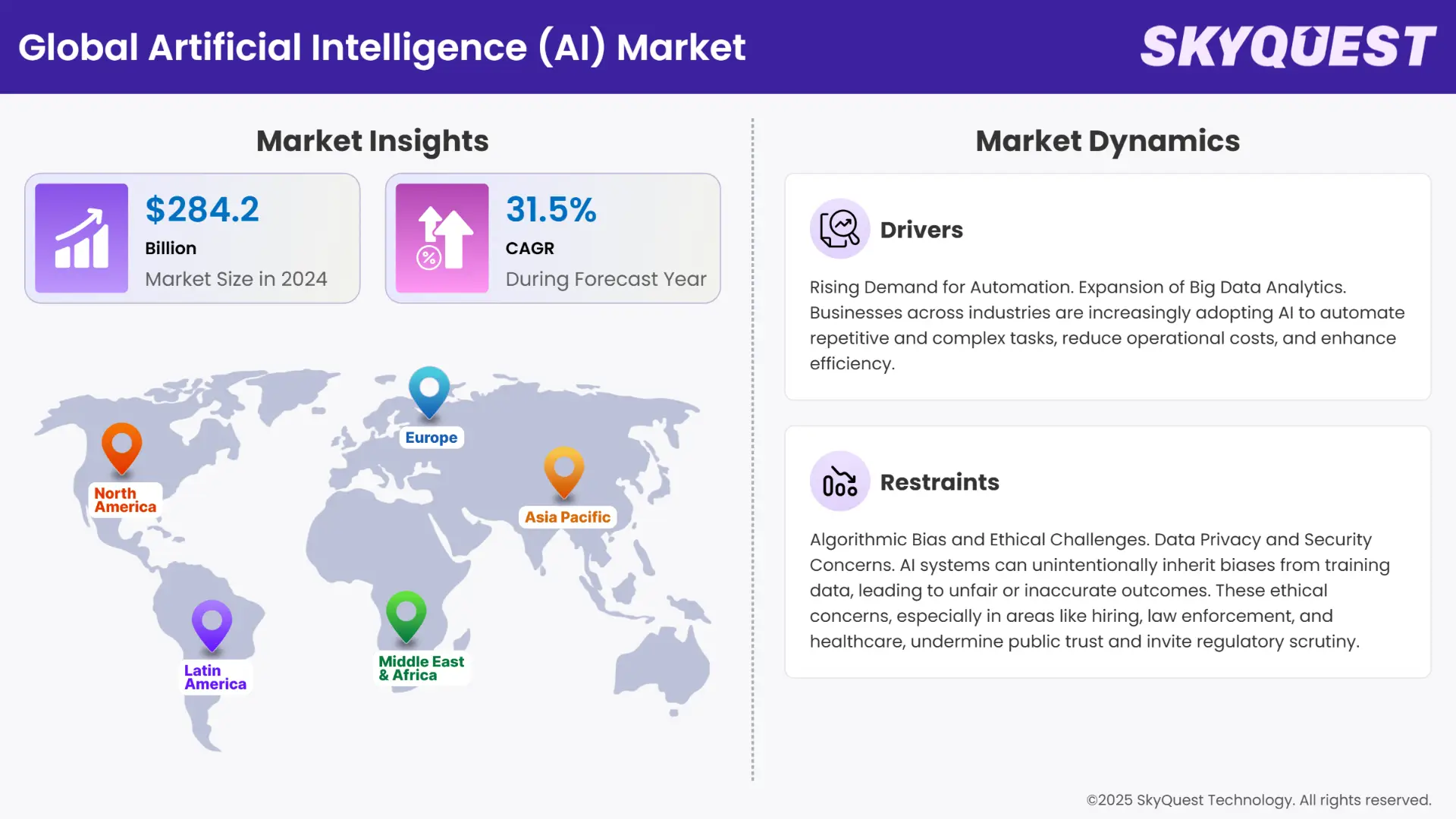
Global Artificial Intelligence (AI) Market size was valued at USD 284.2 Billion in 2024 poised to grow between USD 373.72 Billion in 2025 to USD 3341.61 Billion by 2033, growing at a CAGR of 31.5% in the forecast period (2026–2033).
The exponential growth of digital data is a foundational driver of the global AI market. With the widespread adoption of smartphones, IoT devices, social media platforms, and cloud computing, vast volumes of structured and unstructured data are generated daily. This data is essential for training AI algorithms, as machine learning models require large datasets to identify patterns, improve accuracy, and deliver intelligent insights. As organizations seek to leverage this data for real-time decision-making, customer personalization, and predictive analytics, the demand for AI technologies increases. Consequently, data availability not only fuels AI development but also reinforces its value across industries.
Rapid advancements in computing hardware—especially GPUs (Graphics Processing Units) and TPUs (Tensor Processing Units)—play a critical role in the growth of the AI market. These high-performance processors enable the execution of complex AI models and large-scale data processing at unprecedented speeds. Tasks that once took weeks to compute can now be completed in hours or minutes, making deep learning and neural network training far more efficient. This reduction in time and cost allows companies to innovate faster, test more complex models, and deploy AI at scale. As hardware evolves, it continuously expands the practical and commercial applications of AI technologies.
Why does the Success of AI Implementations Lead to Further Investment and Research?
AI is both a product and a catalyst of its own market expansion. As AI technologies mature—such as generative AI, reinforcement learning, and self-supervised learning—they create new applications and efficiencies across industries. This leads to increased adoption in areas like customer service automation, personalized marketing, and intelligent robotics. The success of these implementations reinforces confidence in AI’s ROI, prompting more investment and R&D. For instance, OpenAI’s GPT models have spurred global interest in large language models, leading tech giants to invest in similar capabilities. This cycle of innovation, adoption, and reinvestment continually fuels the growth of the global AI market.
In 2025, Nvidia partnered with Perplexity to develop localized, sovereign AI models for Europe’s 24 official languages. Using Nvidia’s DGX Cloud infrastructure, the collaboration aims to deliver open-source, culturally relevant AI solutions. This development strengthens AI accessibility and adoption across Europe, significantly contributing to the global artificial intelligence market’s growth.
To get more insights on this market click here to Request a Free Sample Report
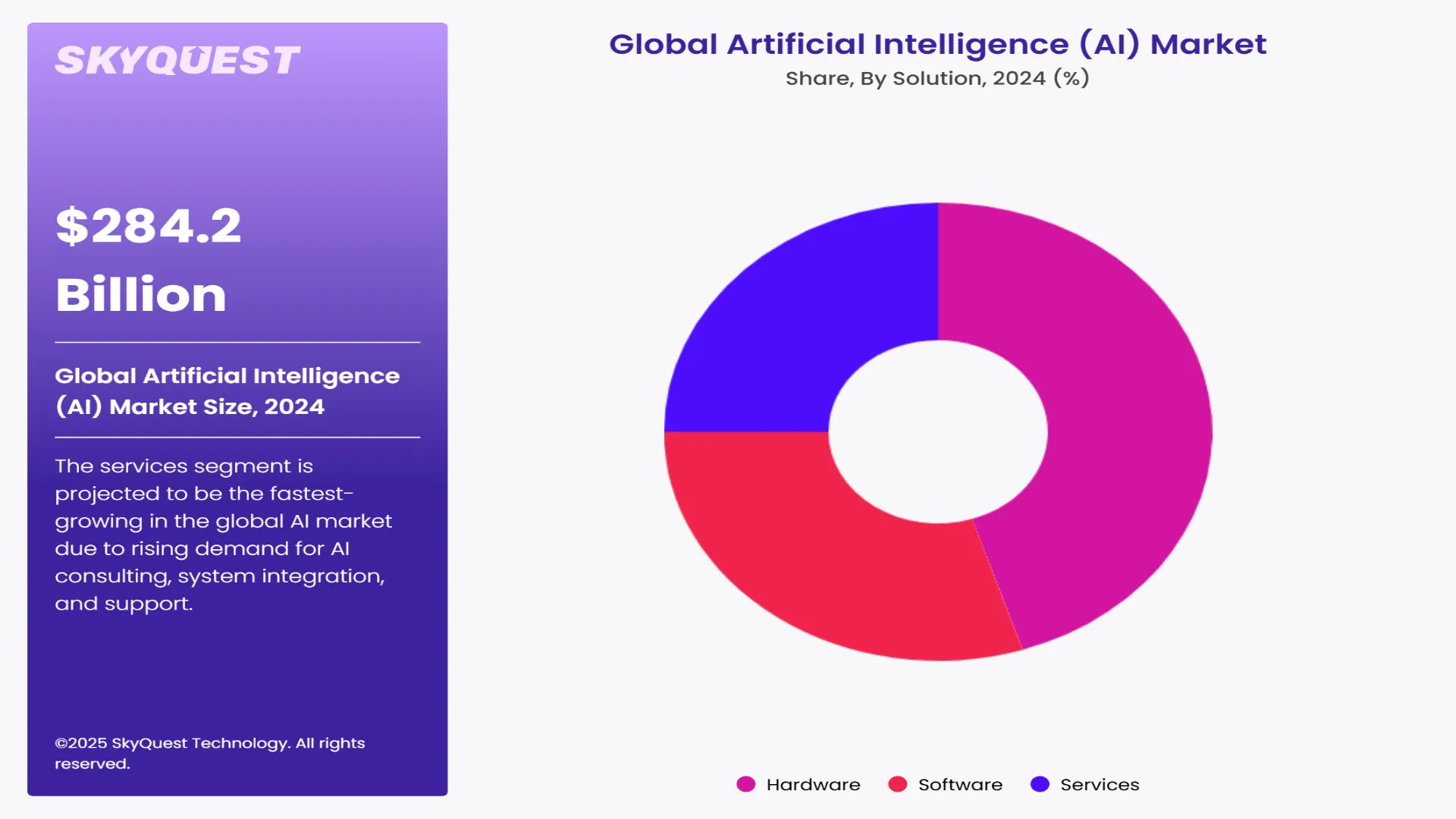
The global artificial intelligence (AI) market is segmented based on solution, technology, end-use, and region. In terms of solution, the market is trifurcated into hardware, software, and services. Based on technology, the market is segmented into deep learning, machine learning, natural language processing (NLP), machine vision, and generative AI. Based on end-use, the market is grouped into healthcare, bfsi, law, retail, advertising & media, automotive & transportation, agriculture, manufacturing, and others. Based on region, the market is segmented into North America, Europe, Asia-Pacific, Central & South America and the Middle East & Africa.
What Advantages does Software Offer in Terms of Scalability?
Software solutions are at the forefront of innovation in the global AI market, driving advancements in machine learning platforms, natural language processing, and computer vision applications. These tools enable seamless integration of AI into diverse sectors like healthcare, finance, and logistics. Software dominates the market due to its scalability, lower deployment costs, and adaptability, allowing businesses to rapidly implement AI-driven insights and automation without the need for expensive hardware overhauls.
The services segment is projected to be the fastest-growing in the global AI market due to rising demand for AI consulting, system integration, and support. As organizations adopt complex AI tools, they increasingly rely on expert services to ensure smooth deployment, customization, and maintenance, driving rapid growth in this segment.
In What Ways is Deep Learning Scalable and Adaptable Across Industries?
Deep learning is driving cutting-edge innovation in the global AI market, powering breakthroughs in speech recognition, image analysis, autonomous systems, and generative AI. Its ability to process vast datasets and identify intricate patterns enables superior accuracy and performance. Deep learning dominates the market due to its scalability, adaptability across industries, and capacity to improve over time, making it indispensable for advanced AI applications in healthcare, finance, automotive, and more.
Machine vision is set to be the fastest-growing AI technology due to rising demand for automation, quality inspection, and surveillance. Industries like manufacturing, retail, and healthcare are adopting machine vision for real-time analysis and precision. Its ability to enhance operational efficiency and reduce errors is fueling rapid adoption and market expansion.
To get detailed segments analysis, Request a Free Sample Report
What Role does Research and Development Activities Play in North America's AI Growth?
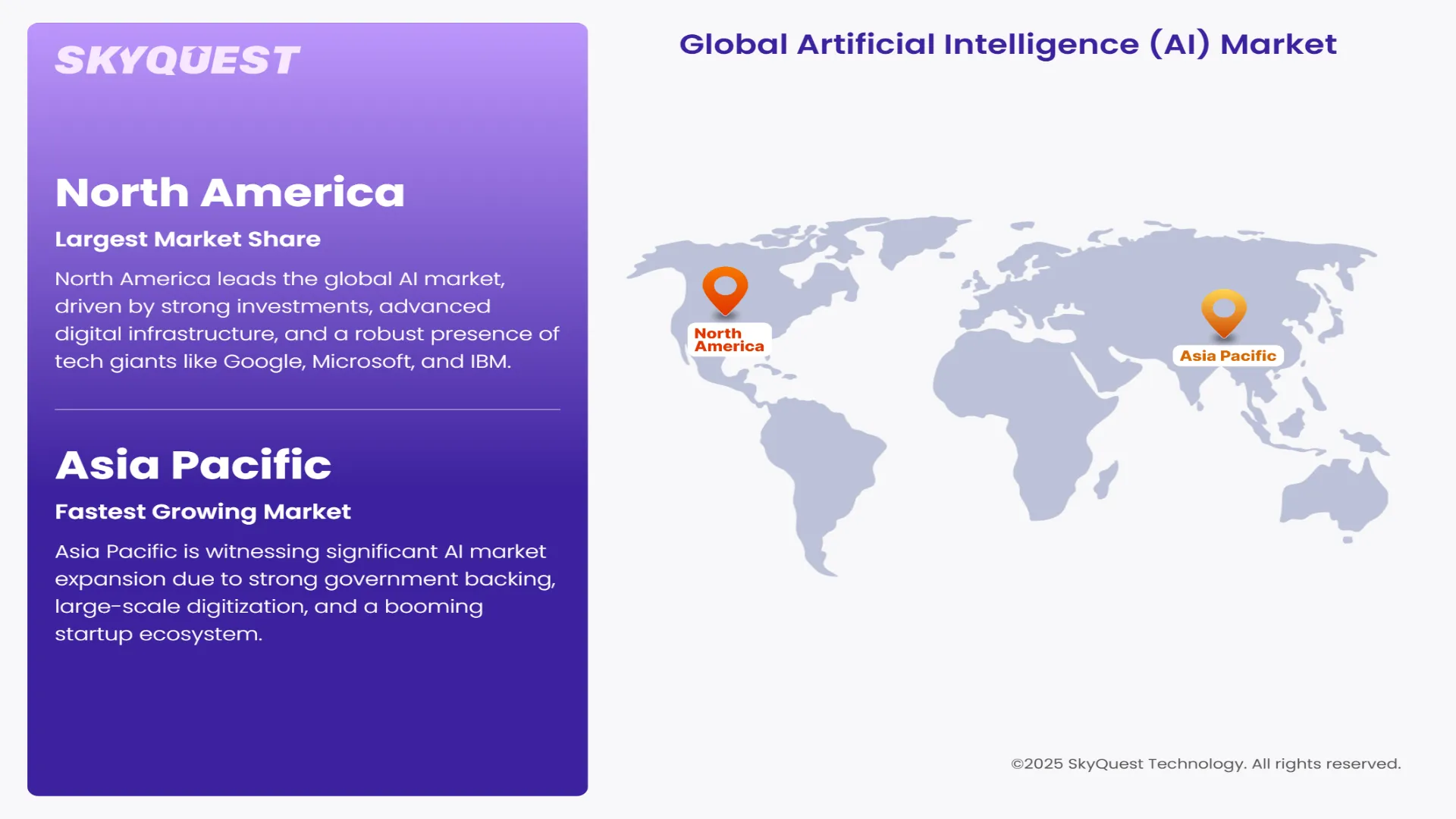
North America leads the global AI market, driven by strong investments, advanced digital infrastructure, and a robust presence of tech giants like Google, Microsoft, and IBM. The region benefits from significant R&D activities, early technology adoption, and government support for AI innovation. Key sectors—including healthcare, finance, and automotive—are leveraging AI for automation and predictive analytics, further accelerating market growth across the United States and Canada.
US Artificial Intelligence (AI) Market
The United States plays a dominant role in North America's AI market, driven by its strong ecosystem of tech giants, startups, and leading research institutions. Companies like Google, Amazon, and OpenAI are pioneering innovations in machine learning, generative AI, and automation. Robust government funding, private investments, and a skilled workforce support widespread AI adoption across sectors like defense, healthcare, finance, and transportation, positioning the U.S. as a global AI innovation hub.
Canada Artificial Intelligence (AI) Market
Canada significantly contributes to North America's AI growth through its emphasis on research, ethics, and inclusive innovation. With AI clusters in cities like Toronto, Montreal, and Edmonton, Canada is home to leading research institutions and global AI labs such as the Vector Institute and Mila. Government-backed initiatives and academic-industry collaborations support advancements in deep learning, natural language processing, and AI governance, making Canada a key player in responsible and cutting-edge AI development.
Why is Digital Sovereignty an Important Focus for Europe in AI Development?
Europe’s AI market is expanding steadily, supported by strong regulatory frameworks, government funding, and a growing ecosystem of AI startups and research institutions. The European Union’s focus on ethical AI and digital sovereignty drives investments in responsible innovation. Countries like Germany, France, and the UK are integrating AI into manufacturing, healthcare, and public services, while initiatives like Horizon Europe and AI Act promote cross-border collaboration and trustworthy AI deployment.
Germany Artificial Intelligence (AI) Market
Germany is a key contributor to the global AI market, focusing on industrial AI applications, especially in manufacturing and automotive sectors. With initiatives like "AI Made in Germany," the country promotes ethical and secure AI development. Strong public-private partnerships, advanced robotics integration, and leading research institutions position Germany as a leader in applying AI to Industry 4.0, smart factories, and autonomous vehicle technologies.
Italy Artificial Intelligence (AI) Market
Italy is emerging as a growing contributor to the global AI market, with increased investments in AI for smart manufacturing, public services, and cultural heritage preservation. Government initiatives support AI R&D, while partnerships between universities and industries foster innovation. Italy emphasizes ethical AI, aligning with EU standards, and is leveraging AI to boost productivity and competitiveness in traditional sectors like fashion, food, and automotive.
France Artificial Intelligence (AI) Market
France actively supports AI innovation through national strategies and investments in research and startups. The government’s AI for Humanity initiative promotes ethical AI and data sovereignty. France excels in AI applications in healthcare, defense, and mobility, supported by institutions like INRIA and partnerships with global tech firms. This positions France as a hub for responsible, high-impact AI development in Europe.
How do Different Countries within Asia Pacific Specialize in AI Applications?
Asia Pacific is witnessing significant AI market expansion due to strong government backing, large-scale digitization, and a booming startup ecosystem. China leads in AI investments and applications, while Japan and South Korea focus on robotics and automation. India’s growing IT sector accelerates AI adoption across industries. Increasing demand for intelligent solutions in healthcare, manufacturing, and fintech is driving rapid regional growth, positioning Asia Pacific as a global AI powerhouse.
Japan Artificial Intelligence (AI) Market
Japan contributes significantly to the global AI market through its leadership in robotics, automation, and industrial AI. The country emphasizes AI integration in manufacturing, healthcare, and elderly care, supported by its Society 5.0 vision. With strong government investment, advanced research institutions, and collaborations between tech firms and academia, Japan is advancing AI applications that improve efficiency, safety, and quality of life in both public and private sectors.
South Korea Artificial Intelligence (AI) Market
South Korea plays a vital role in the global AI market through aggressive investments in smart technologies, 5G infrastructure, and AI R&D. The government’s national AI strategy aims to position the country among the top AI leaders. South Korea focuses on AI in smart cities, autonomous vehicles, and consumer electronics, with major companies like Samsung and LG integrating AI to enhance product innovation and global competitiveness.
To know more about the market opportunities by region and country, click here to
Buy The Complete Report
Artificial Intelligence (AI) Market Drivers
Rising Demand for Automation
Expansion of Big Data Analytics
Artificial Intelligence (AI) Market Restraints
Algorithmic Bias and Ethical Challenges
Data Privacy and Security Concerns
Request Free Customization of this report to help us to meet your business objectives.
The global AI market is highly competitive, with key players like Google, Microsoft, IBM, Amazon, NVIDIA, and OpenAI leading innovation. Google and Microsoft invest heavily in generative AI and cloud-based AI tools. NVIDIA focuses on AI chips and high-performance computing. IBM emphasizes AI-driven enterprise solutions. These companies pursue strategies such as strategic acquisitions, partnerships, and R&D investments to expand capabilities, enhance global presence, and maintain technological leadership in the evolving AI landscape.
The global AI startup landscape is thriving, fuelled by innovation, investor interest, and demand for specialized solutions. Startups are focusing on areas like generative AI, robotics, predictive analytics, and AI safety. With agile teams and deep research orientation, they are challenging traditional players by offering scalable, high-performance models. Strategic partnerships, open-source collaboration, and cutting-edge R&D breakthroughs are driving their global traction, accelerating AI adoption across sectors like healthcare, logistics, finance, and enterprise software.
Top Player’s Company Profiles
Recent Developments in Artificial Intelligence (AI) Market
SkyQuest’s ABIRAW (Advanced Business Intelligence, Research & Analysis Wing) is our Business Information Services team that Collects, Collates, Correlates, and Analyses the Data collected by means of Primary Exploratory Research backed by robust Secondary Desk research.
As per SkyQuest analysis, the global artificial intelligence (AI) market is undergoing transformative growth, driven by a convergence of key technological, industrial, and regional dynamics. From the exponential rise in data and advanced computing capabilities to expanding applications across healthcare, finance, and manufacturing, AI is becoming a foundational pillar of digital economies.
Innovations in deep learning and software integration, coupled with rising demand for expert services, continue to shape the competitive and startup landscape. Regionally, countries like the U.S., China, Germany, and Japan are leading the way with strategic investments and R&D advancements. As ethical frameworks and responsible AI governance mature alongside these innovations, the global AI market is poised to scale further, offering unprecedented opportunities for innovation, automation, and inclusive growth.
| Report Metric | Details |
|---|---|
| Market size value in 2024 | USD 284.2 Billion |
| Market size value in 2033 | USD 3341.61 Billion |
| Growth Rate | 31.5% |
| Base year | 2024 |
| Forecast period | 2026-2033 |
| Forecast Unit (Value) | USD Billion |
| Segments covered |
|
| Regions covered | North America (US, Canada), Europe (Germany, France, United Kingdom, Italy, Spain, Rest of Europe), Asia Pacific (China, India, Japan, Rest of Asia-Pacific), Latin America (Brazil, Rest of Latin America), Middle East & Africa (South Africa, GCC Countries, Rest of MEA) |
| Companies covered |
|
| Customization scope | Free report customization with purchase. Customization includes:-
|
To get a free trial access to our platform which is a one stop solution for all your data requirements for quicker decision making. This platform allows you to compare markets, competitors who are prominent in the market, and mega trends that are influencing the dynamics in the market. Also, get access to detailed SkyQuest exclusive matrix.
Table Of Content
Executive Summary
Market overview
Parent Market Analysis
Market overview
Market size
KEY MARKET INSIGHTS
COVID IMPACT
MARKET DYNAMICS & OUTLOOK
Market Size by Region
KEY COMPANY PROFILES
Methodology
For the Artificial Intelligence (AI) Market, our research methodology involved a mixture of primary and secondary data sources. Key steps involved in the research process are listed below:
1. Information Procurement: This stage involved the procurement of Market data or related information via primary and secondary sources. The various secondary sources used included various company websites, annual reports, trade databases, and paid databases such as Hoover's, Bloomberg Business, Factiva, and Avention. Our team did 45 primary interactions Globally which included several stakeholders such as manufacturers, customers, key opinion leaders, etc. Overall, information procurement was one of the most extensive stages in our research process.
2. Information Analysis: This step involved triangulation of data through bottom-up and top-down approaches to estimate and validate the total size and future estimate of the Artificial Intelligence (AI) Market.
3. Report Formulation: The final step entailed the placement of data points in appropriate Market spaces in an attempt to deduce viable conclusions.
4. Validation & Publishing: Validation is the most important step in the process. Validation & re-validation via an intricately designed process helped us finalize data points to be used for final calculations. The final Market estimates and forecasts were then aligned and sent to our panel of industry experts for validation of data. Once the validation was done the report was sent to our Quality Assurance team to ensure adherence to style guides, consistency & design.
Analyst Support
Customization Options
With the given market data, our dedicated team of analysts can offer you the following customization options are available for the Artificial Intelligence (AI) Market:
Product Analysis: Product matrix, which offers a detailed comparison of the product portfolio of companies.
Regional Analysis: Further analysis of the Artificial Intelligence (AI) Market for additional countries.
Competitive Analysis: Detailed analysis and profiling of additional Market players & comparative analysis of competitive products.
Go to Market Strategy: Find the high-growth channels to invest your marketing efforts and increase your customer base.
Innovation Mapping: Identify racial solutions and innovation, connected to deep ecosystems of innovators, start-ups, academics, and strategic partners.
Category Intelligence: Customized intelligence that is relevant to their supply Markets will enable them to make smarter sourcing decisions and improve their category management.
Public Company Transcript Analysis: To improve the investment performance by generating new alpha and making better-informed decisions.
Social Media Listening: To analyze the conversations and trends happening not just around your brand, but around your industry as a whole, and use those insights to make better Marketing decisions.
REQUEST FOR SAMPLE
 REQUEST FREE CUSTOMIZATION


Want to customize this report? This report can be personalized according to your needs. Our analysts and industry experts will work directly with you to understand your requirements and provide you with customized data in a short amount of time. We offer $1000 worth of FREE customization at the time of purchase.
Feedback From Our Clients


 USA (+1) 351-333-4748

