
3D Printing Market
Report ID: SQMIG45I2161
Report ID: SQMIG45I2161
[email protected]
USA +1 351-333-4748
Report ID:
SQMIG45I2161 |
Region:
Global |
Published Date: June, 2025
Pages:
194
|Tables:
205
|Figures:
78


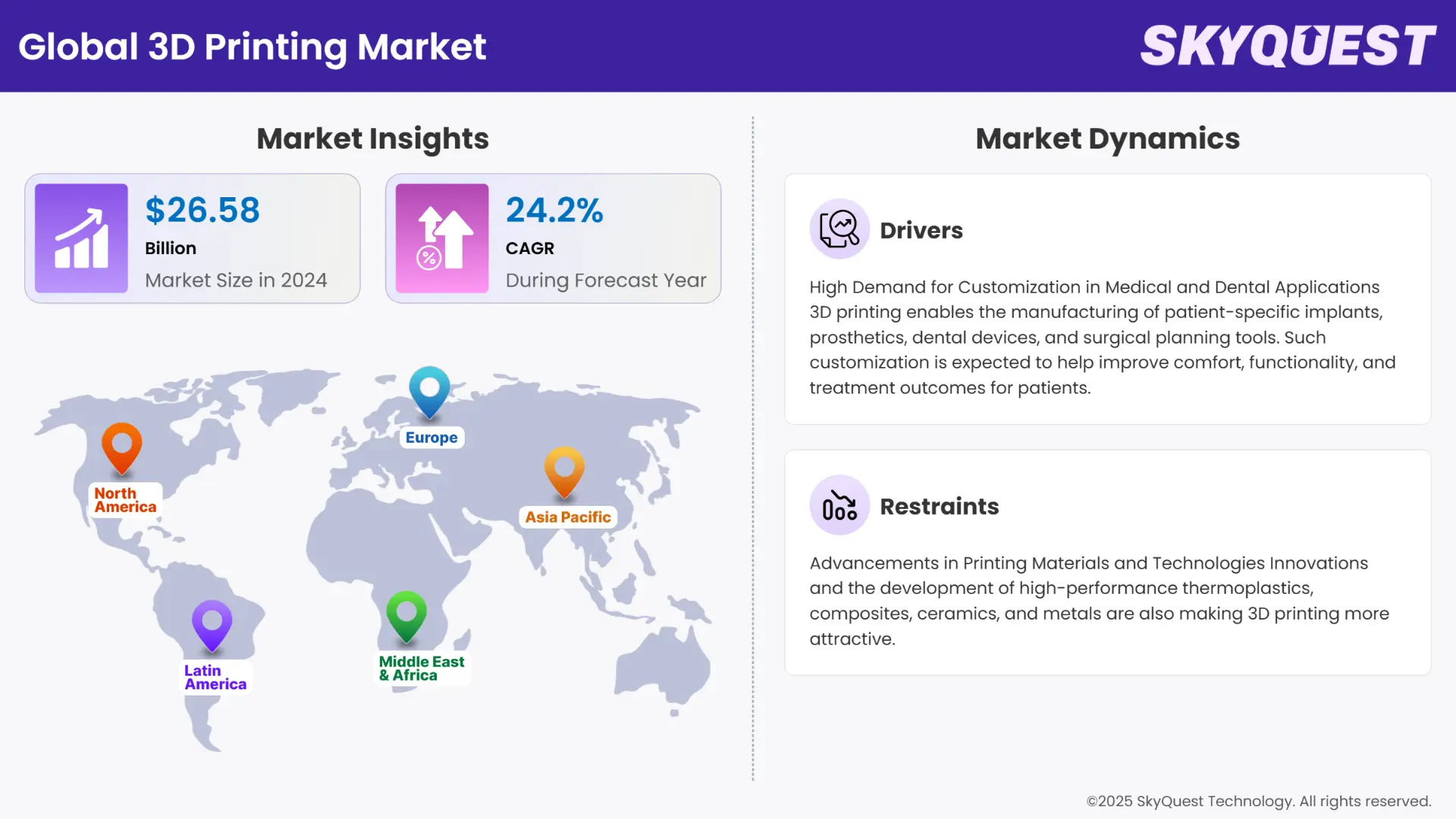
Global 3D Printing Market size was valued at USD 26.58 Billion in 2024 and is poised to grow from USD 33.01 Billion in 2025 to USD 186.92 Billion by 2033, growing at a CAGR of 24.2% during the forecast period (2026–2033).
Growing demand from aerospace and automotive sectors, high R&D investments in material science, emphasis on cost efficiency and waste reduction, and rising adoption of digital manufacturing are driving 3D printing adoption.
Surging adoption of 3D printing in aerospace, automotive, and healthcare sectors is primarily boosting 3D printing market growth. Global governments are actively supporting 3D printing through funding and policy initiatives. The development of eco-friendly and recycled 3D printings addresses environmental concerns and meets the growing demand for sustainable manufacturing. The shift towards digital manufacturing enables on-demand production, reducing inventory costs, and lead times. The ability to produce parts as needed enhances supply chain efficiency and responsiveness, making 3D printings integral to modern manufacturing processes that prioritize agility and cost-effectiveness.
On the contrary, high material and equipment costs, limited material diversity, workforce limitations due to lack of technical expertise, and regulatory and standardization challenges are forecasted to hamper the 3D printing market penetration across the study period and beyond.
How is Bioprinting Changing the Future of 3D printing Adoption?
Bioprinting is emerging as a transformative trend in the 3D printing industry, enabling the layer-by-layer fabrication of biological tissues using cells and biomaterials. It holds promise for creating organ models, regenerative tissue, and customized medical implants. Hospitals and research labs use 3D printing for surgical planning, dental devices, prosthetics, and drug delivery systems. As the healthcare industry pushes toward personalization, 3D printing supports patient-specific solutions that improve outcomes. Regulatory approvals are gradually increasing, encouraging more investment in bio-compatible materials and bioprinting technologies. This trend is expected to revolutionize personalized medicine and redefine how healthcare solutions are developed and delivered.
To get more insights on this market click here to Request a Free Sample Report
The global 3D printing market is segmented by component, printer type, technology, software, application, vertical, material, and region. Based on components, the market is segmented into hardware, software, and services. Based on printer type, the market is segmented into desktop 3D printer and industrial 3D printers. Based on technology, the market is segmented into stereolithography, fuse deposition modeling, selective laser sintering, direct metal laser sintering, polyjet printing, inkjet printing, electron beam melting, laser metal deposition, digital light processing, laminated object manufacturing, and others. Based on software, the market is segmented into design software, inspection software, printer software, and scanning software. Based on application, the market is segmented into prototyping, tooling, and functional parts. Based on vertical, the market is segmented into industrial 3D printing and desktop 3D printing. Based on material, the market is segmented into polymer, metal, and ceramic. Based on region, the market is segmented into North America, Europe, Asia Pacific, Latin America, and Middle East & Africa.
Which Type of 3D Printers are Sold Most?
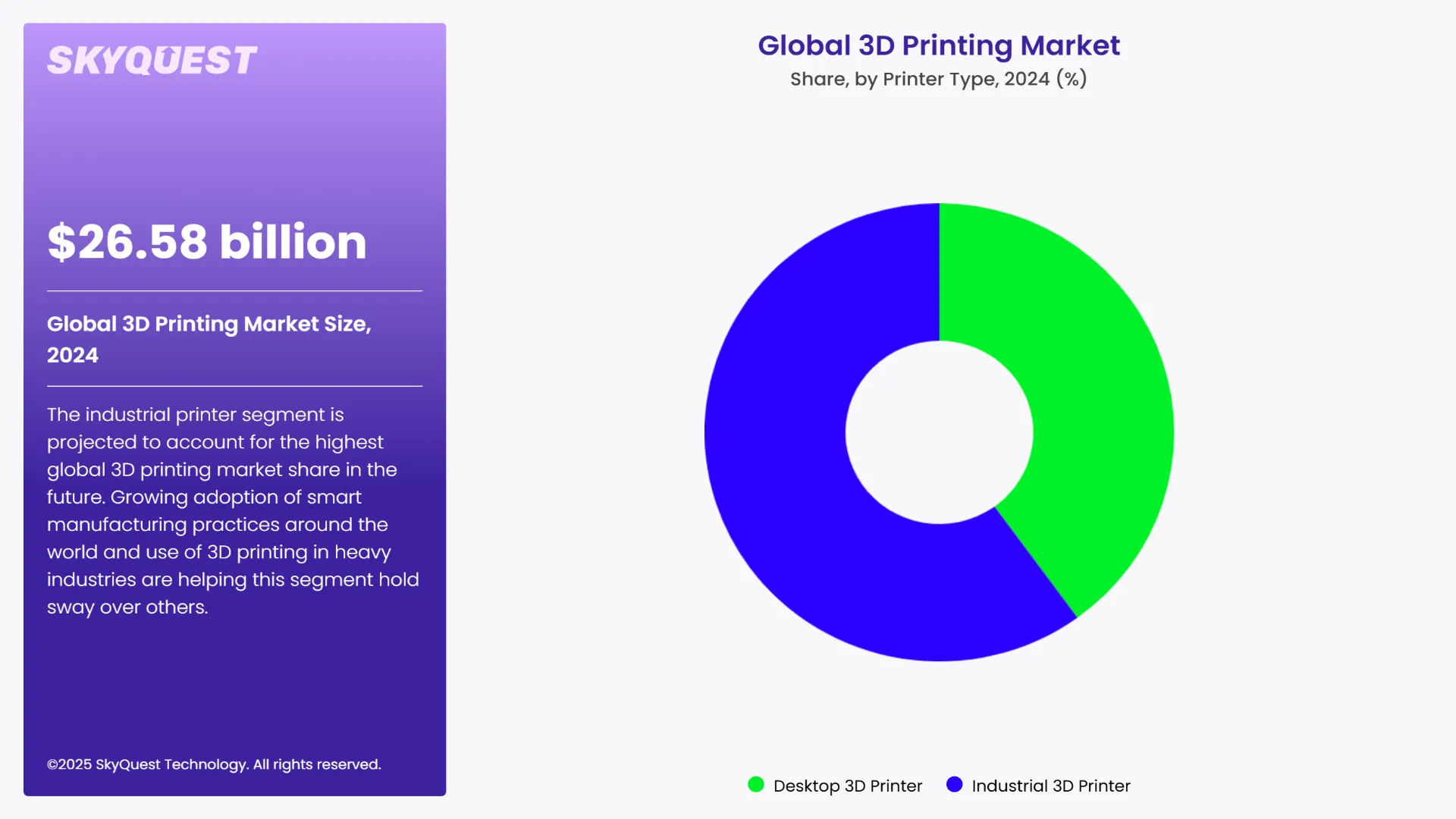
The industrial printer segment is projected to account for the highest global 3D printing market share in the future. Growing adoption of smart manufacturing practices around the world and use of 3D printing in heavy industries are helping this segment hold sway over others. Aerospace and healthcare are key industries adopting industrial printers.
On the other hand, the demand for desktop printers is slated to witness a robust increase going forward as per this 3D printing industry analysis. Growing demand for on-demand printing and the high affordability of these types of printers are helping create new opportunities.
Which 3D Printing Technology is Used Extensively?
The stereolithography segment is forecasted to spearhead 3D printing market revenue generation potential in the long run. High versatility and precision of this technology is helping it maintain its high share on a global level. Low material costs and smooth surface finishes are also forecasted to help bolster the dominance of this segment going forward.
Meanwhile, the demand for Fused Deposition Modeling (FDM) technology is slated to rise at an impressive CAGR over the coming years. High reliability and repeatability offered by this technology is helping boost its adoption in mass production facilities.
To get detailed segments analysis, Request a Free Sample Report
Why are 3D Printing Companies Actively Investing in North America?
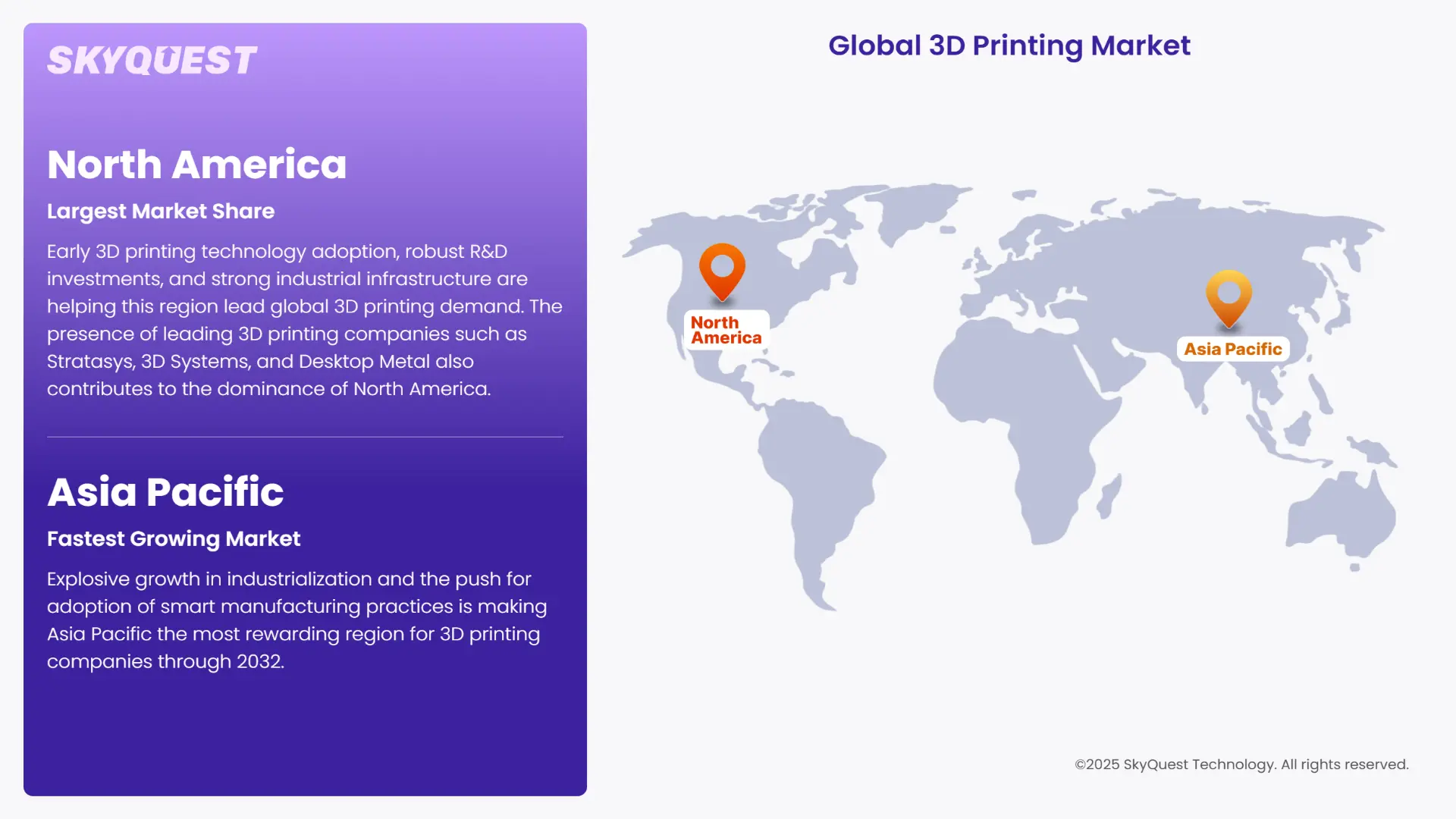
Early 3D printing technology adoption, robust R&D investments, and strong industrial infrastructure are helping this region lead global 3D printing demand. The presence of leading 3D printing companies such as Stratasys, 3D Systems, and Desktop Metal also contributes to the dominance of North America. Growing demand for custom medical devices, lightweight aerospace components, and strategic partnerships in manufacturing are helping generate new business scope for 3D printing providers in the long run.
3D Printing Market in United States
Presence of top 3D printing companies such as 3D Systems, Stratasys, and HP coupled with early technology adoption allow United States to lead global demand outlook. The Department of Defense and NASA play a crucial role in promoting the popularity and adoption of additive manufacturing in the long run. Strong investment, government support, and a skilled workforce further strengthen the country’s stance as a global leader in 3D printing adoption through 2032.
3D Printing Market in Canada
Government and academic institutions play a crucial role in shaping the demand for 3D printing in Canada going forward. Organizations like NRC and Canada Makes are also expected to favor the adoption of novel 3D printing solutions in the future. Emphasis on localization of manufacturing and sustainability is also opening new avenues of opportunities for 3D printing providers. Federal funding, tax incentives, and increased demand for rapid prototyping and customized products ensure sustained adoption of 3D printing technology in Canada.
How Will Popularity of 3D Printing Evolve in Asia Pacific?
Explosive growth in industrialization and the push for adoption of smart manufacturing practices is making Asia Pacific the most rewarding region for 3D printing companies through 2032. Adoption of additive manufacturing practices in aerospace, automotive, electronics, and healthcare is also helping promote the uptake of 3D printing solutions. Local startups, university R&D, and tech-forward policies also provide an attractive setting for 3D printing innovation. Government support and subsidies play a crucial role in making Asia Pacific a hub for 3D printing providers.
3D Printing Market in Japan
Growing demand for precision manufacturing in electronics and medical devices sectors is projected to govern 3D printing adoption in Japan. Mitsubishi, Canon, and Ricoh are leading adopters of 3D printing solutions in the country. Universities and R&D centers collaborate with manufacturers to develop cutting-edge 3D printing solutions. Despite conservative adoption initially, Japan is accelerating deployment across sectors to maintain global competitiveness and drive industrial modernization.
3D Printing Market in South Korea
The Ministry of Science and ICT of the country is heavily investing in the integration of 3D printing in electronics and manufacturing verticals. Companies such as Hanwha and Samsung are exploring the application scope of 3D printing in aerospace, automotive, and electronics verticals. Academic partnerships, launch of smart factory programs, and presence of tech-savvy industries are helping further bolster the demand for novel 3D printing solutions in South Korea over the coming years.
Should 3D printing Providers Invest in Europe?
The surge in demand for rapid prototyping and high emphasis on adoption of Industry 4.0 trends are helping drive 3D printing adoption in Europe. Growing emphasis on sustainability and reduction of waste in manufacturing in this region is also expected to boost the popularity of 3D printing going forward. Strong government backing for digitization of manufacturing and the presence of robust industrial facilities is also expected to bolster the demand for 3D printing devices and solutions.
3D Printing Market in United Kingdom
Use of additive manufacturing by companies such as Rolls-Royce and BAE Systems to create complex and lightweight components in driving 3D printing demand in this country. Government-backed initiatives such as Innovate UK and the Catapult network promote R&D and commercialization of 3D printing tech. Adoption of bio-printing and advanced materials in leading universities such as Oxford and Cambridge is also driving revenue generation for 3D printing companies in the United Kingdom.
3D Printing Market in Germany
High demand for industrial 3D printing from aerospace and automotive sectors is defining market development in Germany. The country’s emphasis on precision, quality, and industrial efficiency ensures its leadership in high-end 3D printing applications in the European region. Use of 3D printed parts is rising in multiple German vehicles to improve sustainability and efficiency. Metal additive manufacturing is highly popular, thereby driving the demand for metal 3D printing solutions.
3D Printing Market in France
Aerospace, medical, and defense sectors are projected to shape the demand for 3D printing solutions in France. Airbus, Safran, and Dassault are the prime companies opting for 3D printing technologies and solutions. Startups and research labs collaborate on bio-printing and material science to further expand the application scope of 3D printing solutions. With increasing focus on sustainable manufacturing and digital transformation, France is slated to offer attractive new opportunities in the long run.
To know more about the market opportunities by region and country, click here to
Buy The Complete Report
3D Printing Market Drivers
High Demand for Customization in Medical and Dental Applications
Advancements in Printing Materials and Technologies
3D Printing Market Restraints
Material Limitations and Inconsistency
Post-Processing Requirements
Request Free Customization of this report to help us to meet your business objectives.
3D printing companies should invest in novel material R&D to help expand the application scope of 3D printing across verticals. Collaborating with tech giants, manufacturing companies, and material science companies can also create new opportunities for companies as per this 3D printing market analysis.
Multiple startups are focusing on innovation in the 3D printing industry owing to the market’s nascent nature. Here are a couple of startups that could emerge as big players in the future.
Top Player’s Company Profiles
Recent Developments in 3D Printing Market
SkyQuest’s ABIRAW (Advanced Business Intelligence, Research & Analysis Wing) is our Business Information Services team that Collects, Collates, Correlates, and Analyses the Data collected by means of Primary Exploratory Research backed by robust Secondary Desk research.
As per SkyQuest analysis, growing adoption of smart manufacturing practices and advancements in additive manufacturing technologies are driving the demand for 3D printing going forward. In contrast, post-processing requirements and material limitations are key issues that slow down the adoption of global 3D printing. Quick adoption of 3D printing and material innovation by startups and tech companies helps North America remain the top market for 3D printing companies. Adoption of 3D printing in mass production and development of metal 3D printers are slated to be key trends driving the 3D printing sector in the long run.
| Report Metric | Details |
|---|---|
| Market size value in 2024 | USD 26.58 Billion |
| Market size value in 2033 | USD 186.92 Billion |
| Growth Rate | 24.2% |
| Base year | 2024 |
| Forecast period | 2026-2033 |
| Forecast Unit (Value) | USD Billion |
| Segments covered |
|
| Regions covered | North America (US, Canada), Europe (Germany, France, United Kingdom, Italy, Spain, Rest of Europe), Asia Pacific (China, India, Japan, Rest of Asia-Pacific), Latin America (Brazil, Rest of Latin America), Middle East & Africa (South Africa, GCC Countries, Rest of MEA) |
| Companies covered |
|
| Customization scope | Free report customization with purchase. Customization includes:-
|
To get a free trial access to our platform which is a one stop solution for all your data requirements for quicker decision making. This platform allows you to compare markets, competitors who are prominent in the market, and mega trends that are influencing the dynamics in the market. Also, get access to detailed SkyQuest exclusive matrix.
Table Of Content
Executive Summary
Market overview
Parent Market Analysis
Market overview
Market size
KEY MARKET INSIGHTS
COVID IMPACT
MARKET DYNAMICS & OUTLOOK
Market Size by Region
KEY COMPANY PROFILES
Methodology
For the 3D Printing Market, our research methodology involved a mixture of primary and secondary data sources. Key steps involved in the research process are listed below:
1. Information Procurement: This stage involved the procurement of Market data or related information via primary and secondary sources. The various secondary sources used included various company websites, annual reports, trade databases, and paid databases such as Hoover's, Bloomberg Business, Factiva, and Avention. Our team did 45 primary interactions Globally which included several stakeholders such as manufacturers, customers, key opinion leaders, etc. Overall, information procurement was one of the most extensive stages in our research process.
2. Information Analysis: This step involved triangulation of data through bottom-up and top-down approaches to estimate and validate the total size and future estimate of the 3D Printing Market.
3. Report Formulation: The final step entailed the placement of data points in appropriate Market spaces in an attempt to deduce viable conclusions.
4. Validation & Publishing: Validation is the most important step in the process. Validation & re-validation via an intricately designed process helped us finalize data points to be used for final calculations. The final Market estimates and forecasts were then aligned and sent to our panel of industry experts for validation of data. Once the validation was done the report was sent to our Quality Assurance team to ensure adherence to style guides, consistency & design.
Analyst Support
Customization Options
With the given market data, our dedicated team of analysts can offer you the following customization options are available for the 3D Printing Market:
Product Analysis: Product matrix, which offers a detailed comparison of the product portfolio of companies.
Regional Analysis: Further analysis of the 3D Printing Market for additional countries.
Competitive Analysis: Detailed analysis and profiling of additional Market players & comparative analysis of competitive products.
Go to Market Strategy: Find the high-growth channels to invest your marketing efforts and increase your customer base.
Innovation Mapping: Identify racial solutions and innovation, connected to deep ecosystems of innovators, start-ups, academics, and strategic partners.
Category Intelligence: Customized intelligence that is relevant to their supply Markets will enable them to make smarter sourcing decisions and improve their category management.
Public Company Transcript Analysis: To improve the investment performance by generating new alpha and making better-informed decisions.
Social Media Listening: To analyze the conversations and trends happening not just around your brand, but around your industry as a whole, and use those insights to make better Marketing decisions.
REQUEST FOR SAMPLE
 REQUEST FREE CUSTOMIZATION


Want to customize this report? This report can be personalized according to your needs. Our analysts and industry experts will work directly with you to understand your requirements and provide you with customized data in a short amount of time. We offer $1000 worth of FREE customization at the time of purchase.
Feedback From Our Clients


 USA (+1) 351-333-4748

