Activated Carbon Market
Report ID: SQMIG15E2737
Report ID: SQMIG15E2737
[email protected]
USA +1 351-333-4748
Report ID:
SQMIG15E2737 |
Region:
Global |
Published Date: May, 2025
Pages:
195
|Tables:
122
|Figures:
76


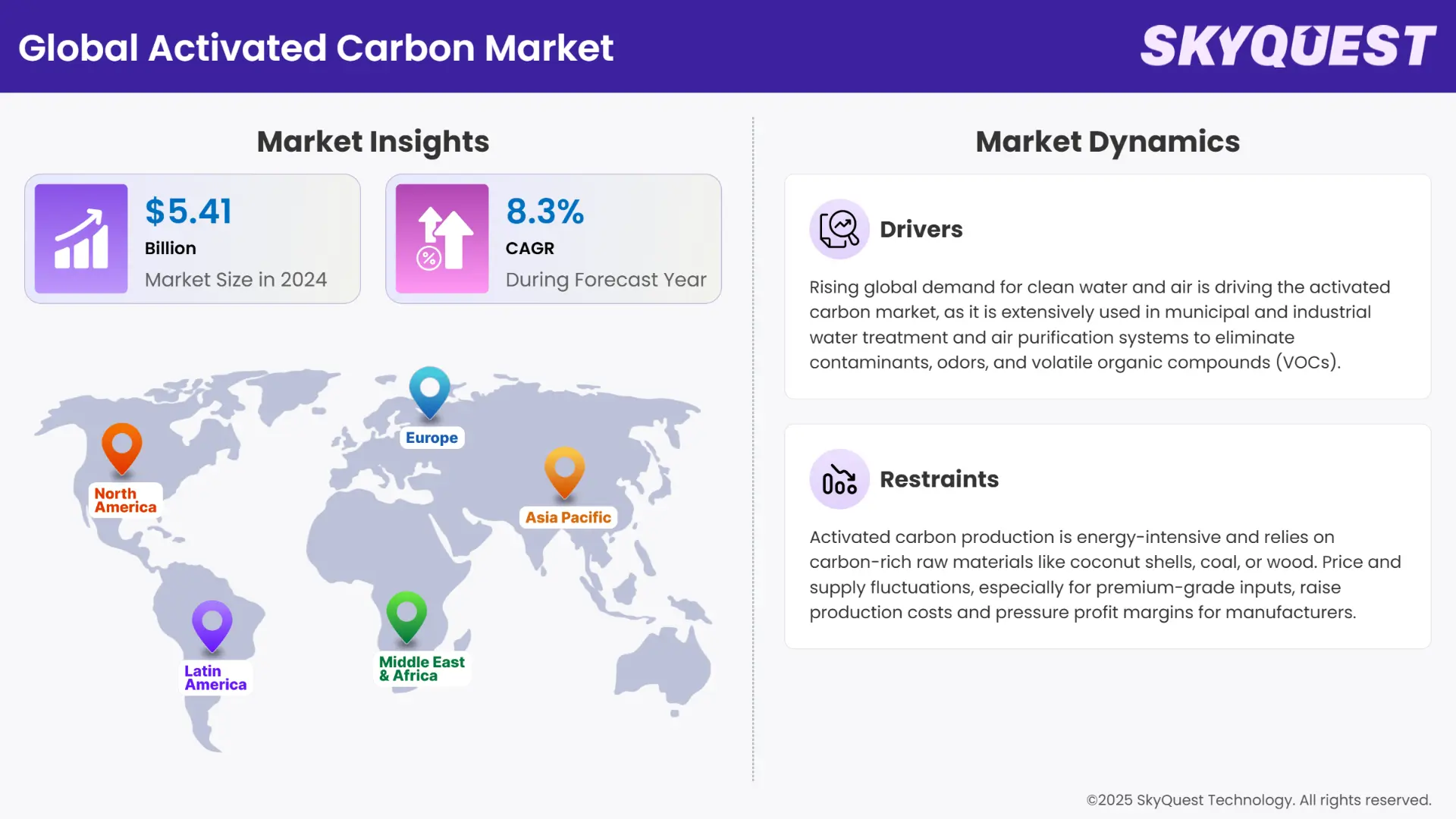
Global Activated Carbon Market size was valued at USD 5.41 Billion in 2024 and is poised to grow from USD 5.86 Billion in 2025 to USD 11.09 Billion by 2033, growing at a CAGR of 8.3% during the forecast period (2026–2033).
The activated carbon market continues to expand due to growing demand across water treatment, air purification, and industrial processing applications. Because of increased focus on pollution and stricter rules for water and air, multiple sectors are turning to activated carbon. Increased demand for filtration in Asia Pacific countries comes from the fast growth of their industries. Moreover, as people use more processed food and drinks, it becomes necessary to decolorize and deodorize them which is supporting market growth. Adsorption using activated carbon is becoming more popular in pharmaceuticals and personal care.
Raw material instability, mainly with coal, wood and coconut shells, forms a challenge for the market due to their importance in the production process. In addition, costly manufacturing processes that depend heavily on energy often cause harm to the environment which leads regulators to pay closer attention. Difficulties related to new filtration technologies and a lack of uniformity among markets pose extra challenges. In spite of these problems, recent progress in reactivation technology and bio-based carbon production promises success in areas focused on carbon neutrality. To avoid issues with supply and improve their standing, a number of players are increasing their capabilities and including new processes in their businesses.
Rising environmental concerns and regulatory mandates are significantly boosting the use of activated carbon in water and air purification systems. According to the UN, over 2 billion people globally lack access to safe drinking water, driving governments and municipalities to invest in filtration technologies. Activated carbon's efficiency in removing organic pollutants, chlorine, and VOCs makes it critical in municipal water treatment and household filters. Additionally, with air pollution contributing to over 7 million premature deaths annually (WHO), demand for activated carbon-based air purifiers is growing rapidly, particularly in industrial regions of Asia Pacific and North America.
The food and beverage industry heavily relies on activated carbon for purification processes, especially in sugar refining, alcoholic beverages, and edible oil processing. In 2023, global sugar production exceeded 180 million metric tons, with activated carbon used for decolorization and impurity removal. Consumer preference for clean-label, high-purity products is pushing manufacturers to integrate advanced filtration systems. Regulatory bodies like the FDA and EFSA further enforce strict quality standards, making activated carbon indispensable in ensuring food safety and product consistency, particularly in processed foods, beverages, and bottled water.
To get more insights on this market click here to Request a Free Sample Report
Global Activated Carbon Market is segmented by Type, Raw Material, Application, End Use Industry and region. Based on Type, the market is segmented into Powdered Activated Carbon, Granular Activated Carbon and Others. Based on Raw Material, the market is segmented into Coal, Coconut, Wood, Peat and Others. Based on Application, the market is segmented into Water Treatment, Air & Gas, Gold Recovery and Others. Based on End Use Industry, the market is segmented into Water and Wastewater Treatment Industry, Food & Beverage, Pharmaceutical & Medical, Automotive, Mining, Chemical Industry and Others. Based on region, the market is segmented into North America, Europe, Asia Pacific, Latin America and Middle East & Africa.
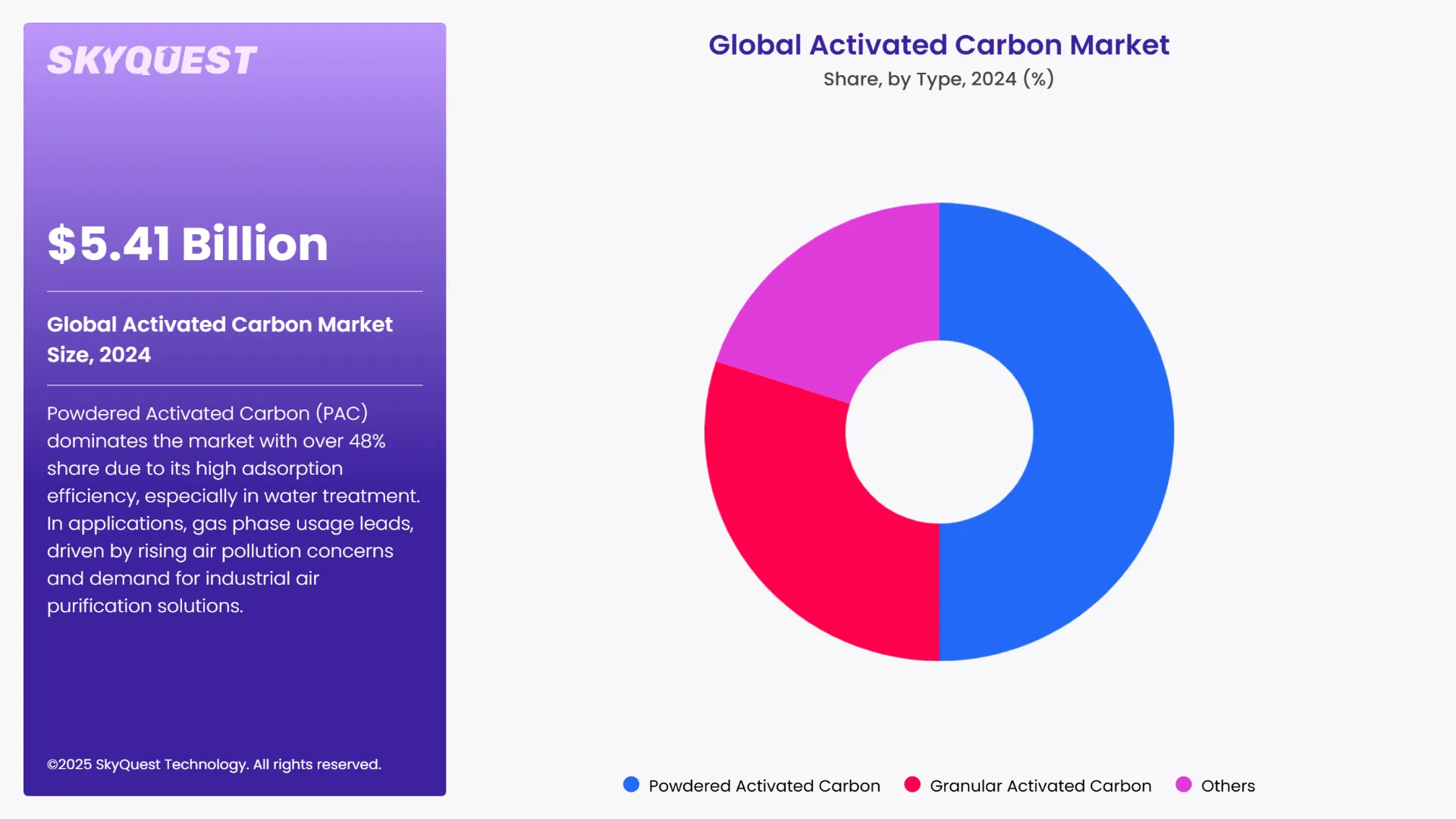
Powdered Activated Carbon (PAC) holds a significant share of over 48% in the global activated carbon market as of 2025. Its dominance is primarily due to its high surface area and fine particle size, which enhance adsorption efficiency. PAC is extensively utilized in water treatment processes, including municipal and industrial wastewater treatment, to remove contaminants such as organic compounds, color, taste, and odor. Additionally, its applications extend to the pharmaceutical industry for purifying pharmaceutical compounds and to the food and beverage sector for decolorization and purification processes.
The increasing awareness among consumers regarding water and air quality, coupled with concerns about health risks associated with pollutants, fuels the demand for PAC-based filtration and purification systems for residential and commercial use.
The gas phase application segment is the largest in the activated carbon market, driven by the increasing need for air purification solutions across various industries. Activated carbon is highly effective in adsorbing gases and vapors, making it essential in removing pollutants such as volatile organic compounds (VOCs), ozone, and other gases from the air. It is commonly used in air filters, gas masks, and industrial air purification systems to ensure clean and safe air quality. The growing concerns about air pollution and stringent environmental regulations are fueling the demand for activated carbon in gas phase applications, solidifying its position as the dominant segment in the market.
To get detailed segments analysis, Request a Free Sample Report
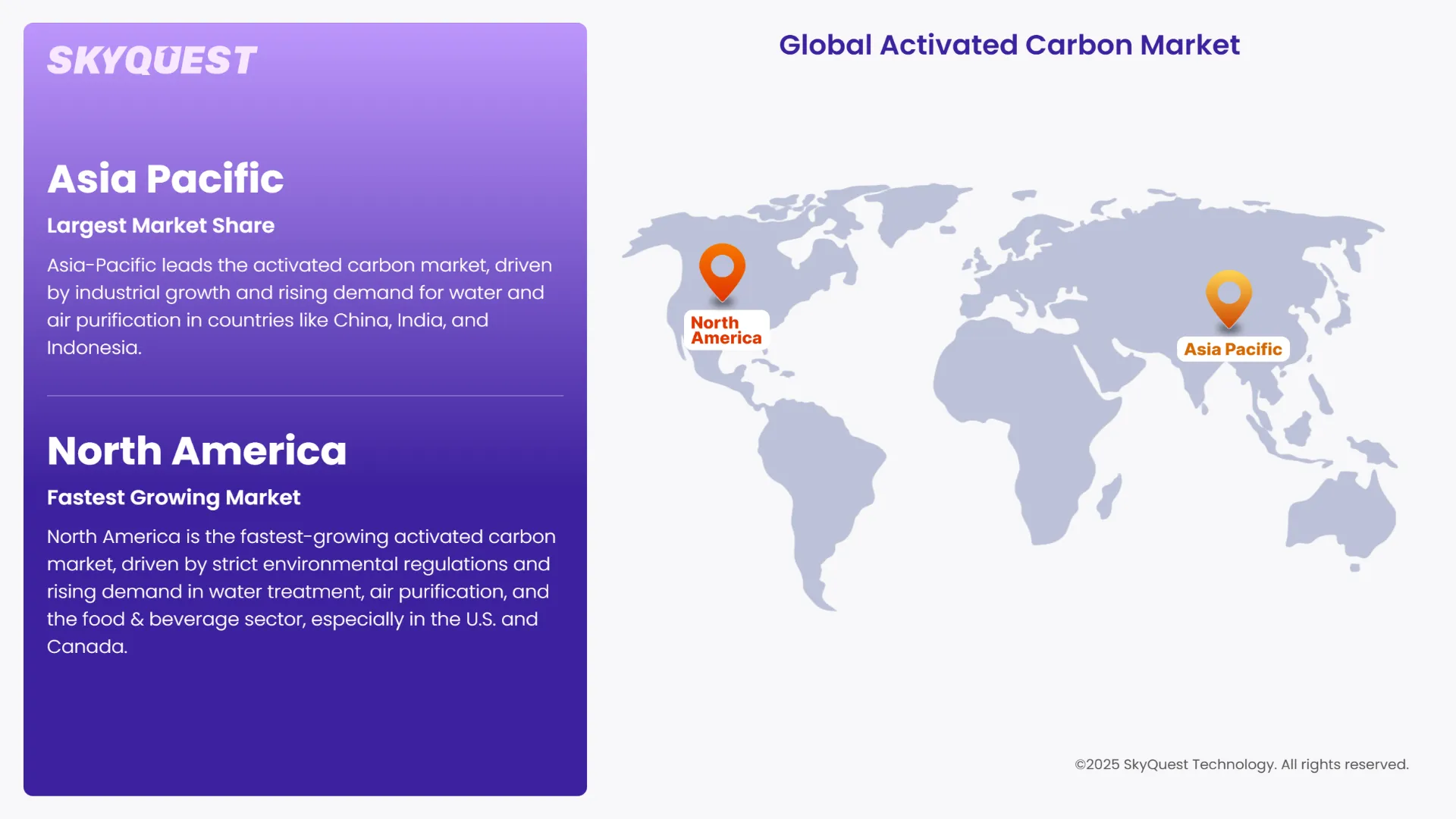
Asia-Pacific leads the global activated carbon market, driven by rapid industrialization, urbanization, and heightened environmental awareness. Countries like China, India, and Indonesia are significant contributors due to their expanding industrial sectors and increasing demand for water and air purification solutions. The region benefits from abundant raw materials, such as coconut shells, and cost-effective manufacturing processes. Stringent environmental regulations and a focus on sustainable practices further bolster market growth. Applications in water treatment, gas purification, and air quality control are witnessing substantial growth, reflecting the region's commitment to addressing environmental challenges.
China Activated Carbon
China dominates the Asia-Pacific activated carbon market, accounting for approximately 53% of the regional share in 2024. This leadership is attributed to its extensive manufacturing infrastructure and growing environmental consciousness. The country's massive industrial base and stringent environmental regulations drive demand, particularly in water treatment and air purification applications. China's focus on addressing air pollution and water quality issues, coupled with its expanding pharmaceutical and food processing industries, continues to propel the activated carbon market.
India Activated Carbon
India is emerging as a significant player in the activated carbon market, driven by increasing industrial activities and environmental concerns. The country's demand for activated carbon is rising in sectors like water treatment, pharmaceuticals, and food processing. India's focus on improving water quality and air purification, along with government initiatives promoting environmental sustainability, supports market growth. The availability of raw materials and cost-effective labor further enhances India's position in the global activated carbon market.
North America is the fastest-growing activated carbon market, with the U.S. and Canada driving growth due to heightened environmental awareness and stringent regulatory frameworks, such as the Clean Water Act and Clean Air Act amendments. Activated carbon is extensively used in municipal water treatment, air purification, and the food & beverage industry. Increased adoption of activated carbon in emerging applications such as energy storage (supercapacitors) and pharmaceutical purification also supports growth. Additionally, innovation in activated carbon fiber and pellet forms is improving efficiency and expanding end-use possibilities.
U.S. Activated Carbon
The U.S. dominates the North American market with around 80% share. In 2024, companies like Calgon Carbon and Cabot Corporation invested over $50 million to expand production facilities in Ohio and Texas to meet rising demand in water treatment and vapor recovery applications. Recent developments include the launch of specialty activated carbon products targeting PFAS (per- and polyfluoroalkyl substances) removal from drinking water—a key environmental concern. Government grants and partnerships, such as those under the EPA’s Water Infrastructure Finance and Innovation Act (WIFIA), support infrastructure upgrades incorporating activated carbon filtration.
Canada Activated Carbon
Canada's activated carbon market is growing steadily, supported by strong government policies promoting clean water initiatives and industrial emissions reduction. Recent developments include the establishment of new activated carbon manufacturing facilities in Alberta and Ontario by companies like Haycarb Canada and Carbon Clean Solutions. These facilities focus on bio-based activated carbon to support sustainability goals. Additionally, the government’s Clean Energy Fund has allocated funds to pilot activated carbon applications in industrial emission control and carbon capture, highlighting a growing trend toward environmental innovation.
Europe accounts for approximately 20-22% of the global activated carbon market, with growth driven by stringent environmental regulations like the EU Water Framework Directive and the Industrial Emissions Directive. The region is focusing heavily on-air purification technologies, wastewater treatment, and emerging uses such as hydrogen storage and carbon capture. Europe's market growth is also bolstered by technological advancements in activated carbon production, including development of nanoporous materials and tailored activated carbon composites for specific industrial applications.
UK Activated Carbon
The U.K. market is growing steadily, driven by new government regulations aimed at reducing industrial pollution and improving urban air quality. Activated carbon is extensively used in municipal water treatment and emerging fields such as pharmaceutical purification. Recent developments include strategic partnerships between activated carbon producers like Calgon Carbon UK and water utilities to pilot advanced filtration systems targeting microplastics and chemical contaminants. The U.K. government’s Clean Growth Strategy and investments in environmental R&D also boost innovation and adoption of activated carbon solutions across multiple sectors.
Germany Activated Carbon
Germany holds the largest share of the European activated carbon market, driven by its strong industrial base and leadership in water treatment technologies. The market is growing at a CAGR of around 7% annually. Recent developments include multi-million-euro investments by companies like Donau Carbon GmbH in new production technologies that increase activated carbon adsorption capacity and recyclability. Germany is also advancing circular economy models by promoting regeneration and reuse of spent activated carbon. Large infrastructure projects in wastewater treatment and air quality monitoring further stimulate demand.
France Activated Carbon
France's activated carbon market is steadily expanding, driven by strict environmental regulations and the country’s commitment to sustainable water and air management. The French government enforces robust policies aligned with the European Union’s Water Framework Directive and Air Quality Directive, mandating industries and municipalities to adopt advanced filtration technologies. Activated carbon is widely used in municipal wastewater treatment plants, air purification systems, and industrial effluent treatment, particularly in sectors such as pharmaceuticals, chemicals, and food & beverage.
To know more about the market opportunities by region and country, click here to
Buy The Complete Report
Rising Demand for Water and Air Purification
Growth in Industrial and Automotive Emissions Control
High Production Costs and Raw Material Availability
Disposal and Regeneration Challenges
Request Free Customization of this report to help us to meet your business objectives.
The activated carbon market is highly competitive, with players intensifying efforts in capacity expansion, vertical integration, and tailored product innovations to strengthen their foothold. For instance, Osaka Gas Chemicals, through its subsidiary Jacobi Carbons, continues to invest in expanding reactivation facilities across Europe to meet the rising demand from water treatment applications while maintaining a sustainable product lifecycle. Similarly, Cabot Corporation has launched EVERSORB™, a high-performance activated carbon line targeting air purification and industrial emissions, signaling its focus on niche, regulation-driven segments. In Asia, Indo German Carbons and Kuraray are leveraging cost-effective coconut shell-based activated carbon to cater to the pharmaceutical and food & beverage sectors, with Kuraray also developing advanced grades for PFAS removal from water. Mergers and partnerships are strategic levers; Haycarb PLC, for example, has deepened supply chain control by partnering directly with coconut growers in Sri Lanka and India to secure raw materials amidst global shortages. These targeted strategies underscore a shift from commoditized offerings to application-specific, value-driven solutions in a market increasingly shaped by environmental regulations and sustainability benchmarks.
Emerging Trends Shaping the Future of Activated Carbon
SkyQuest’s ABIRAW (Advanced Business Intelligence, Research & Analysis Wing) is our Business Information Services team that Collects, Collates, Correlates, and Analyses the Data collected using Primary Exploratory Research backed by robust Secondary Desk research.
As per SkyQuest analysis, The global activated carbon market is experiencing steady growth, primarily driven by increasing environmental regulations and rising demand for water and air purification solutions. One key driver fueling the market is the growing focus on pollution control, as industries seek effective methods to remove contaminants and harmful gases. Activated carbon’s exceptional adsorption properties make it indispensable in treating wastewater and purifying air, especially in industrial and municipal applications. However, the market faces restraints such as high production costs and the availability of alternative adsorbents, which may limit rapid expansion in some regions.
Geographically, Asia pacific dominates t dominates the activated carbon market due to stringent environmental policies, advanced infrastructure, and significant investments in pollution control technologies. In terms of product type, powdered activated carbon leads the market segment owing to its high surface area and versatility in various applications. By application, gas phase applications hold the largest share, driven by the need for air purification in industrial emissions control and indoor air quality improvement. Overall, the activated carbon market continues to grow as environmental concerns and regulatory pressures increase worldwide.
| Report Metric | Details |
|---|---|
| Market size value in 2024 | USD 5.41 Billion |
| Market size value in 2033 | USD 11.09 Billion |
| Growth Rate | 8.3% |
| Base year | 2024 |
| Forecast period | 2026-2033 |
| Forecast Unit (Value) | USD Billion |
| Segments covered |
|
| Regions covered | North America (US, Canada), Europe (Germany, France, United Kingdom, Italy, Spain, Rest of Europe), Asia Pacific (China, India, Japan, Rest of Asia-Pacific), Latin America (Brazil, Rest of Latin America), Middle East & Africa (South Africa, GCC Countries, Rest of MEA) |
| Companies covered |
|
| Customization scope | Free report customization with purchase. Customization includes:-
|
To get a free trial access to our platform which is a one stop solution for all your data requirements for quicker decision making. This platform allows you to compare markets, competitors who are prominent in the market, and mega trends that are influencing the dynamics in the market. Also, get access to detailed SkyQuest exclusive matrix.
Table Of Content
Executive Summary
Market overview
Parent Market Analysis
Market overview
Market size
KEY MARKET INSIGHTS
COVID IMPACT
MARKET DYNAMICS & OUTLOOK
Market Size by Region
KEY COMPANY PROFILES
Methodology
For the Activated Carbon Market, our research methodology involved a mixture of primary and secondary data sources. Key steps involved in the research process are listed below:
1. Information Procurement: This stage involved the procurement of Market data or related information via primary and secondary sources. The various secondary sources used included various company websites, annual reports, trade databases, and paid databases such as Hoover's, Bloomberg Business, Factiva, and Avention. Our team did 45 primary interactions Globally which included several stakeholders such as manufacturers, customers, key opinion leaders, etc. Overall, information procurement was one of the most extensive stages in our research process.
2. Information Analysis: This step involved triangulation of data through bottom-up and top-down approaches to estimate and validate the total size and future estimate of the Activated Carbon Market.
3. Report Formulation: The final step entailed the placement of data points in appropriate Market spaces in an attempt to deduce viable conclusions.
4. Validation & Publishing: Validation is the most important step in the process. Validation & re-validation via an intricately designed process helped us finalize data points to be used for final calculations. The final Market estimates and forecasts were then aligned and sent to our panel of industry experts for validation of data. Once the validation was done the report was sent to our Quality Assurance team to ensure adherence to style guides, consistency & design.
Analyst Support
Customization Options
With the given market data, our dedicated team of analysts can offer you the following customization options are available for the Activated Carbon Market:
Product Analysis: Product matrix, which offers a detailed comparison of the product portfolio of companies.
Regional Analysis: Further analysis of the Activated Carbon Market for additional countries.
Competitive Analysis: Detailed analysis and profiling of additional Market players & comparative analysis of competitive products.
Go to Market Strategy: Find the high-growth channels to invest your marketing efforts and increase your customer base.
Innovation Mapping: Identify racial solutions and innovation, connected to deep ecosystems of innovators, start-ups, academics, and strategic partners.
Category Intelligence: Customized intelligence that is relevant to their supply Markets will enable them to make smarter sourcing decisions and improve their category management.
Public Company Transcript Analysis: To improve the investment performance by generating new alpha and making better-informed decisions.
Social Media Listening: To analyze the conversations and trends happening not just around your brand, but around your industry as a whole, and use those insights to make better Marketing decisions.
REQUEST FOR SAMPLE
 REQUEST FREE CUSTOMIZATION


Want to customize this report? This report can be personalized according to your needs. Our analysts and industry experts will work directly with you to understand your requirements and provide you with customized data in a short amount of time. We offer $1000 worth of FREE customization at the time of purchase.
Feedback From Our Clients


 USA (+1) 351-333-4748

