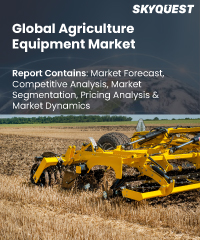
Agriculture Equipment Market
Report ID: SQSG20H2003
Report ID: SQSG20H2003
[email protected]
USA +1 351-333-4748
Report ID:
SQSG20H2003 |
Region:
Global |
Published Date: August, 2025
Pages:
183
|Tables:
69
|Figures:
75


Global Agriculture Equipment Market size was valued at USD 171.8 Billion in 2024 and is poised to grow from USD 180.56 Billion in 2025 to USD 268.81 Billion by 2033, growing at a CAGR of 5.1% during the forecast period (2026–2033).
The agriculture equipment market is growing steadily driven primarily by increases in global food demand, lessening terrestrial agricultural land availability, and labor shortages within the farming sector. To tackle these issues, farmers are turning more toward using advanced machinery; tractors, harvesters, and precision planting equipment, which can improve productivity and efficiency. There are many government initiatives to support mechanized farming, which is very common in developing countries, which also further supports the growth of this market. The added capabilities of GPS, IoT, and AI, which help monitor and improve in real-time, reduce input wastage (e.g., fertilizers, water), and ultimately improve yield, are also generating interest from both large-scale and commercial farmers, which leads them down the high-tech solutions path.
On the contrary, the agriculture equipment market does face certain restraints, which may impede the current growth trend. One major one being the initial costs of modern agricultural equipment can be very large. The tractor, in particular, has a considerable purchase price point related to it but also must be maintained throughout its life which can also limit the uptake from small and marginal farmers. In addition, not having financing options available through existing government or other sources, as well as the lack of existing adequate technical support and training options inhibit a farmer’s ability to obtain and use advanced machinery. Furthermore, using larger and heavier machinery has many implications for soil compaction and emissions, which raises many environmental concerns and regulative scrutiny. Despite these challenges, there is still a positive outlook for the agriculture equipment market to continue to grow because of the ability to advance technological capabilities and increasing investment for sustainable agriculture.
How is Artificial Intelligence Reshaping the Landscape of Agriculture Equipment?
AI, IoT, and other related high-impact technologies are reshaping the agricultural equipment environment by making farms smarter, more efficient, and sustainable. Connected sensors deployed across the fields provide real-time soil, moisture, and environmental data to an AI system so irrigation and fertilization can occur at variable rates and every crop's exact needs can be fulfilled. Additionally, autonomous tractors and robotics with computer vision technology are multitasking in seeding, spraying, and harvesting with limited human intervention - appealing to those suffering from labor shortages while promoting accuracy and lower input costs. These technologies can provide greater yields, less chemical application, and lower associated costs which have hastened adoption by both beneficiaries and providers of agriculture.
At CES 2025, John Deere announced a new generation of fully autonomous tractors and autonomy retrofit kits powered by AI, computer vision, lidar, and stereo cameras that allow the machine to move through the terrain and carry out its purpose without a driver in the cab, which would address a perennial labor crisis for agriculture, construction, and landscaping. Regionally, we can see that their See & Spray system solely uses AI to apply the herbicide to the areas that need it which will mean far less chemical application and environmental impact.
Market snapshot - 2026-2033
Global Market Size
USD 163.46 Billion
Largest Segment
Tractors
Fastest Growth
Tractors
Growth Rate
5.1% CAGR
To get more insights on this market click here to Request a Free Sample Report
Global Agriculture Equipment Market is segmented by Product Type, Automation, Application and region. Based on Product Type, the market is segmented into Harvesters, Tractors, Spraying Equipment, Hay & Forage Equipment, Irrigation & Crop Process equipment, Planting Equipment and Others. Based on Automation, the market is segmented into Manual, Semi-Automatic and Automatic. Based on Application, the market is segmented into Land & Development, Weed Cultivation, Plant Protection, Sowing & Planting, Harvesting & Threshing, Post-Harvest Agro Processing and Others. Based on region, the market is segmented into North America, Europe, Asia Pacific, Latin America and Middle East & Africa.
How the Tractors are dominating the market?
Tractors are forecasted to account for a prominent chunk of the global agriculture equipment market share in the future. Extensive use of tractors for a wide variety of applications in agriculture makes it essential for modern farming and contributes to its high revenue generation potential. Growing availability of novel tractors and increasing mechanization of farms are helping this segment maintain its dominant stance. Providing electric tractors to comply with sustainability trends is expected to be the prime focus of agriculture equipment companies looking to expand their business scope via this segment in the long run.
How the harvester machinery is fastest growing segment of the market?
The demand for harvester machinery is slated to rise at an impressive pace going forward. The surge in popularity of smart combine harvesters and integration of smart actuators in traditional harvester machinery are expected to generate new opportunities via this segment in the future. Innovations in harvester machinery and rising preference for harvesters owing to their high harvesting speeds and efficiency are also expected to boost revenue generation via this segment. Use of harvesters for harvesting grains such as rice and wheat is projected to rise rapidly on a global level as availability of skill agricultural labor reduces.
To get detailed segments analysis, Request a Free Sample Report
How are Government Policies in the Asia-Pacific Driving the Growth of the Agriculture Equipment Market?
The agricultural equipment market is dominated by the Asia-Pacific region because of its large agricultural base, rapidly growing population, government subsidies, and harvesting mechanization. There is strong demand from India and China and supportive policies around rural income. The transition towards tractors, harvesters, and precision equipment, is accelerating with the adoption of agriculture technology. The presence of local manufacturers, combined with growing improved distribution channels, is directly influencing the easy access to and adoption of equipment.
India Agriculture Equipment Market
India is the market leader in sales of agriculture equipment using government schemes such as SMAM and PMKSY, which subsidizes acquiring modern equipment. Rising rural wages and a focus on food security are positively correlated with the uptake of mechanization. In 2024 alone, tractor sales surpassed 875,000 units. Most recently, Andhra Pradesh initiated a statewide survey of agricultural machinery with an integrated digital platform to increase efficient use of machinery, support custom hiring centres, and the use of drone-based and artificial intelligence agricultural solutions.
China Agriculture Equipment Market
China is aggressively pursuing policies of mechanization with a goal of 75% mechanization by 2025. Domestic innovations and subsidies will support this acceleration. More than ~60% of farmland is now mechanized (in China). Recently, China earmarked $1.4 billion into a fund to assist grain farmers with upgrades to equipment. The country is directly investing into smart tractors and precision planters to not only improve agriculture equipment, but improve the entire sector and reduce reliance on rural labour.
What makes North America the top market for Agriculture Equipment in 2024?
North America is the fastest-growing region due to large-scale farming, precision agriculture adoption, and advanced equipment innovation. Federal grants and programs support automation and AI integration in tractors, drones, and harvesters. Labor shortages and a focus on high-yield crops push adoption of autonomous machinery and digital monitoring platforms. Major players like John Deere and AGCO continuously invest in smart farming technologies, driving strong market momentum.
The United States Agriculture Equipment Market
The U.S. leads North America with strong demand for high-capacity autonomous equipment. Government incentives and digital farming advancements boost adoption of precision tools. In early 2025, autonomous tractors gained traction in dairy and solar farms. Despite an overall AgTech funding decline, smart farming received $1.82 billion, highlighting increasing enterprise interest in robotics and AI-led agricultural solutions.
Canada Agriculture Equipment Market
Canada supports agricultural innovation through federal programs and strong dealer networks. Labor shortages in regions like Saskatchewan drive demand for GPS-enabled tractors and smart combines. In 2024, companies began deploying AI-powered harvesters to reduce crop losses and improve yields. The growing emphasis on sustainability and large-scale grain cultivation is further accelerating the adoption of digital farm equipment across Canadian farmlands.
How is Europe Maintaining Its Position in Agriculture Equipment Market?
Europe holds significant market potential due to stringent building energy codes, increasing retrofitting activities, and widespread focus on sustainability. Countries like Germany, the UK, and France are at the forefront of adopting recycled and energy-efficient Agriculture Equipment. Renovation of aging infrastructure and policy mandates are supporting the use of sustainable construction solutions, making the region a strong contender in Agriculture Equipment market expansion.
Germany Agriculture Equipment Market
Germany leads Europe with its strong OEM presence and engineering excellence. CAP subsidies and environmental regulations drive demand for sustainable and precision-based equipment. Mechanization in grain and vegetable farming is widespread, and recent developments show increased deployment of autonomous machinery in large farms. The focus is shifting toward low-emission, data-driven solutions to meet EU climate targets and efficiency standards.
France Agriculture Equipment Market
France benefits from CAP funding, widespread mechanization in wine and cereal production, and strong collaborations between manufacturers and agri-tech startups. The country is investing in electric and autonomous farming equipment to reduce emissions. In 2024, battery-powered tractors and AI-based crop monitoring tools were increasingly adopted across major agricultural zones. France remains a key innovator and contributor to sustainable farming in Europe.
UK Agriculture Equipment Market
The UK is rapidly adopting smart agriculture practices, especially after Brexit reforms. Government-backed eco-schemes support automation, robotic weeding, and precision spraying technologies. DEFRA funding encourages the use of AI-enabled tools and sustainable machinery. In 2024, autonomous tools gained traction among medium-sized farms aiming to reduce chemical use and improve efficiency, making the UK a fast-transforming agricultural equipment market in Europe.
To know more about the market opportunities by region and country, click here to
Buy The Complete Report
Agriculture Equipment Market Drivers
Mechanization of Farming Practices
Surging Demand for Food Around the World
Agriculture Equipment Market Restraints
Limited Access to Credit
High Initial Costs
Request Free Customization of this report to help us to meet your business objectives.
The farm equipment industry is extremely competitive, with industry leaders such as John Deere, AGCO, and Kubota concentrating on AI adoption, autonomous equipment, and sustainability. John Deere introduced fully autonomous tractors recently, and AGCO invested in precision planting technologies with its Fendt brand. They are making tech alliances—such as CNH Industrial's acquisition of Raven Industries—to improve digital skills and minimize downtime in operations through predictive maintenance and smart telemetry systems.
SkyQuest’s ABIRAW (Advanced Business Intelligence, Research & Analysis Wing) is our Business Information Services team that Collects, Collates, Correlates, and Analyses the Data collected using Primary Exploratory Research backed by robust Secondary Desk research.
SkyQuest’s study suggests that the growing mechanization of farming practices and rising demand for food around the world are slated to drive agriculture equipment market development in the future. On the contrary, high initial costs of advanced equipment and limited availability of credit are expected to impede the sales of agriculture equipment across the study period and beyond. The Asia Pacific region is forecasted to spearhead agriculture equipment demand owing to the presence of robust agricultural activity in countries such as China and India. The development of autonomous and electric-powered agriculture equipment is anticipated to present new opportunities for agriculture equipment suppliers in the long run.
| Report Metric | Details |
|---|---|
| Market size value in 2024 | USD 171.8 Billion |
| Market size value in 2033 | USD 268.81 Billion |
| Growth Rate | 5.1% |
| Base year | 2024 |
| Forecast period | 2026-2033 |
| Forecast Unit (Value) | USD Billion |
| Segments covered |
|
| Regions covered | North America (US, Canada), Europe (Germany, France, United Kingdom, Italy, Spain, Rest of Europe), Asia Pacific (China, India, Japan, Rest of Asia-Pacific), Latin America (Brazil, Rest of Latin America), Middle East & Africa (South Africa, GCC Countries, Rest of MEA) |
| Companies covered |
|
| Customization scope | Free report customization with purchase. Customization includes:-
|
To get a free trial access to our platform which is a one stop solution for all your data requirements for quicker decision making. This platform allows you to compare markets, competitors who are prominent in the market, and mega trends that are influencing the dynamics in the market. Also, get access to detailed SkyQuest exclusive matrix.
Table Of Content
Executive Summary
Market overview
Parent Market Analysis
Market overview
Market size
KEY MARKET INSIGHTS
COVID IMPACT
MARKET DYNAMICS & OUTLOOK
Market Size by Region
KEY COMPANY PROFILES
Methodology
For the Agriculture Equipment Market, our research methodology involved a mixture of primary and secondary data sources. Key steps involved in the research process are listed below:
1. Information Procurement: This stage involved the procurement of Market data or related information via primary and secondary sources. The various secondary sources used included various company websites, annual reports, trade databases, and paid databases such as Hoover's, Bloomberg Business, Factiva, and Avention. Our team did 45 primary interactions Globally which included several stakeholders such as manufacturers, customers, key opinion leaders, etc. Overall, information procurement was one of the most extensive stages in our research process.
2. Information Analysis: This step involved triangulation of data through bottom-up and top-down approaches to estimate and validate the total size and future estimate of the Agriculture Equipment Market.
3. Report Formulation: The final step entailed the placement of data points in appropriate Market spaces in an attempt to deduce viable conclusions.
4. Validation & Publishing: Validation is the most important step in the process. Validation & re-validation via an intricately designed process helped us finalize data points to be used for final calculations. The final Market estimates and forecasts were then aligned and sent to our panel of industry experts for validation of data. Once the validation was done the report was sent to our Quality Assurance team to ensure adherence to style guides, consistency & design.
Analyst Support
Customization Options
With the given market data, our dedicated team of analysts can offer you the following customization options are available for the Agriculture Equipment Market:
Product Analysis: Product matrix, which offers a detailed comparison of the product portfolio of companies.
Regional Analysis: Further analysis of the Agriculture Equipment Market for additional countries.
Competitive Analysis: Detailed analysis and profiling of additional Market players & comparative analysis of competitive products.
Go to Market Strategy: Find the high-growth channels to invest your marketing efforts and increase your customer base.
Innovation Mapping: Identify racial solutions and innovation, connected to deep ecosystems of innovators, start-ups, academics, and strategic partners.
Category Intelligence: Customized intelligence that is relevant to their supply Markets will enable them to make smarter sourcing decisions and improve their category management.
Public Company Transcript Analysis: To improve the investment performance by generating new alpha and making better-informed decisions.
Social Media Listening: To analyze the conversations and trends happening not just around your brand, but around your industry as a whole, and use those insights to make better Marketing decisions.
REQUEST FOR SAMPLE
 REQUEST FREE CUSTOMIZATION
Global Agriculture Equipment Market size was valued at USD 171.8 Billion in 2024 and is poised to grow from USD 180.56 Billion in 2025 to USD 268.81 Billion by 2033, growing at a CAGR of 5.1% during the forecast period (2026–2033).
The farm equipment industry is extremely competitive, with industry leaders such as John Deere, AGCO, and Kubota concentrating on AI adoption, autonomous equipment, and sustainability. John Deere introduced fully autonomous tractors recently, and AGCO invested in precision planting technologies with its Fendt brand. They are making tech alliances—such as CNH Industrial's acquisition of Raven Industries—to improve digital skills and minimize downtime in operations through predictive maintenance and smart telemetry systems. 'AGCO Corporation', 'Bellota Agrisolutions', 'CLAAS KGaAmbH', 'CNH Industrial N.V.', 'FlieglAgro-Center GmbH', 'APV GmbH', 'Deere & Company', 'Escorts Limited', 'HORSCH Maschinen GmbH', 'ISEKI & Co., Ltd.', 'J C Bamford Excavators Ltd', 'KUBOTA Corporation'
Growing emphasis on improving agricultural yield and maximization of agricultural productivity has resulted in the high adoption of mechanical machines in agriculture. Mechanization improves efficiency, reduces time, and minimizes manual effort, making it essential for modern farming, which in turn drives the global agriculture equipment market outlook as well.
Use of Autonomous Equipment: Agriculture equipment companies should invest in research and development of autonomous equipment to help boost the use of automation in farming. Focusing on this agriculture equipment market trend can help farmers improve their large-scale farming potential, reduce waste, and also reduce reliance on labor to help make the most of the agriculture industry in the long run.
How are Government Policies in the Asia-Pacific Driving the Growth of the Agriculture Equipment Market?


Want to customize this report? This report can be personalized according to your needs. Our analysts and industry experts will work directly with you to understand your requirements and provide you with customized data in a short amount of time. We offer $1000 worth of FREE customization at the time of purchase.
Feedback From Our Clients


 USA (+1) 351-333-4748

