Artificial Intelligence (AI) in Manufacturing Market
Report ID: SQMIG20I2457
Report ID: SQMIG20I2457
[email protected]
USA +1 351-333-4748
Report ID:
SQMIG20I2457 |
Region:
Global |
Published Date: August, 2025
Pages:
173
|Tables:
122
|Figures:
72


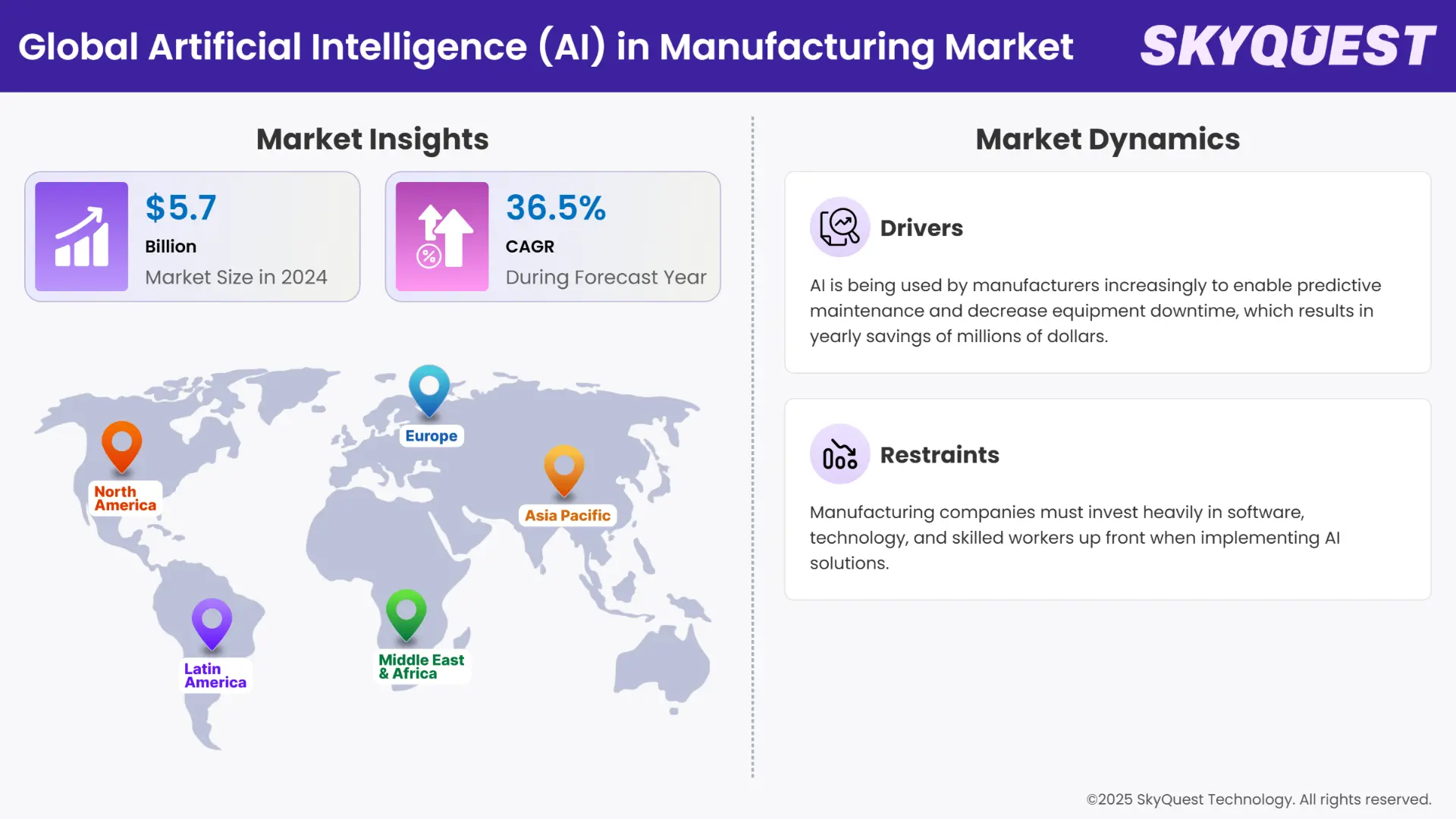
Global Artificial Intelligence (AI) in Manufacturing Market size was valued at USD 6.96 Billion in 2024 and is poised to grow from USD 9.5 Billion in 2025 to USD 114.52 Billion by 2033, growing at a CAGR of 36.5% during the forecast period (2026–2033).
By forecasting budgets using historical data and assisting in the development of predictive models in line with timelines, artificial intelligence (AI) can help the manufacturing industry avoid cost overruns.
The development of automation in the manufacturing sector and the increasing demand for big data integration are driving artificial intelligence (AI) in manufacturing market growth. The extensive use of machine vision cameras in a range of manufacturing applications, such as quality control, field service, material movement, and machinery inspection, is also a significant factor propelling the development of artificial intelligence in manufacturing. Major market players are also using a range of tactics, like launching new products and promoting innovation, to broaden their product lines and stay competitive in the rapidly evolving market.
How are Industry Leaders Leveraging AI to Improve Efficiency?
The artificial intelligence (AI) in the manufacturing sector has grown rapidly as organizations implement computer vision, machine learning, and predictive analytics to enhance productivity. Using AI-based predictive maintenance across all its operations in Germany, Siemens was able to reduce equipment downtime by 30% in 2024. Moreover, General Motors adopted AI-based robotic systems for quality inspection in 2025 and increased fault detection accuracy by 25%. AI also supports energy management, supply chain optimization, and real-time decisions. The growing adoption of Industry 4.0 and smart manufacturing initiatives continues to drive increasing demand. Advanced investments from both public and private organizations have validated AI as a critical component of next-generation manufacturing's improved efficiency, sustainability, and productivity.
To get more insights on this market click here to Request a Free Sample Report
The global artificial intelligence (AI) in the manufacturing market is segmented into component, technology, application, end use, and region. By component, the market is trifurcated into software, hardware, and services. Depending on technology, it is divided into machine learning (ML), computer vision, context awareness, and natural language processing. According to the application, the market is classified into material movement, predictive maintenance & machinery inspection, production planning, field services, and quality control & reclamation. As per end use, it is categorized into semiconductor & electronics, energy & power, medical devices, automobile, and heavy metal & machine manufacturing. Regionally, it is analyzed across North America, Europe, Asia-Pacific, Latin America, and the Middle East and Africa.
What Makes Specialized Hardware Crucial for AI Adoption in Manufacturing?
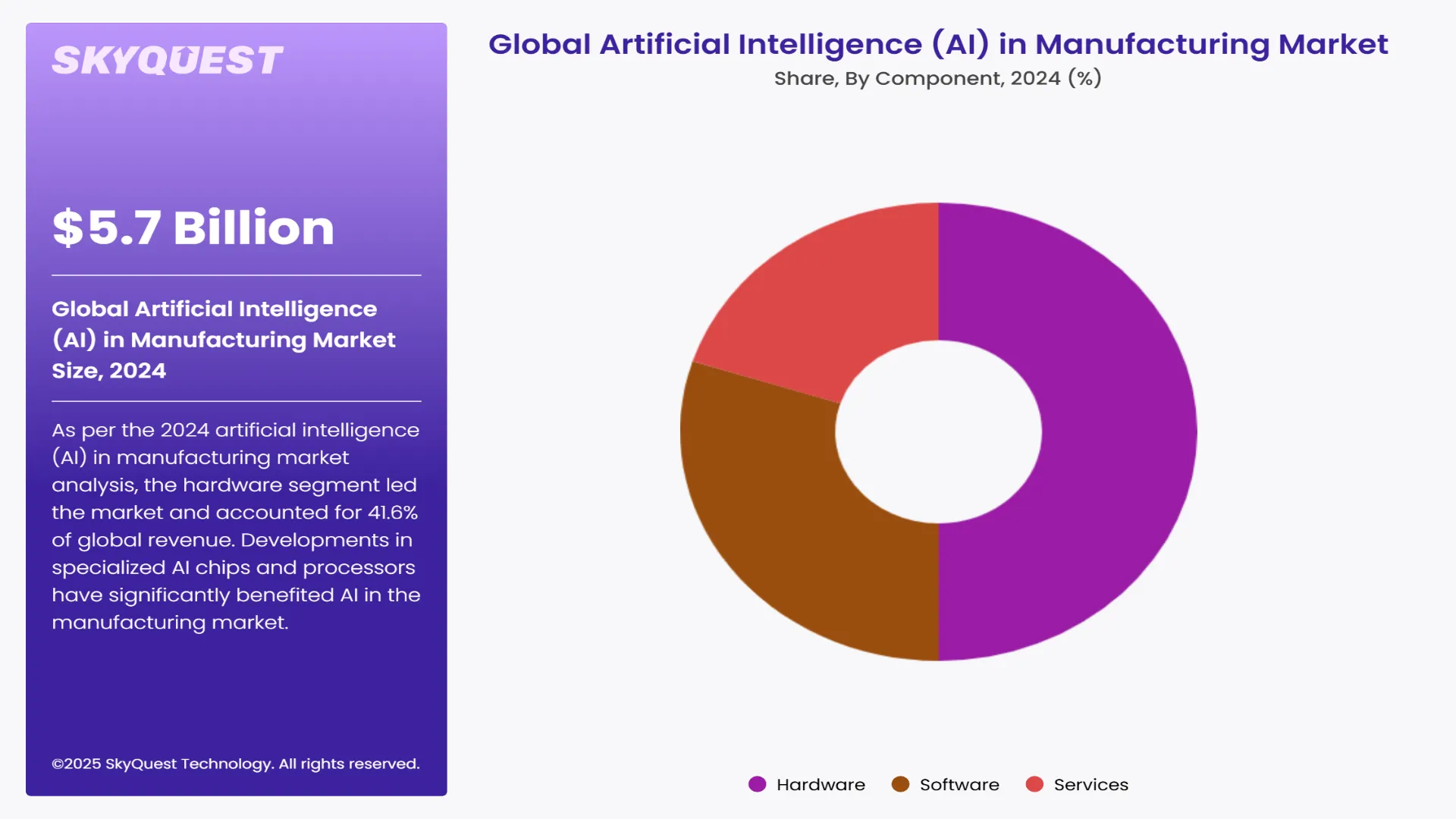
As per the 2024 artificial intelligence (AI) in manufacturing market analysis, the hardware segment led the market and accounted for 41.6% of global revenue. Developments in specialized AI chips and processors have significantly benefited AI in the manufacturing market. Complex datasets were processed more quickly and effectively due to these hardware advancements that were especially made to meet the computational requirements of AI algorithms. Businesses are spending money on creating specialized hardware that was tailored for machine learning tasks, which boosted output and allowed for the implementation of increasingly complex AI applications in manufacturing settings. These specialized chips were essential in managing complex neural network computations, enabling the industry-wide development of AI-centric operations.
The software segment is expected to grow its highest artificial intelligence (AI) in manufacturing market share during the forecast period. Software solutions can be used in a variety of production processes due to their extreme adaptability and versatility. Due to its inherent flexibility, software is the best choice for a sector with a wide range of needs. Fast implementation is made possible by software's rapid development, testing, and deployment features, which is very advantageous in a manufacturing setting. This adaptability is crucial in an industry that requires prompt responses to advancements in artificial intelligence and technology in the manufacturing sector.
Why did Medical Devices Lead AI Adoption in Manufacturing in 2024?
As per the 2024 artificial intelligence (AI) in manufacturing market forecast, the market is dominated by medical devices end use. AI is a promising tool for the manufacturing of medical devices because of its features, which include yield optimization, quality control, and predictive maintenance, among others. The use of computing and machine learning enhances engineers' roles by improving accuracy and enabling learning from errors. Medical device manufacturers can use AI in many ways, including device quality assurance and predictive maintenance based on data analysis.
The automotive segment is expected to grow at the fastest rate during the forecast period due to the combination of AI technology and state-of-the-art connectivity components. With the advent of sophisticated AI assistants that provide predictive navigation and real-time traffic updates, this integration has enhanced vehicle-infrastructure communication, enhancing driving safety and enjoyment.
To get detailed segments analysis, Request a Free Sample Report
Why are North American Manufacturers Investing Heavily in AI?
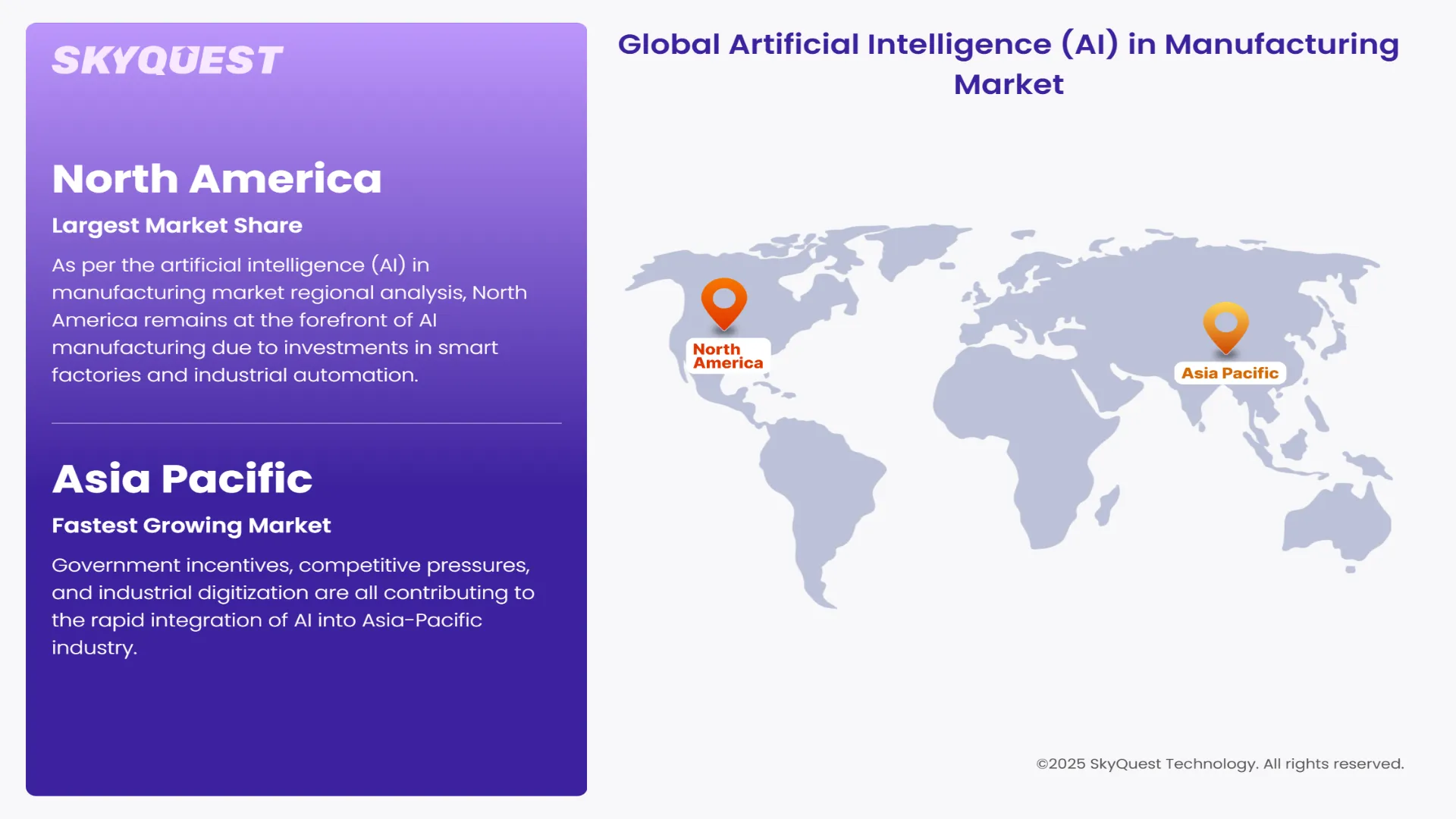
As per the artificial intelligence (AI) in manufacturing market regional analysis, North America remains at the forefront of AI manufacturing due to investments in smart factories and industrial automation. The use of AI by manufacturers in the region increased by 23% in 2024. Predictive maintenance systems were particularly advanced in the aerospace and automotive industries. While innovation has been sparked by public-private partnerships like NIST's AI Manufacturing Initiative, regional competitiveness has also been strengthened by the availability of skilled labor and a strong tech ecosystem.
U.S. Artificial Intelligence (AI) in Manufacturing Market
With the backing of well-known tech companies and government funding, the US is leading the way in AI-driven manufacturing. In 2024, Tesla increased fault identification by 28% at its gigafactory in Texas by implementing deep learning models for autonomous quality inspections. Additionally, the development of semiconductor-based AI hardware is being promoted by the CHIPS and Science Act. Industrial behemoths like GE and Honeywell are still making significant investments in AI because of their potential to increase productivity and predictive maintenance.
Canada Artificial Intelligence (AI) in Manufacturing Market
The artificial intelligence (AI) in manufacturing industry is steadily expanding in Canada, with a focus on process automation and sustainability. In 2025, Linamar Corporation deployed robotic systems driven by artificial intelligence, resulting in an 18% reduction in energy consumption. SMEs were also assisted in incorporating AI into smart manufacturing by the Strategic Innovation Fund of the Canadian government. Canada is well-positioned to play a significant role in intelligent industrial systems due to its robust academic research ecosystem and AI hubs in Toronto and Montreal.
How are EU Policies Shaping the Future of AI in Manufacturing?
The European artificial intelligence (AI) in the manufacturing market is growing as a result of stringent quality standards and automation laws. AI integration in European manufacturers had increased by 20% by 2025, especially in the industrial and automotive sectors. AI research and development were advanced by EU-funded projects such as Horizon Europe. Robotics, digital twins, and predictive maintenance gained traction as businesses prioritized data protection and ethical AI application in accordance with GDPR.
UK Artificial Intelligence (AI) in Manufacturing Market
To finance AI in manufacturing, the UK started the "Made Smarter" initiative in 2024. BAE Systems was able to increase turnaround times by 17% by integrating AI for real-time supply chain visibility. Adoption will be greatly impacted by the nation's emphasis on ethical deployment and AI upskilling. The UK is advancing its smart factory capabilities due to the growing demand for industrial automation and the close cooperation between academia and industry.
France Artificial Intelligence (AI) in Manufacturing Market
As it advances AI in manufacturing, France is concentrating on the aerospace and precision sectors. Dassault Aviation reduced inspection time by 30% in 2025 by using machine learning to identify flaws in aircraft parts. AI innovation across industries is given priority in government-backed initiatives like France 2030. It is simpler to implement AI in manufacturing sectors in a way that is both structured and legal due to the nation's emphasis on data localization and public-private research and development collaborations.
Germany Artificial Intelligence (AI) in Manufacturing Market
Leading the way in AI in manufacturing, Germany was a pioneer in Industry 4.0. Siemens reduced equipment downtime by 30% in 2024 because of integrating AI-based predictive analytics throughout its operations. While assisting SMEs in implementing AI tools, the government's "AI Made in Germany" campaign advocates for ethical AI. Germany has become a major player in the market due to its sophisticated industrial base and use of AI in robotics, quality assurance, and energy management.
Why is Asia-Pacific Emerging as a Global Hub for AI in Manufacturing?
Government incentives, competitive pressures, and industrial digitization are all contributing to the rapid integration of AI into Asia-Pacific industry. In 2025, the automotive and electronics industries adopted AI-led process optimization. The region's smart industrial installations increased by 25% in the past year. Through partnerships with international tech companies and investments in AI training platforms, the region is moving closer to becoming a global leader in AI manufacturing.
China Artificial Intelligence (AI) in Manufacturing Market
China is leading Asia-Pacific in the adoption of AI manufacturing due to its large industrial scale and strong policy support. By implementing AI vision systems in its Shenzhen plants in 2024, Foxconn was able to increase manufacturing productivity by 32%. The 14th Five-Year Plan's "AI + Manufacturing" approach promotes widespread automation. China's dominance in industrial AI has been further cemented by the significant investments made by Chinese tech giants such as Huawei and Baidu in AI chipsets and smart factory platforms.
Japan Artificial Intelligence (AI) in Manufacturing Market
Japan is utilizing AI in manufacturing to improve precise engineering and alleviate a shortage of labor. Toyota reduced idle time by 21% in 2025 by optimizing their production line with AI-driven robotics. Artificial intelligence is regarded as crucial to maintaining production, and the government's Society 5.0 initiative encourages the integration of cutting-edge technologies. Strong partnerships between AI startups and robotics companies are boosting the nation's capacity to deliver automated, high-quality manufacturing.
To know more about the market opportunities by region and country, click here to
Buy The Complete Report
Artificial Intelligence (AI) in Manufacturing Market Drivers
Demand for Quality Control and Predictive Maintenance
Initiatives for Smart Factory and Industrial IoT Integration
Artificial Intelligence (AI) in Manufacturing Market Restraints
Costly Implementation and Legacy Infrastructure
Risks to Data Security and Intellectual Property
Request Free Customization of this report to help us to meet your business objectives.
Major rivals are investing in digital twins, predictive analytics, and AI-driven automation in the fiercely competitive artificial intelligence (AI) in the manufacturing market. For intelligent manufacturing processes, GE and Siemens each have their own AI platforms. IBM combines AI and hybrid cloud to provide production intelligence. Schneider Electric uses AI-powered energy management to put sustainability first. Global innovation and market penetration are accelerated by strategic alliances, R&D expenditures, and acquisitions, such as Nvidia's partnerships for AI chips.
Top Player’s Company Profile
Recent Developments in Artificial Intelligence (AI) in Manufacturing Market
SkyQuest’s ABIRAW (Advanced Business Intelligence, Research & Analysis Wing) is our Business Information Services team that Collects, Collates, Correlates, and Analyses the Data collected by means of Primary Exploratory Research backed by robust Secondary Desk research.
As per SkyQuest analysis, the demand for stronger, more responsive, and higher-quality industrial processes has precipitated to change the global artificial intelligence (AI) in manufacturing market outlook. Digital twins, predictive analytics, and robot systems powered by artificial intelligence (AI) are helping factories automate complex processes and make decisions in real-time. The uncontrollable growth of IIoT and a more sophisticated understanding of AI algorithms are driving automatic surveillance developments, greater data availability, and a decreasing focus on cost, as the release of cheap AI systems ensures data security and low costs. Despite the various challenges associated with AI, collaborative partnerships, accounting for all acquisitions, and the emergence of nimble startups are continuing to infuse innovation. As AI becomes cheaper and a larger part of the rapid transformation of global manufacturing, from design to production, and supply chain optimization, the industry will emerge.
| Report Metric | Details |
|---|---|
| Market size value in Manufacturing | USD 6.96 Billion |
| Market size value in 2033 | USD 114.52 Billion |
| Growth Rate | 36.5% |
| Base year | 2024 |
| Forecast period | 2026-2033 |
| Forecast Unit (Value) | USD Billion |
| Segments covered |
|
| Regions covered | North America (US, Canada), Europe (Germany, France, United Kingdom, Italy, Spain, Rest of Europe), Asia Pacific (China, India, Japan, Rest of Asia-Pacific), Latin America (Brazil, Rest of Latin America), Middle East & Africa (South Africa, GCC Countries, Rest of MEA) |
| Companies covered |
|
| Customization scope | Free report customization with purchase. Customization includes:-
|
To get a free trial access to our platform which is a one stop solution for all your data requirements for quicker decision making. This platform allows you to compare markets, competitors who are prominent in the market, and mega trends that are influencing the dynamics in the market. Also, get access to detailed SkyQuest exclusive matrix.
Table Of Content
Executive Summary
Market overview
Parent Market Analysis
Market overview
Market size
KEY MARKET INSIGHTS
COVID IMPACT
MARKET DYNAMICS & OUTLOOK
Market Size by Region
KEY COMPANY PROFILES
Methodology
For the Artificial Intelligence (AI) in Manufacturing Market, our research methodology involved a mixture of primary and secondary data sources. Key steps involved in the research process are listed below:
1. Information Procurement: This stage involved the procurement of Market data or related information via primary and secondary sources. The various secondary sources used included various company websites, annual reports, trade databases, and paid databases such as Hoover's, Bloomberg Business, Factiva, and Avention. Our team did 45 primary interactions Globally which included several stakeholders such as manufacturers, customers, key opinion leaders, etc. Overall, information procurement was one of the most extensive stages in our research process.
2. Information Analysis: This step involved triangulation of data through bottom-up and top-down approaches to estimate and validate the total size and future estimate of the Artificial Intelligence (AI) in Manufacturing Market.
3. Report Formulation: The final step entailed the placement of data points in appropriate Market spaces in an attempt to deduce viable conclusions.
4. Validation & Publishing: Validation is the most important step in the process. Validation & re-validation via an intricately designed process helped us finalize data points to be used for final calculations. The final Market estimates and forecasts were then aligned and sent to our panel of industry experts for validation of data. Once the validation was done the report was sent to our Quality Assurance team to ensure adherence to style guides, consistency & design.
Analyst Support
Customization Options
With the given market data, our dedicated team of analysts can offer you the following customization options are available for the Artificial Intelligence (AI) in Manufacturing Market:
Product Analysis: Product matrix, which offers a detailed comparison of the product portfolio of companies.
Regional Analysis: Further analysis of the Artificial Intelligence (AI) in Manufacturing Market for additional countries.
Competitive Analysis: Detailed analysis and profiling of additional Market players & comparative analysis of competitive products.
Go to Market Strategy: Find the high-growth channels to invest your marketing efforts and increase your customer base.
Innovation Mapping: Identify racial solutions and innovation, connected to deep ecosystems of innovators, start-ups, academics, and strategic partners.
Category Intelligence: Customized intelligence that is relevant to their supply Markets will enable them to make smarter sourcing decisions and improve their category management.
Public Company Transcript Analysis: To improve the investment performance by generating new alpha and making better-informed decisions.
Social Media Listening: To analyze the conversations and trends happening not just around your brand, but around your industry as a whole, and use those insights to make better Marketing decisions.
REQUEST FOR SAMPLE
 REQUEST FREE CUSTOMIZATION


Want to customize this report? This report can be personalized according to your needs. Our analysts and industry experts will work directly with you to understand your requirements and provide you with customized data in a short amount of time. We offer $1000 worth of FREE customization at the time of purchase.
Feedback From Our Clients


 USA (+1) 351-333-4748

