
Artificial Intelligence In Security Market
Report ID: SQMIG45F2221
Report ID: SQMIG45F2221
[email protected]
USA +1 351-333-4748
Report ID:
SQMIG45F2221 |
Region:
Global |
Published Date: July, 2025
Pages:
187
|Tables:
91
|Figures:
71


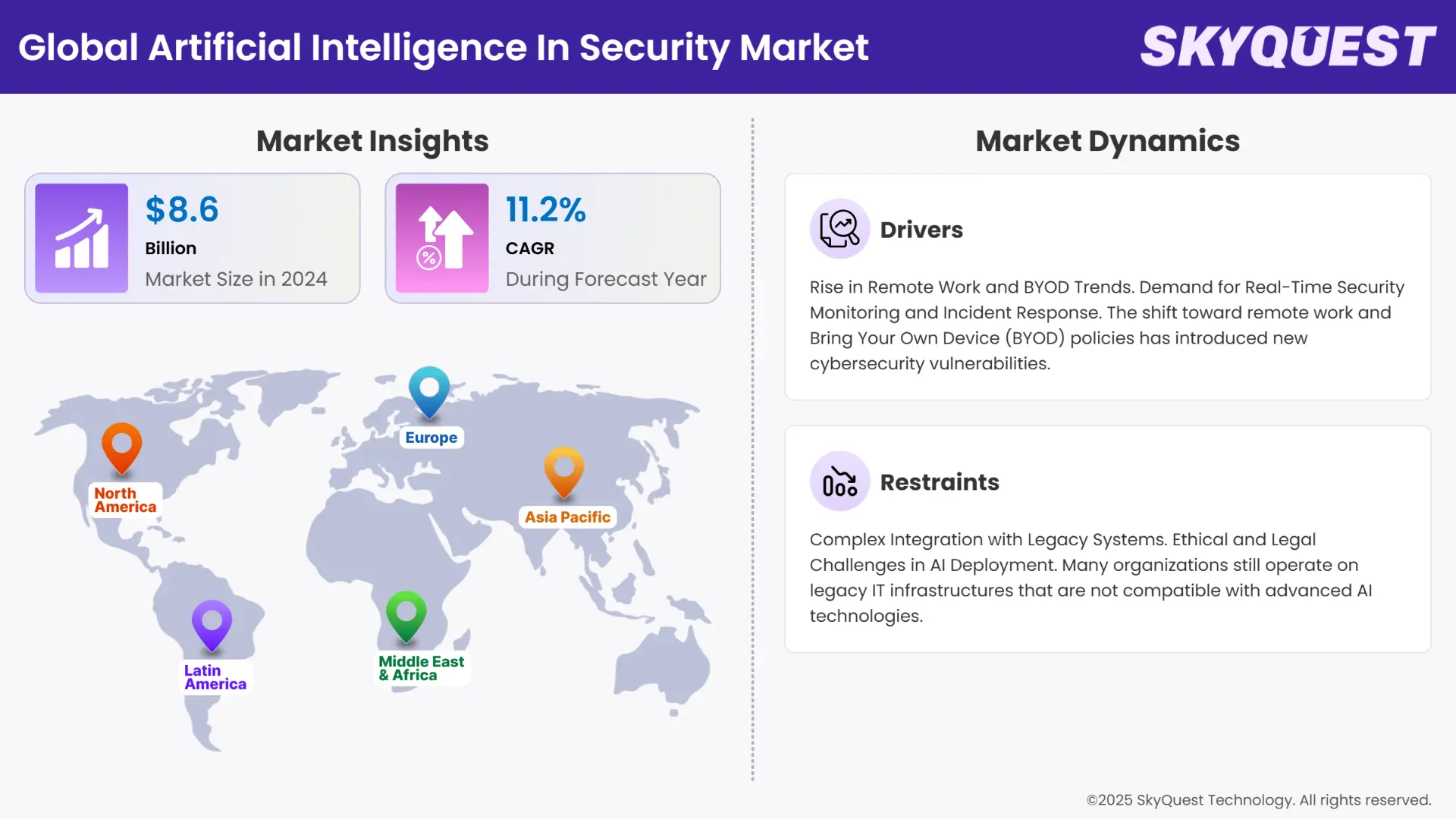
Global Artificial Intelligence In Security Market size was valued at USD 9.56 Billion in 2024 and is poised to grow from USD 10.63 Billion in 2025 to USD 24.85 Billion by 2033, growing at a CAGR of 11.2% during the forecast period (2026–2033).
The growing frequency and complexity of cyberattacks—ranging from ransomware and phishing to advanced persistent threats (APTs) and deepfake-based social engineering—have rendered traditional security solutions increasingly ineffective. These evolving threats adapt quickly, exploit unknown vulnerabilities, and bypass static security protocols. As a result, organizations are turning to AI-based security systems that can learn, adapt, and respond dynamically. Artificial Intelligence enables real-time threat detection, predictive analytics, and automated incident response, providing a significant advantage in combating modern cyber risks. This urgent need for intelligent, proactive cybersecurity is a major force propelling the global artificial intelligence in security market forward.
The rapid expansion of Internet of Things (IoT) devices, along with cloud computing and mobile technologies, has dramatically increased the number of endpoints in enterprise ecosystems. Each connected device serves as a potential entry point for cyber threats, drastically enlarging the attack surface. This complexity overwhelms traditional security systems, which cannot scale effectively to monitor dynamic and distributed environments. Consequently, businesses are adopting AI-driven security frameworks that provide continuous monitoring, anomaly detection, and autonomous threat mitigation across all endpoints. This transformation in network architecture makes AI a vital component, reinforcing its role as a key trend driving the global artificial intelligence in security sector.
Why are Organizations Adopting AI in Cybersecurity Defense?
As cybercriminals increasingly weaponize AI to launch more intelligent and automated attacks—such as adaptive malware, AI-generated phishing, and deepfake impersonations—organizations are compelled to counter these threats with equally advanced defense mechanisms. This direct arms race is pushing security vendors to embed AI into every layer of their platforms for real-time detection, behavior-based analytics, and autonomous threat response. For example, Cisco’s launch of an open-source AI-native security assistant at RSAC 2025 exemplifies how AI is shaping next-generation cybersecurity tools. As AI both drives threats and solutions, it becomes a central force accelerating market innovation and adoption.
In 2025, Palo Alto Networks launched Cortex XSIAM 3.0 and Prisma AIRS, integrating AI-powered threat detection, email protection, and autonomous security response. This development, alongside its acquisition of Protect AI, underscores the company’s commitment to AI-native security solutions in response to increasingly sophisticated, AI-driven cyber threats globally.
To get more insights on this market click here to Request a Free Sample Report
The global artificial intelligence in the security market is segmented based on component, security deployment, vertical, and region. In terms of components, the market is trifurcated into services, hardware, and software. Based on security deployment, the market is bifurcated into on-cloud and on-premises. Based on vertical, the market is grouped into government, bfsi, healthcare, manufacturing, and retail. Based on region, the market is segmented into North America, Europe, Asia-Pacific, Central & South America and the Middle East & Africa.
What makes Services the Fastest-Growing Component in Market?
Based on the global artificial intelligence in security market forecast, services component is dominating the industry and are rapidly evolving—spanning consulting, integration, training, and managed security operations. Organizations lack in-house AI cybersecurity expertise, so they rely on service providers to deploy, fine-tune, and maintain AI-based platforms, ensuring 24/7 threat monitoring and incident response. This dominance stems from the complexity of AI deployments—businesses need ongoing support, updates, and skilled operators—making Services the largest, fastest‑growing component in the sector.
The hardware component is projected to grow fastest in the global artificial intelligence in security market due to rising demand for high-performance processors like GPUs, TPUs, and edge devices. These enable real-time threat analysis and support AI workloads at scale. Increasing adoption in IoT, autonomous systems, and smart infrastructure further accelerates this growth.
How does On-Cloud Deployment Support Dynamic Business Environments?
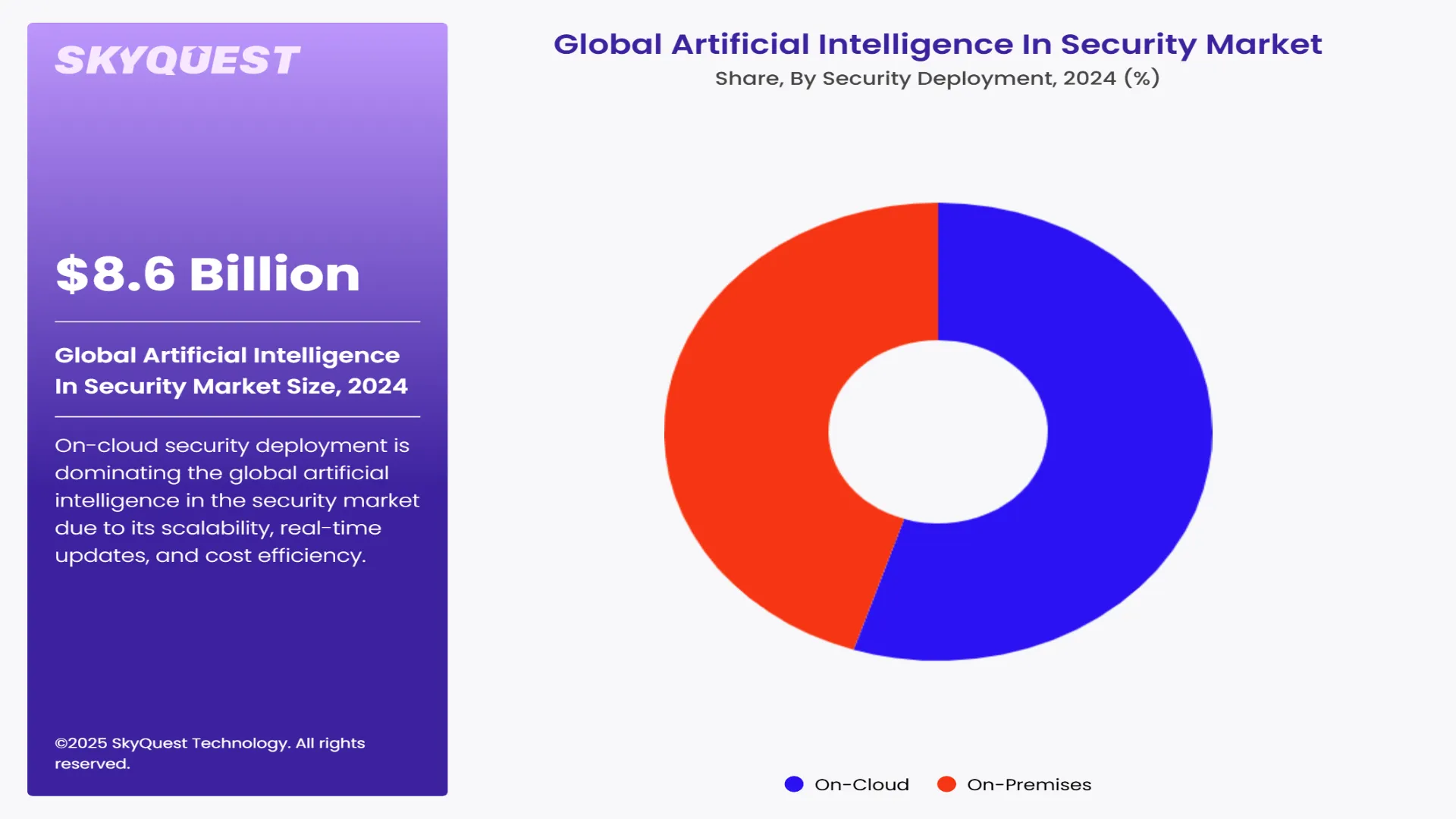
On-cloud security deployment is dominating the global artificial intelligence in the security market due to its scalability, real-time updates, and cost efficiency. Cloud-based platforms integrate AI to deliver automated threat detection, behavior analytics, and incident response across distributed networks. As organizations shift to hybrid and multi-cloud infrastructures, cloud-native AI security ensures centralized control and continuous protection. Innovations from AWS, Azure, and Google Cloud are further driving adoption by offering advanced, AI-powered security capabilities.
The on-premises security deployment segment is projected to grow fastest in the global artificial intelligence security market due to rising concerns over data privacy, regulatory compliance, and control over sensitive information. Organizations, especially in critical infrastructure and financial sectors, prefer on-premises solutions to ensure maximum security, customization, and reduced risk of external breaches.
To get detailed segments analysis, Request a Free Sample Report
How has Early Tech Adoption Influenced North America’s Market Position?
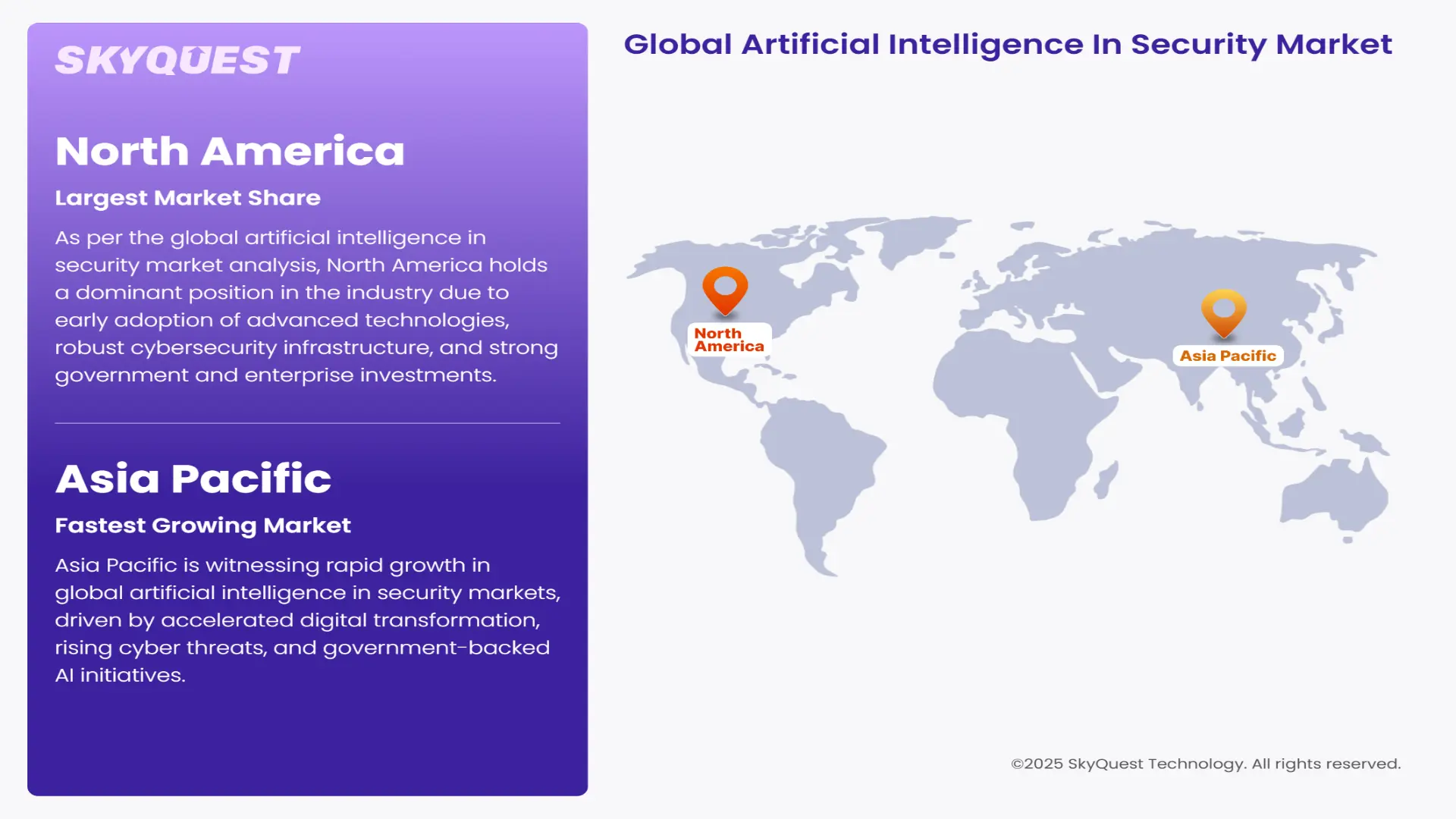
As per the global artificial intelligence in security market analysis, North America holds a dominant position in the industry due to early adoption of advanced technologies, robust cybersecurity infrastructure, and strong government and enterprise investments. The U.S. drives growth through initiatives in defense, finance, and critical infrastructure protection. Additionally, regulatory frameworks like CCPA and increased public-private partnerships foster innovation. Canada also contributes significantly, benefiting from national AI strategies and growing demand for secure digital transformation.
US Artificial Intelligence in Security Market
The United States is the primary contributor to North America’s artificial intelligence in security market, driven by advanced technology infrastructure, high cybersecurity spending, and widespread AI adoption across sectors like defense, finance, and healthcare. Government initiatives, such as NIST frameworks and federal cybersecurity mandates, promote AI integration. Major U.S. companies including Microsoft, IBM, and Palo Alto Networks lead innovation, while increased cyber threats continue to accelerate AI-based security deployments nationwide.
Canada Artificial Intelligence in Security Market
Canada is emerging as the fastest-growing contributor in North America’s artificial intelligence in security market, supported by its national AI strategy and substantial government investments in digital infrastructure. Canadian enterprises increasingly adopt artificial intelligence for cybersecurity to counter rising threats and overcome skilled labor shortages. Research hubs in Toronto and Montreal, combined with public-private collaboration, foster innovation. The country’s commitment to secure digital transformation is positioning it as a key regional player.
What are the Key Drivers of AI Security Market Expansion in Asia Pacific?
Asia Pacific is witnessing rapid growth in global artificial intelligence in security markets, driven by accelerated digital transformation, rising cyber threats, and government-backed AI initiatives. Countries like China, India, Japan, and South Korea are investing heavily in AI-driven cybersecurity to protect critical infrastructure and digital services. The region benefits from growing cloud adoption, smart city projects, and talent-rich AI ecosystems, making it a dynamic hub for innovation and deployment of intelligent security solutions.
Japan Artificial Intelligence in Security Market
Japan plays a vital role in the Asia Pacific artificial intelligence in security market, driven by strong investments in AI-powered cybersecurity across manufacturing, finance, and public safety sectors. Major initiatives, including Microsoft’s multi-billion-dollar AI data centers and Oracle’s cloud investments, highlight Japan’s commitment to enhancing AI capabilities. The country focuses on integrating AI for real-time threat detection and response, supporting its vision for secure digital transformation and industrial innovation.
South Korea Artificial Intelligence In Security Market
South Korea significantly contributes to the Asia Pacific artificial intelligence in security market with a focus on AI-enhanced threat detection, especially in finance, healthcare, and manufacturing. The government’s proactive policies and partnerships with global tech firms accelerate AI adoption. South Korea emphasizes innovation through developing AI-based cybersecurity platforms that offer automated threat analysis, supporting national cybersecurity resilience and positioning itself as a regional leader in intelligent security technologies.
How are Increasing Cyber Threats Affecting Europe’s Security Landscape?
Europe is a significant player in the global artificial intelligence in the security market, driven by strict regulatory frameworks such as GDPR and the Cyber Resilience Act. Countries like Germany, the UK, and France are investing heavily in AI to protect critical infrastructure, financial systems, and manufacturing sectors. EU-wide initiatives and funding programs support AI research and deployment, while increasing cyber threats and compliance demands are accelerating AI-driven security adoption across the region.
Germany Artificial Intelligence in Security Market
Germany is a key player in Europe’s artificial intelligence in security market, driven by its strong industrial base and emphasis on protecting critical infrastructure. The government actively supports AI integration through initiatives targeting manufacturing and energy sectors. Germany is also home to ATHENE, Europe’s largest cybersecurity research center, which fosters innovation in AI-driven defense systems. Increasing cyber threats and digital transformation across enterprises continue to drive the country’s investment in AI-powered security solutions.
France Artificial Intelligence in Security Market
France is experiencing rapid growth in the Europe artificial intelligence in security market, supported by government-led initiatives like the national AI strategy and large-scale investments in digital infrastructure. The country prioritizes AI-driven cybersecurity for public institutions, finance, and defense sectors. French companies are developing secure AI systems aligned with GDPR and the EU AI Act. Strategic partnerships with global tech leaders further enhance France’s position as a dynamic contributor to AI-based security adoption.
UK Artificial Intelligence in Security Market
The United Kingdom contributes significantly to the Europe artificial intelligence in security market through its advanced technology ecosystem and strong regulatory focus. Government-backed efforts like the AI Safety Institute and National AI Strategy promote secure, ethical AI deployment. The UK's financial and healthcare sectors increasingly adopt AI-driven security tools to counter rising cyber threats. Public-private collaboration and a growing AI talent pool position the UK as a leader in trusted AI cybersecurity solutions.
To know more about the market opportunities by region and country, click here to
Buy The Complete Report
Artificial Intelligence in Security Market Drivers
Rise in Remote Work and BYOD Trends
Demand for Real-Time Security Monitoring and Incident Response
Artificial Intelligence in Security Market Restraints
Complex Integration with Legacy Systems
Ethical and Legal Challenges in AI Deployment
Request Free Customization of this report to help us to meet your business objectives.
The global artificial intelligence in security market outlook is highly competitive and is driven by innovation, partnerships, and acquisitions. Key players include IBM, Palo Alto Networks, Cisco, Microsoft, and Fortinet. IBM focuses on AI threat intelligence integration; Palo Alto recently launched Cortex XSIAM 3.0 to automate SecOps. Cisco’s acquisition of Splunk enhances real-time analytics, while Microsoft invests in AI-native cloud security. These strategies strengthen market positioning and accelerate advanced security solution adoption.
As per the global artificial intelligence in security industry analysis, the startup landscape is rapidly expanding, driven by escalating cyber threats and the evolution of AI-powered attacks. Startups are leveraging machine learning, behavioural analytics, and automation to outpace traditional security models. Backed by strong venture capital, these companies are innovating in deepfake detection, autonomous red-teaming, and AI supply chain protection. Their agile R&D models and cloud-native solutions are reshaping how enterprises anticipate, detect, and respond to modern cyber risks.
Top Player’s Company Profiles
Recent Developments in Artificial Intelligence in Security Market
SkyQuest’s ABIRAW (Advanced Business Intelligence, Research & Analysis Wing) is our Business Information Services team that Collects, Collates, Correlates, and Analyses the Data collected by means of Primary Exploratory Research backed by robust Secondary Desk research.
As per SkyQuest analysis, the global artificial intelligence in security industry is undergoing rapid transformation, driven by rising cyber threats, evolving enterprise architectures, and the need for intelligent, automated defenses. AI’s ability to detect, analyze, and respond to threats in real time makes it indispensable across industries and regions. Innovations in AI hardware, cloud deployment, and advanced services enable scalable, efficient security systems.
Government support, increasing investments, and robust startup activity further accelerate adoption. From deepfake detection to autonomous SecOps, AI is reshaping how organizations approach cybersecurity. With major players launching AI-native platforms and startups disrupting legacy models, the global artificial intelligence in security market revenue is set for sustained growth, making AI a cornerstone of modern security strategies in an increasingly connected and vulnerable digital landscape.
| Report Metric | Details |
|---|---|
| Market size value in 2024 | USD 9.56 Billion |
| Market size value in 2033 | USD 24.85 Billion |
| Growth Rate | 11.2% |
| Base year | 2024 |
| Forecast period | 2026–2033 |
| Forecast Unit (Value) | USD Billion |
| Segments covered |
|
| Regions covered | North America (US, Canada), Europe (Germany, France, United Kingdom, Italy, Spain, Rest of Europe), Asia Pacific (China, India, Japan, Rest of Asia-Pacific), Latin America (Brazil, Rest of Latin America), Middle East & Africa (South Africa, GCC Countries, Rest of MEA) |
| Companies covered |
|
| Customization scope | Free report customization with purchase. Customization includes:-
|
To get a free trial access to our platform which is a one stop solution for all your data requirements for quicker decision making. This platform allows you to compare markets, competitors who are prominent in the market, and mega trends that are influencing the dynamics in the market. Also, get access to detailed SkyQuest exclusive matrix.
Table Of Content
Executive Summary
Market overview
Parent Market Analysis
Market overview
Market size
KEY MARKET INSIGHTS
COVID IMPACT
MARKET DYNAMICS & OUTLOOK
Market Size by Region
KEY COMPANY PROFILES
Methodology
For the Artificial Intelligence In Security Market, our research methodology involved a mixture of primary and secondary data sources. Key steps involved in the research process are listed below:
1. Information Procurement: This stage involved the procurement of Market data or related information via primary and secondary sources. The various secondary sources used included various company websites, annual reports, trade databases, and paid databases such as Hoover's, Bloomberg Business, Factiva, and Avention. Our team did 45 primary interactions Globally which included several stakeholders such as manufacturers, customers, key opinion leaders, etc. Overall, information procurement was one of the most extensive stages in our research process.
2. Information Analysis: This step involved triangulation of data through bottom-up and top-down approaches to estimate and validate the total size and future estimate of the Artificial Intelligence In Security Market.
3. Report Formulation: The final step entailed the placement of data points in appropriate Market spaces in an attempt to deduce viable conclusions.
4. Validation & Publishing: Validation is the most important step in the process. Validation & re-validation via an intricately designed process helped us finalize data points to be used for final calculations. The final Market estimates and forecasts were then aligned and sent to our panel of industry experts for validation of data. Once the validation was done the report was sent to our Quality Assurance team to ensure adherence to style guides, consistency & design.
Analyst Support
Customization Options
With the given market data, our dedicated team of analysts can offer you the following customization options are available for the Artificial Intelligence In Security Market:
Product Analysis: Product matrix, which offers a detailed comparison of the product portfolio of companies.
Regional Analysis: Further analysis of the Artificial Intelligence In Security Market for additional countries.
Competitive Analysis: Detailed analysis and profiling of additional Market players & comparative analysis of competitive products.
Go to Market Strategy: Find the high-growth channels to invest your marketing efforts and increase your customer base.
Innovation Mapping: Identify racial solutions and innovation, connected to deep ecosystems of innovators, start-ups, academics, and strategic partners.
Category Intelligence: Customized intelligence that is relevant to their supply Markets will enable them to make smarter sourcing decisions and improve their category management.
Public Company Transcript Analysis: To improve the investment performance by generating new alpha and making better-informed decisions.
Social Media Listening: To analyze the conversations and trends happening not just around your brand, but around your industry as a whole, and use those insights to make better Marketing decisions.
REQUEST FOR SAMPLE
 REQUEST FREE CUSTOMIZATION
Global Artificial Intelligence In Security Market size was valued at USD 9.56 Billion in 2024 and is poised to grow from USD 10.63 Billion in 2025 to USD 24.85 Billion by 2033, growing at a CAGR of 11.2% during the forecast period (2026–2033).
The global artificial intelligence in security market outlook is highly competitive and is driven by innovation, partnerships, and acquisitions. Key players include IBM, Palo Alto Networks, Cisco, Microsoft, and Fortinet. IBM focuses on AI threat intelligence integration; Palo Alto recently launched Cortex XSIAM 3.0 to automate SecOps. Cisco’s acquisition of Splunk enhances real-time analytics, while Microsoft invests in AI-native cloud security. These strategies strengthen market positioning and accelerate advanced security solution adoption. 'IBM (USA)', 'Cisco Systems (USA)', 'Palo Alto Networks (USA)', 'Fortinet (USA)', 'Microsoft (USA)', 'Darktrace (United Kingdom)', 'Check Point Software Technologies (Israel)', 'CrowdStrike (USA)', 'FireEye (now part of Trellix) (USA)', 'BAE Systems (United Kingdom)', 'Bitdefender (Romania)', 'NortonLifeLock (USA)', 'Trend Micro (Japan)', 'Sophos (United Kingdom)', 'CYBERDYNE Inc. (Japan)'
The shift toward remote work and Bring Your Own Device (BYOD) policies has introduced new cybersecurity vulnerabilities. AI-based security systems help organizations monitor distributed networks, detect unauthorized access, and secure endpoints in real time, making them essential tools in managing decentralized work environments and safeguarding sensitive business data.
Rise of Autonomous Security Operations: The adoption of AI-powered autonomous security operations is accelerating as organizations seek real-time threat detection and faster incident response. These systems minimize manual intervention by automating analytics, investigation, and remediation processes. This global artificial intelligence in security market trend improves efficiency, reduces operational costs, and enables organizations to keep pace with increasingly sophisticated cyber threats.
How has Early Tech Adoption Influenced North America’s Market Position?


Want to customize this report? This report can be personalized according to your needs. Our analysts and industry experts will work directly with you to understand your requirements and provide you with customized data in a short amount of time. We offer $1000 worth of FREE customization at the time of purchase.
Feedback From Our Clients


 USA (+1) 351-333-4748

