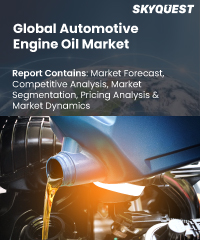
Automotive Engine Oil Market
Report ID: SQMIG10G2049
Report ID: SQMIG10G2049
[email protected]
USA +1 351-333-4748
Report ID:
SQMIG10G2049 |
Region:
Global |
Published Date: August, 2025
Pages:
178
|Tables:
123
|Figures:
70


Global Automotive Engine Oil Market size was valued at USD 44.51 Billion in 2024 and is poised to grow from USD 46.29 Billion in 2025 to USD 63.35 Billion by 2033, growing at a CAGR of 4% during the forecast period 4%.
The primary factors driving the global automotive engine oil market growth are the increase in automobile production and the falling prices and rising demand for both synthetic and conventional engine oils. Urbanization greater disposable income, and technological advancements in engine design have also all been an influence on growth. Another driver for the demand of high-performance engine oil is the shift towards direct-injection, turbocharged engines along with stricter standards for emissions. The additional mechanical and thermal stress put onto these modern powertrains means synthetic, low viscosity formulations, which protect turbo components, maintain film strength and reduce emissions, are critical.
Additionally, market expansion is driven by the expansion of the automotive aftermarket and the rising number of vehicles in developing regions, particularly Asia Pacific. Along with the automotive industry's robust growth from manufacturing and selling many motorcycles and other vehicles globally, the growing middle class's standard of living, rising disposable income, and increased demand for higher-quality lubricants have all contributed to the automotive engine oil market penetration.
What Role Does Technology Play in Meeting Emission and Efficiency Standards?
Organizations are deploying AI-enabled programming for the optimization of formulations development, performance monitoring, and predictive maintenance, particularly in the automotive engine oil sector. AI-enabled sensors in connected vehicles are still assessing engine load, road conditions, and oil degradation, allowing, and enabling, personalized oil-change intervals and for use of optimum efficiency. For instance, Shell claimed in March 2025 that it was embedding predictive analytics into its AI-enabled Lubricant Solutions platform to reduce unscheduled maintenance and increase oil life in healthcare fleet vehicles. This is an excellent example of using technology to assist in the management of engine oil while working to meet increasingly strict emissions standards and reducing costs for commercial operators.
Market snapshot - 4%
Global Market Size
USD 42.8 Billion
Largest Segment
Passenger Cars
Fastest Growth
Motorcycles
Growth Rate
4% CAGR
To get more insights on this market click here to Request a Free Sample Report
The global automotive engine oil market is segmented into product, application, engine type, grade, and region. By product, the market is classified into OW-20, OW-30, OW-40, 5W-20, 5W-30, 5W-40, 10W-60, 10W-40, and 15W-40. Depending on the application, it is divided into passenger cars, commercial vehicles, and motorcycles. According to engine type, the market is categorized into diesel, gasoline, and alternative fuel. As per grade, it is segregated into mineral, synthetic, and semi-synthetic. Regionally, it is analyzed across North America, Europe, Asia-Pacific, Latin America, and the Middle East and Africa.
Why is 10W-60 Oil Preferred for High-Performance Engines?
As per the 2024 automotive engine oil market analysis, the 10W-60 segment dominated the market and had the largest revenue share, 15.1%. The 10W-60 motor oil is made to provide the best engine protection and performance in hot, demanding environments. Furthermore, 10W-60 oil is completely synthetic and possesses remarkable durability and viscosity. It is ideal for high-performance automobiles, motorcycles, and heavy-duty applications. Moreover, the increasing use of passenger and commercial vehicles, particularly in emerging economies, is driving the demand for specialized engine oils like 10W-60.
The 0W-20 category will expand at a compound annual growth rate (CAGR) of 5.4% during the forecast period. The 0W-20 oil type's expansion in the automotive engine oil market is being driven by several significant factors. The 0W-20 oils offer better fuel economy and lower carbon dioxide emissions due to their lower viscosity, which reduces friction compared to higher viscosity grades. The popularity of hybrid vehicles has further increased demand for 0W-20 oils, as most automakers use them in their latest hybrid internal combustion engine (ICE) vehicles. Therefore, fuel efficiency, hybrid adoption, and government regulations all promote growth.
What Makes Passenger Cars the Leading Segment in Engine Oil Consumption?
As per the 2024 automotive engine oil market forecast, the passenger cars category held the largest revenue share (51.3%) and dominated the market. Over the past few years, the demand for passenger cars has been gradually increasing due to shifts in consumer preferences for this market segment globally. The segment is expected to grow because of rising urbanization and human incomes. In addition, leisure and tour activities have led to a rise in the demand for automobiles. The demand for automotive engine oils is also influenced by rising sales of cars and passenger vehicles as well as the upkeep and improvement of their operating environments.
Over the course of the forecast period, the motorcycles segment is anticipated to have the highest automotive engine oil market share. Better engine oil is essential in the modern motorcycle industry. In addition to protecting the engine, motorcycle engine oil also protects other crucial parts like the clutch, gearbox, and coupling. All these components function in the same lubricating environment. The motorcycle engine oil market has also benefited from urbanization, growing consumer desires for car ownership, and a rise in the need for goods carriers from small and medium-sized enterprises for a range of personal or commercial applications.
To get detailed segments analysis, Request a Free Sample Report
How are Emission Regulations Driving Engine Oil Demand in Asia-Pacific?
As per the automotive engine oil market regional analysis, Asia-Pacific dominated the market in 2024 due to the region's enormous commercial fleets and quickly rising car ownership. The demand for synthetic and semi-synthetic oils increased after the Indian Ministry of Road Transport revealed in April 2025 that over 23 million passenger cars were sold annually. The region became the world's largest consumer of premium oil due to the tightening of BS-VI and the adoption of hybrids in China, Japan, and India.
Automotive Engine Oil Market in China
China dominated the Asia-Pacific automotive engine oil industry in 2024 due to its large automobile fleet and more stringent pollution regulations. In January 2025, Sinopec ramped up the production of high-performance lubricants to match the demand of hybrid and turbocharged vehicles. Consumers and automakers are utilizing synthetic lubricants for additional efficiency and less emissions to maintain their sector's share in the regional market based on China's 2060 carbon neutrality goals.
Automotive Engine Oil Market in India
The Indian automotive engine oil market witnessed strong growth in 2024 driven by rising car ownership alongside the expanding middle class. The IOC launched Servo Future XT-a totally new synthetic lubricant product range with BS-VI compliant lubricants in February 2025, which demonstrates the increasing stringency of standards. India's independence in the supply of synthetic lubricants and demand from rising passenger car sales has reinforced its credentials as the one of the fastest growing automotive engine oil markets in Asia-Pacific.
Why is North America a Key Market for Premium Automotive Engine Oils?
North America is expected to dominate the market due to high consumer demand for synthetic oils, high income levels of consumers, and cutting-edge automobile technology, which is witnessed as instrumental driving forces of the market. An artificial intelligence-based oil monitoring system was introduced in the United States by ExxonMobil in March 2025, which boosts the performance of turbocharged engines while prolonging oil life. With hybrid and electric-hybrid vehicle alternatives gained traction among retail consumers, oil companies have newfound methods for promoting/advocating for this advancing automotive technology. Thus, North America is experiencing significant growth.
Automotive Engine Oil Market in the U.S.
The United States is the leader of the North American automotive engine oil market in 2024 due to its high vehicle ownership rate and steep demand for premium oils. The ebb and flow of its move away from fossil fuels, the United States witnessed a launch from Valvoline of a synthetic oil line specifically for electric hybrid cars in June 2025. The United States still boasts a world leading exploration of premium oil and indicates new thinking related to this due to of rising EV penetration and turbocharged car sales.
Automotive Engine Oil Market in Canada
Canada made a substantial contribution to the North American automotive engine oil market in 2024 due to the country's harsh winters, long-distance driving requirements, and need for long-lasting lubricants. In January 2025, Petro-Canada Lubricants unveiled their newest generation of Duron lubricants. These oils are specifically designed for use by commercial fleets, and they meet stringent efficiency standards. High-performance lubricants are always in demand, especially the cold climate/high performance heavy-duty lubricants because of the growing number of trucks and commercial vehicles on Canada's roads.
Why Does Europe Prioritize Low-Emission and High-Performance Engine Oils?
Europe held a significant market share in 2024 due to EU emission regulations and the strong demand for low-viscosity synthetic oils. To directly support the EU Green Deal, TotalEnergies announced a carbon-neutral engine oil line across Europe in May 2025. As hybrid vehicle sales have risen, plus strong German automotive production and decarbonization policies by government, premium and sustainable oil options are quickly becoming more popular with consumers and manufacturers in Europe.
Automotive Engine Oil Market in UK
The UK automotive engine oil market in 2024 will be bolstered by a high demand for high-end car lubricants and an increasingly popular hybrid vehicle market. In February 2025, Castrol and Jaguar Land Rover announced a collaboration to develop state-of-the-art hybrid engine lubricants that deliver sustainable solutions for their consumers to improve efficiency. As such, the UK is positioned as an important market for high performance oils innovation owing to the government pollution targets, the increasing popularity of EVs and hybrids and the sales of luxury cars.
Automotive Engine Oil Market in France
In 2024, France showed a consistent demand for low-emission vehicles and hybrids, aided by government subsidies. Motul's Hybrid Engine Oil Series for plug-in hybrids was introduced in March 2025 and aims for the strict emission requirements of France. France is committed to reducing vehicle carbon footprints and to increasing the use of sustainable lubricants, which explains why they are a good early adopter of new engine oil technologies, and ensures there will be future market development.
Automotive Engine Oil Market in Germany
In 2024, Germany dominated the European automobile engine oil market due to its robust automotive industry. Liqui Moly increased its production capacity in April 2025 to satisfy the demand for oils that work with high-performance and turbocharged vehicles. Germany is the biggest consumer of synthetic oils in Europe and a major force behind regional growth because of its robust base of luxury automobiles, stringent EU emission regulations, and innovative thinking.
To know more about the market opportunities by region and country, click here to
Buy The Complete Report
Automotive Engine Oil Market Drivers
Hybrids, Turbocharging, and Lower Emissions
Fleet Total Cost of Ownership & Extended Drains
Automotive Engine Oil Market Restraints
Oil and Additive Supply's Volatile Base
Drain-Interval Compression and Electrification
Request Free Customization of this report to help us to meet your business objectives.
Among the leading companies in the automotive engine oil market are Shell, CASTROL LIMITED, Petroliam Nasional Berhad, Repsol, Exxon Mobil Corporation, and BP PLC. They are focusing on growth and acquiring a competitive edge in the industry. Valvoline manufactures and distributes lubricants, grease, and automotive chemicals for passenger car motor oil and automotive services. It has an established network of service centres comprising of both franchised and company owned locations. Motul is a reputable French company with a history of having a long history in producing high performance lubricants and lubricating oils for vehicle engines. Nutol specifically, has been emphasizing production of mineral and completely synthetic oils with the objective to enhance the performance and life of your engine.
Top Player’s Company Profile
Recent Developments in Automotive Engine Oil Market
SkyQuest’s ABIRAW (Advanced Business Intelligence, Research & Analysis Wing) is our Business Information Services team that Collects, Collates, Correlates, and Analyses the Data collected by means of Primary Exploratory Research backed by robust Secondary Desk research.
As per SkyQuest analysis, the condition of the automotive engine oil market outlook favors premium synthetics, lower viscosities, and OEM approval formulas, primarily due to emissions challenges, the presence of turbo/hybrid powertrains, and fleets need for uptime. New drain intervals, AI-enabled monitoring, and channel innovation (OEM service fill, e-commerce) are driving value per litre even as BEVs limit any long-term volume growth. The main sources of short-term worries are base oil/additive volatility and more stringent sustainability standards that impose costs and complexity. Effective sustainability roadmaps (RRBO, packaging), quick compliance to specs, robust relationships with OEMs, and digital service programs for fleets and workshops will all be leveraged by the winners. While securing share in growth regions and sized locally blended/stocked viscosity portfolios will protect margin and profits.
| Report Metric | Details |
|---|---|
| Market size value in 2024 | USD 44.51 Billion |
| Market size value in 2033 | USD 63.35 Billion |
| Growth Rate | 4% |
| Base year | 2024 |
| Forecast period | 4% |
| Forecast Unit (Value) | USD Billion |
| Segments covered |
|
| Regions covered | North America (US, Canada), Europe (Germany, France, United Kingdom, Italy, Spain, Rest of Europe), Asia Pacific (China, India, Japan, Rest of Asia-Pacific), Latin America (Brazil, Rest of Latin America), Middle East & Africa (South Africa, GCC Countries, Rest of MEA) |
| Companies covered |
|
| Customization scope | Free report customization with purchase. Customization includes:-
|
To get a free trial access to our platform which is a one stop solution for all your data requirements for quicker decision making. This platform allows you to compare markets, competitors who are prominent in the market, and mega trends that are influencing the dynamics in the market. Also, get access to detailed SkyQuest exclusive matrix.
Table Of Content
Executive Summary
Market overview
Parent Market Analysis
Market overview
Market size
KEY MARKET INSIGHTS
COVID IMPACT
MARKET DYNAMICS & OUTLOOK
Market Size by Region
KEY COMPANY PROFILES
Methodology
For the Automotive Engine Oil Market, our research methodology involved a mixture of primary and secondary data sources. Key steps involved in the research process are listed below:
1. Information Procurement: This stage involved the procurement of Market data or related information via primary and secondary sources. The various secondary sources used included various company websites, annual reports, trade databases, and paid databases such as Hoover's, Bloomberg Business, Factiva, and Avention. Our team did 45 primary interactions Globally which included several stakeholders such as manufacturers, customers, key opinion leaders, etc. Overall, information procurement was one of the most extensive stages in our research process.
2. Information Analysis: This step involved triangulation of data through bottom-up and top-down approaches to estimate and validate the total size and future estimate of the Automotive Engine Oil Market.
3. Report Formulation: The final step entailed the placement of data points in appropriate Market spaces in an attempt to deduce viable conclusions.
4. Validation & Publishing: Validation is the most important step in the process. Validation & re-validation via an intricately designed process helped us finalize data points to be used for final calculations. The final Market estimates and forecasts were then aligned and sent to our panel of industry experts for validation of data. Once the validation was done the report was sent to our Quality Assurance team to ensure adherence to style guides, consistency & design.
Analyst Support
Customization Options
With the given market data, our dedicated team of analysts can offer you the following customization options are available for the Automotive Engine Oil Market:
Product Analysis: Product matrix, which offers a detailed comparison of the product portfolio of companies.
Regional Analysis: Further analysis of the Automotive Engine Oil Market for additional countries.
Competitive Analysis: Detailed analysis and profiling of additional Market players & comparative analysis of competitive products.
Go to Market Strategy: Find the high-growth channels to invest your marketing efforts and increase your customer base.
Innovation Mapping: Identify racial solutions and innovation, connected to deep ecosystems of innovators, start-ups, academics, and strategic partners.
Category Intelligence: Customized intelligence that is relevant to their supply Markets will enable them to make smarter sourcing decisions and improve their category management.
Public Company Transcript Analysis: To improve the investment performance by generating new alpha and making better-informed decisions.
Social Media Listening: To analyze the conversations and trends happening not just around your brand, but around your industry as a whole, and use those insights to make better Marketing decisions.
REQUEST FOR SAMPLE
 REQUEST FREE CUSTOMIZATION


Want to customize this report? This report can be personalized according to your needs. Our analysts and industry experts will work directly with you to understand your requirements and provide you with customized data in a short amount of time. We offer $1000 worth of FREE customization at the time of purchase.
Feedback From Our Clients


 USA (+1) 351-333-4748

