Global Biochar Market
Biochar Market

Report ID: SQMIG15E2809

sales@skyquestt.com
USA +1 351-333-4748

Biochar Market Size, Share, and Growth Analysis

Global Biochar Market

Biochar Market By Product (Coarse & Fine Chips, Fine Powder, Pellets, Granules & Prills, Liquid Suspension), By Application (Agriculture, Animal Farming, Industrial Uses), By Technology, By Region -Industry Forecast 2026-2033


Report ID: SQMIG15E2809 | Region: Global | Published Date: August, 2025
Pages: 192 |Tables: 91 |Figures: 69

Format - word format excel data power point presentation

Biochar Market Insights

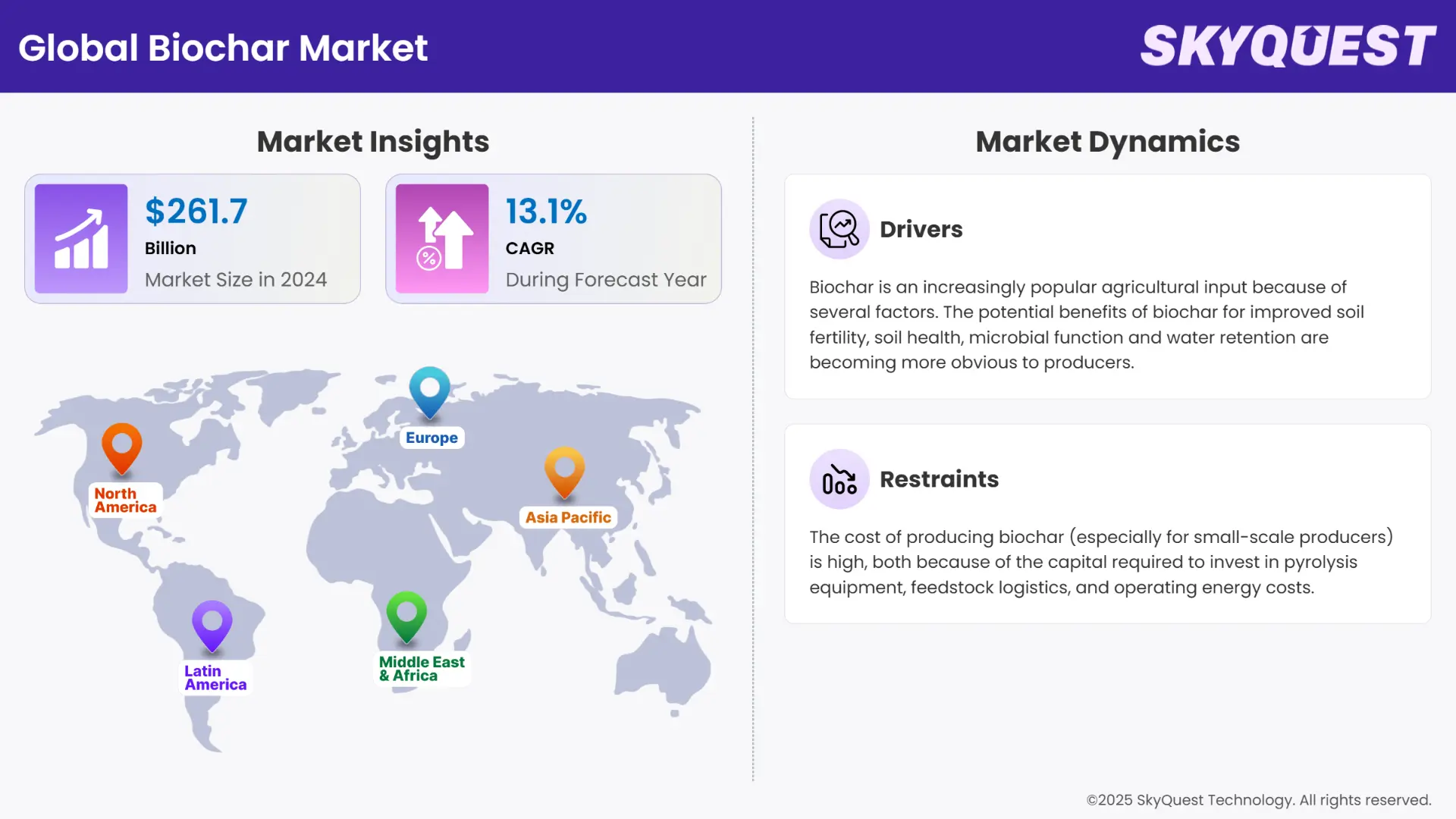
Global Biochar Market size was valued at USD 261.7 Million in 2024 and is poised to grow from USD 295.98 Million in 2025 to USD 792.44 Million by 2033, growing at a CAGR of 13.1% in the forecast period (2026–2033).

Key Takeaways : Market Trends & Insights

  • North America dominated the biochar market with a largest market share in 2025.
  • The U.S. biochar market is expected to grow significantly over the forecast period.
  • By application, the agriculture segment held the largest biochar market share in 2024.
  • The industrial uses segment held the highest growing market over the forecast period.
  • North America: Largest Market in 2025
  • Asia-Pacific: Fastest Growing Market
  • 2025 Market Size: USD 295.98 Million
  • 2026 Projected Market Size: USD 334.76 Million
  • 2033 Projected Market Size: USD 792.44 Million
  • CAGR (2026-2033): 13.1%

The expansion of the global biochar market growth is driven by several positive government policies, increasing awareness about climate change and soil degradation, and the rising adoption of biochar as a soil improving product and carbon sequestration method across agriculture.

With the intensity of biochar use in agriculture, the alarming rate of global soil degradation and climate change, the global biochar industry is predicted to grow steadily. In addition, the market is likely to grow as a result of positive government regulations and increasing awareness of climate change and soil degradation. Many other farming systems, including mixed farming, zero tillage farming, and biodynamic farming, also use biochar.

The global biochar market share continues to expand, primarily through government action and funding for biochar R&D, as well as partnerships and alliances between biochar manufacturers and research institutions to enhance demand for biochar in the U.S. Under a first order schedule beginning in June 2024, Biochar Now, LLC ordered USD 600,000 in kilns and connected equipment from SEM, the product and manufacturing division of Strategic Environmental & Energy Resources, Inc. (SEER), for delivery to Biochar Now's operation in Colorado. SEER and BCN also intended to form a joint venture biochar production unit in Texas.

How is Artificial Intelligence Optimizing Biochar Production?

Artificial intelligence (AI) is revolutionizing the global biochar market outlook by improving feedstock selection, facility operability, and predicting yield and carbon content. AI-enabled systems that can check the temperature, moisture, and pyrolysis variables in real time can also minimize emissions and increase productivity. In 2024, Carbo Culture, a Finnish biochar company, implemented machine learning into their reactors, improving the efficiency of carbon removal from biomass. By 2025, producers in North America and Europe are using these or other AI-based monitoring systems to comply with emerging sustainability requirements. AI can also help to track soil improvements following biochar application to ensure positive agricultural outcomes, making biochar more attractive than in markets grounded in regenerative agriculture and carbon sequestration.
Biochar Market Insights

To get more insights on this market click here to Request a Free Sample Report

Biochar Market Segments Analysis

The global biochar market is segmented into product, application, technology, and region. By product, the market is classified into coarse & fine chips, fine powder, pellets, granules & prills, and liquid suspension. Depending on the application, it is divided into agriculture, animal farming, and industrial uses. According to technology, the market is bifurcated into pyrolysis and gasification. Regionally, it is analyzed across North America, Europe, Asia-Pacific, Latin America, and the Middle East and Africa.

How is Biochar Transforming Agricultural Practices Globally?

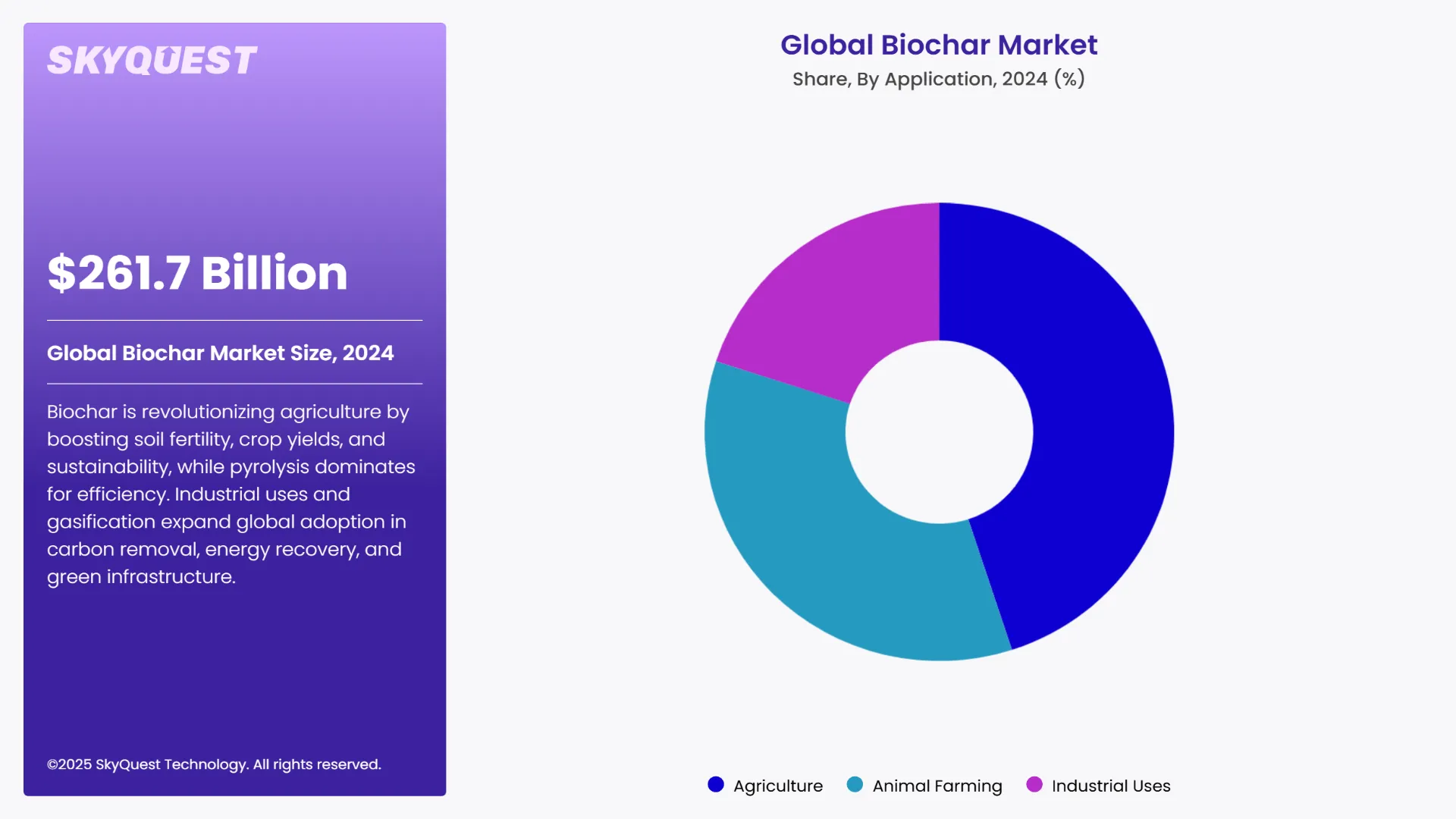
As per the 2024 biochar market analysis, the agriculture industry shared the lead in the market with its potential to enhance soil fertility, increase crop production and improve water retention. Biochar is gaining traction as an environmentally sustainably soil amendment tool with farmers in the U.S., Brazil and India and other countries. In 2025, India’s Ministry of Agriculture is proving to be at the forefront of dryland farming combined with biochar and regenerative agriculture programs and pilot projects.

The industrial uses segment is expected to have the highest compound annual growth rate due to the rising need for carbon removal and construction applications. The U.S. start-ups like Charm Industrial scaled young biochar-based carbon sequestration technologies, increasing the market attractiveness of green infrastructure projects, and several EU countries began studies to explore the viability of biochar in combination with cement and asphalt.

Why are Companies Favoring Pyrolysis Over Other Biochar Technologies?

As per the 2024 biochar market forecast, the pyrolysis segment is prevalent with its large charcoal yield, scalability, and energy efficiency. In Canada and Germany, many producers selected slow pyrolysis systems for agricultural applications and the development of carbon credits. For instance, in 2025, Carbon future, Germany, improved the consistency of production and quality of biochar from various plants by using AI-integrated sensors in its slow pyrolysis operation.

The gasification category is expected to take off soon due to its ability to produce syngas and biochar. Southeast Asian countries such as Thailand and Indonesia funded gasification facilities to achieve energy recovery and soil remediation objectives. For many of these manufacturers, gasifiers are becoming increasingly attractive for both industrial and rural settings because of their versatility and comparatively lower emissions.
Global Biochar Market By Technology 2026-2033
Biochar Market Segmental Analysis

To get detailed segments analysis, Request a Free Sample Report

Biochar Market Regional Insights

Why is North America's Agricultural Sector Embracing Biochar at Scale?

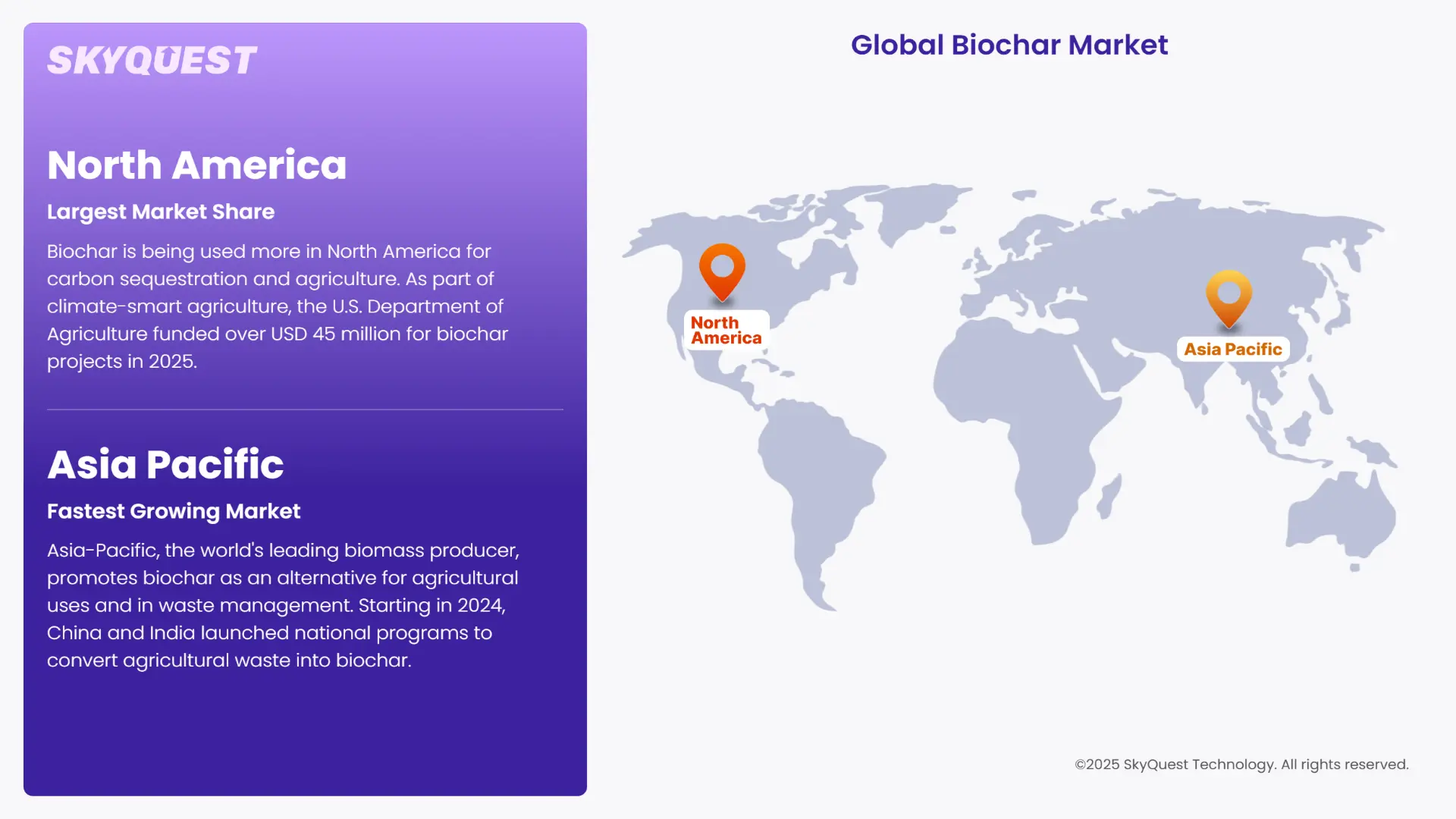
As per the biochar market regional analysis, biochar is being used more in North America for carbon sequestration and agriculture. As part of climate-smart agriculture, the U.S. Department of Agriculture funded over USD 45 million for biochar projects in 2025. Canada's Clean Tech program also improved waste valorization and soil health by supporting CHAR Technologies and other pyrolysis companies. Regional sustainability programs and carbon credit trading are still driving demand for biochar-based solutions.

Biochar Market in the U.S.

In 2024, the use of biochar in the United States increased as a direct result of increased funding for regenerative agriculture and carbon offset programs. Pilot projects, funded by USDA's Climate-Smart Commodities program, added biochar to the soils to drive crop productivity and sequester carbon. To meet farmer and municipal demand to meet environmental regulations, many companies (such as Pacific Biochar) reported expanding their biochar production facilities.

Biochar Market in Canada

The biochar market in Canada is growing because of government subsidies for carbon removal techniques. Funding for the expansion of CHAR Technologies' high-temperature pyrolysis factory in Ontario was obtained in 2025. The use of biochar in soil restoration and forestry waste management is growing. To improve soil retention and lower carbon emissions, provinces like British Columbia are encouraging the use of biochar in regions that are vulnerable to wildfires.

Is Asia-Pacific the Next Frontier for Biochar Manufacturing and Export?

Asia-Pacific, the world's leading biomass producer, promotes biochar as an alternative for agricultural uses and in waste management. Starting in 2024, China and India launched national programs to convert agricultural waste into biochar. Local chapters of government, support for pyrolysis projects, and circular economy models are increasingly available. Growing demand for carbon capture and soil remediation practices are also driving investment and forming technology alliances with biochar companies.

Biochar Market in China

China's extensive agricultural sector and surplus crop residue are the main drivers of the country's biochar market. The Ministry of Ecology and Environment launched a program in 2025 to use biochar to restore rural soil. To address the problems of pollution and productivity, major provinces such as Henan and Shandong have implemented mobile pyrolysis units to transform waste biomass into soil enhancers.

Biochar Market in India

India is scaling up biochar production as part of the National Mission on Sustainable Agriculture. In 2024, the Indian Council of Agricultural Research began promoting the use of biochar to marginal farmers, mainly to combat soil degradation. Northern states like Punjab and Haryana have launched initiatives to use biochar made from paddy straw, in order to provide a solution for stubble burning which improves agricultural yields, as well as air quality.

How are EU Regulations Fueling Sustainable Biochar Adoption?

Biochar has been gaining traction as a product used for regenerative farming and carbon removal in Europe. In 2025, biochar was officially included in the certification framework for carbon reduction in the European Union. Market demand is also starting to grow due to the EU's strict carbon targets and the European Common Agricultural Policy (CAP) subsidies. Companies like Carbon Gold (UK), and Carbofex (Finland) have expanded into the agriculture and construction sectors in response to the rising demand resulting from carbon policy.

Biochar Market in UK

The UK is encouraging the use of biochar through green finance and sustainability regulations. In 2024, Defra and the UK Biochar Research Centre collaborated to test biochar on pasturelands to increase soil carbon. Demand from farmers and environmental NGOs has increased as a result of the nation's net-zero commitments and emphasis on nature-based solutions.

Biochar Market in France

France's focus on the circular bioeconomy and agroecology policy are driving the country's biochar market. In 2025, grants for dispersed pyrolysis units were first given out by the French Environment and Energy Management Agency (ADEME). As it can enhance soil quality with fewer chemicals, biochar has become increasingly popular among Bordeaux and Champagne vineyards.

Biochar Market in Germany

Germany is currently one of the primary centers for the development of biochar. The Federal Ministry for Economic Affairs provided funding for several studies in 2024 on the use of industrial biochar in filtration and concrete. Compost enhanced with biochar was used by agricultural cooperatives in Bavaria and Baden-Württemberg to improve soil health and satisfy EU green standards.
Global Biochar Market By Geography, 2026-2033
Biochar Market Regional Analysis

To know more about the market opportunities by region and country, click here to
Buy The Complete Report

Biochar Market Dynamics

Biochar Market Drivers

Increasing Interest in Carbon Sequestration and Soil Amendment

  • Biochar is an increasingly popular agricultural input because of several factors. The potential benefits of biochar for improved soil fertility, soil health, microbial function and water retention are becoming more obvious to producers. Additionally, its inherently stable carbon structure enables climate change mitigation through long-term carbon sequestration. The global biochar market penetration is being driven by soil health and carbon credit schemes as governments and farmers adopt biochar to drive toward sustainability goals, as well as looking to optimize agricultural production.

Carbon Markets and the Policy Instruments that Enable Them

  • The growing interest in using biochar for soil health and carbon sequestration stems from increased government subsidized carbon offset programs and incentives for sustainable farm management practices. Policy push is promoting use in forestry and agriculture in countries like the US, Canada, and EU. The economic value of biochar is more attractive when it is included in the carbon credit schemes which incentivizes producers and land managers to create investment and carbon sequestration opportunities through widespread use of biochar.

Biochar Market Restraints

Excessive Production and Processing Costs

  • The cost of producing biochar (especially for small-scale producers) is high, both because of the capital required to invest in pyrolysis equipment, feedstock logistics, and operating energy costs. Costs can also be increased if improved production methods provide superior biochar. These costs and the uncertainty surrounding the return on investment severely inhibit adoption of biochar, especially in developing countries that have limited access to the required resources and technology.

Limited Knowledge and Product Disparity

  • Many farmers and land managers lack knowledge of the appropriate use of biochar or do not have any information about its benefits. Unpredictable performance is often caused by a lack of reliable quality standards resulting from the variability in feedstocks and pyrolysis conditions. These challenges create hurdles to widespread adoption especially in regulated ingredients and the commercial agriculture sector.


Request Free Customization of this report to help us to meet your business objectives.

Biochar Market Competitive Landscape

Companies in the somewhat fragmented biochar market are focusing their attention on increasing production, expanding their uses, and accessing carbon credit markets. Companies like Wakefield Biochar and Carbon Gold are expanding by leveraging smart partnerships with the forest and agricultural sectors. Obtaining carbon sequestration certifications, developing in-house pyrolysis technology, partnering with carbon credit registries, are all important strategies for gaining market credibility and for developing new revenue from climate finance.

  • Charm Industrial was established in the United States in 2018. Charm Industrial innovatively removes carbon from air by converting biomass into bio-oil, which is deposited and stored indefinitely in underground wells. The company also produces biochar as a byproduct for environmental remediation and agricultural uses. Supported by commercial validation from high-profile customers like Stripe and Microsoft, Charm is scalable, and is now a leader in engineered carbon removal that merges technology with biochar's regenerative elements.
  • Carbo Culture was founded in 2017 in the USA and Finland. Using a patented pyrolysis process, Carbo Culture turns wood and agricultural waste into stable carbon to create high-purity biochar. Its biochar is intended to sequester carbon, prevent erosion, and enhance soil. The company positions itself as a scalable, eco-friendly solution to the climate crisis by collaborating with carbon credit exchanges such as Puro.earth and aiming to establish decentralized production facilities worldwide.

Top Player’s Company Profile

  • Wakefield Biochar
  • Google
  • CapChar
  • Agri-Tech Producers, LLC
  • The Biochar Company (US Biocarbon)
  • Biochar Now, LLC
  • Ofi
  • Cool Planet Energy Systems
  • CharGrow USA
  • ArSta Eco Pvt. Ltd.
  • Airex Energy Inc.
  • Genesis Industries
  • Swiss Biochar GmbH

Recent Developments in Biochar Market

  • In January 2025, Google and Varaha, an Indian startup, reached an agreement to purchase 100,000 tons of carbon credits made from biochar by 2030. This largest biochar transaction in history aligns with Google's net-zero goals and promotes scalable carbon removal. Varaha's innovative biochar production encourages climate action and sustainable practices.
  • In January 2025, CapChar, which is based in the United Kingdom, has opened itself up to a consultation process to create a Biochar Carbon Code to provide guidance and further standardize the removal of carbon to and from biochar. This code is designed to deepen the soil regeneration journey and carbon adsorption process with an integrated end-to-end solution encompassing dMRV software and tachnology, and pyrolysis technology. It was developed for UK agriculture specifically, with a focus on achieving compatibility with various feedstocks and towards robust standards.
  • In December 2024, Ofi, in partnership with LOTTE, Fuji Oil, and MC Agri Alliance, announced its first cocoa biochar project in Dankwa County, Ghana. The project improves soil health and reduces carbon emissions by converting cocoa pod husks into biochar. It aligns with Ofi's Cocoa Compass sustainability goals and the 2050 Net Zero target.

Biochar Key Market Trends

Biochar Market SkyQuest Analysis

SkyQuest’s ABIRAW (Advanced Business Intelligence, Research & Analysis Wing) is our Business Information Services team that Collects, Collates, Correlates, and Analyses the Data collected by means of Primary Exploratory Research backed by robust Secondary Desk research.

As per SkyQuest analysis, the global biochar market is emerging as an essential tool for renewable agriculture, climate change reduction, and the circular economy. As the demand for carbon storage, healthy soil, and effective waste management increases, biochar is expanding beyond agriculture into the environmental and industrial sector. Although challenges related to costs of production and a lack of standardization currently exist, some regulatory support and shifting carbon credit markets (which are entering the commercialization phase) are driving commercialization. Startups and established companies are collaborating on climate finance projects and scaling existing pyrolysis technology to take advantage of these new opportunities. With an increased focus on carbon negative solutions globally, biochar is rapidly emerging as a key contributor to sustainable agriculture and long-term carbon reductions.

Report Metric Details
Market size value in 2024 USD 261.7 Million
Market size value in 2033 USD 792.44 Million
Growth Rate 13.1%
Base year 2024
Forecast period 2026-2033
Forecast Unit (Value) USD Million
Segments covered
  • Product
    • Coarse & Fine Chips, Fine Powder, Pellets, Granules & Prills, Liquid Suspension
  • Application
    • Agriculture, Animal Farming, Industrial Uses
  • Technology
    • Pyrolysis, Gasification
Regions covered North America (US, Canada), Europe (Germany, France, United Kingdom, Italy, Spain, Rest of Europe), Asia Pacific (China, India, Japan, Rest of Asia-Pacific), Latin America (Brazil, Rest of Latin America), Middle East & Africa (South Africa, GCC Countries, Rest of MEA)
Companies covered
  • Wakefield Biochar
  • Google
  • CapChar
  • Agri-Tech Producers, LLC
  • The Biochar Company (US Biocarbon)
  • Biochar Now, LLC
  • Ofi
  • Cool Planet Energy Systems
  • CharGrow USA
  • ArSta Eco Pvt. Ltd.
  • Airex Energy Inc.
  • Genesis Industries
  • Swiss Biochar GmbH
Customization scope

Free report customization with purchase. Customization includes:-

  • Segments by type, application, etc
  • Company profile
  • Market dynamics & outlook
  • Region

To get a free trial access to our platform which is a one stop solution for all your data requirements for quicker decision making. This platform allows you to compare markets, competitors who are prominent in the market, and mega trends that are influencing the dynamics in the market. Also, get access to detailed SkyQuest exclusive matrix.

Table Of Content

Executive Summary

Market overview

  • Exhibit: Executive Summary – Chart on Market Overview
  • Exhibit: Executive Summary – Data Table on Market Overview
  • Exhibit: Executive Summary – Chart on Biochar Market Characteristics
  • Exhibit: Executive Summary – Chart on Market by Geography
  • Exhibit: Executive Summary – Chart on Market Segmentation
  • Exhibit: Executive Summary – Chart on Incremental Growth
  • Exhibit: Executive Summary – Data Table on Incremental Growth
  • Exhibit: Executive Summary – Chart on Vendor Market Positioning

Parent Market Analysis

Market overview

Market size

  • Market Dynamics
    • Exhibit: Impact analysis of DROC, 2021
      • Drivers
      • Opportunities
      • Restraints
      • Challenges
  • SWOT Analysis

KEY MARKET INSIGHTS

  • Technology Analysis
    • (Exhibit: Data Table: Name of technology and details)
  • Pricing Analysis
    • (Exhibit: Data Table: Name of technology and pricing details)
  • Supply Chain Analysis
    • (Exhibit: Detailed Supply Chain Presentation)
  • Value Chain Analysis
    • (Exhibit: Detailed Value Chain Presentation)
  • Ecosystem Of the Market
    • Exhibit: Parent Market Ecosystem Market Analysis
    • Exhibit: Market Characteristics of Parent Market
  • IP Analysis
    • (Exhibit: Data Table: Name of product/technology, patents filed, inventor/company name, acquiring firm)
  • Trade Analysis
    • (Exhibit: Data Table: Import and Export data details)
  • Startup Analysis
    • (Exhibit: Data Table: Emerging startups details)
  • Raw Material Analysis
    • (Exhibit: Data Table: Mapping of key raw materials)
  • Innovation Matrix
    • (Exhibit: Positioning Matrix: Mapping of new and existing technologies)
  • Pipeline product Analysis
    • (Exhibit: Data Table: Name of companies and pipeline products, regional mapping)
  • Macroeconomic Indicators

COVID IMPACT

  • Introduction
  • Impact On Economy—scenario Assessment
    • Exhibit: Data on GDP - Year-over-year growth 2016-2022 (%)
  • Revised Market Size
    • Exhibit: Data Table on Biochar Market size and forecast 2021-2027 ($ million)
  • Impact Of COVID On Key Segments
    • Exhibit: Data Table on Segment Market size and forecast 2021-2027 ($ million)
  • COVID Strategies By Company
    • Exhibit: Analysis on key strategies adopted by companies

MARKET DYNAMICS & OUTLOOK

  • Market Dynamics
    • Exhibit: Impact analysis of DROC, 2021
      • Drivers
      • Opportunities
      • Restraints
      • Challenges
  • Regulatory Landscape
    • Exhibit: Data Table on regulation from different region
  • SWOT Analysis
  • Porters Analysis
    • Competitive rivalry
      • Exhibit: Competitive rivalry Impact of key factors, 2021
    • Threat of substitute products
      • Exhibit: Threat of Substitute Products Impact of key factors, 2021
    • Bargaining power of buyers
      • Exhibit: buyers bargaining power Impact of key factors, 2021
    • Threat of new entrants
      • Exhibit: Threat of new entrants Impact of key factors, 2021
    • Bargaining power of suppliers
      • Exhibit: Threat of suppliers bargaining power Impact of key factors, 2021
  • Skyquest special insights on future disruptions
    • Political Impact
    • Economic impact
    • Social Impact
    • Technical Impact
    • Environmental Impact
    • Legal Impact

Market Size by Region

  • Chart on Market share by geography 2021-2027 (%)
  • Data Table on Market share by geography 2021-2027(%)
  • North America
    • Chart on Market share by country 2021-2027 (%)
    • Data Table on Market share by country 2021-2027(%)
    • USA
      • Exhibit: Chart on Market share 2021-2027 (%)
      • Exhibit: Market size and forecast 2021-2027 ($ million)
    • Canada
      • Exhibit: Chart on Market share 2021-2027 (%)
      • Exhibit: Market size and forecast 2021-2027 ($ million)
  • Europe
    • Chart on Market share by country 2021-2027 (%)
    • Data Table on Market share by country 2021-2027(%)
    • Germany
      • Exhibit: Chart on Market share 2021-2027 (%)
      • Exhibit: Market size and forecast 2021-2027 ($ million)
    • Spain
      • Exhibit: Chart on Market share 2021-2027 (%)
      • Exhibit: Market size and forecast 2021-2027 ($ million)
    • France
      • Exhibit: Chart on Market share 2021-2027 (%)
      • Exhibit: Market size and forecast 2021-2027 ($ million)
    • UK
      • Exhibit: Chart on Market share 2021-2027 (%)
      • Exhibit: Market size and forecast 2021-2027 ($ million)
    • Rest of Europe
      • Exhibit: Chart on Market share 2021-2027 (%)
      • Exhibit: Market size and forecast 2021-2027 ($ million)
  • Asia Pacific
    • Chart on Market share by country 2021-2027 (%)
    • Data Table on Market share by country 2021-2027(%)
    • China
      • Exhibit: Chart on Market share 2021-2027 (%)
      • Exhibit: Market size and forecast 2021-2027 ($ million)
    • India
      • Exhibit: Chart on Market share 2021-2027 (%)
      • Exhibit: Market size and forecast 2021-2027 ($ million)
    • Japan
      • Exhibit: Chart on Market share 2021-2027 (%)
      • Exhibit: Market size and forecast 2021-2027 ($ million)
    • South Korea
      • Exhibit: Chart on Market share 2021-2027 (%)
      • Exhibit: Market size and forecast 2021-2027 ($ million)
    • Rest of Asia Pacific
      • Exhibit: Chart on Market share 2021-2027 (%)
      • Exhibit: Market size and forecast 2021-2027 ($ million)
  • Latin America
    • Chart on Market share by country 2021-2027 (%)
    • Data Table on Market share by country 2021-2027(%)
    • Brazil
      • Exhibit: Chart on Market share 2021-2027 (%)
      • Exhibit: Market size and forecast 2021-2027 ($ million)
    • Rest of South America
      • Exhibit: Chart on Market share 2021-2027 (%)
      • Exhibit: Market size and forecast 2021-2027 ($ million)
  • Middle East & Africa (MEA)
    • Chart on Market share by country 2021-2027 (%)
    • Data Table on Market share by country 2021-2027(%)
    • GCC Countries
      • Exhibit: Chart on Market share 2021-2027 (%)
      • Exhibit: Market size and forecast 2021-2027 ($ million)
    • South Africa
      • Exhibit: Chart on Market share 2021-2027 (%)
      • Exhibit: Market size and forecast 2021-2027 ($ million)
    • Rest of MEA
      • Exhibit: Chart on Market share 2021-2027 (%)
      • Exhibit: Market size and forecast 2021-2027 ($ million)

KEY COMPANY PROFILES

  • Competitive Landscape
    • Total number of companies covered
      • Exhibit: companies covered in the report, 2021
    • Top companies market positioning
      • Exhibit: company positioning matrix, 2021
    • Top companies market Share
      • Exhibit: Pie chart analysis on company market share, 2021(%)

Methodology

For the Biochar Market, our research methodology involved a mixture of primary and secondary data sources. Key steps involved in the research process are listed below:

1. Information Procurement: This stage involved the procurement of Market data or related information via primary and secondary sources. The various secondary sources used included various company websites, annual reports, trade databases, and paid databases such as Hoover's, Bloomberg Business, Factiva, and Avention. Our team did 45 primary interactions Globally which included several stakeholders such as manufacturers, customers, key opinion leaders, etc. Overall, information procurement was one of the most extensive stages in our research process.

2. Information Analysis: This step involved triangulation of data through bottom-up and top-down approaches to estimate and validate the total size and future estimate of the Biochar Market.

3. Report Formulation: The final step entailed the placement of data points in appropriate Market spaces in an attempt to deduce viable conclusions.

4. Validation & Publishing: Validation is the most important step in the process. Validation & re-validation via an intricately designed process helped us finalize data points to be used for final calculations. The final Market estimates and forecasts were then aligned and sent to our panel of industry experts for validation of data. Once the validation was done the report was sent to our Quality Assurance team to ensure adherence to style guides, consistency & design.

Analyst Support

Customization Options

With the given market data, our dedicated team of analysts can offer you the following customization options are available for the Biochar Market:

Product Analysis: Product matrix, which offers a detailed comparison of the product portfolio of companies.

Regional Analysis: Further analysis of the Biochar Market for additional countries.

Competitive Analysis: Detailed analysis and profiling of additional Market players & comparative analysis of competitive products.

Go to Market Strategy: Find the high-growth channels to invest your marketing efforts and increase your customer base.

Innovation Mapping: Identify racial solutions and innovation, connected to deep ecosystems of innovators, start-ups, academics, and strategic partners.

Category Intelligence: Customized intelligence that is relevant to their supply Markets will enable them to make smarter sourcing decisions and improve their category management.

Public Company Transcript Analysis: To improve the investment performance by generating new alpha and making better-informed decisions.

Social Media Listening: To analyze the conversations and trends happening not just around your brand, but around your industry as a whole, and use those insights to make better Marketing decisions.

Biochar Market Report Snapshots

$5,300

REQUEST FOR SAMPLE

Please verify that you're not a robot to proceed!
Want to customize this report? REQUEST FREE CUSTOMIZATION

FAQs

Global Biochar Market size was valued at USD 261.7 Million in 2024 and is poised to grow from USD 295.98 Million in 2025 to USD 792.44 Million by 2033, growing at a CAGR of 13.1% in the forecast period (2026–2033).

Companies in the somewhat fragmented biochar market are focusing their attention on increasing production, expanding their uses, and accessing carbon credit markets. Companies like Wakefield Biochar and Carbon Gold are expanding by leveraging smart partnerships with the forest and agricultural sectors. Obtaining carbon sequestration certifications, developing in-house pyrolysis technology, partnering with carbon credit registries, are all important strategies for gaining market credibility and for developing new revenue from climate finance. 'Wakefield Biochar', 'Google', 'CapChar', 'Agri-Tech Producers, LLC', 'The Biochar Company (US Biocarbon)', 'Biochar Now, LLC', 'Ofi', 'Cool Planet Energy Systems', 'CharGrow USA', 'ArSta Eco Pvt. Ltd.', 'Airex Energy Inc.', 'Genesis Industries', 'Swiss Biochar GmbH'

Biochar is an increasingly popular agricultural input because of several factors. The potential benefits of biochar for improved soil fertility, soil health, microbial function and water retention are becoming more obvious to producers. Additionally, its inherently stable carbon structure enables climate change mitigation through long-term carbon sequestration. The global biochar market penetration is being driven by soil health and carbon credit schemes as governments and farmers adopt biochar to drive toward sustainability goals, as well as looking to optimize agricultural production.

The growth of voluntary and regulated carbon markets is allowing companies to capture revenue for biochar's carbon sequestering capacity. Companies are signing up for carbon removal projects with certifiers like Puro.earth and Verra. This trend is generating new revenue streams for biochar producers and development of biochar as a natural solution to climate change.

As per the biochar market regional analysis, biochar is being used more in North America for carbon sequestration and agriculture. As part of climate-smart agriculture, the U.S. Department of Agriculture funded over USD 45 million for biochar projects in 2025. Canada's Clean Tech program also improved waste valorization and soil health by supporting CHAR Technologies and other pyrolysis companies. Regional sustainability programs and carbon credit trading are still driving demand for biochar-based solutions.
AGC3x.webp
Aisin3x.webp
ASKA P Co. LTD3x.webp
BD3x.webp
BILL & MELIDA3x.webp
BOSCH3x.webp
CHUNGHWA TELECOM3x.webp
DAIKIN3x.webp
DEPARTMENT OF SCIENCE & TECHNOLOGY3x.webp
ETRI3x.webp
Fiti Testing3x.webp
GERRESHEIMER3x.webp
HENKEL3x.webp
HITACHI3x.webp
HOLISTIC MEDICAL CENTRE3x.webp
Institute for information industry3x.webp
JAXA3x.webp
JTI3x.webp
Khidi3x.webp
METHOD.3x.webp
Missul E&S3x.webp
MITSUBISHI3x.webp
MIZUHO3x.webp
NEC3x.webp
Nippon steel3x.webp
NOVARTIS3x.webp
Nttdata3x.webp
OSSTEM3x.webp
PALL3x.webp
Panasonic3x.webp
RECKITT3x.webp
Rohm3x.webp
RR KABEL3x.webp
SAMSUNG ELECTRONICS3x.webp
SEKISUI3x.webp
Sensata3x.webp
SENSEAIR3x.webp
Soft Bank Group3x.webp
SYSMEX3x.webp
TERUMO3x.webp
TOYOTA3x.webp
UNDP3x.webp
Unilever3x.webp
YAMAHA3x.webp
Yokogawa3x.webp

Want to customize this report? This report can be personalized according to your needs. Our analysts and industry experts will work directly with you to understand your requirements and provide you with customized data in a short amount of time. We offer $1000 worth of FREE customization at the time of purchase.

Feedback From Our Clients


