
Chocolate Market
Report ID: SQMIG30I2290
Report ID: SQMIG30I2290
[email protected]
USA +1 351-333-4748
Report ID:
SQMIG30I2290 |
Region:
Global |
Published Date: December, 2024
Pages:
163
|Tables:
121
|Figures:
77


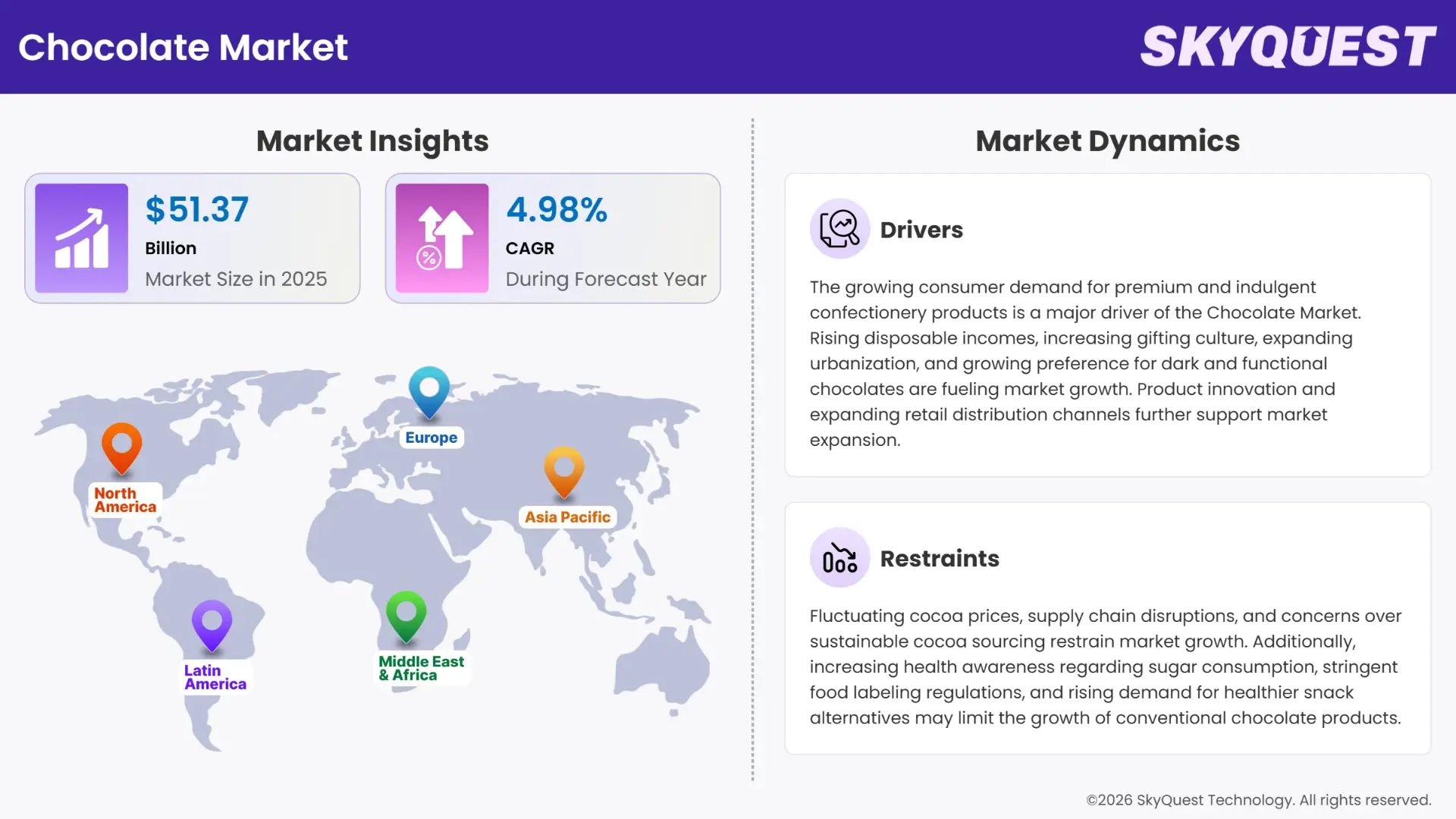
Global Chocolate Market size was valued at USD 48.93 Billion in 2024 and is poised to grow from USD 51.37 Billion in 2025 to USD 75.78 Billion by 2033, growing at a CAGR of 4.98% during the forecast period (2026–2033).
Key Takeaways: Market Trends & Insights
Growing demand for organic, vegan, sugar-free, and gluten-free chocolates is driving growth of the global chocolate market. With growing awareness of the negative effects of synthetic products on health and the environment, the majority of health-conscious and informed consumers have begun to use organic products. Furthermore, seasonal demand influences the sale of premium chocolates. During holidays such as Easter and Christmas, various companies release a wide variety of chocolate varieties. For example, Lindt Teddy, dressed in a traditional English Christmas pullover, remains a seasonal best-seller in the United Kingdom.
Other factor driving Chocolate market growth is significant growth in the food and beverage industry. Furthermore, rising consumer demand for molded chocolates, which typically include solid-shaped or segmented bar/block variants infused with various additional flavors or stuffed with nuts, raisins, and other fillings, is boosting Chocolate market growth. Furthermore, rising public awareness of the health benefits of dark chocolate consumption is fueling growth. Dark chocolate is known to improve blood circulation in the body, improve brain function, lower blood pressure, and reduce the risk of heart disease when consumed in moderation.
To get more insights on this market click here to Request a Free Sample Report
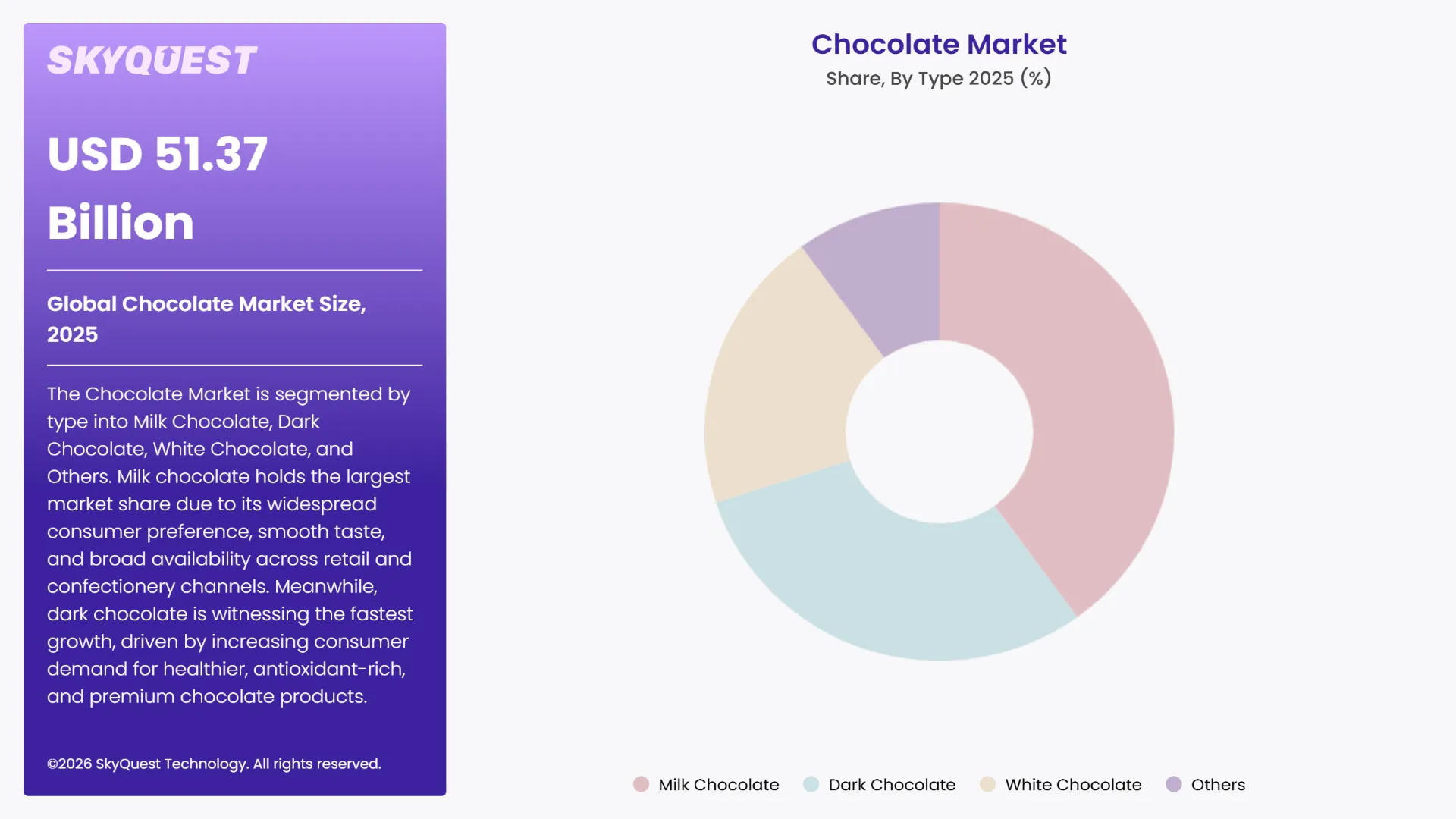
Global Chocolate Market is segmented by Type, Product Form, Product Category, Age Group, Cocoa Content, Packaging Type, Flavor, Price Range, Distribution Channel, Application and region. Based on Type, the market is segmented into Milk Chocolate, Dark Chocolate, White Chocolate and Others. Based on Product Form, the market is segmented into Chocolate Bars, Chocolate Chips/Chunks, Chocolate Spread, Chocolate Syrup, Chocolate Powder and Others. Based on Product Category, the market is segmented into Real Chocolate and Compound Chocolate. Based on Age Group, the market is segmented into Children, Teenagers/Young Adults and Adults. Based on Cocoa Content, the market is segmented into High Cocoa (>70%), Medium Cocoa (50–70%) and Low Cocoa (<50%).
Based on Packaging Type, the market is segmented into Aluminum Foil, Plastic Films, Cardboard & Paper, Jars, Tins and Others. Based on Flavor, the market is segmented into Flavored Chocolate and Unflavored Chocolate. Based on Price Range, the market is segmented into Economical, Mid-Range and Premium. Based on Distribution Channel, the market is segmented into Online Retail and Offline Retail. Based on Application, the market is segmented into Direct Consumption, Bakery & Confectionery, Beverages, Ice Cream & Dairy, Snacks & Cereal and Others. Based on region, the market is segmented into North America, Europe, Asia Pacific, Latin America and Middle East & Africa.
The dark chocolate segment is expected to be the largest segment in the global chocolate market over the forecast period. Dark chocolate contains 55-90% of cocoa solids. Cocoa beans are full of phytonutrients that serve as antioxidants and added health benefits. Cocoa beans are a rich source of iron, copper, magnesium, zinc, and phosphorus. The presence of these nutrients is much higher in dark chocolate than that in milk chocolates.
In product type, softlines/ selflines type has a higher market share in the chocolate market followed by countlines. The definition of “countline" in confectionery industry jargon for items sold by number rather than by weight. Countlines consider a single individual center, usually in a format that allows one-handed eating. Apart from that, molded chocolates have gained popularity for gifting purposes.
The supermarket/hypermarket segment contributed to the highest share of more than 60% in 2021 owing to high product availability. The online segment is anticipated the fastest growth over the forecast period. Increasing internet penetration in various countries and high adoption of online purchasing gained significant traction in the last few years. The major driving factor for online sales channel would be Generation X, millennials, and generation Z parents on internet and e-commerce access.
To get detailed segments analysis, Request a Free Sample Report
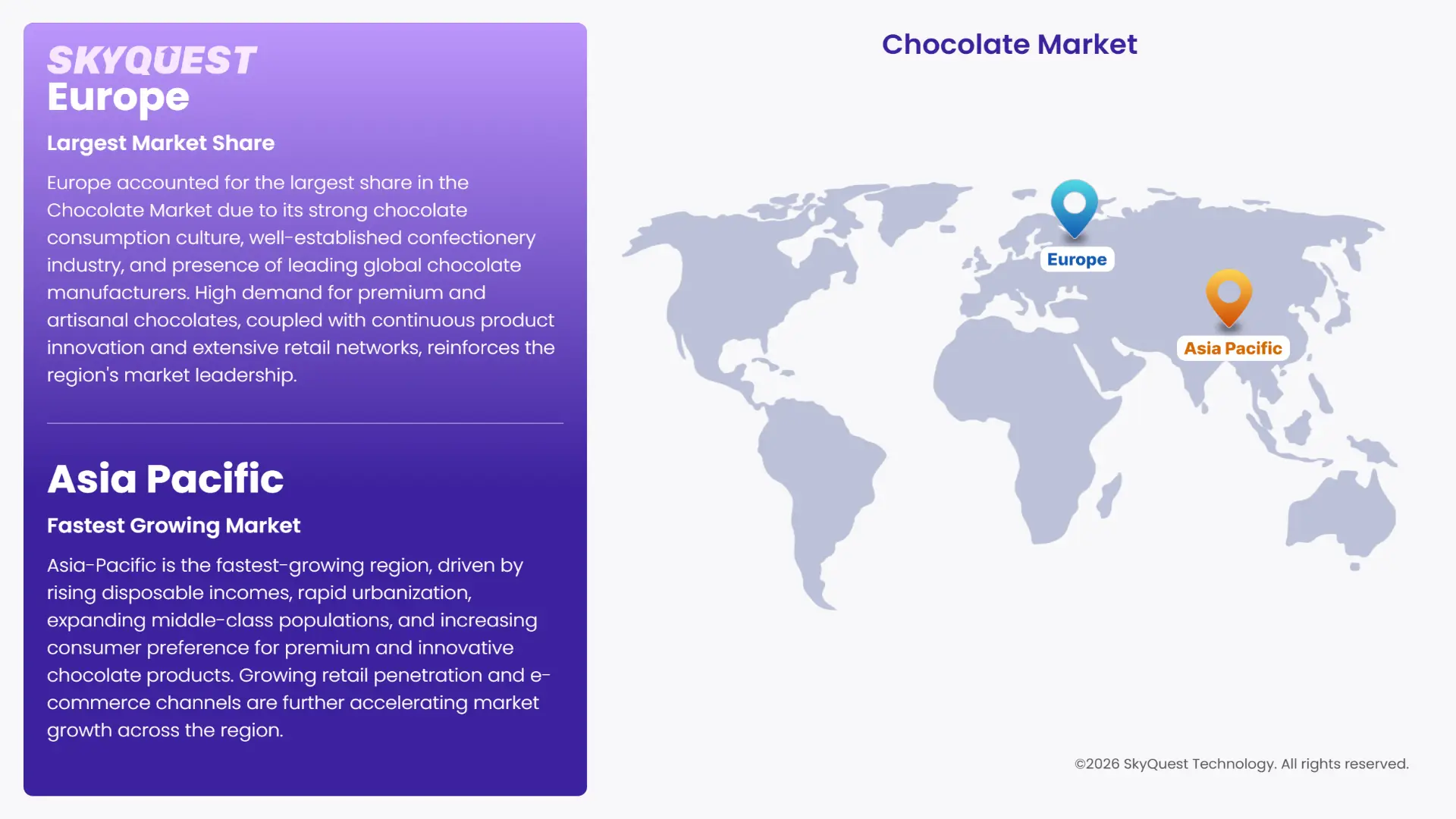
Europe dominated the global chocolate market with a market share of 35%. The increasing popularity of dark chocolate among consumers is a major factor fuelling the Chocolate market growth in the region. In the Europe region, Germany has the highest Chocolate market share in 2020 owing to increasing per capita consumption.
The chocolate market in the United Kingdom is one of the largest in Europe. The most popular appears to be plain chocolate. Premium chocolates, on the other hand, are gaining popularity, with consumers increasingly favoring premium dark chocolate. Furthermore, confectionery sales in the United Kingdom have increased, with an increase in demand for chocolate aimed at a specific group of consumers. To meet the growing demand, companies are also focusing on developing free-from and vegan chocolates. GodessiLimited, for example, sells premium chocolates in a variety of flavors, including walnut and cinnamon, orange and cinnamon, peppermint, and raspberry and almonds. The chocolates are gluten-free, dairy-free, soy-free, and vegan, and thus meet the consumers' special dietary needs.
The Middle East and Africa are expected to grow at the fastest CAGR of 6.7% from 2021 to 2028, owing to increased product availability in retail stores. Furthermore, favorable government initiatives, such as tax concession, chocolate producers are expected to increase product availability in the region. Furthermore, an increasing number of specialty retailers is expected to contribute to regional Chocolate market growth. For example, in February 2019, Pierre Marcolini opened the first store in a mall in the UAE in order to broaden his customer base.
To know more about the market opportunities by region and country, click here to
Buy The Complete Report
Request Free Customization of this report to help us to meet your business objectives.
The global chocolate market is fairly concentrated, with a few big and medium-sized market participants accounting for a large portion of Chocolate market revenue. Major players are implementing numerous tactics, including mergers and acquisitions, strategic agreements and contracts, and the development and new product lunch with more varieties.
SkyQuest's ABIRAW (Advanced Business Intelligence, Research & Analysis Wing) is our Business Information Services team that Collects, Collates, Co-relates, and Analyses the Data collected using Primary Exploratory Research backed by robust Secondary Desk research.
According to our analysis, rising disposable income, combined with growing awareness of the health benefits of chocolate, is expected to drive Chocolate market growth. The European region has a large dark chocolate-consuming population, and with more product launches, the Chocolate market is expected to grow significantly in the coming years. The e-commerce industry has seen a significant increase in sales. The growth and development of online shopping are causally related to economic growth and the rate of urbanization, which are expected to propel Chocolate market growth opportunities over the forecast period.
| Report Metric | Details |
|---|---|
| Market size value in 2024 | USD 48.93 Billion |
| Market size value in 2033 | USD 75.78 Billion |
| Growth Rate | 4.98% |
| Base year | 2024 |
| Forecast period | 2026–2033 |
| Forecast Unit (Value) | USD Billion |
| Segments covered |
|
| Regions covered | North America (US, Canada), Europe (Germany, France, United Kingdom, Italy, Spain, Rest of Europe), Asia Pacific (China, India, Japan, Rest of Asia-Pacific), Latin America (Brazil, Rest of Latin America), Middle East & Africa (South Africa, GCC Countries, Rest of MEA) |
| Companies covered |
|
| Customization scope | Free report customization with purchase. Customization includes:-
|
To get a free trial access to our platform which is a one stop solution for all your data requirements for quicker decision making. This platform allows you to compare markets, competitors who are prominent in the market, and mega trends that are influencing the dynamics in the market. Also, get access to detailed SkyQuest exclusive matrix.
Table Of Content
Executive Summary
Market overview
Parent Market Analysis
Market overview
Market size
KEY MARKET INSIGHTS
COVID IMPACT
MARKET DYNAMICS & OUTLOOK
Market Size by Region
KEY COMPANY PROFILES
Methodology
For the Chocolate Market, our research methodology involved a mixture of primary and secondary data sources. Key steps involved in the research process are listed below:
1. Information Procurement: This stage involved the procurement of Market data or related information via primary and secondary sources. The various secondary sources used included various company websites, annual reports, trade databases, and paid databases such as Hoover's, Bloomberg Business, Factiva, and Avention. Our team did 45 primary interactions Globally which included several stakeholders such as manufacturers, customers, key opinion leaders, etc. Overall, information procurement was one of the most extensive stages in our research process.
2. Information Analysis: This step involved triangulation of data through bottom-up and top-down approaches to estimate and validate the total size and future estimate of the Chocolate Market.
3. Report Formulation: The final step entailed the placement of data points in appropriate Market spaces in an attempt to deduce viable conclusions.
4. Validation & Publishing: Validation is the most important step in the process. Validation & re-validation via an intricately designed process helped us finalize data points to be used for final calculations. The final Market estimates and forecasts were then aligned and sent to our panel of industry experts for validation of data. Once the validation was done the report was sent to our Quality Assurance team to ensure adherence to style guides, consistency & design.
Analyst Support
Customization Options
With the given market data, our dedicated team of analysts can offer you the following customization options are available for the Chocolate Market:
Product Analysis: Product matrix, which offers a detailed comparison of the product portfolio of companies.
Regional Analysis: Further analysis of the Chocolate Market for additional countries.
Competitive Analysis: Detailed analysis and profiling of additional Market players & comparative analysis of competitive products.
Go to Market Strategy: Find the high-growth channels to invest your marketing efforts and increase your customer base.
Innovation Mapping: Identify racial solutions and innovation, connected to deep ecosystems of innovators, start-ups, academics, and strategic partners.
Category Intelligence: Customized intelligence that is relevant to their supply Markets will enable them to make smarter sourcing decisions and improve their category management.
Public Company Transcript Analysis: To improve the investment performance by generating new alpha and making better-informed decisions.
Social Media Listening: To analyze the conversations and trends happening not just around your brand, but around your industry as a whole, and use those insights to make better Marketing decisions.
REQUEST FOR SAMPLE
 REQUEST FREE CUSTOMIZATION
Chocolate Market size was valued at USD 48.93 Billion in 2024 and is poised to grow from USD 51.37 Billion in 2025 to USD 75.78 Billion by 2033, growing at a CAGR of 4.98% during the forecast period (2026–2033).
Key vendors in the Chocolate Market include Mars, Incorporated, Mondelez International, Inc., Nestlé S.A., Ferrero International S.A., The Hershey Company, Lindt & Sprüngli AG, Barry Callebaut AG, Meiji Holdings Co., Ltd., Ezaki Glico Co., Ltd., and Yıldız Holding. These companies offer a broad portfolio of milk, dark, and premium chocolates, catering to retail, foodservice, and industrial customers worldwide.
The key driver of the Chocolate Market is the growing consumer demand for premium and indulgent confectionery products. Rising disposable incomes, increasing gifting culture, expanding urbanization, and growing preference for dark and functional chocolates with health benefits are driving market growth. Additionally, product innovation and expanding retail distribution channels further support market expansion.
The key market trend in the Chocolate Market is the rising demand for premium, dark, and functional chocolates made with organic, sustainably sourced, and clean-label ingredients. Manufacturers are introducing innovative flavors, sugar-reduced formulations, and ethically sourced cocoa products to meet evolving consumer preferences for healthier and environmentally responsible confectionery.
Europe accounted for the largest share in the Chocolate Market due to its strong chocolate consumption culture, established confectionery industry, and presence of leading global chocolate manufacturers. High consumer demand for premium and artisanal chocolates, coupled with continuous product innovation and well-developed retail networks, further supports the region's market dominance.


Want to customize this report? This report can be personalized according to your needs. Our analysts and industry experts will work directly with you to understand your requirements and provide you with customized data in a short amount of time. We offer $1000 worth of FREE customization at the time of purchase.
Feedback From Our Clients


 USA (+1) 351-333-4748

