DNA Sequencing Market
Report ID: SQMIG35H2380
Report ID: SQMIG35H2380
[email protected]
USA +1 351-333-4748
Report ID:
SQMIG35H2380 |
Region:
Global |
Published Date: August, 2025
Pages:
171
|Tables:
119
|Figures:
69


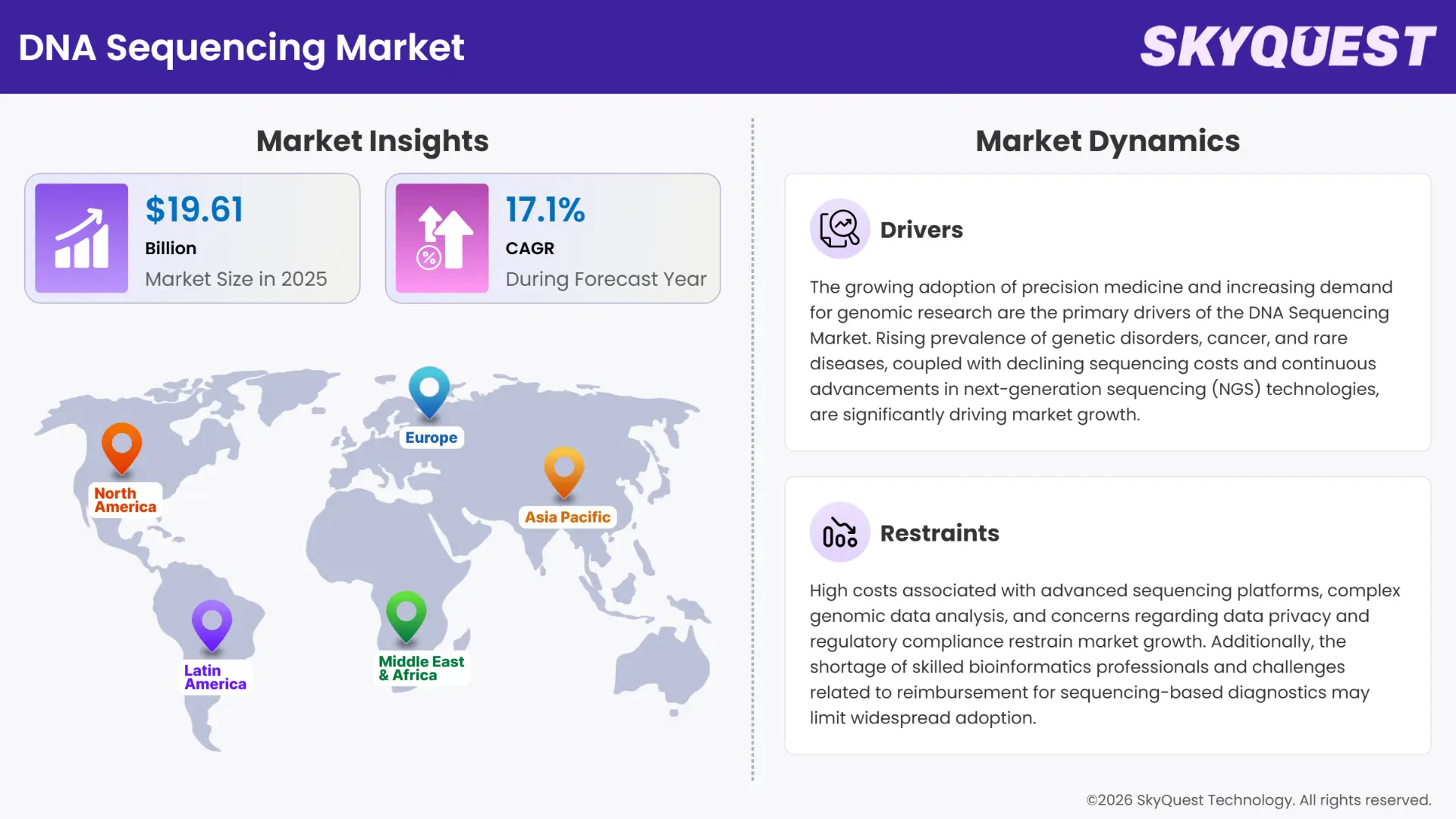
Global DNA Sequencing Market size was valued at USD 16.75 Billion in 2024 and is poised to grow from USD 19.61 Billion in 2025 to USD 69.33 Billion by 2033, growing at a CAGR of 17.1% in the forecast period (2026–2033).
Key Takeaways: Market Trends & Insights
The global DNA sequencing market has a combination of technology, applications and regional forces that shape the industry. The industry is categorized primarily into instruments, consumables, and services that create opportunities for players to build a sustaining revenue model based on consumables, a growing revenue model on sequencing-as-a-service, and analytics. Regionally, North America is ahead in terms of both innovation and uptake because of superior R&D infrastructure and supportive regulatory regimes, while the Asia-Pacific region is similarly enjoying extreme rates of growth including diagnostics, R&D, and agri-genomics.
Furthermore, the market is being transformed by enabling technologies (such as AI and advanced bioinformatics) delivering real-time data, which allow for rapid interpretation of data and integrate quickly with the sequencing hardware, to provide end users with full ecosystems. Thus, the growth of the market is driven by a large part by mature NGS platforms, growing number of clinical applications, and the realization of integrated, data-driven preference.
What Role Do Collaborations Play in Advancing AI-Driven Genomics?
Artificial intelligence is a steadily changing the DNA sequencing market through automation, increasing operational speed, and advancing clinical applications. An example of the current advances was an announcement made in May 2024 where Bangalore based start-up G-KnowMe devised a completely automated workflow for implementing whole-genome sequencing data in respect to cancer.
To get more insights on this market click here to Request a Free Sample Report
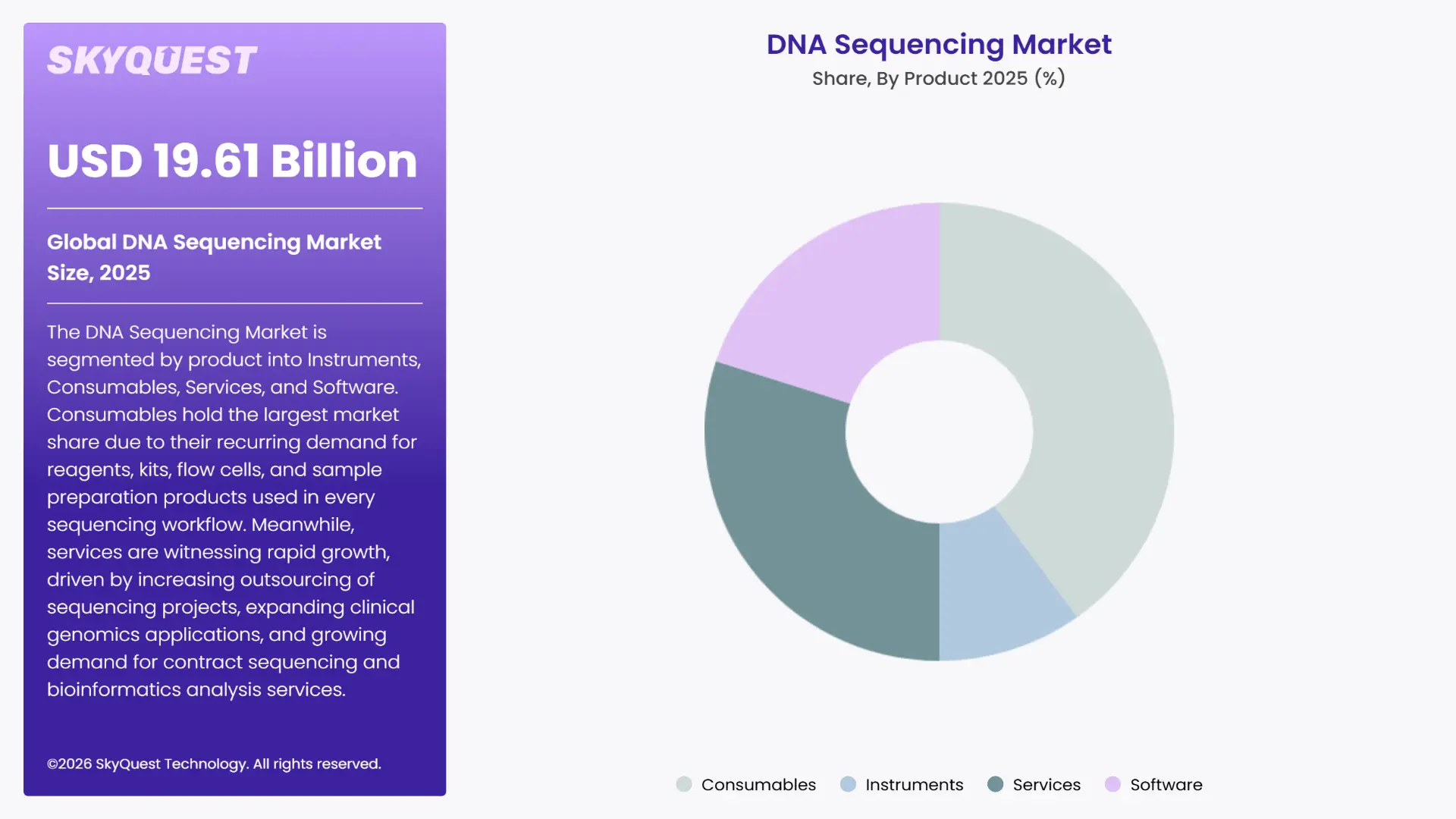
The global DNA sequencing market is segmented into product, application, technology, end user, and region. By product, the market is segmented into consumables, instruments and services. By application, the market is segmented into biomarkers, cancer, diagnostics and reproductive health. By technology, the market is segmented into synthesis, ion semiconductor sequencing, sequencing by ligation and pyrosequencing. By end user, the market is segmented into academic & government research institutes, pharmaceutical companies, biotechnology companies and clinical research. Region-wise, the market is studied across North America, Europe, Asia-Pacific, Middle East and Africa, and Latin America.
As per global DNA sequencing market outlook, consumable hold the dominant share and act as the backbone of recurring revenue. These include reagents, sequencing kits, flow cells, library preparation kits, and other single-use materials required for every sequencing run. The “razor-and-blade” business model adopted by major players ensures that once an instrument is installed, continuous demand for compatible consumables drives steady income. Since sequencing is performed in a wide range of applications such as genomics research, clinical diagnostics, and agricultural biotechnology the consumption rate remains consistently high, even as technologies evolve.
As per global DNA sequencing market analysis, the service segment is currently the fastest expanding segment, and much faster than either consumables or instruments. The trend is driven to a large extent by many researchers are willing to outsource sequencing projects and bioinformatics analysis to expert service providers ('sequencing-as-a-service'). Many of the research institutions, small biotech firms, and clinical labs that do sequencing, do not have the capacity to do large scale sequencing or advanced computational analysis. Instead, they use sequencing-as-a-service providers who offer a complete package solution that provides sample processing, sequencing, and data interpretation.
The academic research segment represented the largest portion of the DNA sequencing market share in 2024, accounting for approximately 52.0% of total revenues. This is largely because next-generation sequencing (NGS), and Sanger sequencing are already commonplace in universities and other research institutions, as well as public research programs that usually require very large sequencing efforts, or many smaller sequencing efforts. Increasing funding amounts from public agencies and organizations have bolstered research priorities and efforts that encompass broader research capabilities including multi-omics which offer insight into genomics, transcriptomics, proteomics, and epigenomics.
As per global DNA sequencing market forecast, the clinical research segment is projected to grow at the fastest pace during the forecast period. This surge is driven by the increasing application of sequencing technologies in precision diagnostics, rare genetic disease identification, and oncology research. NGS's capacity to provide accurate sequencing for multiple genes simultaneously and with low implicate nucleic acid, has encouraged the increased use of NGS as a clinical testing application. Furthermore, in rare disease, DNA sequencing is providing information about genetic disorders previously considered undiagnosed and offering faster and more accurate treatment options.
To get detailed segments analysis, Request a Free Sample Report
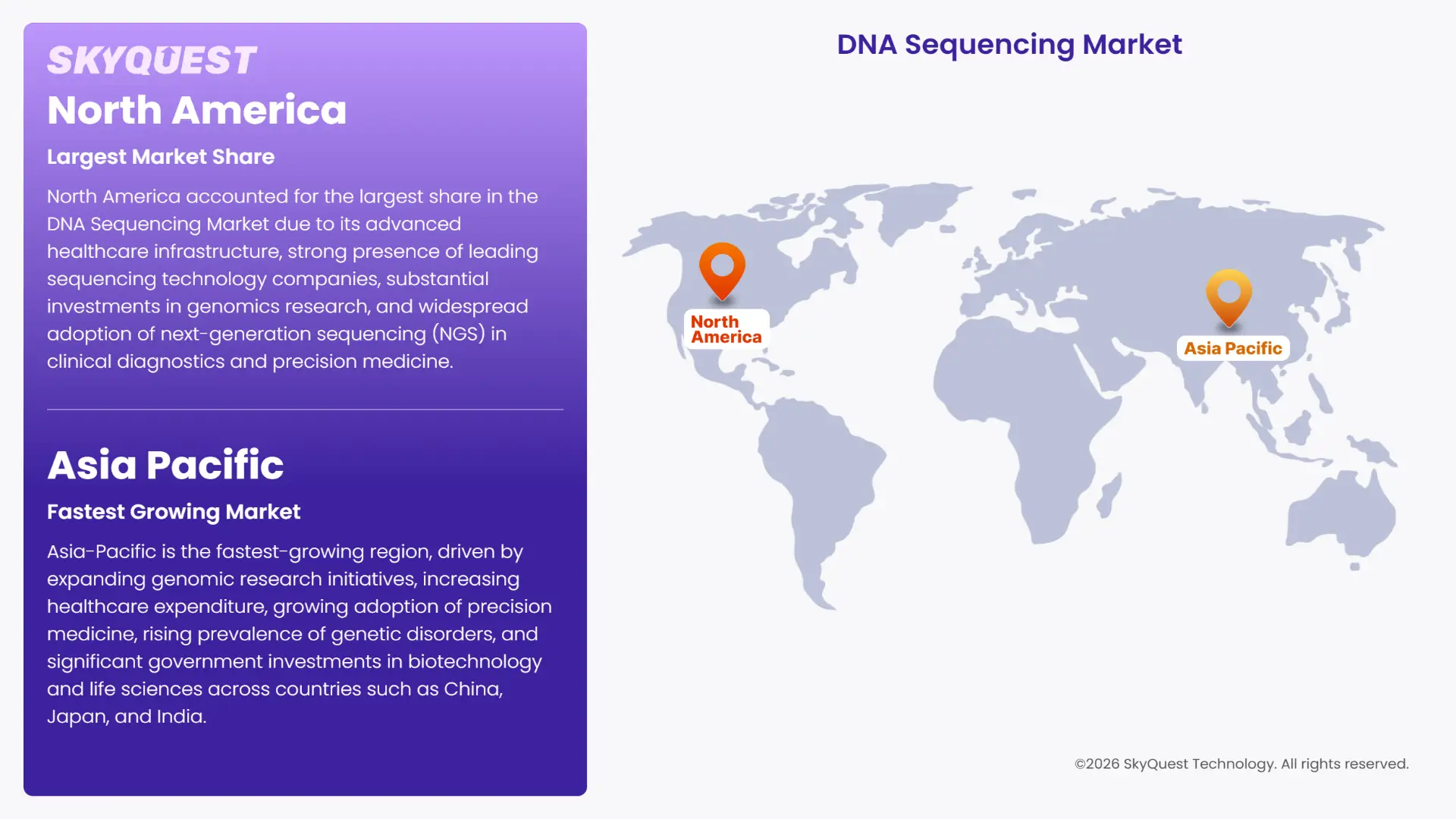
As per regional forecast, the DNA sequencing market is largely driven by North America. This is due to their strong research infrastructure, high healthcare expenditure, and presence of top genomics companies. North America benefits from the early adoption of next-generation sequencing (NGS) technologies by life sciences organizations, a highly developed biotechnology landscape, and supportive regulatory frameworks for genomic testing and precision medicine programs. Additionally, government genomic programs and sizeable R&D investment support market growth.
U.S. DNA Sequencing Market
Regionally, the U.S. represents the largest sector in the North America market, fuelled by a sophisticated healthcare system; large genomic research initiatives; and rapid adoption of sequencing into clinical practices. Initiatives such as the All of Us Research Program, along with large NIH grant funds, have greatly increased both genomic data generation and utilization. A plethora of private industry, from startups to established ventures, continue to grow their own services and technologies.
Canada DNA Sequencing Market
National genomics initiatives, collaborative research networks, and increasing reliance on sequencing technologies in healthcare rare disease diagnostics and oncology all support growth for Canada's market. For example, funding programs from the government of Canada such as Genome Canada's help expand the space for NGS in research and personalized medicine. Research and biotech collaborations, help generate innovation within the NGS environment.
The Asia-Pacific region is seeing an increasing rapid adoption of DNA sequencing as a result of greater funding for genomics research and development of precision medicine programs and more generalizable exposure to genetic testing for medical reasons. As examples, Japan and South Korea are innovators in terms of the sector, while emerging economies are building their genomic infrastructures to meet demand.
Japan DNA Sequencing Market
Japan holds a strong position in the market due to its robust support from central government agencies, existing advanced healthcare systems, and high penetration of NGS in cancer diagnostic and personalized medicine. Also, Japan's growing aging population is also creating an increase in demand for genetic testing related to improving disease prevention and treatment outcomes.
South Korea DNA Sequencing Market
As reported in a recent industry analysis, South Korea has established itself as one of the leading technological countries in genomics based on its commitment to R&D investments, active biotech industry, and application of sequencing to public health initiatives. South Korea’s emphasis on precision medicine and collaboration between universities, hospitals, and tech companies will drive innovation and increase adoption.
Europe continues to be an important market due to government-backed genomics initiatives, an advanced healthcare infrastructure, and a well-established research ecosystem. There is a considerable amount of collaboration between academic institutions, healthcare systems, and business enterprises, and a growing focus on the integration of sequencing in regular healthcare.
Germany DNA Sequencing Market
Germany's market benefits greatly from its highly developed biotechnology sector, government funding for genomics research, and the regular use of sequencing by academic and clinical organizations. It has strong initiatives around rare disease diagnosis and cancer genomics.
U.K. DNA Sequencing Market
The U.K. is a leader in Europe for genomics, driven by the Genomics England program and the integration of sequencing into clinical practice by the NHS. Large scale genomic projects and a strong policy to support genomics make the U.K. one of the most important locations for sequencing innovation and application.
Italy DNA Sequencing Market
The market in Italy is driven by the slow adoption of sequencing in oncology, rare diseases, and research in academic settings. Government-funded research programs and collaborations with European genomics networks are expanding access to advanced sequencing technologies.
To know more about the market opportunities by region and country, click here to
Buy The Complete Report
Advancements in Sequencing Technology Driving Market Adoption
Rising Adoption in Clinical Diagnostics Boosting Growth
High Infrastructure Costs Preventing Broader Scope Market Access
Data Management Issues Preventing Market Growth
Request Free Customization of this report to help us to meet your business objectives.
The global DNA sequencing industry is highly competitive with a combination of established leaders and new innovators continuing to drive new technology and applications. Illumina continues to maintain its dominance with a well-established and diverse range of sequencing platforms and consumables. Thermo Fisher Scientific uses Ion Torrent technology and its well-established life sciences ecosystem. As per market strategies, Pacific Biosciences (PacBio) and Oxford Nanopore Technologies are at the forefront of long-read and real-time sequencing innovations, catering to applications requiring higher accuracy and structural variant detection.
New companies in the DNA sequencing market are making great strides in not only ushering in disruptive technology but also improving access to that technology. Startups often focus on narrow applications, cost or time effective sequencing, or creating integrated bioinformatics solutions to gaps left by larger companies. Many startups are enhancing their capabilities with AI, cloud computing, automation all of which can speed sample analysis, reduce sequencing costs, and create live genomic insight. Some startups are creating portable sequencing devices for field work while others are creating sample prep and targeted sequencing assay for particular diseases.
Shift Toward Long-Read and Single-Cell Sequencing
Integration of AI Transforming Genome Data Analysis
SkyQuest’s ABIRAW (Advanced Business Intelligence, Research & Analysis Wing) is our Business Information Services team that Collects, Collates, Correlates, and Analyses the Data collected by means of Primary Exploratory Research backed by robust Secondary Desk research.
According to SkyQuest analysis, the DNA sequencing market is poised for high growth largely to a confluence of technology advancements, demand for personalized medicine, and the implications of sequencing across several areas. There will be challenges with high costs, data management, technology developments, and forms of artificial intelligence, but they will further speed accuracy and availability of data. The market will experience significant progress, which will shift health care, research, and diagnostics permanently, and will culminate in better patient outcomes and new scientific knowledge from experienced and inexperienced developer and implementers. The increasing product launch strategies by top market players, rising technological developments in DNA sequencing techniques and its application in medical science are some of the key drivers expected to drive market growth during the forecast period. Furthermore, the rising interest in genomics research and personalized medicine is a powerful catalyst for the expansion of the market. As technological advancements continue to unravel the complexities of the human genome, researchers & healthcare professionals are increasingly turning to DNA sequencing to obtain valuable insights that have transformative implications for medical diagnosis, treatment, and disease prevention.
| Report Metric | Details |
|---|---|
| Market size value in 2024 | USD 16.75 Billion |
| Market size value in 2033 | USD 69.33 Billion |
| Growth Rate | 17.1% |
| Base year | 2024 |
| Forecast period | 2026–2033 |
| Forecast Unit (Value) | USD Billion |
| Segments covered |
|
| Regions covered | North America (US, Canada), Europe (Germany, France, United Kingdom, Italy, Spain, Rest of Europe), Asia Pacific (China, India, Japan, Rest of Asia-Pacific), Latin America (Brazil, Rest of Latin America), Middle East & Africa (South Africa, GCC Countries, Rest of MEA) |
| Companies covered |
|
| Customization scope | Free report customization with purchase. Customization includes:-
|
To get a free trial access to our platform which is a one stop solution for all your data requirements for quicker decision making. This platform allows you to compare markets, competitors who are prominent in the market, and mega trends that are influencing the dynamics in the market. Also, get access to detailed SkyQuest exclusive matrix.
Table Of Content
Executive Summary
Market overview
Parent Market Analysis
Market overview
Market size
KEY MARKET INSIGHTS
COVID IMPACT
MARKET DYNAMICS & OUTLOOK
Market Size by Region
KEY COMPANY PROFILES
Methodology
For the DNA Sequencing Market, our research methodology involved a mixture of primary and secondary data sources. Key steps involved in the research process are listed below:
1. Information Procurement: This stage involved the procurement of Market data or related information via primary and secondary sources. The various secondary sources used included various company websites, annual reports, trade databases, and paid databases such as Hoover's, Bloomberg Business, Factiva, and Avention. Our team did 45 primary interactions Globally which included several stakeholders such as manufacturers, customers, key opinion leaders, etc. Overall, information procurement was one of the most extensive stages in our research process.
2. Information Analysis: This step involved triangulation of data through bottom-up and top-down approaches to estimate and validate the total size and future estimate of the DNA Sequencing Market.
3. Report Formulation: The final step entailed the placement of data points in appropriate Market spaces in an attempt to deduce viable conclusions.
4. Validation & Publishing: Validation is the most important step in the process. Validation & re-validation via an intricately designed process helped us finalize data points to be used for final calculations. The final Market estimates and forecasts were then aligned and sent to our panel of industry experts for validation of data. Once the validation was done the report was sent to our Quality Assurance team to ensure adherence to style guides, consistency & design.
Analyst Support
Customization Options
With the given market data, our dedicated team of analysts can offer you the following customization options are available for the DNA Sequencing Market:
Product Analysis: Product matrix, which offers a detailed comparison of the product portfolio of companies.
Regional Analysis: Further analysis of the DNA Sequencing Market for additional countries.
Competitive Analysis: Detailed analysis and profiling of additional Market players & comparative analysis of competitive products.
Go to Market Strategy: Find the high-growth channels to invest your marketing efforts and increase your customer base.
Innovation Mapping: Identify racial solutions and innovation, connected to deep ecosystems of innovators, start-ups, academics, and strategic partners.
Category Intelligence: Customized intelligence that is relevant to their supply Markets will enable them to make smarter sourcing decisions and improve their category management.
Public Company Transcript Analysis: To improve the investment performance by generating new alpha and making better-informed decisions.
Social Media Listening: To analyze the conversations and trends happening not just around your brand, but around your industry as a whole, and use those insights to make better Marketing decisions.
REQUEST FOR SAMPLE
 REQUEST FREE CUSTOMIZATION
Global DNA Sequencing Market size was valued at USD 16.75 Billion in 2024 and is poised to grow from USD 19.61 Billion in 2025 to USD 69.33 Billion by 2033, growing at a CAGR of 17.1% in the forecast period (2026–2033).
Key vendors in the DNA Sequencing Market include Illumina, Inc., Thermo Fisher Scientific Inc., Pacific Biosciences of California, Inc., Oxford Nanopore Technologies plc, QIAGEN N.V., BGI Genomics Co., Ltd., F. Hoffmann-La Roche Ltd., Agilent Technologies, Inc., Danaher Corporation, and PerkinElmer, Inc.. These companies provide DNA sequencing instruments, consumables, reagents, software, and sequencing services for applications in clinical diagnostics, genomics research, precision medicine, agriculture, and drug discovery.
The key driver of the DNA Sequencing Market is the growing adoption of precision medicine and increasing demand for genomic research. Rising prevalence of genetic disorders, cancer, and rare diseases, coupled with declining sequencing costs and advancements in next-generation sequencing (NGS) technologies, is significantly driving market growth. Additionally, expanding applications in clinical diagnostics, drug discovery, and personalized healthcare further support market expansion.
The key market trend in the DNA Sequencing Market is the increasing adoption of next-generation sequencing (NGS) technologies and AI-powered genomic data analysis. Advances in long-read sequencing, automation, cloud-based bioinformatics platforms, and multi-omics integration are improving sequencing accuracy, reducing turnaround times, and expanding applications in precision medicine, oncology, infectious disease diagnostics, and population genomics.
North America accounted for the largest share in the DNA Sequencing Market due to its advanced healthcare infrastructure, strong presence of leading sequencing technology companies, substantial investments in genomics research, and widespread adoption of next-generation sequencing (NGS) in clinical diagnostics and precision medicine. Government funding, increasing genomic research initiatives, and the growing prevalence of cancer and genetic disorders further support the region's market leadership.


Want to customize this report? This report can be personalized according to your needs. Our analysts and industry experts will work directly with you to understand your requirements and provide you with customized data in a short amount of time. We offer $1000 worth of FREE customization at the time of purchase.
Feedback From Our Clients


 USA (+1) 351-333-4748

