
Edge Computing Market
Report ID: SQMIG45M2026
Report ID: SQMIG45M2026
[email protected]
USA +1 351-333-4748
Report ID:
SQMIG45M2026 |
Region:
Global |
Published Date: July, 2025
Pages:
183
|Tables:
136
|Figures:
74


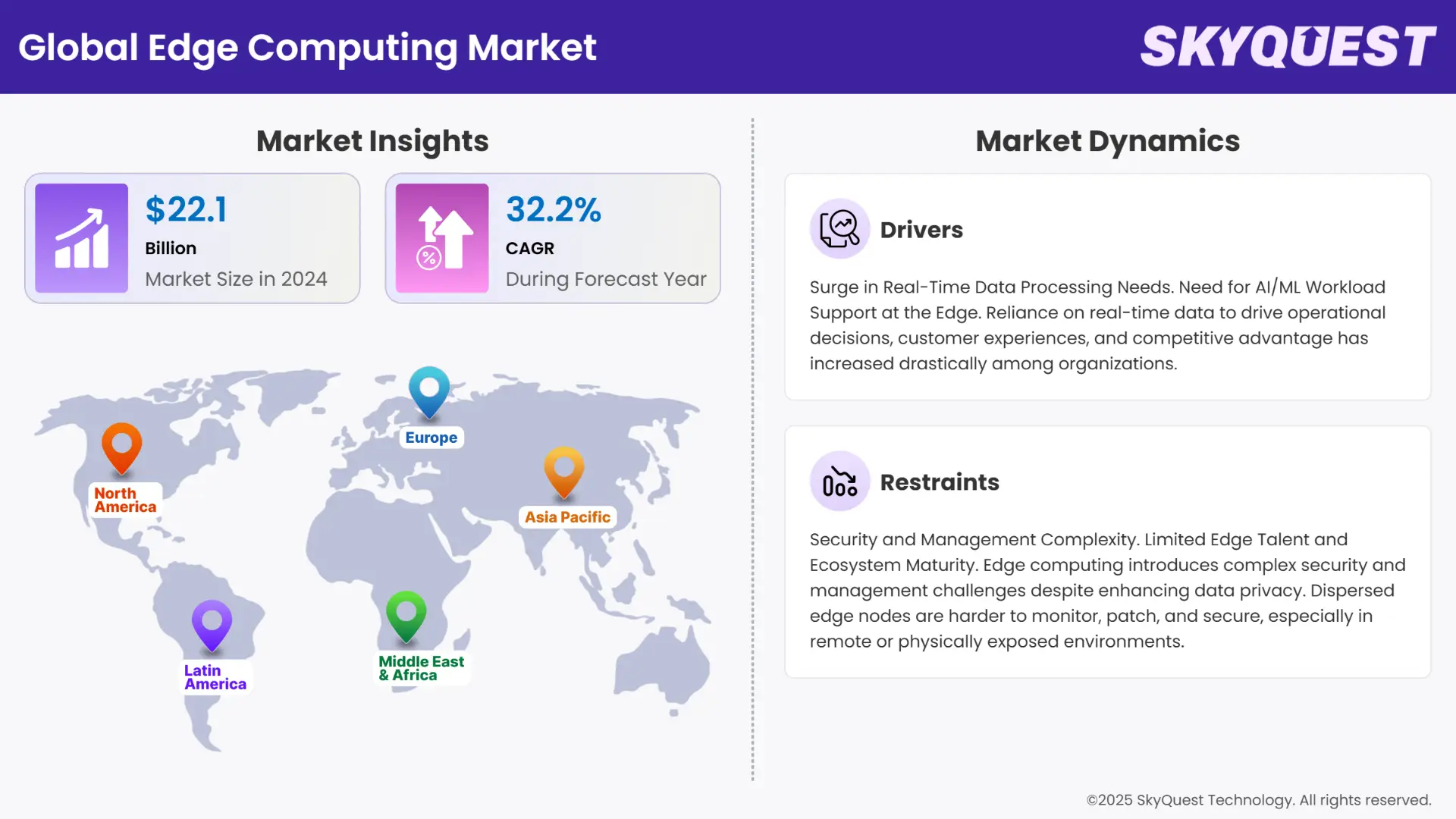
Global Edge Computing Market size was valued at USD 22.1 Billion in 2024 and is poised to grow from USD 29.22 Billion in 2025 to USD 272.57 Billion by 2033, growing at a CAGR of 32.2% during the forecast period (2026–2033).
Growing demand for low-latency processing, high adoption of IoT devices, advancements in 5G infrastructure, rise in demand for better data privacy and security, and need for edge support for AI/ML workloads are slated to drive market development.
Edge computing reduces latency by processing data closer to its source, enabling real-time analytics and decision-making. The proliferation of Internet of Things (IoT) devices is significantly boosting the demand for edge computing. 5G networks offer ultra-low latency, high bandwidth, and reliable connectivity, making them ideal for supporting edge computing environments. The synergy between 5G and edge computing allows distributed networks to process data close to the source while maintaining seamless connectivity. Edge computing improves data security by minimizing data movement across networks, which reduces the exposure to cyberattacks during transmission. Privacy-sensitive industries like healthcare, finance, and defense are helping bolster the global edge computing market growth. Surge in adoption of artificial intelligence and machine learning technologies is slated to create new business scope for edge computing providers.
On the contrary, high initial infrastructure costs, limited standardization, complexity in management and security, and limited talent working on egde are forecasted to hamper the edge computing market penetration across the study period and beyond.
How is AI Altering the Adoption of Edge Computing?
Edge computing is rapidly evolving to support AI and ML workloads, enabling real-time inference and automation at the data source. This trend is being driven by demand for intelligent applications in retail (e.g., smart shelves), manufacturing (e.g., predictive maintenance), and healthcare (e.g., diagnostic devices). AI chips optimized for the edge are becoming more common, allowing models to run locally without relying on the cloud. This shift reduces latency, boosts privacy, and enhances performance. As businesses seek faster, smarter decisions, the convergence of AI and edge computing is creating new possibilities for decentralized intelligence and hyper-personalized experiences.
To get more insights on this market click here to Request a Free Sample Report
The global edge computing market is segmented by component, organization size, application, end user, and region. Based on components, the market is segmented into hardware, software, services, and edge-managed platforms. Based on organization size, the market is segmented into small & medium enterprises and large enterprises. Based on application, the market is segmented into Industrial Internet of Things (IIoT), remote monitoring, content delivery, video analytics, AR/VR, connected cars, smart grids, critical infrastructure monitoring, traffic management, assets tracking, security & surveillance, smart cities, and others. Based on end user, the market is segmented into energy & utilities, healthcare, agriculture, industrial, transportation & logistics, retail, data centers, wearables, government & public sector, media & entertainment, manufacturing, telecom & IT, and others. Based on region, the market is segmented into North America, Europe, Asia Pacific, Latin America, and Middle East & Africa.
Which Component Brings in the Most Business for Edge Computing Companies?
The hardware segment is slated to spearhead the global edge computing market revenue generation potential going forward. Surge in number of IoT and IIoT devices coupled with integration of advanced sensors with edge computing systems is bolstering the dominance of this segment. Advancements in hardware technology and growing need for edge data centers are also helping this segment hold sway over others.
Meanwhile, the demand for software is slated to rise at an impressive CAGR over the coming years as per this edge computing industry analysis. High demand for scalable and low-latency software for edge computing applications is creating new business scope. Need for integration of advanced technologies and rise of containerization are also boosting revenue generation.
Which Organizations are Leading the Adoption of Edge Computing?
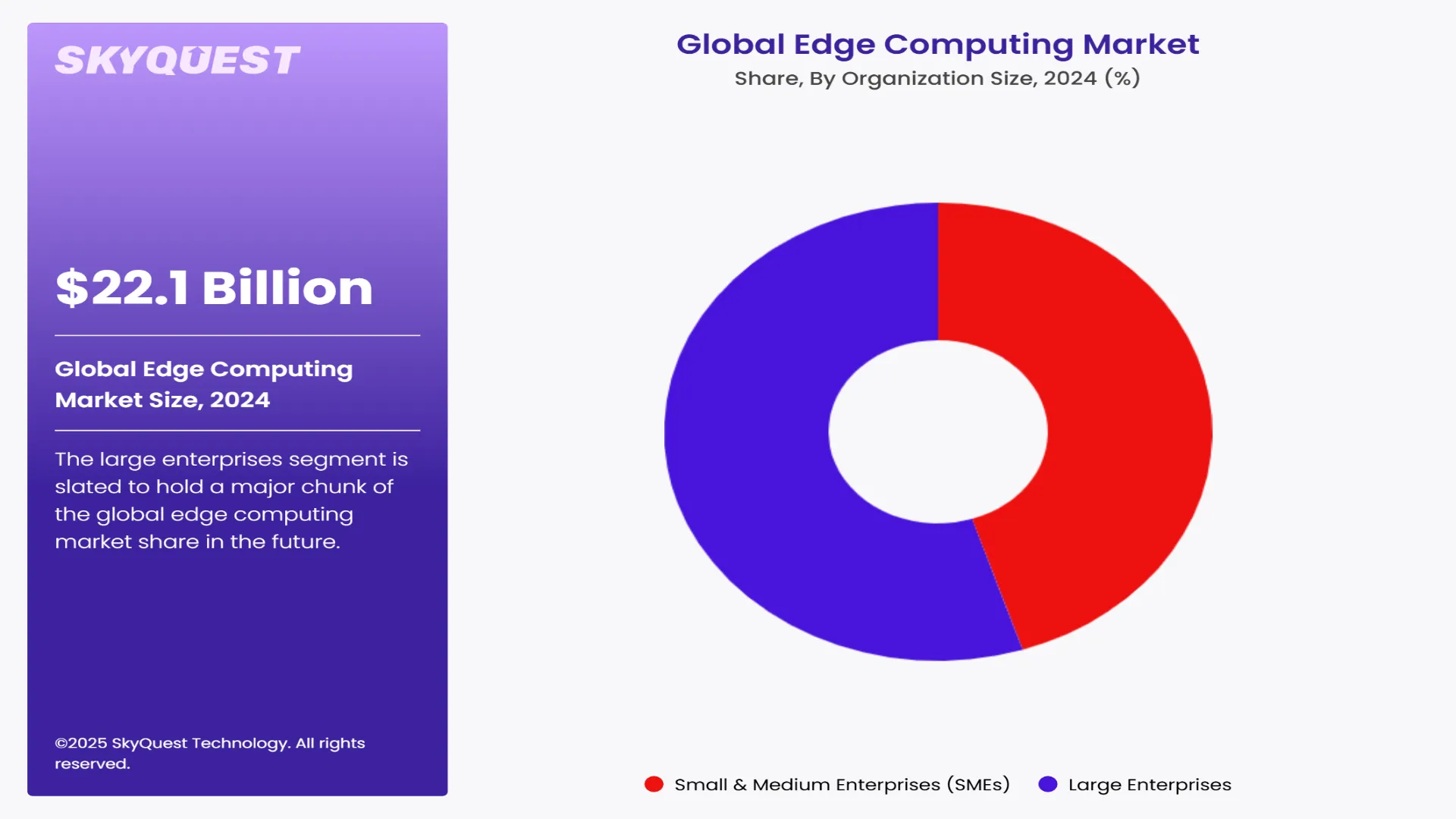
The large enterprises segment is slated to hold a major chunk of the global edge computing market share in the future. Large organizations deal with high volumes of data and operations in such organizations are highly latency-sensitive, which is promoting the adoption of edge computing solutions. High spending potential of these organizations and their emphasis on digital transformation to boost efficiency are helping cement the dominance of this segment.
On the other hand, the demand for edge computing in small and medium enterprises is slated to rise at a notable pace over the coming years. Increasing emphasis on improving customer experience and high adoption of real-time data processing are helping generate new opportunities for edge computing providers focusing on this segment.
To get detailed segments analysis, Request a Free Sample Report
Why is North America a Top Region for Edge Computing Adoption?
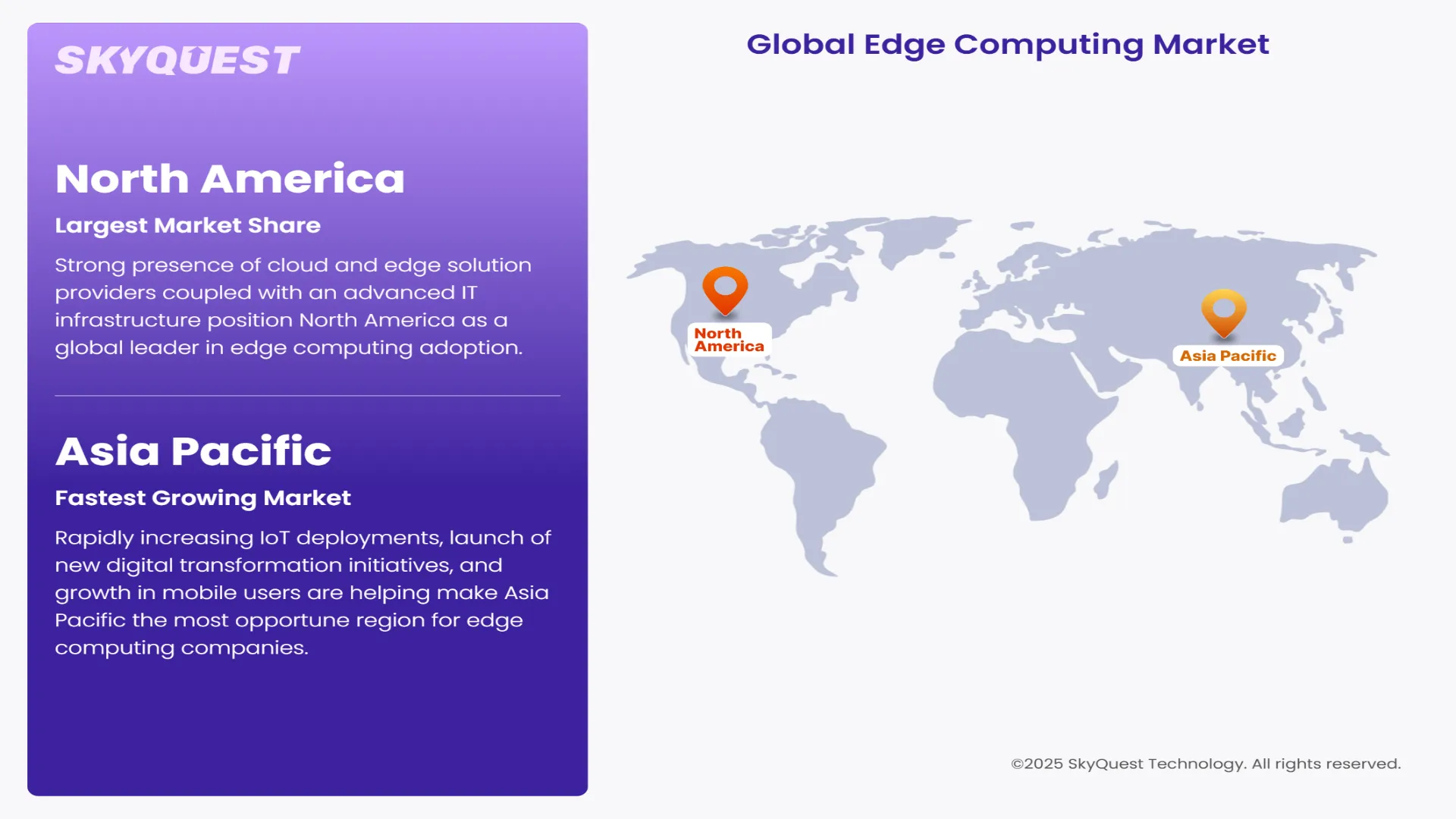
Strong presence of cloud and edge solution providers coupled with an advanced IT infrastructure position North America as a global leader in edge computing adoption. Supportive government initiatives to promote smart infrastructure, data sovereignty, and 5G expansion in this region are also expected to help bolster revenue generation for market players in the long run. Enterprise readiness and technological leadership help this region maintain its dominant stance going forward.
Edge Computing Market in United States
Strong ecosystem of tech giants like Amazon, Microsoft, Google, and IBM coupled with an advanced cloud infrastructure helps boost edge computing deployment in the United States. Government initiatives around AI, smart cities, and military tech further cement the country’s dominance in this region. The presence of hyperscalers, robust cybersecurity infrastructure, and high demand for decentralized intelligence are anticipated to ensure sustained dominance of the country in North America across the study period.
Edge Computing Market in Canada
The rising number of smart city and industrial IoT initiatives and government support for technology innovation are helping boost edge computing demand in the country. Expansion of 5G networks by telecom providers like Bell and Rogers in Canada is also forecasted to help promote the demand for edge computing solutions. The market benefits from North America’s broader ecosystem, while Canadian regulations around privacy and data localization drive demand for on-premises edge solutions.
Will Edge Computing Demand be High in Asia Pacific?
Rapidly increasing IoT deployments, launch of new digital transformation initiatives, and growth in mobile users are helping make Asia Pacific the most opportune region for edge computing companies. Robust investments in 5G, AI, and industrial automation adoption in the region are also expected to boost the demand for edge computing solutions over the coming years. Rising demand for real-time analytics and cloud offloading in dense urban areas are also projected to boost revenue generation for market players in the region.
Edge Computing Market in Japan
Strong government emphasis on Society 5.0, which integrates IoT, robotics, and AI into daily life is primarily boosting edge computing adoption in Japan. Fujitsu, NEC, and NTT are top companies developing novel edge-native platforms and solutions. Japan’s focus on automation, efficiency, and real-time data processing in sectors like logistics and healthcare accelerates adoption. Growing digital transformation in public services and industry is boosting the demand for scalable, secure, and AI-integrated edge solutions in the future.
Edge Computing Market in South Korea
Presence of a developed telecom infrastructure and strong 5G penetration are helping drive the adoption of edge computing in South Korea going forward. Samsung and SK Telecom are key companies playing a pivotal role in the adoption of edge computing solutions in consumer devices, factories, and smart transportation systems. With its tech-savvy population and government incentives promoting AI and IoT adoption, South Korea is becoming a global testbed for cutting-edge edge computing applications, making it one of Asia’s most aggressive and innovative adopters.
How Will Demand for Edge Computing Fare in Europe?
The edge computing market in Europe is projected to be shaped by a regulatory focus on data sovereignty, energy efficiency, and digital infrastructure modernization. Rising emphasis on GDPR compliance and green computing is creating new opportunities for edge data centers in the region. Europe's strategic emphasis on security, sustainability, and industry-specific edge applications is forecasted to help expand the application scope of edge computing solutions in Europe through 2032.
Edge Computing Market in United Kingdom
A robust increase in 5G deployment and digital transformation in public services are forecasted to boost the demand for edge computing in the country. The surge in adoption of IoT devices across sectors such as healthcare, logistics, and energy is also helping promote the use of edge computing solutions. Companies such as BT and Vodafone are leading in telecom-edge convergence. Startup innovation and growing investments in edge R&D are slated to help make this a key market in Europe.
Edge Computing Market in Germany
Germany emerges as a leader in edge computing adoption in the European region owing to high emphasis on Industry 4.0 trends and strong industrial base. The country’s advanced manufacturing sector uses edge for predictive maintenance, robotics, and real-time quality control. Major enterprises like Siemens and Bosch are investing in edge platforms and collaborating with cloud providers to decentralize processing. With a mature ecosystem of industrial automation and 5G infrastructure, Germany is setting benchmarks for edge deployment in complex and high-precision industrial environments in Europe.
Edge Computing Market in France
The edge computing demand in France is expected to be defined by smart city development, 5G expansion, and AI integration in public infrastructure going forward. Companies such as Orange and Atos are expected to lead deployment of edge-enabled services for the telecom, energy, and healthcare sectors. France is also investing in regional edge data centers to reduce latency and comply with GDPR. As edge becomes essential for privacy-first, high-performance applications, France is strategically positioning itself as a secure and efficient edge market.
To know more about the market opportunities by region and country, click here to
Buy The Complete Report
Edge Computing Market Drivers
Surge in Real-Time Data Processing Needs
Need for AI/ML Workload Support at the Edge
Edge Computing Market Restraints
Security and Management Complexity
Limited Edge Talent and Ecosystem Maturity
Request Free Customization of this report to help us to meet your business objectives.
Edge computing providers should focus on integration of advanced technologies to improve their revenue generation potential in the long run. Creating custom and secure edge platforms and devices for sensitive industries is a key opportunity as per this global edge computing market forecast through 2032.
Innovation remains the top priority for almost all technologies, and the same is true for edge computing as well. Here are some key startups that are innovating in the edge computing space.
Top Player’s Company Profiles
Recent Developments in Edge Computing Market
SkyQuest’s ABIRAW (Advanced Business Intelligence, Research & Analysis Wing) is our Business Information Services team that Collects, Collates, Correlates, and Analyses the Data collected by means of Primary Exploratory Research backed by robust Secondary Desk research.
As per SkyQuest analysis, increasing demand for real-time data processing and growing need for edge support for AI/ML workloads are slated to primarily drive the demand for edge computing going forward. However, high initial infrastructure costs and complexity in management are expected to slow down the demand for edge computing in the future. North America is forecasted to emerge as the leading market for edge computing providers owing to the presence of a developed technological infrastructure and high enterprise IT spending. Rise of edge-as-a-service models and adoption of zero trust security architectures are slated to present new business scope for companies across the study period.
| Report Metric | Details |
|---|---|
| Market size value in 2024 | USD 22.1 Billion |
| Market size value in 2033 | USD 272.57 Billion |
| Growth Rate | 32.2% |
| Base year | 2024 |
| Forecast period | 2026-2033 |
| Forecast Unit (Value) | USD Billion |
| Segments covered |
|
| Regions covered | North America (US, Canada), Europe (Germany, France, United Kingdom, Italy, Spain, Rest of Europe), Asia Pacific (China, India, Japan, Rest of Asia-Pacific), Latin America (Brazil, Rest of Latin America), Middle East & Africa (South Africa, GCC Countries, Rest of MEA) |
| Companies covered |
|
| Customization scope | Free report customization with purchase. Customization includes:-
|
To get a free trial access to our platform which is a one stop solution for all your data requirements for quicker decision making. This platform allows you to compare markets, competitors who are prominent in the market, and mega trends that are influencing the dynamics in the market. Also, get access to detailed SkyQuest exclusive matrix.
Table Of Content
Executive Summary
Market overview
Parent Market Analysis
Market overview
Market size
KEY MARKET INSIGHTS
COVID IMPACT
MARKET DYNAMICS & OUTLOOK
Market Size by Region
KEY COMPANY PROFILES
Methodology
For the Edge Computing Market, our research methodology involved a mixture of primary and secondary data sources. Key steps involved in the research process are listed below:
1. Information Procurement: This stage involved the procurement of Market data or related information via primary and secondary sources. The various secondary sources used included various company websites, annual reports, trade databases, and paid databases such as Hoover's, Bloomberg Business, Factiva, and Avention. Our team did 45 primary interactions Globally which included several stakeholders such as manufacturers, customers, key opinion leaders, etc. Overall, information procurement was one of the most extensive stages in our research process.
2. Information Analysis: This step involved triangulation of data through bottom-up and top-down approaches to estimate and validate the total size and future estimate of the Edge Computing Market.
3. Report Formulation: The final step entailed the placement of data points in appropriate Market spaces in an attempt to deduce viable conclusions.
4. Validation & Publishing: Validation is the most important step in the process. Validation & re-validation via an intricately designed process helped us finalize data points to be used for final calculations. The final Market estimates and forecasts were then aligned and sent to our panel of industry experts for validation of data. Once the validation was done the report was sent to our Quality Assurance team to ensure adherence to style guides, consistency & design.
Analyst Support
Customization Options
With the given market data, our dedicated team of analysts can offer you the following customization options are available for the Edge Computing Market:
Product Analysis: Product matrix, which offers a detailed comparison of the product portfolio of companies.
Regional Analysis: Further analysis of the Edge Computing Market for additional countries.
Competitive Analysis: Detailed analysis and profiling of additional Market players & comparative analysis of competitive products.
Go to Market Strategy: Find the high-growth channels to invest your marketing efforts and increase your customer base.
Innovation Mapping: Identify racial solutions and innovation, connected to deep ecosystems of innovators, start-ups, academics, and strategic partners.
Category Intelligence: Customized intelligence that is relevant to their supply Markets will enable them to make smarter sourcing decisions and improve their category management.
Public Company Transcript Analysis: To improve the investment performance by generating new alpha and making better-informed decisions.
Social Media Listening: To analyze the conversations and trends happening not just around your brand, but around your industry as a whole, and use those insights to make better Marketing decisions.
REQUEST FOR SAMPLE
 REQUEST FREE CUSTOMIZATION


Want to customize this report? This report can be personalized according to your needs. Our analysts and industry experts will work directly with you to understand your requirements and provide you with customized data in a short amount of time. We offer $1000 worth of FREE customization at the time of purchase.
Feedback From Our Clients


 USA (+1) 351-333-4748

