
Electrolyzer Market
Report ID: SQMIG15F2255
Report ID: SQMIG15F2255
[email protected]
USA +1 351-333-4748
Report ID:
SQMIG15F2255 |
Region:
Global |
Published Date: August, 2025
Pages:
183
|Tables:
124
|Figures:
72


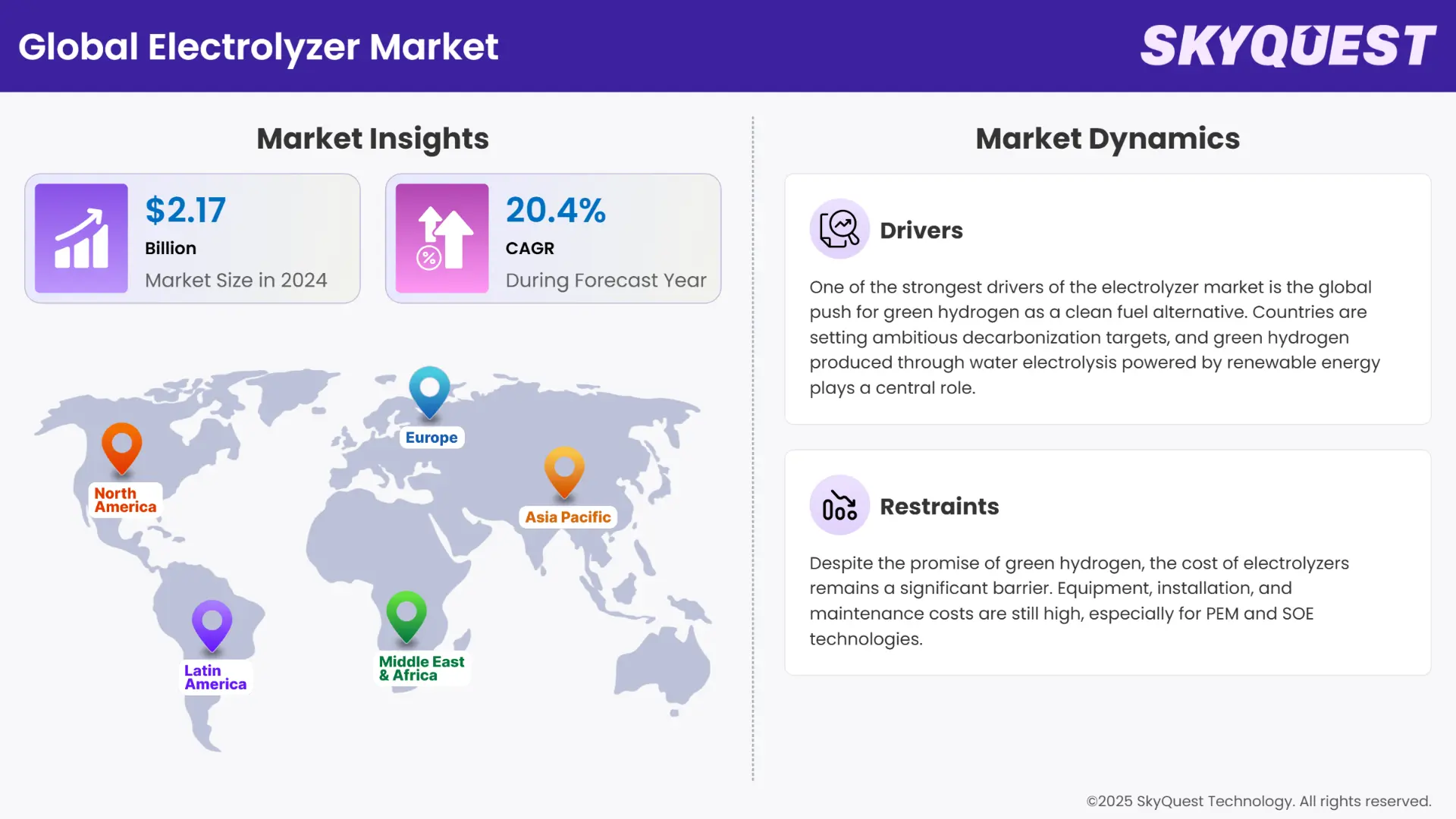
Global Electrolyzer Market size was valued at USD 2.17 Billion in 2024 and is poised to grow from USD 2.61 Billion in 2025 to USD 11.52 Billion by 2033, growing at a CAGR of 20.4% in the forecast period (2026–2033).
The global electrolyzer market is witnessing growing momentum driven by the worldwide push for clean hydrogen production. Electrolyzers, which use electricity to split water into hydrogen and oxygen, are increasingly seen as essential for decarbonizing sectors such as energy, transport, chemicals, and heavy industry. The surge in renewable energy deployment, particularly solar and wind, has further enhanced the feasibility of using electrolyzers for green hydrogen generation. This has positioned technology as a cornerstone in the transition toward net-zero emissions.
Among the major electrolyzer types, alkaline electrolyzers are currently favored due to their long-standing industrial presence and cost advantages. However, proton exchange membrane (PEM) electrolyzers are gaining prominence for their flexibility, compact design, and faster start-up capabilities, making them suitable for variable renewable energy inputs. In addition, emerging technologies such as anion exchange membrane (AEM) and solid oxide electrolyzers (SOE) are being developed to improve efficiency and reduce overall system costs, although these are still in early commercialization stages.
Key application areas span across industrial hydrogen production, mobility solutions, energy storage, and grid balancing. The integration of electrolyzers with renewable power sources enables surplus energy to be stored as hydrogen, offering a buffer for fluctuating supply and demand. Heavy industries, such as steelmaking and ammonia production, are exploring electrolyzers to replace fossil-fuel-based hydrogen with cleaner alternatives. Similarly, the use of hydrogen fuel in public transport and logistics is expanding, supported by government incentives and pilot programs.
How is AI Transforming Quality Control in Plastic Caps and Closures Production?
Artificial intelligence is increasingly transforming global markets by boosting efficiency, reshaping investment strategies, and introducing new risks and opportunities. In 2024, AI-driven trading tools gained attention for their ability to generate significant returns while managing volatility, with innovations like MarketSenseAI, a GPT-4-based system demonstrating the potential to outperform traditional strategies by analyzing complex macroeconomic data. Financial institutions such as UBS and QBE Insurance also integrated AI into their core operations; UBS used AI to streamline client onboarding and advisory tasks, while QBE improved underwriting efficiency without workforce reductions. Meanwhile, AI's disruptive power was evident when the Chinese startup DeepSeek released a low-cost, high-performing AI model, triggering a historic drop in Nvidia’s market value. On a macroeconomic level, heavy investments by major tech companies into AI infrastructure helped drive GDP growth and economic momentum.
To get more insights on this market click here to Request a Free Sample Report
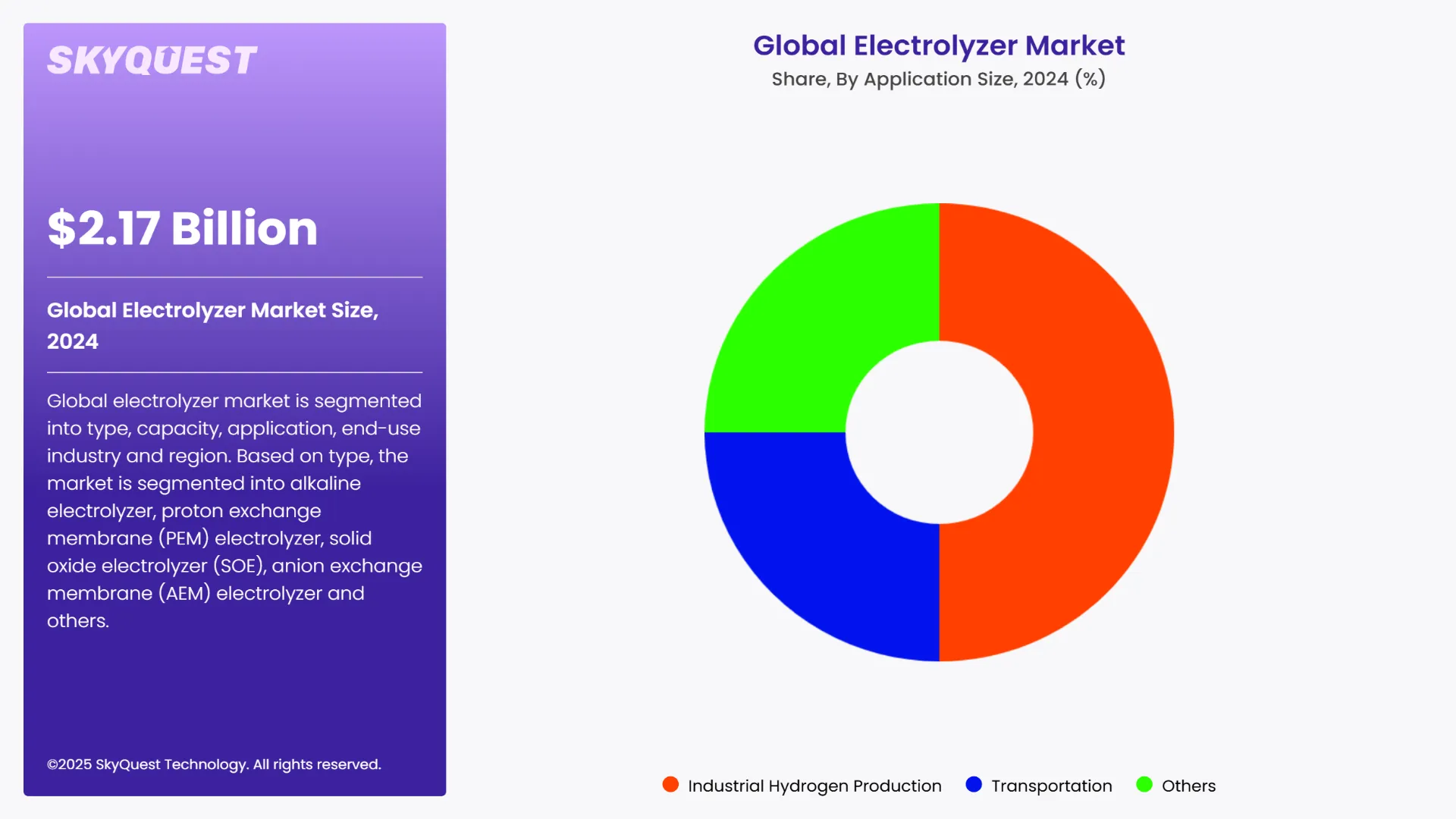
Global electrolyzer market is segmented into type, capacity, application, end-use industry and region. Based on type, the market is segmented into alkaline electrolyzer, proton exchange membrane (PEM) electrolyzer, solid oxide electrolyzer (SOE), anion exchange membrane (AEM) electrolyzer and others. Based on capacity, the market is segmented into < 500 kW, 500 kW – 2 MW and > 2 MW. Based on application, the market is segmented into industrial hydrogen production, power-to-gas, energy storage, transportation (fuel cell vehicles), ammonia and methanol production, petroleum refining and others. Based on end-use industry, the market is segmented into chemicals, power & energy, transportation, petroleum refining, steel & mining, electronics & semiconductors and others. Based on region, the market is segmented into North America, Asia Pacific, Europe, Latin America, Middle East and Africa.
Why is AEM Electrolyzer Gaining Momentum as a Hybrid Option?
Alkaline electrolyzer currently holds the dominant electrolyzer market share. Their widespread adoption is due to their long-established history, robust design, and lower capital costs. These systems are especially effective in industrial-scale hydrogen production where steady operation is preferred. Since they use inexpensive catalysts like nickel, they are more cost-efficient than other types such as PEM. Most large-scale green hydrogen projects in China and some parts of Europe continue to rely heavily on alkaline technology due to its commercial maturity and proven track record. However, they are less suitable for dynamic operations powered by intermittent renewable sources.
As per the global electrolyzer market outlook, proton exchange membrane (PEM) electrolyzer is currently the fastest-growing technology in the market. Their ability to operate under high current densities and respond rapidly to variable loads makes them ideal for coupling with renewable energy sources like solar and wind. Unlike alkaline systems, PEM electrolyzers use a solid polymer electrolyte and can start and stop quickly, offering high operational flexibility. Though they require costly materials like platinum and iridium, ongoing research is bringing down costs. Major players like Siemens Energy, Plug Power, and Ohmium are heavily investing in PEM production facilities, reflecting its accelerating adoption in both mobility and decentralized energy applications.
Why Does Industrial Hydrogen Production Dominate the Electrolyzer Market?
As per electrolyzer market forecast, industrial hydrogen production remains the dominant application of electrolyzers globally. Industries such as chemicals, fertilizers, and refineries require large volumes of hydrogen for processes like hydrocracking, desulfurization, and ammonia production. Historically, this hydrogen came from fossil fuels (grey hydrogen), but now there is a growing push to replace it with green hydrogen via electrolyzers to reduce carbon emissions. Alkaline electrolyzers are often used in these large, steady-load industrial setups due to their cost-efficiency and reliability. The well-established infrastructure and continuous hydrogen demand ensure that this segment continues to lead in market share.
As per electrolyzer market analysis, transportation, particularly the use of hydrogen in fuel cell electric vehicles (FCEVs), is the fastest-growing application segment. Countries like South Korea, Japan, Germany, and China are investing heavily in hydrogen mobility for buses, trucks, trains, and even ships. PEM electrolyzers, with their quick ramp-up times and compact footprint, are preferred for producing hydrogen used in refueling stations. While this segment is currently smaller than industrial use, rapid infrastructure expansion and government support through subsidies and zero-emission targets are accelerating adoption. As costs fall and the hydrogen supply chain matures, transportation is expected to become a major growth driver.
To get detailed segments analysis, Request a Free Sample Report
How is the Electrolyzer Market Progressing in North America?
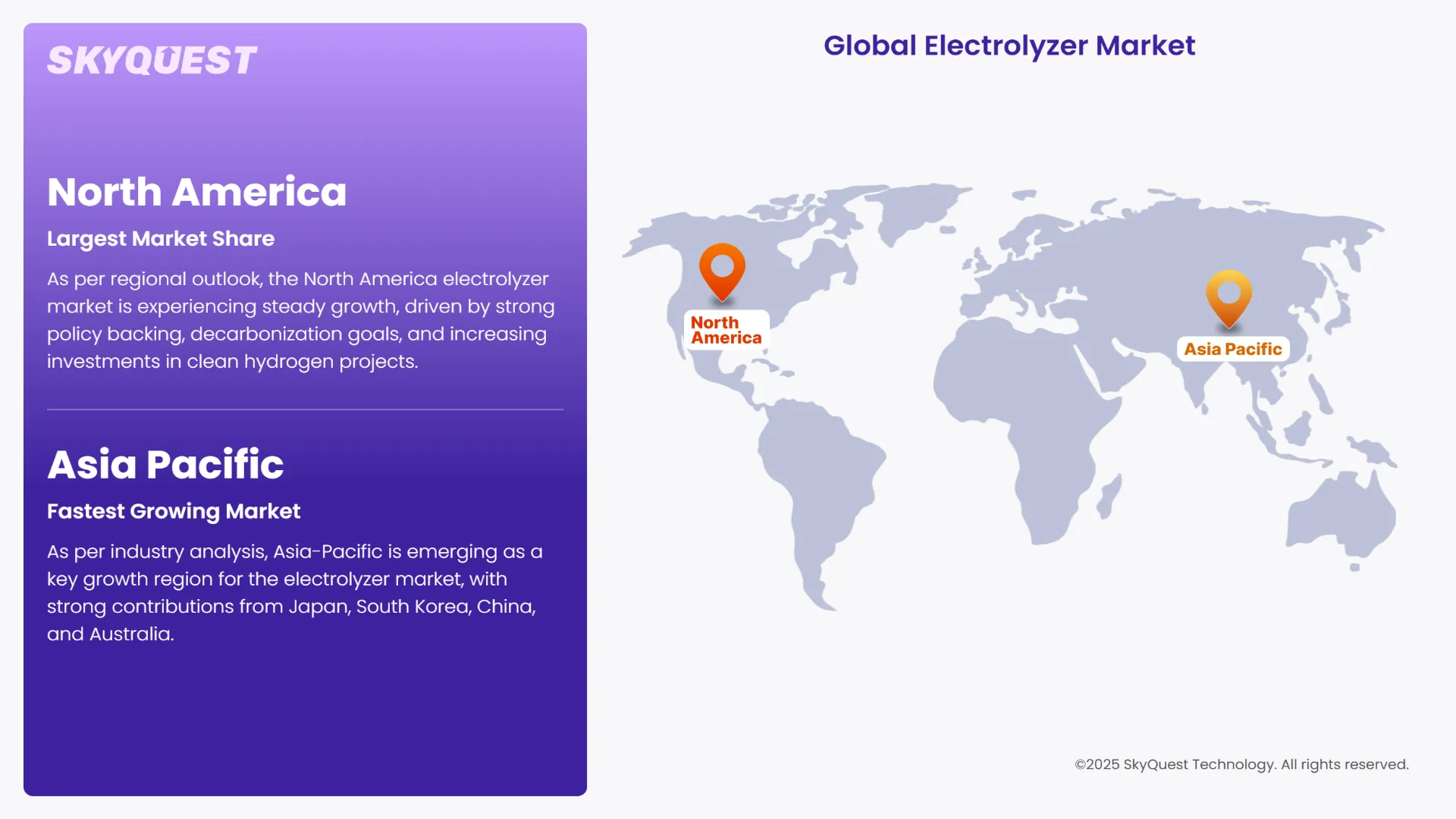
As per regional outlook, the North America electrolyzer market is experiencing steady growth, driven by strong policy backing, decarbonization goals, and increasing investments in clean hydrogen projects. The U.S. Inflation Reduction Act and Canada’s Clean Hydrogen Investment Tax Credit are boosting demand for domestic electrolyzer manufacturing and deployment. North America is also focusing on developing hydrogen hubs and green corridors to support industrial, transportation, and export applications.
Electrolyzer Market in the U.S.
As per regional analysis, in the United States, major growth is being fuelled by federal funding, such as the $8 billion allocated to regional hydrogen hubs under the Bipartisan Infrastructure Law. Companies like Plug Power, Cummins, and Bloom Energy are expanding electrolyzer production facilities. The focus is on supporting green hydrogen for power generation, mobility, and industrial decarbonization.
Electrolyzer Market in Canada
Canada is aligning its hydrogen strategy with climate goals, with significant investments in electrolyzer projects across Alberta and Quebec. The country is positioning itself as a global supplier of clean hydrogen, especially for export to Europe. Canadian players are actively adopting both alkaline and PEM electrolyzers for large-scale industrial and utility-scale applications.
What is Driving Electrolyzer Market Growth in Asia-Pacific?
As per industry analysis, Asia-Pacific is emerging as a key growth region for the electrolyzer market, with strong contributions from Japan, South Korea, China, and Australia. Governments are aggressively pushing hydrogen as a strategic energy carrier for industrial use, clean transport, and energy security. The region is witnessing increasing domestic production capabilities and pilot-scale green hydrogen projects.
Electrolyzer Market in Japan
Japan is investing heavily in hydrogen as part of its Basic Hydrogen Strategy, aiming to build a full hydrogen supply chain. The country is deploying electrolyzers in pilot projects for power-to-gas, hydrogen refuelling stations, and integration with renewables. Japanese firms like Asahi Kasei and Toshiba are advancing innovative electrolyzer technologies, including alkaline and solid oxide types.
Electrolyzer Market in South Korea
South Korea's hydrogen roadmap targets mass adoption of FCEVs and green hydrogen production. The government is supporting the development of PEM electrolyzer systems for domestic use and export. Companies like Doosan and Hyundai are involved in building integrated hydrogen production and mobility ecosystems, backed by state subsidies and public-private partnerships.
Why is Europe a Front-runner in Electrolyzer Adoption?
Europe remains at the forefront of electrolyzer deployment due to strong policy frameworks, climate targets, and leadership in green hydrogen. The European Union’s REPowerEU plan and Hydrogen Strategy are accelerating gigawatt-scale electrolyzer installations. The region supports local manufacturing, innovation, and cross-border hydrogen infrastructure development.
Electrolyzer Market in Germany
Germany leads Europe in electrolyzer installations, with aggressive targets to develop 10 GW of green hydrogen capacity by 2030. It is home to key players like Siemens Energy and Thyssenkrupp Nucera. The country is prioritizing industrial decarbonization and renewable energy integration with large-scale alkaline and PEM electrolyzer deployments.
Electrolyzer Market in the U.K.
The U.K. government has committed to doubling its hydrogen production goal to 10 GW by 2030, with at least half coming from electrolyzers. Projects such as HyNet and the Teesside Hydrogen Hub are driving demand. The focus is on leveraging offshore wind to power green hydrogen generation using PEM and alkaline electrolyzers.
Electrolyzer Market in Italy
Italy is increasingly investing in green hydrogen projects as part of its National Recovery and Resilience Plan (NRRP). The country is promoting electrolyzer use in industrial decarbonization and transportation sectors. Italian energy firms are entering partnerships to scale up local manufacturing and integrate hydrogen into existing gas infrastructure.
To know more about the market opportunities by region and country, click here to
Buy The Complete Report
Electrolyzer Market Drivers
Rising Demand for Green Hydrogen
Expanding Renewable Energy Capacity
Electrolyzer Market Restraints
High Capital and Operating Costs
Limited Hydrogen Infrastructure
Request Free Customization of this report to help us to meet your business objectives.
The global electrolyzer industry is moderately consolidated, with a mix of established industrial giants and specialized clean-tech firms competing on technological innovation, scale, and regional presence. Leading players like Nel ASA, Siemens Energy, Plug Power, and Thyssenkrupp Nucera are investing heavily in capacity expansion and partnerships to strengthen their market positions. These companies are focusing on large-scale PEM and alkaline electrolyzer projects, while emerging firms like Enapter AG and Sunfire GmbH are targeting modular and high-efficiency solutions such as AEM and SOE technologies. A key strategy observed in 2024 is the vertical integration of electrolyzer manufacturing with green hydrogen production and application.
As per market strategies, in July 2024, Ohmium International launched its second gigafactory in India, designed to produce 2 GW of PEM electrolyzers annually, with plans to integrate them into hydrogen mobility and industrial decarbonization projects.
In the dynamic electrolyzer market, a new wave of startups is emerging with innovative technologies aimed at improving efficiency, modularity, and cost-effectiveness. Companies like Enapter AG are pioneering anion exchange membrane (AEM) electrolyzers, which offer a balance between the low cost of alkaline systems and the flexibility of PEM systems, making them suitable for decentralized and small-scale hydrogen production. Another notable startup is Sunfire GmbH, which focuses on solid oxide electrolyzer cells (SOEC) a high-efficiency technology that operates at elevated temperatures, ideal for integration with industrial heat processes.
Top Player’s Company Profiles
Recent Developments in Electrolyzer Market
SkyQuest’s ABIRAW (Advanced Business Intelligence, Research & Analysis Wing) is our Business Information Services team that Collects, Collates, Correlates, and Analyses the Data collected by means of Primary Exploratory Research backed by robust Secondary Desk research.
According to SkyQuest analysis, the market growth is fueled by rising green hydrogen demand, supportive clean energy policies, and increasing fuel cell vehicle adoption. Technological advancements in electrolyzers, strategic collaborations, and growing investments in Asia Pacific’s power generation further drive expansion across industrial and mobility sectors. The market is undergoing considerable expansion, fueled by the rising need for clean energy options and the international movement toward decarbonization. Electrolyzers play a crucial role in generating green hydrogen by separating water into hydrogen and oxygen using electricity derived from renewable resources.
| Report Metric | Details |
|---|---|
| Market size value in 2024 | USD 2.17 Billion |
| Market size value in 2033 | USD 11.52 Billion |
| Growth Rate | 20.4% |
| Base year | 2024 |
| Forecast period | 2026–2033 |
| Forecast Unit (Value) | USD Billion |
| Segments covered |
|
| Regions covered | North America (US, Canada), Europe (Germany, France, United Kingdom, Italy, Spain, Rest of Europe), Asia Pacific (China, India, Japan, Rest of Asia-Pacific), Latin America (Brazil, Rest of Latin America), Middle East & Africa (South Africa, GCC Countries, Rest of MEA) |
| Companies covered |
|
| Customization scope | Free report customization with purchase. Customization includes:-
|
To get a free trial access to our platform which is a one stop solution for all your data requirements for quicker decision making. This platform allows you to compare markets, competitors who are prominent in the market, and mega trends that are influencing the dynamics in the market. Also, get access to detailed SkyQuest exclusive matrix.
Table Of Content
Executive Summary
Market overview
Parent Market Analysis
Market overview
Market size
KEY MARKET INSIGHTS
COVID IMPACT
MARKET DYNAMICS & OUTLOOK
Market Size by Region
KEY COMPANY PROFILES
Methodology
For the Electrolyzer Market, our research methodology involved a mixture of primary and secondary data sources. Key steps involved in the research process are listed below:
1. Information Procurement: This stage involved the procurement of Market data or related information via primary and secondary sources. The various secondary sources used included various company websites, annual reports, trade databases, and paid databases such as Hoover's, Bloomberg Business, Factiva, and Avention. Our team did 45 primary interactions Globally which included several stakeholders such as manufacturers, customers, key opinion leaders, etc. Overall, information procurement was one of the most extensive stages in our research process.
2. Information Analysis: This step involved triangulation of data through bottom-up and top-down approaches to estimate and validate the total size and future estimate of the Electrolyzer Market.
3. Report Formulation: The final step entailed the placement of data points in appropriate Market spaces in an attempt to deduce viable conclusions.
4. Validation & Publishing: Validation is the most important step in the process. Validation & re-validation via an intricately designed process helped us finalize data points to be used for final calculations. The final Market estimates and forecasts were then aligned and sent to our panel of industry experts for validation of data. Once the validation was done the report was sent to our Quality Assurance team to ensure adherence to style guides, consistency & design.
Analyst Support
Customization Options
With the given market data, our dedicated team of analysts can offer you the following customization options are available for the Electrolyzer Market:
Product Analysis: Product matrix, which offers a detailed comparison of the product portfolio of companies.
Regional Analysis: Further analysis of the Electrolyzer Market for additional countries.
Competitive Analysis: Detailed analysis and profiling of additional Market players & comparative analysis of competitive products.
Go to Market Strategy: Find the high-growth channels to invest your marketing efforts and increase your customer base.
Innovation Mapping: Identify racial solutions and innovation, connected to deep ecosystems of innovators, start-ups, academics, and strategic partners.
Category Intelligence: Customized intelligence that is relevant to their supply Markets will enable them to make smarter sourcing decisions and improve their category management.
Public Company Transcript Analysis: To improve the investment performance by generating new alpha and making better-informed decisions.
Social Media Listening: To analyze the conversations and trends happening not just around your brand, but around your industry as a whole, and use those insights to make better Marketing decisions.
REQUEST FOR SAMPLE
 REQUEST FREE CUSTOMIZATION
Global Electrolyzer Market size was valued at USD 2.17 Billion in 2024 and is poised to grow from USD 2.61 Billion in 2025 to USD 11.52 Billion by 2033, growing at a CAGR of 20.4% in the forecast period (2026–2033).
The global electrolyzer industry is moderately consolidated, with a mix of established industrial giants and specialized clean-tech firms competing on technological innovation, scale, and regional presence. Leading players like Nel ASA, Siemens Energy, Plug Power, and Thyssenkrupp Nucera are investing heavily in capacity expansion and partnerships to strengthen their market positions. These companies are focusing on large-scale PEM and alkaline electrolyzer projects, while emerging firms like Enapter AG and Sunfire GmbH are targeting modular and high-efficiency solutions such as AEM and SOE technologies. A key strategy observed in 2024 is the vertical integration of electrolyzer manufacturing with green hydrogen production and application. 'BPCL', 'Nel ASA', 'GAIL (India) Limited', 'Ohmium International', 'ITM Power Plc', 'Cummins Inc.', 'Siemens Energy', 'Thyssenkrupp Nucera', 'Plug Power Inc.', 'Bloom Energy', 'McPhy Energy', 'Enapter AG', 'Sunfire GmbH', 'Asahi Kasei', 'Air Liquide'
One of the strongest drivers of the electrolyzer market is the global push for green hydrogen as a clean fuel alternative. Countries are setting ambitious decarbonization targets, and green hydrogen produced through water electrolysis powered by renewable energy plays a central role. It offers a zero-emission solution for sectors that are hard to electrify, such as steel, cement, chemicals, and heavy transport. Government subsidies, national hydrogen strategies (in EU, Japan, India, etc.), and private investments are accelerating electrolyzer deployments to meet this demand.
Technological Advancements and Hybrid Systems: The market is seeing rapid innovation in electrolyzer technology. Apart from traditional alkaline and PEM models, solid oxide electrolyzers (SOE) and anion exchange membrane (AEM) types are being explored for higher efficiency and fuel flexibility. Additionally, hybrid systems that combine electrolyzers with battery storage or solar PV units are gaining traction, especially in off-grid or industrial setups. These innovations aim to lower costs and improve system responsiveness, paving the way for wider deployment.
How is the Electrolyzer Market Progressing in North America?


Want to customize this report? This report can be personalized according to your needs. Our analysts and industry experts will work directly with you to understand your requirements and provide you with customized data in a short amount of time. We offer $1000 worth of FREE customization at the time of purchase.
Feedback From Our Clients


 USA (+1) 351-333-4748

