Enterprise Asset Management Market
Report ID: SQMIG45E2367
Report ID: SQMIG45E2367
[email protected]
USA +1 351-333-4748
Report ID:
SQMIG45E2367 |
Region:
Global |
Published Date: June, 2025
Pages:
192
|Tables:
91
|Figures:
71


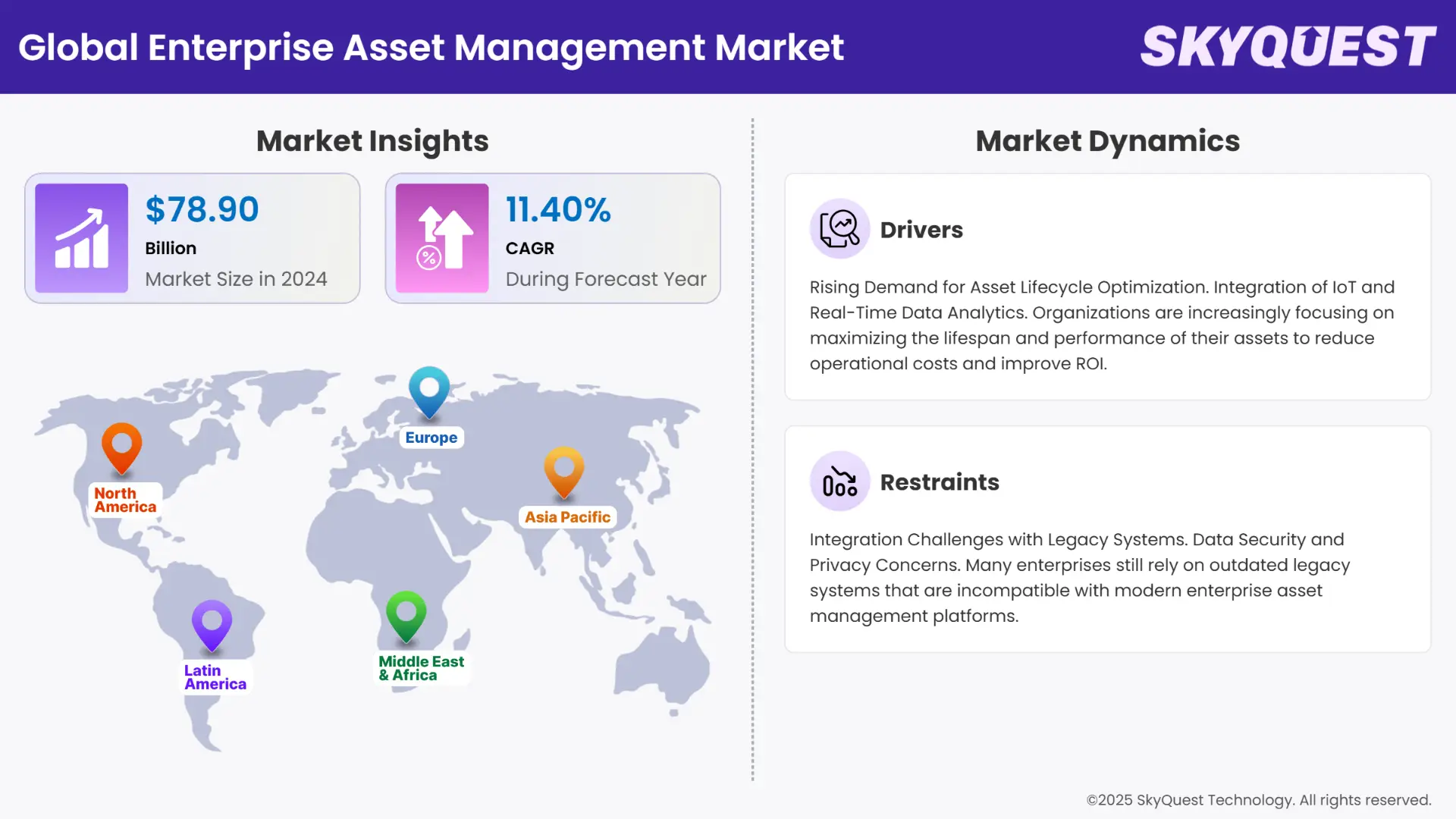
Global Enterprise Asset Management Market size was valued at USD 78.90 Billion in 2024 and is poised to grow from USD 87.89 Billion in 2025 to USD 208.47 Billion by 2033, growing at a CAGR of 11.4% in the forecast period (2026–2033).
The global Enterprise Asset Management market is primarily driven by the increasing need for predictive maintenance across industries. Traditional reactive maintenance methods often lead to unexpected equipment failures, resulting in costly downtimes and productivity losses. enterprise asset management solutions integrated with IoT sensors and AI analytics enable businesses to continuously monitor asset health and performance. By identifying potential issues before they escalate, companies can schedule maintenance activities more efficiently, reduce repair costs, and prolong asset lifespan. This predictive approach not only ensures higher asset availability but also enhances operational planning and resource allocation, significantly boosting the adoption of enterprise asset management systems globally.
A key trend driving the global enterprise asset management sector is the widespread shift toward cloud-based platforms. Unlike traditional on-premises systems, cloud-based enterprise asset management solutions offer greater scalability, real-time accessibility, and lower initial investment, making them highly attractive to both large enterprises and small-to-medium businesses. These platforms facilitate seamless updates, faster deployment, and integration with other digital tools, such as ERP and mobile apps, enabling decentralized teams to manage assets across multiple locations. The flexibility and cost-effectiveness of cloud-based enterprise asset management support digital transformation initiatives, helping organizations enhance operational agility and asset visibility, thereby accelerating market expansion.
How do AI-Enabled Enterprise Asset Managment Systems Influence Capital Planning and Budgeting Decisions?
Artificial Intelligence (AI) is significantly transforming the global enterprise asset management market by enabling smarter, data-driven asset decisions. Through machine learning algorithms and real-time analytics, AI helps predict equipment failures, optimize maintenance schedules, and automate routine tasks. This reduces unplanned downtime and extends asset life, improving operational efficiency. AI also enhances decision-making by analyzing vast historical and sensor data to uncover patterns and risks. For instance, IBM’s Maximo Application Suite integrates AI to deliver predictive maintenance insights and automate workflows. As AI capabilities mature, organizations increasingly adopt AI-enabled enterprise asset management systems to boost productivity and minimize maintenance costs, driving market growth.
In October 2024, IFS Ultimo integrated AI and large language models (LLMs) into its Enterprise Asset Management platform. This development enables automated failure diagnostics, streamlines maintenance workflows, and reduces the mean time to repair (MTTR). The AI-powered system enhances operational efficiency by minimizing equipment downtime and improving decision-making in asset management.
To get more insights on this market click here to Request a Free Sample Report
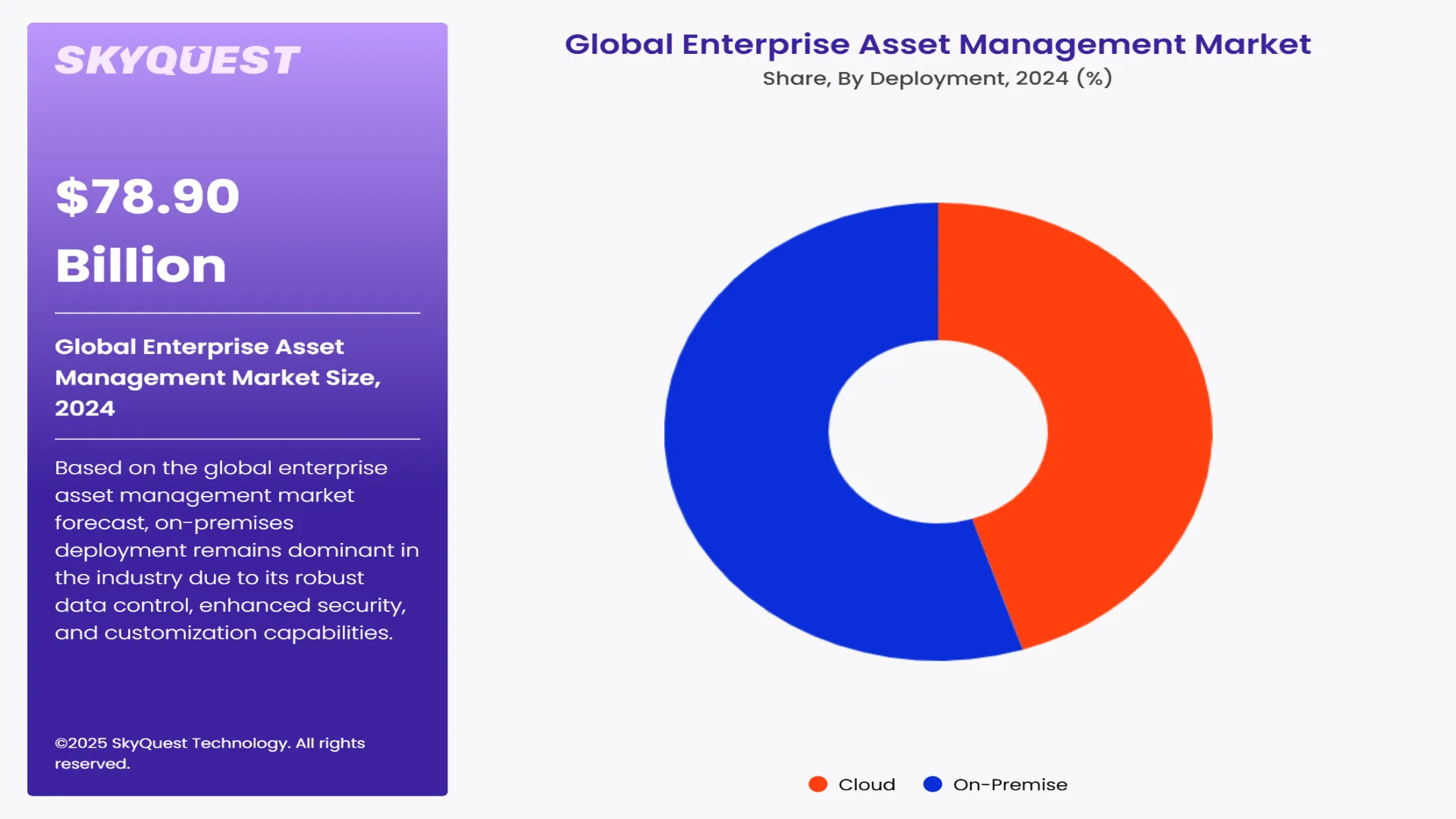
The global enterprise asset management market is segmented based on deployment, enterprise size, end use, and region. In terms of deployment, the market is divided into clouds and on-premises. Based on enterprise size, the market is divided into large enterprises and small and medium enterprises. Based on end use, the market is segmented into facility management, manufacturing, education, healthcare, government, and others. Based on region, the market is segmented into North America, Europe, Asia-Pacific, Central & South America and the Middle East & Africa.
Based on the global enterprise asset management market forecast, on-premises deployment remains dominant in the industry due to its robust data control, enhanced security, and customization capabilities. Industries with strict regulatory requirements—such as oil & gas, utilities, and manufacturing—prefer on-premises systems for critical asset operations. Current innovations focus on integrating AI and IoT locally to improve real-time monitoring, while maintaining full ownership of infrastructure and sensitive operational data.
Cloud deployment is the fastest growing segment in the global enterprise asset management market due to its scalability, lower upfront costs, and remote accessibility. It enables real-time data integration, faster implementation, and seamless updates. As businesses prioritize agility and digital transformation, cloud-based enterprise asset management solutions are increasingly favoured across diverse industries.
Large enterprises are leading innovation and usage in the global enterprise asset management market by deploying AI-driven analytics, predictive maintenance, and IoT integration at scale. Their extensive asset portfolios—spanning plants, fleets, and infrastructure—demand advanced enterprise asset management platforms capable of handling high data volumes and complex workflows. Their financial resources support tailored implementations, deep ERP integration, and in-house expertise. This combination of scale, capability, and demand enables large enterprises to dominate the market.
Small & medium enterprises are the fastest-growing segment in the global enterprise asset management market due to their increasing adoption of affordable, cloud-based enterprise asset management solutions. With lower upfront costs, easy implementation, and scalable features, these platforms support their digital transformation. As SMEs modernize operations and expand, flexible enterprise asset management tools become essential for efficient asset management.
To get detailed segments analysis, Request a Free Sample Report
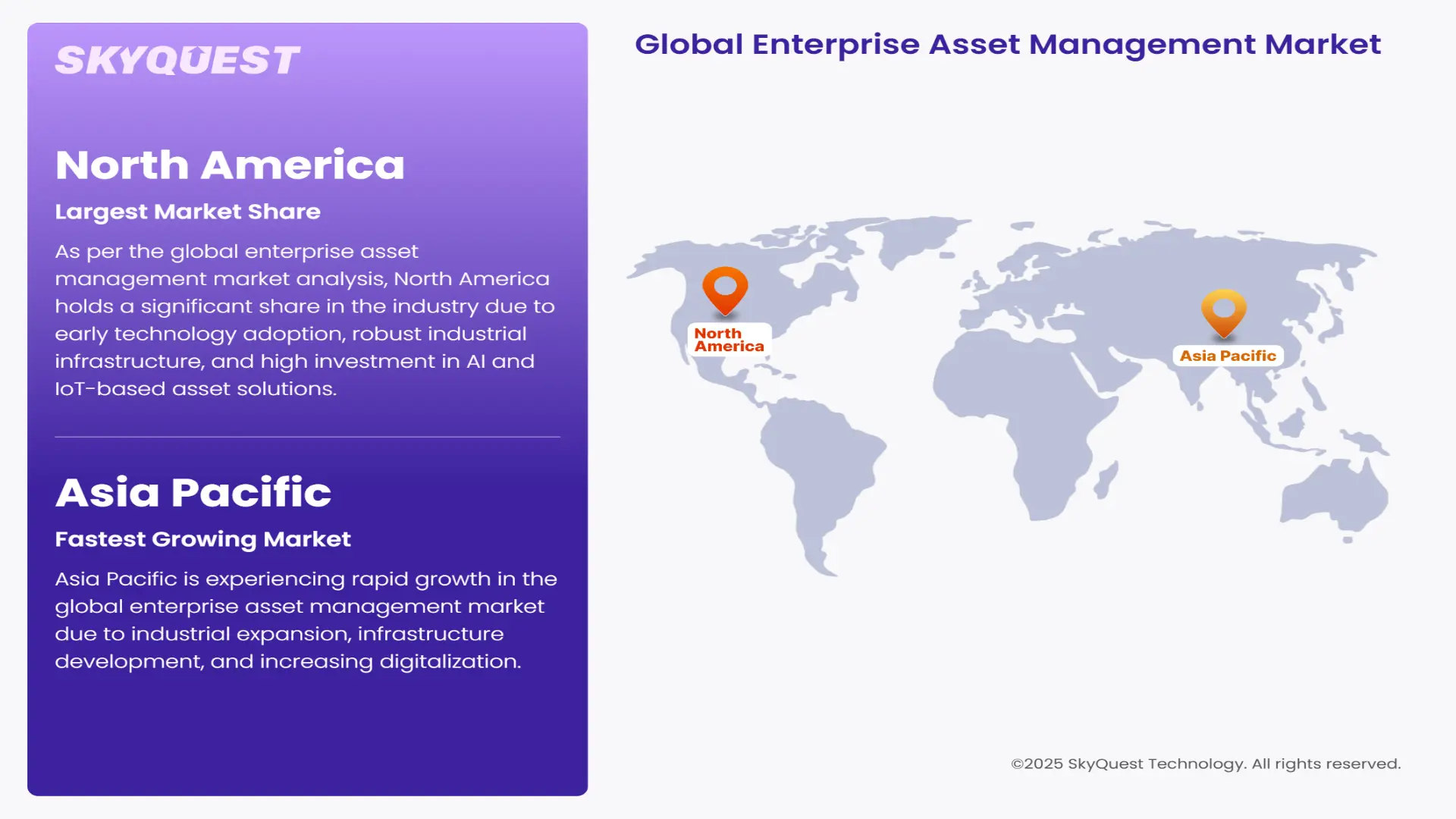
As per the global enterprise asset management market analysis, North America holds a significant share in the industry due to early technology adoption, robust industrial infrastructure, and high investment in AI and IoT-based asset solutions. Sectors like manufacturing, energy, and utilities drive demand for predictive maintenance and lifecycle asset optimization. Additionally, the presence of major enterprise asset management providers and growing interest in cloud-based platforms further support market expansion across the U.S. and Canada.
The United States leads North America’s enterprise asset management market due to its advanced industrial base, high digitalization levels, and strong demand for predictive maintenance across sectors like manufacturing, oil & gas, and utilities. U.S. enterprises invest heavily in AI, IoT, and cloud technologies to enhance asset performance. Additionally, the presence of leading enterprise asset management vendors fosters innovation and widespread adoption of sophisticated, scalable asset management solutions nationwide.
Canada contributes significantly to North America’s enterprise asset management market through its focus on infrastructure modernization, energy efficiency, and regulatory compliance in industries such as mining, transportation, and utilities. Canadian enterprises increasingly adopt cloud-based and mobile-friendly enterprise asset management platforms to manage dispersed assets across vast geographies. Government-backed digital transformation initiatives and sustainability goals further encourage Canadian businesses to embrace smart asset management technologies for improved operational control and lifecycle cost reduction.
Asia Pacific is experiencing rapid growth in the global enterprise asset management market due to industrial expansion, infrastructure development, and increasing digitalization. Countries like China, Japan, India, and Australia are investing in predictive maintenance and IoT-enabled asset tracking across sectors such as manufacturing, energy, and transportation. Government initiatives supporting smart industry and urban development, along with rising adoption of cloud-based enterprise asset management solutions, are accelerating market growth across the regional analysis.
Japan contributes significantly to the Asia Pacific enterprise asset management market through its advanced manufacturing sector and strong focus on automation and precision. Japanese companies leverage AI, IoT, and robotics integrated with enterprise asset management systems to improve asset performance and minimize downtime. With a national emphasis on smart factories and aging infrastructure management, industries such as automotive, electronics, and public utilities are driving the adoption of predictive and preventive asset management technologies.
South Korea plays a key role in the Asia Pacific enterprise asset management market with its high-tech industrial landscape and strong government support for digital innovation. Leading sectors like electronics, shipbuilding, and energy are integrating cloud-based and AI-powered enterprise asset management solutions to enhance asset reliability and efficiency. The country’s aggressive push toward smart manufacturing and digital infrastructure is fostering widespread adoption of advanced asset management systems across both public and private enterprises.
Europe’s enterprise asset management market is driven by strict regulatory compliance, emphasis on sustainability, and widespread digital transformation across industries. Countries like Germany, the UK, and France are adopting advanced enterprise asset management solutions in manufacturing, energy, and transportation sectors. The region’s focus on predictive maintenance, asset lifecycle optimization, and integration of AI and IoT technologies supports market growth, while increasing cloud adoption accelerates digital asset management strategies across the continent.
Germany plays a vital role in the Europe’s enterprise asset management market due to its strong manufacturing and industrial base. German firms prioritize precision, efficiency, and predictive maintenance, driving demand for advanced enterprise asset management systems. Integration of Industry 4.0, IoT, and AI in asset-intensive sectors such as automotive and engineering enhances operational performance. Government incentives for digital transformation further accelerate enterprise asset management adoption among enterprises seeking optimized asset lifecycle management.
France contributes to the Europe’s enterprise asset management market through its focus on infrastructure modernization, energy transition, and industrial automation. French companies in sectors like energy, transportation, and public utilities increasingly invest in enterprise asset management to ensure regulatory compliance and asset reliability. The government's push for smart city development and sustainability encourages the integration of cloud-based and AI-driven enterprise asset management platforms, improving asset visibility and efficiency across municipal and corporate operations.
The UK supports Europe’s enterprise asset management market growth through advanced infrastructure, strong financial services, and a focus on digital transformation. British companies in sectors such as utilities, transport, and defense are increasingly adopting enterprise asset management for compliance, cost efficiency, and predictive maintenance. Cloud and mobile enterprise asset management platforms are gaining traction, especially among enterprises managing geographically dispersed assets. The UK’s innovation-friendly ecosystem and government-backed digital initiatives further boost enterprise asset management implementation across industries.
To know more about the market opportunities by region and country, click here to
Buy The Complete Report
Rising Demand for Asset Lifecycle Optimization
Integration of IoT and Real-Time Data Analytics
Integration Challenges with Legacy Systems
Data Security and Privacy Concerns
Request Free Customization of this report to help us to meet your business objectives.
The global enterprise asset management market outlook is competitive, and it is marked by innovation, strategic partnerships, and cloud integration. Key international players include IBM Corporation, SAP SE, Oracle Corporation, Infor, and IFS AB. IBM focuses on AI-enabled predictive maintenance through its Maximo suite, while SAP integrates enterprise asset management with ERP systems. IFS emphasizes industry-specific solutions, and Oracle enhances its cloud-first strategy. These companies compete through technology upgrades, global expansions, and tailored service offerings.
As per the global enterprise asset management industry analysis, the startup landscape in the industry is rapidly evolving, fueled by industrial digitalization and the demand for intelligent, scalable solutions. Startups are leveraging AI, IoT, and cloud computing to develop predictive maintenance tools, real-time asset monitoring, and mobile-first platforms. These agile companies are gaining traction by addressing gaps in legacy systems, offering cost-effective solutions, and forming strategic partnerships with enterprises seeking digital transformation in asset management.
SkyQuest’s ABIRAW (Advanced Business Intelligence, Research & Analysis Wing) is our Business Information Services team that Collects, Collates, Correlates, and Analyses the Data collected by means of Primary Exploratory Research backed by robust Secondary Desk research.
As per SkyQuest analysis, the global enterprise asset management industry is undergoing transformative growth driven by predictive maintenance needs, AI integration, and cloud adoption. Organizations are shifting from reactive to proactive asset strategies, leveraging technologies like IoT and AI to reduce downtime and enhance operational efficiency. While large enterprises dominate due to scale and investment capacity, SMEs are emerging as fast adopters through affordable cloud solutions.
Despite security and integration challenges, innovations—especially AI-powered platforms and predictive analytics—are reshaping enterprise asset management capabilities. Regional markets such as North America, Europe, and Asia-Pacific are advancing rapidly due to industrial modernization and digital transformation. With evolving deployment models, competitive innovation, and growing startup contributions, the global enterprise asset management market strategy is positioned for continued expansion and technological evolution across industries worldwide.
| Report Metric | Details |
|---|---|
| Market size value in 2024 | USD 78.90 Billion |
| Market size value in 2033 | USD 208.47 Billion |
| Growth Rate | 11.4% |
| Base year | 2024 |
| Forecast period | 2026-2033 |
| Forecast Unit (Value) | USD Billion |
| Segments covered |
|
| Regions covered | North America (US, Canada), Europe (Germany, France, United Kingdom, Italy, Spain, Rest of Europe), Asia Pacific (China, India, Japan, Rest of Asia-Pacific), Latin America (Brazil, Rest of Latin America), Middle East & Africa (South Africa, GCC Countries, Rest of MEA) |
| Companies covered |
|
| Customization scope | Free report customization with purchase. Customization includes:-
|
To get a free trial access to our platform which is a one stop solution for all your data requirements for quicker decision making. This platform allows you to compare markets, competitors who are prominent in the market, and mega trends that are influencing the dynamics in the market. Also, get access to detailed SkyQuest exclusive matrix.
Table Of Content
Executive Summary
Market overview
Parent Market Analysis
Market overview
Market size
KEY MARKET INSIGHTS
COVID IMPACT
MARKET DYNAMICS & OUTLOOK
Market Size by Region
KEY COMPANY PROFILES
Methodology
For the Enterprise Asset Management Market, our research methodology involved a mixture of primary and secondary data sources. Key steps involved in the research process are listed below:
1. Information Procurement: This stage involved the procurement of Market data or related information via primary and secondary sources. The various secondary sources used included various company websites, annual reports, trade databases, and paid databases such as Hoover's, Bloomberg Business, Factiva, and Avention. Our team did 45 primary interactions Globally which included several stakeholders such as manufacturers, customers, key opinion leaders, etc. Overall, information procurement was one of the most extensive stages in our research process.
2. Information Analysis: This step involved triangulation of data through bottom-up and top-down approaches to estimate and validate the total size and future estimate of the Enterprise Asset Management Market.
3. Report Formulation: The final step entailed the placement of data points in appropriate Market spaces in an attempt to deduce viable conclusions.
4. Validation & Publishing: Validation is the most important step in the process. Validation & re-validation via an intricately designed process helped us finalize data points to be used for final calculations. The final Market estimates and forecasts were then aligned and sent to our panel of industry experts for validation of data. Once the validation was done the report was sent to our Quality Assurance team to ensure adherence to style guides, consistency & design.
Analyst Support
Customization Options
With the given market data, our dedicated team of analysts can offer you the following customization options are available for the Enterprise Asset Management Market:
Product Analysis: Product matrix, which offers a detailed comparison of the product portfolio of companies.
Regional Analysis: Further analysis of the Enterprise Asset Management Market for additional countries.
Competitive Analysis: Detailed analysis and profiling of additional Market players & comparative analysis of competitive products.
Go to Market Strategy: Find the high-growth channels to invest your marketing efforts and increase your customer base.
Innovation Mapping: Identify racial solutions and innovation, connected to deep ecosystems of innovators, start-ups, academics, and strategic partners.
Category Intelligence: Customized intelligence that is relevant to their supply Markets will enable them to make smarter sourcing decisions and improve their category management.
Public Company Transcript Analysis: To improve the investment performance by generating new alpha and making better-informed decisions.
Social Media Listening: To analyze the conversations and trends happening not just around your brand, but around your industry as a whole, and use those insights to make better Marketing decisions.
REQUEST FOR SAMPLE
 REQUEST FREE CUSTOMIZATION


Want to customize this report? This report can be personalized according to your needs. Our analysts and industry experts will work directly with you to understand your requirements and provide you with customized data in a short amount of time. We offer $1000 worth of FREE customization at the time of purchase.
Feedback From Our Clients


 USA (+1) 351-333-4748

