Food Safety Testing Market
Report ID: SQMIG20Q2012
Report ID: SQMIG20Q2012
[email protected]
USA +1 351-333-4748
Report ID:
SQMIG20Q2012 |
Region:
Global |
Published Date: July, 2025
Pages:
179
|Tables:
135
|Figures:
77


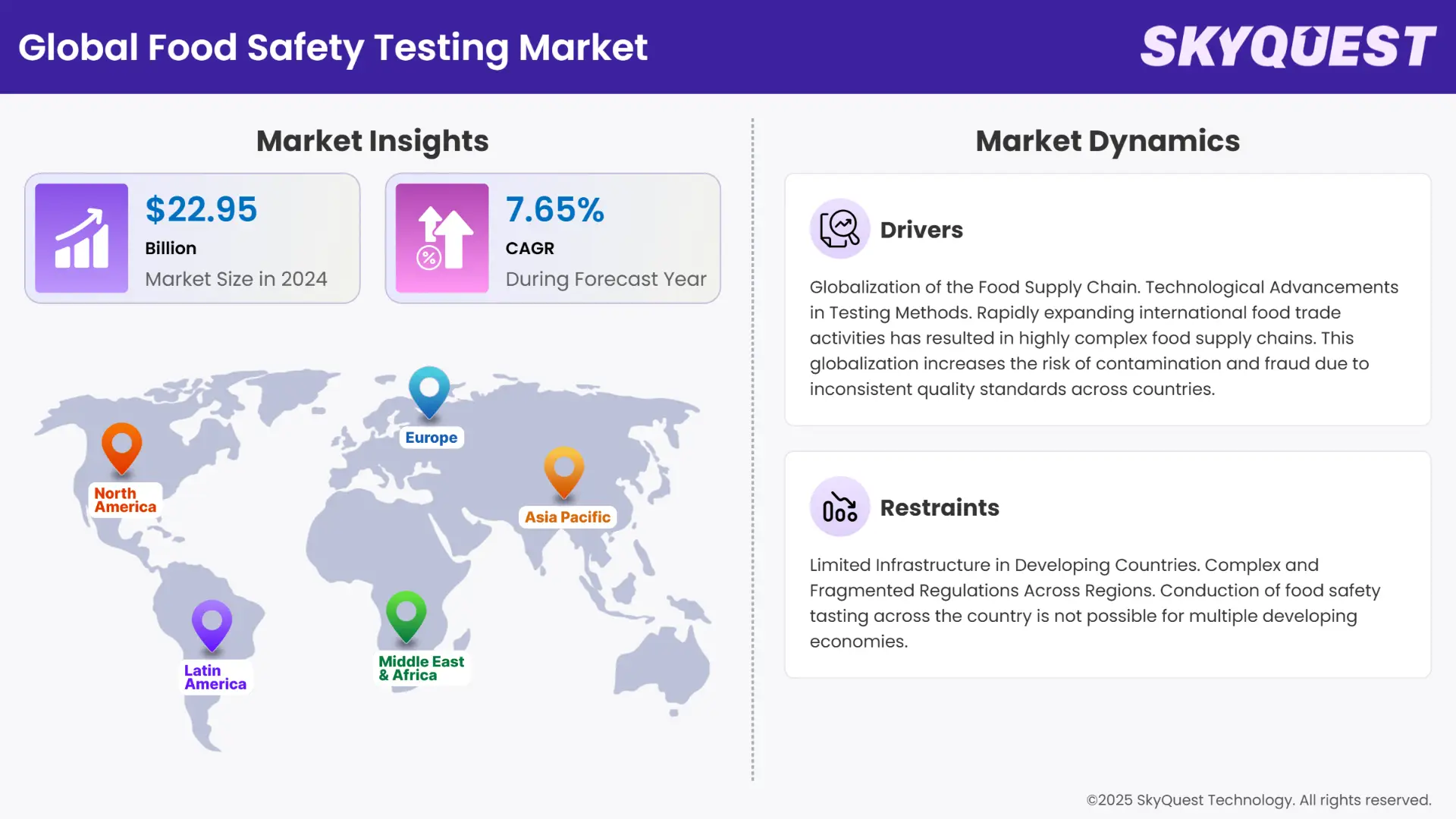
Global Food Safety Testing Market Size was valued at USD 22.94 Billion in 2024 and is poised to grow from USD 24.7 Billion in 2025 to USD 44.54 Billion by 2033, growing at a CAGR of 7.65% during the forecast period (2026–2033).
Growing prevalence of foodborne illnesses, imposition of stringent regulations, high demand for processed and packaged food products, globalization of food supply chain, and rising consumer awareness and demand for transparency are slated to drive the demand for food safety testing going forward.
The growing number of foodborne disease outbreaks has heightened global awareness around food safety. Contaminants like Salmonella, Listeria, and E. coli are linked to serious health issues. Governments and food safety authorities worldwide, such as the FDA (U.S.), EFSA (Europe), and FSSAI (India), have implemented rigorous food testing protocols to ensure consumer protection. The increasing consumption of packaged and ready-to-eat food products, especially in urban centers, drives the need for food safety testing. Consumers today are more informed and health-conscious, demanding clarity about food origins, ingredients, and safety. This pressure from end users forces manufacturers and retailers to invest in reliable food safety testing protocols, thereby expanding the food safety testing market growth.
On the contrary, high costs of advanced testing technologies, complex regulations across regions, limited infrastructure in developing countries, and time-consuming nature of traditional testing methods are anticipated to slow down food safety testing market penetration across the study period and beyond.
How Digital Technologies are Impacting the Food safety testing Business?
Food producers are increasingly integrating blockchain and digital traceability technologies to improve supply chain transparency and trust. These systems record every step in the food lifecycle, from farm to fork, enabling real-time tracking of contamination sources and verification of testing records. Blockchain ensures data integrity, while AI and IoT sensors automate monitoring of temperature, hygiene, and safety conditions. When combined with food safety testing results, these platforms offer a tamper-proof digital record, useful for audits and recalls. This trend is especially prominent in global trade, where provenance verification and safety compliance are critical. It enhances accountability, efficiency, and consumer confidence.
To get more insights on this market click here to Request a Free Sample Report
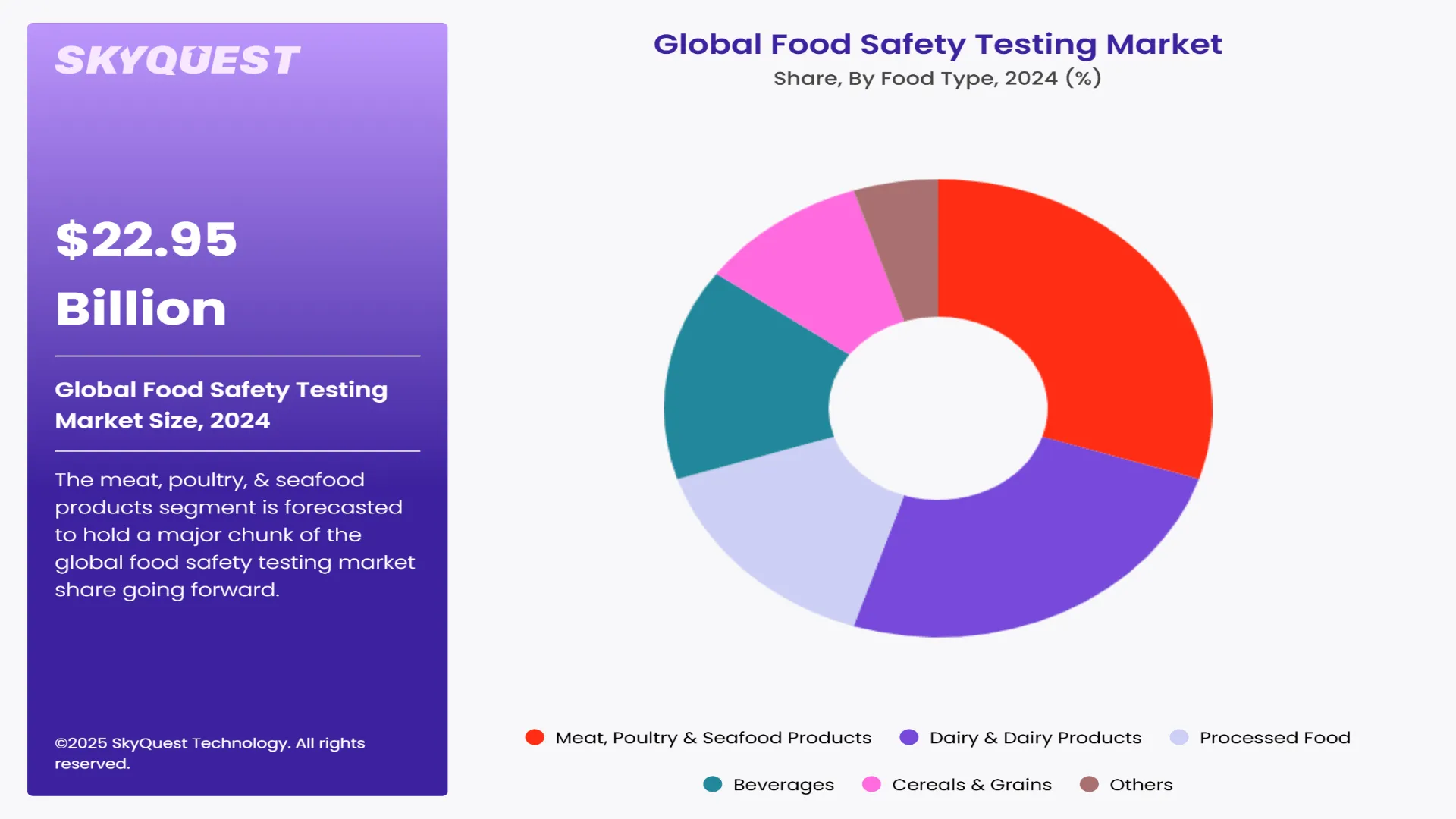
The global food safety testing market is segmented by food type, contaminant, test type, technology, and region. Based on food type, the market is segmented into meat, poultry, & seafood products, dairy & dairy products, processed food, beverages, cereals & grains, and others. Based on test type, the market is segmented into allergen testing, chemical & nutritional testing, genetically modified organism (GMO) testing, microbiological testing, residues & contamination testing, and others. Based on technology, the market is segmented into traditional, rapid (convenience-based, polymerase chain reaction (PCR), immunoassay), and chromatography & spectrometry. Based on contaminant, the market is segmented into pathogens (E. coli, Salmonella, Campylobacter, Listeria, Others), pesticides, GMOs, mycotoxin, allergens, heavy metals, and others. Based on region, the market is segmented into North America, Europe, Asia Pacific, Latin America, and Middle East & Africa.
Which Type of Food Safety Testing is Highly Popular?
The microbiological testing segment is slated to spearhead the global food safety testing market revenue generation potential in the future. Growing emphasis on detection of harmful microorganisms in food items using biological, molecular, and biochemical methods is helping bolster the dominance of this type testing.
Meanwhile, the demand for genetically modified organism (GMO) testing is slated to rise at a robust pace over the coming years. Rising consumer awareness regarding the presence of harmful GMOs in food products and high preference for non-GMO food are helping create new opportunities via this segment.
Demand for Safety Testing of Which Food Products is High?
The meat, poultry, & seafood products segment is forecasted to hold a major chunk of the global food safety testing market share going forward. Surge in demand for animal protein around the world and high adoption of processed meat in foodservice industry are helping this segment hold sway over others. Growing awareness regarding foodborne illnesses associated with animal product consumption is also helping bolster the dominance of this segment.
On the other hand, the demand for food safety testing for dairy & dairy products is slated to rise at an impressive CAGR as per this food safety testing industry analysis. High incidence of lactose intolerance around the world is expected to help create new opportunities for food safety testing companies focusing on this segment.
To get detailed segments analysis, Request a Free Sample Report
Why North America Leads Food Safety Testing Adoption on a Global Level?
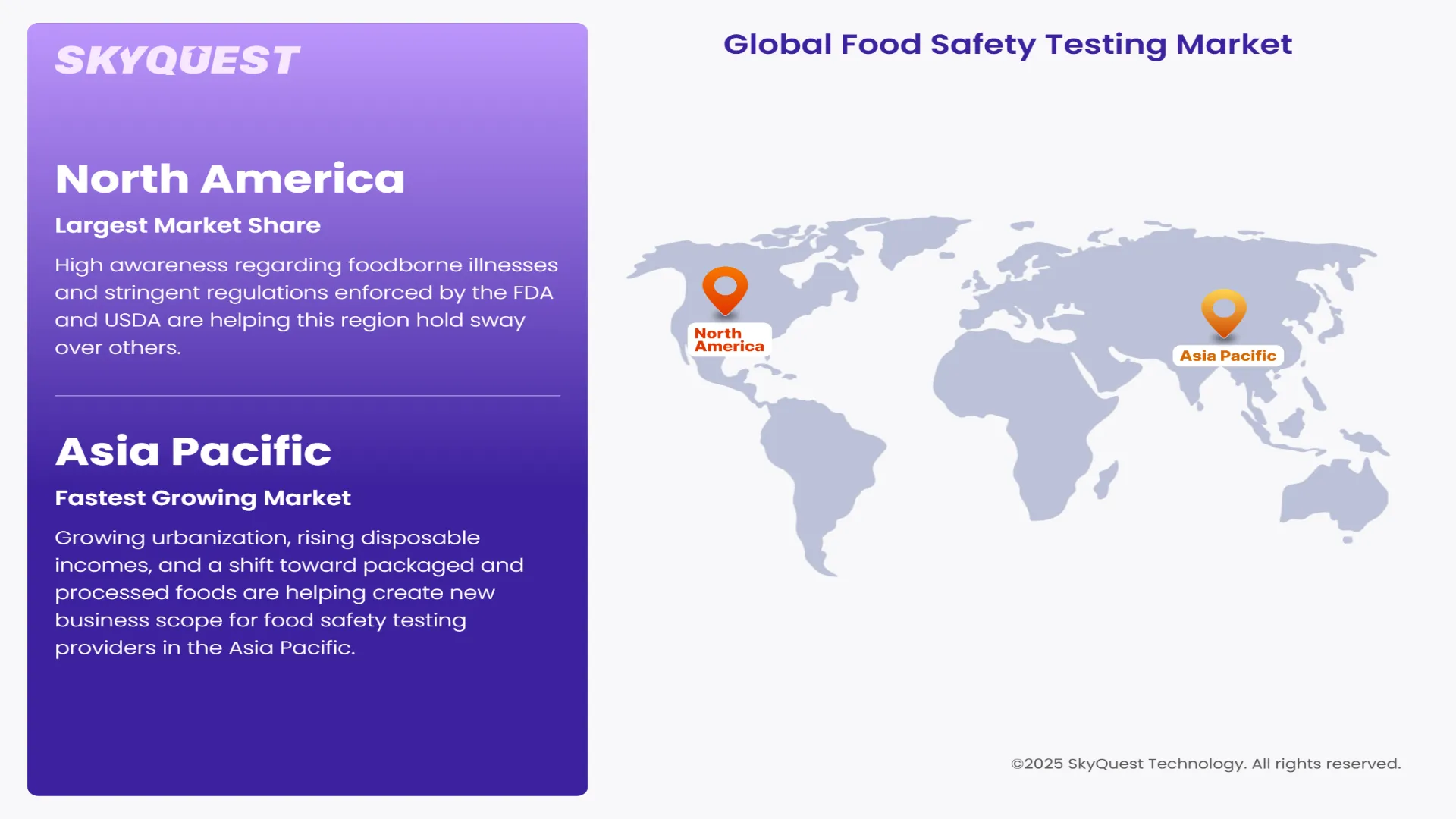
High awareness regarding foodborne illnesses and stringent regulations enforced by the FDA and USDA are helping this region hold sway over others. The presence of advanced laboratories, significant R&D investment, and the adoption of cutting-edge technologies like PCR and ELISA are further fueling the dominance of North America. Frequent food recalls and lawsuits have made safety compliance a top priority for food manufacturers and processors operating in this region.
Food Safety Testing Market in United States
The United States holds sway over global food safety testing demand backed by stringent FDA and USDA regulations, frequent foodborne outbreaks, and a massive, processed food industry. Frequent food product recalls are prompting the need for greater compliance and third-party certification. Rising consumer demand for transparency, clean labels, and organic products pushes manufacturers to conduct rigorous testing. Innovation hubs and private laboratories fuel R&D, while digitization and traceability systems enhance oversight.
Food Safety Testing Market in Canada
The Canadian Food Inspection Agency (CFIA) plays a central role governing the adoption of food safety testing in the country. High awareness of food allergies and contaminants like Salmonella, Listeria, and GMOs are slated to ensure sustained demand for novel food safety testing solutions and services in Canada. With harmonized regulations across provinces and alignment with global standards, Canada remains a well-regulated market for food safety testing companies operating in the North American region.
Why are Food Safety Testing Companies Eyeing Investments in Asia Pacific?
Growing urbanization, rising disposable incomes, and a shift toward packaged and processed foods are helping create new business scope for food safety testing providers in the Asia Pacific. Technological advancements and international partnerships are helping improve testing capabilities in this region. Increasing exports demand compliance with international standards, spurring adoption of food safety testing. The urgency to prevent public health crises is pushing both private and public sectors toward aggressive market expansion.
Food Safety Testing Market in Japan
Adoption of zero-tolerance policy for food contamination and presence of a highly informed consumer base are boosting the adoption of food safety testing in Japan. High reliance of the country on food imports also mandates the use of novel food safety testing solutions. Innovation, aging population needs, and health-conscious consumption trends are ensuring sustained demand for advanced testing solutions in the country through 2032. Strict standards set by the Ministry of Health, Labour and Welfare (MHLW) mandate testing for pesticide residues, allergens, heavy metals, and microbial contaminants.
Food Safety Testing Market in South Korea
Increased imports, rising consumer awareness, and government emphasis on hygiene are helping create new business scope for food safety testing companies in South Korea. The Ministry of Food and Drug Safety (MFDS) enforces rigorous standards for microbial and chemical contaminants, which necessitates the need for real-time pathogen detection and blockchain traceability. The country’s fast-paced food innovation and export ambitions further support new opportunities for food safety testing companies.
What Influences the Demand for Food Safety Testing in Europe?
The presence of comprehensive regulatory systems like EFSA and a deeply embedded food safety culture help govern food safety testing adoption in the European region. Widespread consumer awareness and the high value placed on food traceability are also favoring the quick adoption of advanced food safety testing over the coming years. With strong government oversight and investment in modern laboratories, Europe remains a critical market for high-standard food safety testing solutions.
Food Safety Testing Market in Germany
Imposition of strict hygiene standards and efficient regulatory oversight under BVL and EFSA are helping bolster the adoption of advanced food safety testing solutions in Germany. High demand for sustainable and organic farming in the country is also driving up the adoption of rigorous food testing solutions. Advanced testing techniques like mass spectrometry and next-gene sequencing are widely adopted. High emphasis on consumer trust, traceability, and green food trends is also helping bolster the demand for food safety testing going forward.
Food Safety Testing Market in United Kingdom
The Food Standards Agency (FSA) enforces strict domestic protocols, including testing for contaminants, pathogens, and labeling compliance. High emphasis on imported food testing and novel food regulation are also expected to bolster revenue generation in the United Kingdom. Technological integration, including rapid diagnostics and data-driven audits, is gaining traction among food safety testing companies operating in the country.
Food Safety Testing Market in France
France is home to a robust food safety testing industry governed by ANSES and adhering to EFSA guidelines. High preference for traditional and artisanal foods, which require microbiological testing to ensure safety. Growing organic food consumption and EU Green Deal policies have intensified testing across the supply chain. Regular food scandals in Europe have made consumers vigilant, boosting demand for independent testing labs and government-monitored systems, and sustaining steady growth in the country.
To know more about the market opportunities by region and country, click here to
Buy The Complete Report
Food Safety Testing Market Drivers
Globalization of the Food Supply Chain
Technological Advancements in Testing Methods
Food Safety Testing Market Restraints
Limited Infrastructure in Developing Countries
Complex and Fragmented Regulations Across Regions
Request Free Customization of this report to help us to meet your business objectives.
Food safety testing providers should invest in the R&D of novel testing methods and techniques to improve food safety. Collaborating with food manufacturers can also help companies expand their business scope. Developing allergen and GMO testing solutions can also help companies improve their global sales potential as per this food safety testing market analysis.
Startups are leveraging advanced technologies to improve testing times and efficiency. Here’s a startup that could change the trajectory of food safety testing industry in the long run.
SkyQuest’s ABIRAW (Advanced Business Intelligence, Research & Analysis Wing) is our Business Information Services team that Collects, Collates, Correlates, and Analyses the Data collected by means of Primary Exploratory Research backed by robust Secondary Desk research.
As per SkyQuest analysis, growing awareness regarding food safety among consumers and advancements in food safety testing technologies are slated to primarily drive the demand for food safety testing going forward. However, limited infrastructure in developing countries and fragmented regulations across regions are expected to slow down the demand for food safety testing in the future. North America is forecasted to emerge as the leading market for food safety testing providers owing to high awareness regarding foodborne diseases and strict enforcement of food safety regulations by the FDA. High demand for organic food products and development of rapid testing kits are key trends driving the food safety testing sector in the long run.
| Report Metric | Details |
|---|---|
| Market size value in 2024 | USD 22.94 Billion |
| Market size value in 2033 | USD 44.54 Billion |
| Growth Rate | 7.65% |
| Base year | 2024 |
| Forecast period | 2026-2033 |
| Forecast Unit (Value) | USD Billion |
| Segments covered |
|
| Regions covered | North America (US, Canada), Europe (Germany, France, United Kingdom, Italy, Spain, Rest of Europe), Asia Pacific (China, India, Japan, Rest of Asia-Pacific), Latin America (Brazil, Rest of Latin America), Middle East & Africa (South Africa, GCC Countries, Rest of MEA) |
| Companies covered |
|
| Customization scope | Free report customization with purchase. Customization includes:-
|
To get a free trial access to our platform which is a one stop solution for all your data requirements for quicker decision making. This platform allows you to compare markets, competitors who are prominent in the market, and mega trends that are influencing the dynamics in the market. Also, get access to detailed SkyQuest exclusive matrix.
Table Of Content
Executive Summary
Market overview
Parent Market Analysis
Market overview
Market size
KEY MARKET INSIGHTS
COVID IMPACT
MARKET DYNAMICS & OUTLOOK
Market Size by Region
KEY COMPANY PROFILES
Methodology
For the Food Safety Testing Market, our research methodology involved a mixture of primary and secondary data sources. Key steps involved in the research process are listed below:
1. Information Procurement: This stage involved the procurement of Market data or related information via primary and secondary sources. The various secondary sources used included various company websites, annual reports, trade databases, and paid databases such as Hoover's, Bloomberg Business, Factiva, and Avention. Our team did 45 primary interactions Globally which included several stakeholders such as manufacturers, customers, key opinion leaders, etc. Overall, information procurement was one of the most extensive stages in our research process.
2. Information Analysis: This step involved triangulation of data through bottom-up and top-down approaches to estimate and validate the total size and future estimate of the Food Safety Testing Market.
3. Report Formulation: The final step entailed the placement of data points in appropriate Market spaces in an attempt to deduce viable conclusions.
4. Validation & Publishing: Validation is the most important step in the process. Validation & re-validation via an intricately designed process helped us finalize data points to be used for final calculations. The final Market estimates and forecasts were then aligned and sent to our panel of industry experts for validation of data. Once the validation was done the report was sent to our Quality Assurance team to ensure adherence to style guides, consistency & design.
Analyst Support
Customization Options
With the given market data, our dedicated team of analysts can offer you the following customization options are available for the Food Safety Testing Market:
Product Analysis: Product matrix, which offers a detailed comparison of the product portfolio of companies.
Regional Analysis: Further analysis of the Food Safety Testing Market for additional countries.
Competitive Analysis: Detailed analysis and profiling of additional Market players & comparative analysis of competitive products.
Go to Market Strategy: Find the high-growth channels to invest your marketing efforts and increase your customer base.
Innovation Mapping: Identify racial solutions and innovation, connected to deep ecosystems of innovators, start-ups, academics, and strategic partners.
Category Intelligence: Customized intelligence that is relevant to their supply Markets will enable them to make smarter sourcing decisions and improve their category management.
Public Company Transcript Analysis: To improve the investment performance by generating new alpha and making better-informed decisions.
Social Media Listening: To analyze the conversations and trends happening not just around your brand, but around your industry as a whole, and use those insights to make better Marketing decisions.
REQUEST FOR SAMPLE
 REQUEST FREE CUSTOMIZATION


Want to customize this report? This report can be personalized according to your needs. Our analysts and industry experts will work directly with you to understand your requirements and provide you with customized data in a short amount of time. We offer $1000 worth of FREE customization at the time of purchase.
Feedback From Our Clients


 USA (+1) 351-333-4748

