Healthcare IT Market
Report ID: SQMIG35G2171
Report ID: SQMIG35G2171
[email protected]
USA +1 351-333-4748
Report ID:
SQMIG35G2171 |
Region:
Global |
Published Date: July, 2025
Pages:
193
|Tables:
88
|Figures:
74


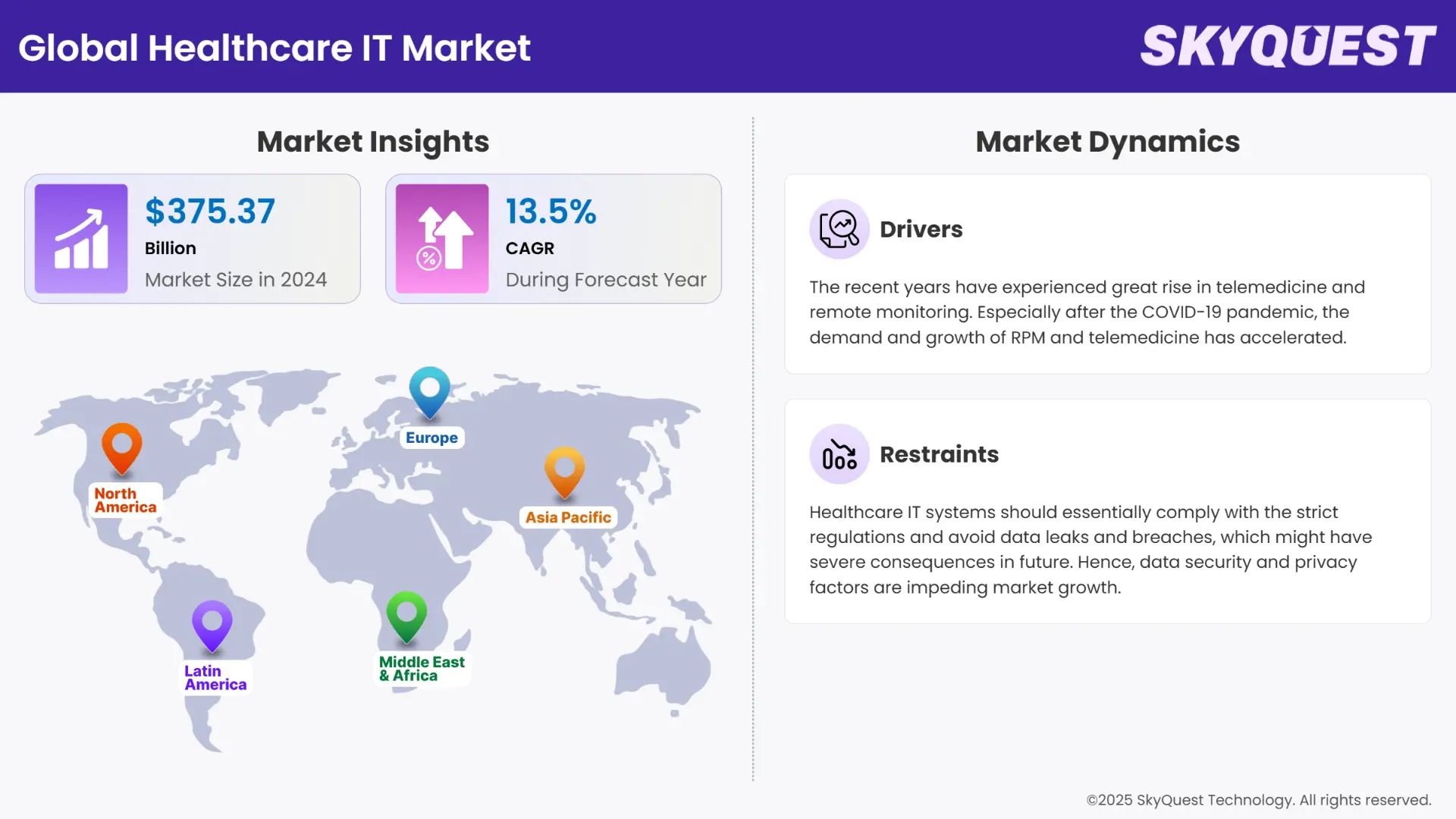
Global Healthcare IT Market size was valued at USD 375.37 Billion in 2024 and is poised to grow from USD 426.04 Billion in 2025 to USD 1173.34 Billion by 2033, growing at a CAGR of 13.5% in the forecast period (2026–2033).
The Healthcare IT sector is currently growing at an accelerated rate due to an increasing critical demand for efficient systems of healthcare delivery, the increasing volume of electronic health records (EHR's) in use, and favorable government policies in various parts of the world (Scott et al., 2022). Three main drivers will continue to fuel growth in the healthcare IT market: the need to reduce healthcare costs, increasing quality of care for patients, and the desire to eliminate many of the administrative processes by automating them and integrating documentation. Emerging technologies like artificial intelligence (AI), telehealth, and cloud computing are changing the delivery of healthcare in various ways by offering access to critical real-time information and personalization to treatments. The digital health technologies need will also grow due to a continual rise in the aging population, and chronic diseases, among other unforeseen events that have recently catapulted the use of digital health technologies.
The key drivers of the growth in the digital health technologies sector are vast, and government policies like rhe Health Information Technology for Economic and Clinical Health (HITECH) Act in the U.S. and rhe digital health aspect of the EU4Health program in Europe demonstrate their support. As indicated above, the coupling of certain innovative technologies and tools, such as big data analytics, wearable devices, rising interoperability standards, the culmination of these will help further improve patient's clinical outcomes and operational efficiencies. The continued shift to value-based care will also continue to incentivize providers of care delivery systems to implement IT systems that provide actionable insights and performance tracking to keep their patient populations engaged, satisified and improve overall health.
However, the market also faces considerable restraint challenges. High implementation costs, particularly for small and mid-sized hospitals represent significant barriers to adoption. Cost data security and privacy concerns from increasing cyber threats are major restraints, particularly because of the cloud-based systems and sharing and portability of patients' data on different platforms. Furthermore, the lack of skilled IT workers and healthcare workers' resistance to adapting to a new system when new technology is implemented are also impacting market expansion. Integration challenges with existing legacy systems could also restrict the degree of full interoperability which is critical for the seamless flow of data and user experience. However, the market will continue to have a positive outlook due to ongoing technological advances and policies.
Artificial intelligence is fundamentally changing the Healthcare IT field by improving diagnostics, automating workflows in clinical settings, and accelerating drug development. AI tools include things like robotic surgery systems, imaging analytics, and virtual medical scribes, which amount to improved accuracy and decreased burden on clinicians while improving patient care. These smart systems deliver real-time decision support, enable earlier identification of disease, and provide automated documentation which results in efficiency and lower cost. For example, Forbes reported that adding AI to help with mammograms produced a 17.6% improvement in breast cancer detection rates and decreased unnecessary recalls, and that is a demonstrable benefit to diagnostic performance.
Another recent accomplishment is Microsoft's "AI Diagnostic Orchestrator" (MAI-DxO). The MAI-DxO model was tested using 304 complicated cases from the New England Journal of Medicine and achieved an 85.5% diagnostic accuracy rate itself - this is over FOUR TIMES more accuracy than experienced physicians (20% maximum), and accomplished it with a 20% savings in testing costs. Although the MAI-DxO model is still in development in the research field, it shows the potential for AI to transform the diagnosis process and reduce medical errors in reach of expert-level healthcare around the world.
To get more insights on this market click here to Request a Free Sample Report
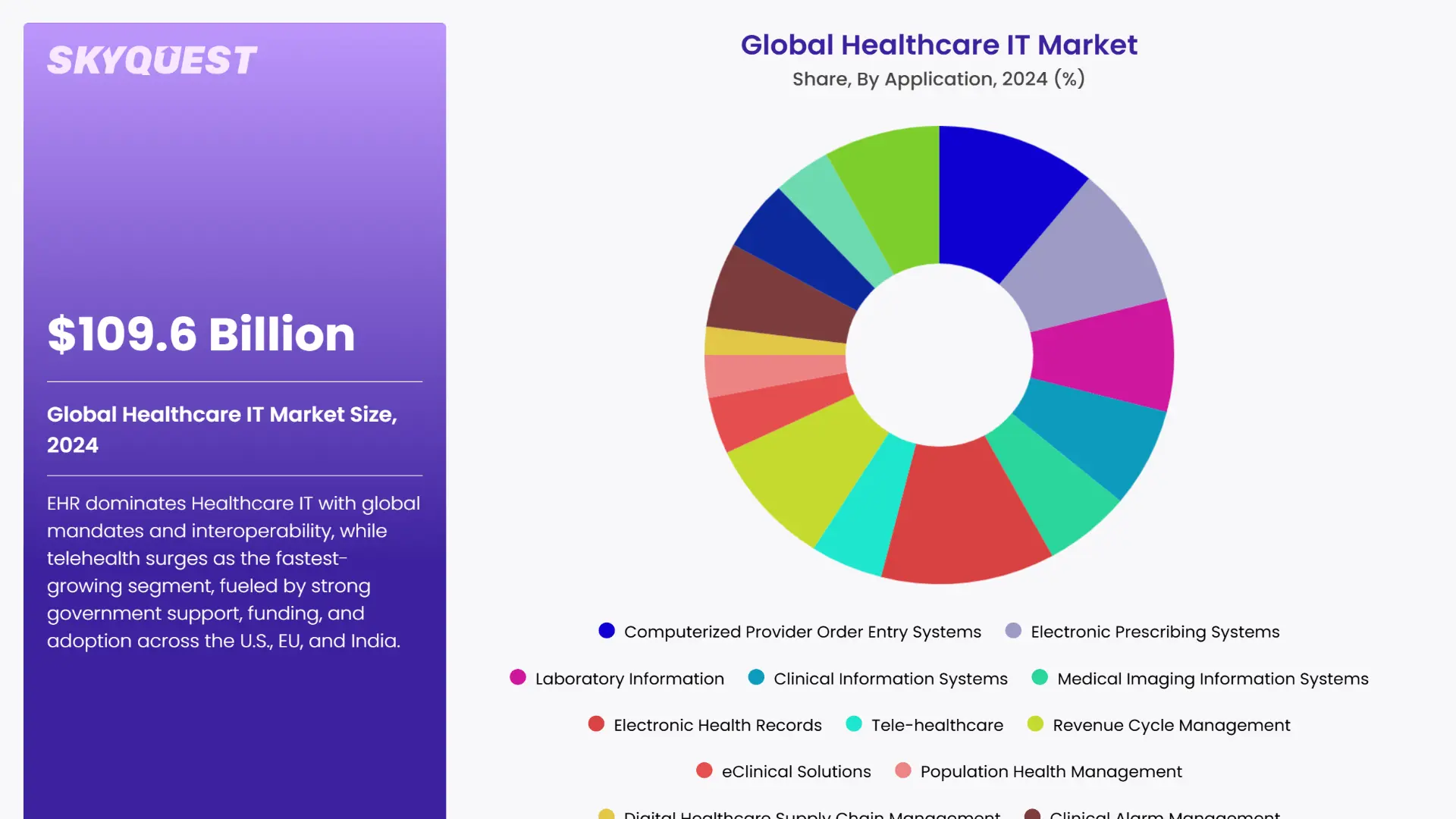
Global Healthcare IT Market is segmented by Application, Delivery Mode, End Use and region. Based on Application, the market is segmented into Computerized Provider Order Entry Systems, Electronic Prescribing Systems (E-Prescribing Solutions), Laboratory Information, Clinical Information Systems, Medical Imaging Information Systems, Electronic Health Records, Tele-healthcare, Revenue Cycle Management, eClinical Solutions, Population Health Management (PHM), Digital Healthcare Supply Chain Management, Clinical alarm management, Healthcare Customer relationship management (CRM), Technology Solutions in the Healthcare Payers and Healthcare Analytics. Based on Delivery Mode, the market is segmented into Solutions and Hardware. Based on End Use, the market is segmented into Healthcare Providers, Healthcare Payers and Life Sciences Industry. Based on region, the market is segmented into North America, Europe, Asia Pacific, Latin America and Middle East & Africa.
Electronic Health Records (EHR) are the pervasive category in Healthcare IT due to global mandates related to digitization of healthcare and coordination of multiple forms of care, continuing a trend from prior to the pandemic. For example, the U.S. federal government's Centers for Medicaid and Medicare Services (CMS) reports that 96.9% of hospitals, and over 90% of doctors now use a certified EHR in 2023. The EU's European Health Data Space is promoting EHR to enable data-driven interoperable healthcare systems and India's ABDM is also promoting EHR.
Telehealth Solutions is the fastest-growing segment, due to strong government support at the national and regional levels. For example, in the U.S., CMS, the Medicare entity, extends the telehealth reimbursement reimbursement schedule (effective in 2024). In the EU, the EU4Health program introduced €5.1B of investment into digital health. And India is expanding its e-sanjeevani teleconsultation system, with consultations reaching over 200 million in 2024, driven by adoption, accessibility and funding across the world.
Cloud/web-based deployment dominates Healthcare IT vertically around the globe, driven by government engagement, scalability, and cost effectiveness. To provide just a few examples, the EU’s European Health Data Space regulation (March 2025) commits member states to interoperability standards for digital health and cross-border EHR access. In the UK, the G Cloud (Version 14) enforces 'cloud first' purchasing policy for public sector IT. These major developments are illustrative of significant momentum behind cloud-based systems departmentally driven by policy globally.
The telehealth space is also the fastest growing sector globally, with significant government support. The U.S. (Medicare) extended telehealth reimbursement from now on, CMS (2024), and the EU has invested over €5.1B in digital health delivery as part of the EU4Health program. India's ABDM takes access to eSanjeevani teleconsultations - over 200M in 2024 -which is an amazing positive for global access and adoption and funding.
To get detailed segments analysis, Request a Free Sample Report
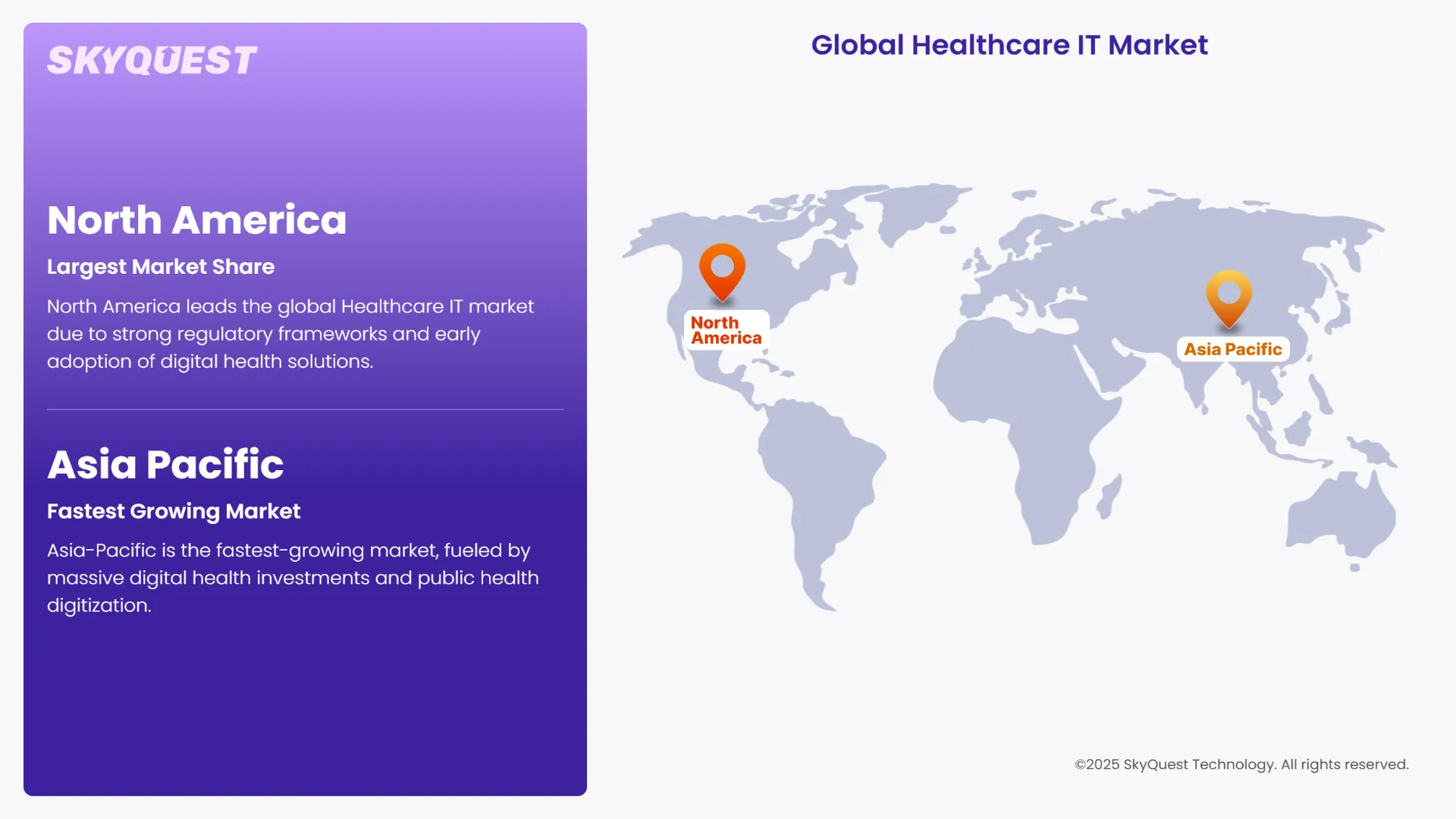
North America leads the global Healthcare IT market due to strong regulatory frameworks and early adoption of digital health solutions. The U.S. government's HITECH Act, continuous Medicare telehealth reimbursement expansion (CMS 2024), and ONC’s Interoperability Standards have driven EHR, telehealth, and data integration adoption. In 2024, the U.S. allocated $1.3 billion for digital health under the Health Resources and Services Administration (HRSA), further cementing its leadership.
U.S. Healthcare IT Market
The U.S. dominates the North American Healthcare IT market due to strong federal funding and advanced infrastructure. In 2024, CMS expanded Medicare telehealth reimbursement, while the ONC pushed EHR interoperability standards. The $1.3B HRSA digital health funding further accelerates nationwide HIT adoption across hospitals, clinics, and underserved areas.
Canada Healthcare IT Market
Canada is accelerating digital health adoption through federal-provincial collaboration. In 2023, the government committed CAD 2.1 billion to modernize health systems under the Pan-Canadian Health Data Strategy, aiming for interoperable EHRs across provinces. This national effort strengthens Canada’s Healthcare IT infrastructure while improving data access and patient outcomes.
Asia-Pacific is the fastest-growing market, fueled by massive digital health investments and public health digitization. India’s Ayushman Bharat Digital Mission (ABDM) crossed 200 million eSanjeevani teleconsultations by late 2024. China’s Healthy China 2030 plan and Japan’s Digital Agency are pushing nationwide EHR and telemedicine reforms. WHO also backed digital health strategies in Southeast Asia, boosting IT adoption across low- and middle-income countries.
China Healthcare IT Market
China leads in AI integration and smart hospital development. Backed by the Healthy China 2030 plan, the government is scaling digital health platforms and AI diagnostics. In 2023, China's National Health Commission expanded AI use in over 1,000 public hospitals, boosting clinical efficiency and population health management systems.
India Healthcare IT Market
India is leading growth with government-driven digital health infrastructure. The Ayushman Bharat Digital Mission (ABDM) surpassed 200 million eSanjeevani teleconsultations in 2024, promoting national EHRs and telemedicine. Government investment and digital public infrastructure make India the region's fastest-growing Healthcare IT hub, improving access across urban and rural sectors.
South Korea Healthcare IT Market
South Korea is investing in AI-powered health platforms under its Digital New Deal. The Ministry of Health launched a smart medical infrastructure program in 2023, equipping hospitals with AI diagnostics, robotics, and cloud EHRs. Government incentives accelerate adoption, positioning Korea as a high-tech leader in Healthcare IT.
Europe maintains strong growth, backed by the EU4Health program (€5.1 billion budget), aiming for cross-border health data exchange and AI integration in diagnostics. The European Health Data Space (EHDS), rolled out in 2024, is a milestone for secure data sharing, but regulatory complexity slows pace compared to Asia-Pacific.
Germany Healthcare IT Market
Germany leads Europe's Healthcare IT market due to its robust infrastructure and policy-driven digitization. In 2024, the government passed the Digital Health Act (DVG) mandating Prescriptions and EHR usage across providers. The €4.3 billion Hospital Future Fund accelerates nationwide hospital IT modernization and interoperability initiatives.
France Healthcare IT Market
France is investing heavily in EHR standardization and health data platforms. In 2023, the Ségur de la Santé plan allocated €2 billion to accelerate digital adoption in public hospitals and clinics. The Mon Espace Santé platform now offers citizens centralized access to digital health records and teleconsultation tools.
UK Healthcare IT Market
The UK is rapidly scaling Healthcare IT via NHS Digital. In 2024, the NHS Federated Data Platform was rolled out to improve real-time patient data sharing. Backed by a £2 billion investment, the system supports population health analytics, EHR integration, and AI-enabled decision support in public health services.
To know more about the market opportunities by region and country, click here to
Buy The Complete Report
Remote Monitoring and Telemedicine:
Funding and Investment by Private Equity Firms:
Data Security and Privacy Issues:
Request Free Customization of this report to help us to meet your business objectives.
Healthcare IT manufacturers should focus on minimizing the risks and costs associated with production to maximize their profits. Developing new Healthcare IT with better finishes and prints to attract new customers will also be a key strategy for all Healthcare IT companies. Creating Healthcare IT with sustainable materials could also pay off big time for Healthcare IT manufacturers in the long run. Launching new products will help Healthcare IT providers stay competitive in this highly saturated market.
Governments are mandating interoperability of health data. In 2024, the U.S. ONC officially enforced TEFCA for health data exchange at scale. Similarly, the EU launched the European Health Data Space (EHDS) to facilitate interoperable health service data sharing, alongside an investment of €810M. Using frameworks developed by the TEFCA and the EHDS means organizations can exchange securely and with standardized technology and processes, creating better more informed choices about diagnostics for patients, decision making for health care professionals, and, in the future, integration of AI across systems.
With their backing, telehealth grew rapidly. The U.S. CMS announced that they are extending telehealth waivers in 2024 for services payable by Medicare (abnormally generous); India’s E-Sanjeevani platform has conducted over 200M consultations under the ABDM; and globally governments are investing in the necessary virtual care infrastructure to rely on telehealth as a critical delivery channel for primary care, chronic disease management, and access.
SkyQuest’s ABIRAW (Advanced Business Intelligence, Research & Analysis Wing) is our Business Information Services team that Collects, Collates, Correlates, and Analyses the Data collected using Primary Exploratory Research backed by robust Secondary Desk research.
As per SkyQuest analysis, the growing focus on patient engagement and increasing healthcare costs are fueling the adoption of advanced healthcare systems, thereby driving the Healthcare IT market. Nonetheless, implementation complexity and regulatory compliance issues are a few hurdles to the growth of the Healthcare IT market. North America is expected to lead the market due to regulatory policy and support and rising investment and funding. Moreover, constant healthcare reforms and initiatives for enhancing efficiency are the opportunities seen in the healthcare IT market.
| Report Metric | Details |
|---|---|
| Market size value in 2024 | USD 375.37 Billion |
| Market size value in 2033 | USD 1173.34 Billion |
| Growth Rate | 13.5% |
| Base year | 2024 |
| Forecast period | 2026-2033 |
| Forecast Unit (Value) | USD Billion |
| Segments covered |
|
| Regions covered | North America (US, Canada), Europe (Germany, France, United Kingdom, Italy, Spain, Rest of Europe), Asia Pacific (China, India, Japan, Rest of Asia-Pacific), Latin America (Brazil, Rest of Latin America), Middle East & Africa (South Africa, GCC Countries, Rest of MEA) |
| Companies covered |
|
| Customization scope | Free report customization with purchase. Customization includes:-
|
To get a free trial access to our platform which is a one stop solution for all your data requirements for quicker decision making. This platform allows you to compare markets, competitors who are prominent in the market, and mega trends that are influencing the dynamics in the market. Also, get access to detailed SkyQuest exclusive matrix.
Table Of Content
Executive Summary
Market overview
Parent Market Analysis
Market overview
Market size
KEY MARKET INSIGHTS
COVID IMPACT
MARKET DYNAMICS & OUTLOOK
Market Size by Region
KEY COMPANY PROFILES
Methodology
For the Healthcare IT Market, our research methodology involved a mixture of primary and secondary data sources. Key steps involved in the research process are listed below:
1. Information Procurement: This stage involved the procurement of Market data or related information via primary and secondary sources. The various secondary sources used included various company websites, annual reports, trade databases, and paid databases such as Hoover's, Bloomberg Business, Factiva, and Avention. Our team did 45 primary interactions Globally which included several stakeholders such as manufacturers, customers, key opinion leaders, etc. Overall, information procurement was one of the most extensive stages in our research process.
2. Information Analysis: This step involved triangulation of data through bottom-up and top-down approaches to estimate and validate the total size and future estimate of the Healthcare IT Market.
3. Report Formulation: The final step entailed the placement of data points in appropriate Market spaces in an attempt to deduce viable conclusions.
4. Validation & Publishing: Validation is the most important step in the process. Validation & re-validation via an intricately designed process helped us finalize data points to be used for final calculations. The final Market estimates and forecasts were then aligned and sent to our panel of industry experts for validation of data. Once the validation was done the report was sent to our Quality Assurance team to ensure adherence to style guides, consistency & design.
Analyst Support
Customization Options
With the given market data, our dedicated team of analysts can offer you the following customization options are available for the Healthcare IT Market:
Product Analysis: Product matrix, which offers a detailed comparison of the product portfolio of companies.
Regional Analysis: Further analysis of the Healthcare IT Market for additional countries.
Competitive Analysis: Detailed analysis and profiling of additional Market players & comparative analysis of competitive products.
Go to Market Strategy: Find the high-growth channels to invest your marketing efforts and increase your customer base.
Innovation Mapping: Identify racial solutions and innovation, connected to deep ecosystems of innovators, start-ups, academics, and strategic partners.
Category Intelligence: Customized intelligence that is relevant to their supply Markets will enable them to make smarter sourcing decisions and improve their category management.
Public Company Transcript Analysis: To improve the investment performance by generating new alpha and making better-informed decisions.
Social Media Listening: To analyze the conversations and trends happening not just around your brand, but around your industry as a whole, and use those insights to make better Marketing decisions.
REQUEST FOR SAMPLE
 REQUEST FREE CUSTOMIZATION
The Healthcare IT sector is expected to grow at a rate of 23.6% CAGR from 2025 to 2032 driven by increased demand for digital healthcare delivery, cost reduction, and government support.
Solutions are the fastest growing component in the Healthcare IT sector driven by demand for integrated platforms in healthcare settings to improve clinical outcomes and return on investment (ROI), improve administration and operational workflows, and automate the administrative/office workflows inherent in healthcare settings.
AI is changing the Healthcare IT sector through improved diagnostics, automation of clinical workflows, and delivered real-time decision support. AI improves accuracy and reducing costs. An example of this is measured diagnostic accuracy of MAI-DxO at 85.5%, and physician accuracy at 20%.
Cloud-based deployments in healthcare systems offer data portability and interoperability and large-scale scalability in pricing and product purchases. Governments like the EU with its EHDS, and the UK with its G Cloud government solutions strategy, continue to push leveraged adoption of cloud-based systems which will truly become a central aspect of the health systems of the future digital health infrastructure.
EHR's generally centrality lies in the theory that they are the mandated platform for not only digitization but care coordination and interoperability. In the U.S. 96.9% of hospitals use certified EHR's. Europe and India have similar adoption rates for electronic health records. EHR's are foundational to an ecosystem for digital health.
North America is the lead region because it has strong regulations being enforced, early adoption of EHR, and substantial federal funding. The U.S. committed $1.3 billion to digital health in 2024, supported by the HITECH Act and covering reimbursement for telehealth visits through CMS.
Telehealth platforms are providing patients with expanded access to care and greater ability for remote populations to overcome barriers to achieving care access in their communities. With CMS support, along with similar engagements from EU4Health and India's eSanjeevani (with 200M consultations in 2024), telehealth platforms are generally becoming the platform for patients to engage with chronic care and for primary health services.
Wearable devices allow individuals to track their vital signs in real-time. They provide real-time information for chronic management and can transmit data directly into digital health systems. Their utilization is the perfect complement for clinical decision-making, facilitating a move to value-based patient and family-centered care models.
Predictive analytics allows for time-sensitive interventions by quickly identifying disease risk, directing treatment plans for patients, and potentially reducing hospital readmissions. When combined with AI and big data, it also provides usable, patient-specific actionable insights for the provider.
Small hospitals have challenges with expense, available IT workforce, and the culture of accepting new technology and systems. There are also integration challenges when combining new software with legacy systems and concerns about data privacy to consider with rapidly moving into full-scale adoption of Healthcare IT products.


Want to customize this report? This report can be personalized according to your needs. Our analysts and industry experts will work directly with you to understand your requirements and provide you with customized data in a short amount of time. We offer $1000 worth of FREE customization at the time of purchase.
Feedback From Our Clients


 USA (+1) 351-333-4748

