
Mushroom Market
Report ID: SQMIG30D2070
Report ID: SQMIG30D2070
[email protected]
USA +1 351-333-4748
Report ID:
SQMIG30D2070 |
Region:
Global |
Published Date: June, 2025
Pages:
194
|Tables:
93
|Figures:
71


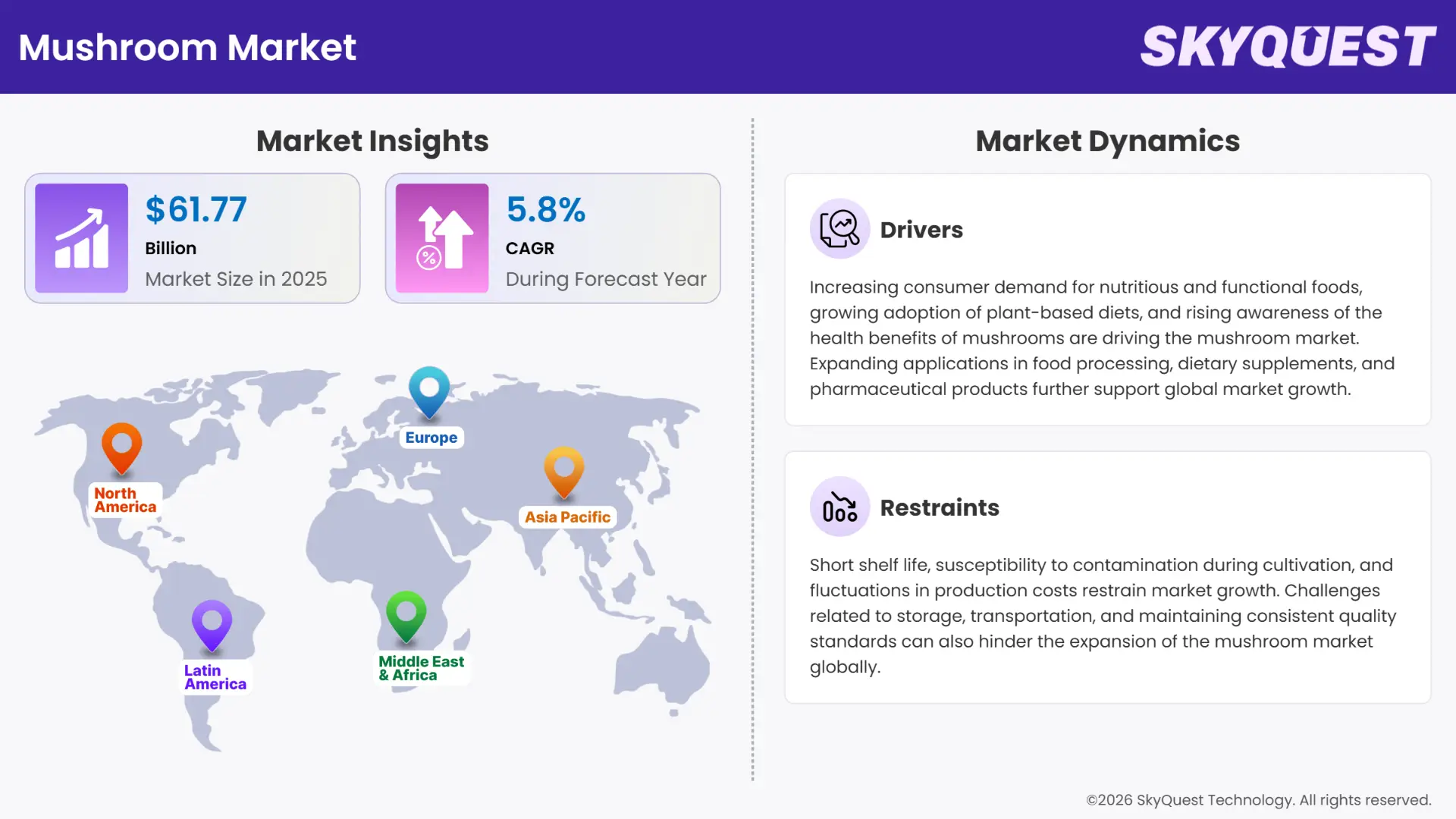
Global Mushroom Market size was valued at USD 58.38 Billion in 2024 poised to grow from USD 61.77 Billion in 2025 to USD 96.97 Billion by 2033, growing at a CAGR of 5.8% in the forecast period (2026–2033).
Key Takeaways: Market Trends & Insights
Rising consumer awareness of mushrooms’ value in nutrition is a significant area stimulating growth in the global mushroom market. Mushrooms are high in vitamins like D and B6, antioxidants, the mineral selenium, and dietary fiber. Together, these vitamins, minerals, and fiber help boost immune health, lower inflammation, and promote digestion. As health-conscious consumers look for a functional food that will improve wellness and prevent diseases, mushrooms are becoming a favorite food in the marketplace mostly because they are low in calories and nutritionally dense. This increasing awareness towards healthy eating stimulates new mushroom consumption behavior that drives up mushroom sales and contributes significantly to expanding the global mushroom market.
A dramatic rise in plant-based eating, and veganism, is a key trend driving the global mushroom sector. People are avoiding meat for a variety of reasons, including personal health, environmental concerns, and animal rights. This means that many people avoid, or at least reduce, meat consumption. Mushrooms are an obviously great alternative with a delicious umami flavor and a texture like meat. This is very attractive to the vegetarian, vegan, and flexitarian communities who are looking for nutritious, delicious alternatives. Increasingly, mushrooms are a huge part of the plant-based culinary scene, which provides new kinds of demand, continuing the expansion of mushroom markets worldwide.
How does AI Contribute to Sustainability in Mushroom Farming?
Artificial Intelligence (AI) is rapidly transforming the global mushroom industry by improving growing efficiency and sustainability. AI systems, such as those founded by companies like MycoSense and Tupu, utilize computer vision and machine learning to monitor mushroom growth, identify and mitigate diseases early, and automate the harvesting process. For example, MycoSense's AI-aided harvesting system uses visual data analysis to identify when mushrooms are at maturity.
Using this information, it harvests mushrooms on time and uniformly. Similarly, Tupu employs camera vision AI in its harvesting robots to automate the harvesting process. Robotic harvesting can improve harvest efficiency while cutting labor costs; by automating the harvesting process, AI can generate increased yield, decrease waste, and reduce ongoing operational costs. This allows mushroom farming to be more successful and profitable in terms of productivity. Furthermore, AI enabled data-gathering and reporting capabilities fosters better climate and production decisions and/or management of resources. Ultimately, this can relate to the scaling of pre-existing global mushroom market, while in turn can relate to efficiencies within the global mushroom market.
To get more insights on this market click here to Request a Free Sample Report
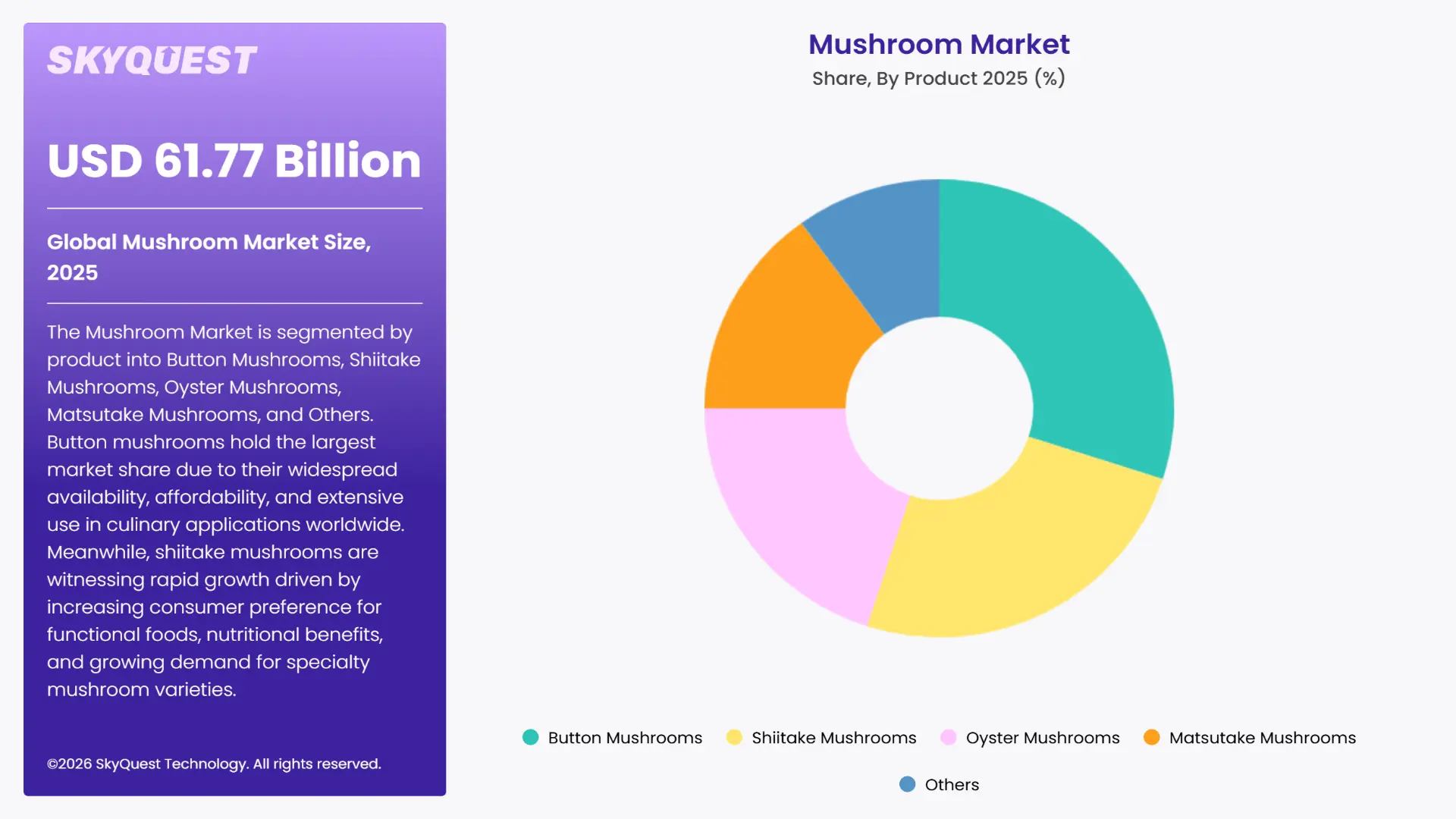
The global mushroom market is segmented based on product, form, distribution channel, and regions. In terms of product, the market is grouped into button, shiitake, oyster, matsutake, truffles, and others. Based on form, the market is bifurcated into fresh and processed. Based on distribution channel, the market is grouped directly to customer, grocery stores, supermarkets & hypermarkets, convenience stores, and online stores. Based on region, the market is segmented into North America, Europe, Asia-Pacific, Central & South America and the Middle East & Africa.
Based on the global mushroom market forecast, Button mushrooms remain the dominant variety in the industry due to their versatility, mild flavor, and affordability. They are widely used in various cuisines and are available in fresh, dried, and powdered forms, catering to diverse consumer preferences. Their nutritional benefits, including being low in calories and rich in essential vitamins and minerals, further enhance their appeal. Additionally, button mushrooms require minimal resources for cultivation, aligning with the growing demand for sustainable food sources. These factors collectively contribute to their continued market dominance.
The shiitake product is experiencing rapid growth in the global mushroom market, driven by increasing health consciousness and the rising popularity of plant-based diets. Shiitake mushrooms are valued for their nutritional benefits, including immune system support and potential anti-inflammatory properties. This surge in demand is further fueled by their versatility in various culinary applications and the growing interest in functional foods.
Fresh mushrooms dominate the global mushroom market due to their superior taste, nutritional value, and culinary versatility. With increasing consumer awareness of health benefits, fresh mushrooms are preferred for their low-calorie content and rich nutrients like vitamins and antioxidants . Their short shelf life has been mitigated by advancements in packaging technologies, such as modified atmosphere packaging, ensuring freshness during distribution. Additionally, fresh mushrooms align with the rising demand for organic and plant-based foods, further solidifying their market dominance.
The processed mushroom segment is fastest growing in the global mushroom market due to rising demand for convenient, long-lasting foods. Innovations in drying, freezing, and packaging extend shelf life and enhance quality. Increasing plant-based diets and functional food interest further boost processed mushrooms’ popularity, driving their rapid adoption in global markets.
To get detailed segments analysis, Request a Free Sample Report
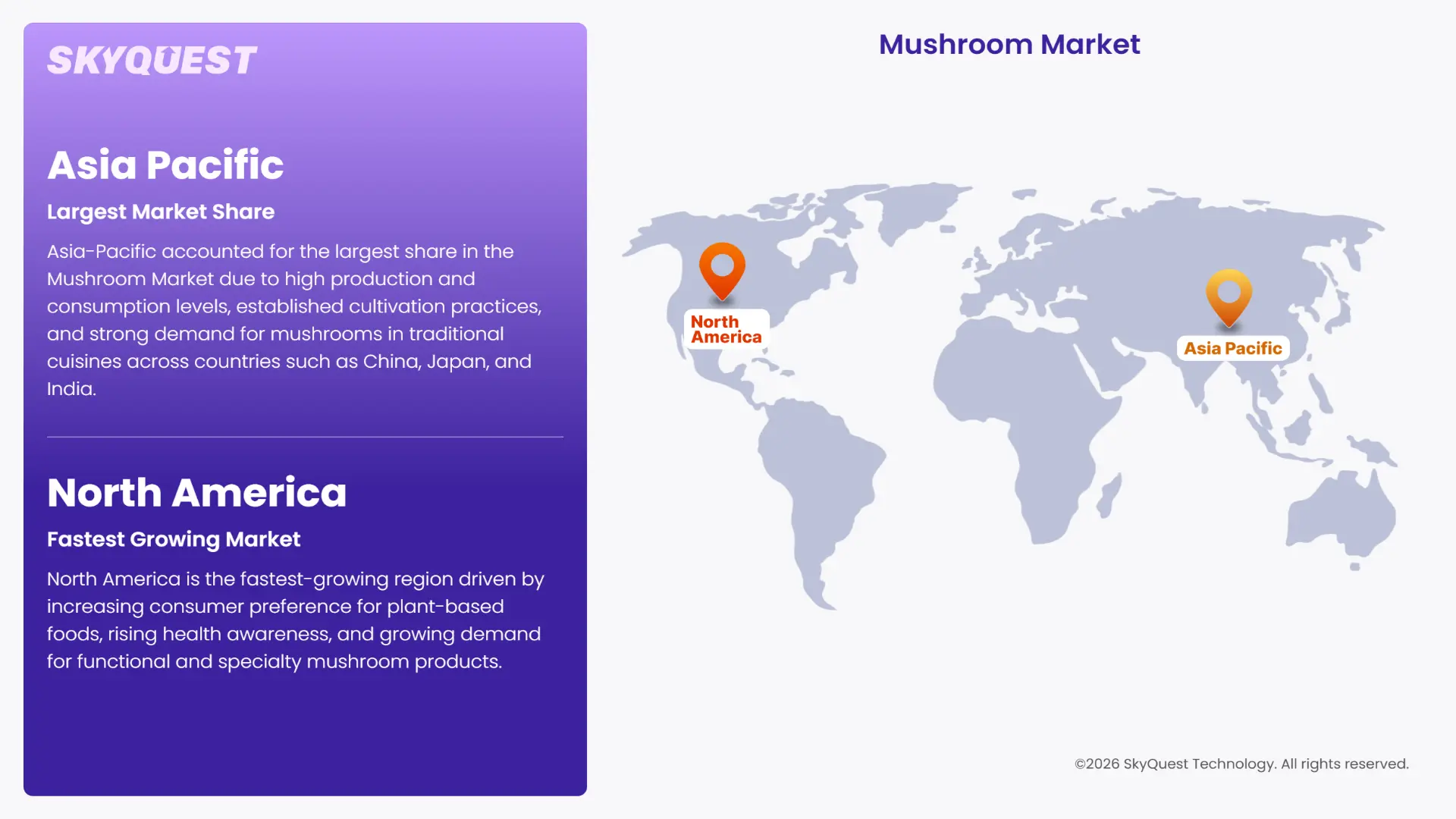
As per global mushroom market analysis, North America leads the industry, driven by high consumer awareness of health benefits and increasing demand for organic and specialty mushrooms. Advanced farming technologies and strong distribution networks support year-round supply. The region’s growing plant-based food trend and expanding foodservice industry further propel market growth. Additionally, government initiatives promoting sustainable agriculture and innovations in mushroom processing enhance North America’s dominant position in the global mushroom market share.
US Mushroom Market
The U.S. is the largest contributor to North America’s mushroom market share, known for major production hubs like Pennsylvania’s Kennett Square. High consumer demand for fresh and processed mushrooms, especially driven by plant-based and health-conscious trends, fuels growth. Advanced cultivation technologies and well-established supply chains support year-round availability. The U.S. market’s strong focus on innovation and sustainability continues to drive its leading position regionally and globally.
Canada Mushroom Market
Canada contributes significantly to North America’s mushroom market growth, with Ontario and British Columbia as primary production centers. Canadian growers focus mainly on Agaricus species, exporting nearly all production to the U.S. Government support through programs promoting market expansion strengthens the sector. Growing consumer interest in organic and specialty mushrooms boosts domestic demand, while advances in cultivation techniques enhance production efficiency and sustainability, supporting steady market growth.
Europe’s mushroom market demand is expanding steadily, driven by strong demand for organic and specialty mushrooms. Countries like Poland, the Netherlands, and Italy lead production, supported by advanced cultivation technologies and sustainable farming practices. Growing consumer awareness of mushrooms’ health benefits and increasing use in gourmet and processed foods boost market growth. Additionally, Europe’s focus on food safety and quality standards strengthens its competitive position globally.
France Mushroom Market
France holds a prominent position in the Europe’s mushroom market growth, known for its rich culinary tradition involving mushrooms. The country has robust production of button and specialty mushrooms, serving both domestic consumption and export. French consumers increasingly favor organic and wild mushrooms, driving market expansion. Government support for sustainable farming and food quality standards boosts the mushroom industry, strengthening France’s role as a major European mushroom market contributor.
Germany Mushroom Market
Germany is a key player in Europe’s mushroom market growth, with strong domestic production and high consumer demand for fresh and processed mushrooms. Its well-developed food processing industry incorporates mushrooms in diverse products. Germany’s focus on sustainability and organic cultivation supports market growth. Innovation in mushroom-based functional foods and health supplements further enhances its global market presence, making it a significant contributor to the mushroom sector.
UK Mushroom Market
The UK’s mushroom market demand is growing steadily, fueled by rising consumer health awareness and demand for plant-based foods. The country produces significant volumes of button mushrooms and imports specialty varieties. Innovations in cultivation technology and distribution improve supply chain efficiency. The UK’s foodservice and retail sectors actively promote mushroom-based products, enhancing market penetration. Increasing interest in organic and functional mushrooms further supports the UK’s expanding contribution to the European mushroom market.
Asia Pacific Steadily growing in global mushroom production, with China and India as major contributors due to favorable climates and low-cost labor. Rising health awareness, urbanization, and increasing disposable incomes boost demand for fresh and processed mushrooms. Innovations in cultivation techniques and expanding export activities further stimulate growth. The region’s diverse culinary uses and growing plant-based food trends enhance its dominant position in the global mushroom market.
Japan Mushroom Market
Japan plays a significant role in the Asia Pacific’s mushroom market share, with shiitake mushrooms dominating production and consumption. The country focuses heavily on functional and health-beneficial mushroom varieties, driving domestic demand. Japan exports mushrooms to over 29 countries, including Vietnam, Russia, and India. Advanced cultivation technologies and growing consumer preference for nutritious foods support steady market growth, solidifying Japan’s strong position in the regional outlook.
South Korea Mushroom Market
South Korea contributes substantially to the Asia Pacific’s mushroom market growth, producing around 300,000 metric tons annually. The country’s mushroom sector benefits from advanced farming practices and a rich culinary culture that favors mushrooms. South Korea exports to more than 40 countries, with key markets including the United States and Vietnam. Increasing domestic demand for healthy, plant-based foods fuels ongoing growth and innovation in mushroom production and processing.
To know more about the market opportunities by region and country, click here to
Buy The Complete Report
Rising Health Awareness
Growing Plant-Based Food Trend
Perishability and Shelf-Life Issues
Limited Awareness in Emerging Markets
Request Free Customization of this report to help us to meet your business objectives.
The global mushroom market outlook is highly competitive, dominated by major players like Monterey Mushrooms, Ltd., Greenyard NV, and Okechamp. These companies focus on expanding product portfolios, investing in sustainable farming, and adopting advanced cultivation technologies. Monterey Mushrooms emphasizes organic product lines, while Greenyard NV leverages strategic acquisitions to enhance global reach. Innovation in processing and distribution, coupled with strong branding, remains key to gaining market share in this rapidly growing sector.
As per the global mushroom industry analysis, the startup ecosystem is vibrant, driven by innovations in sustainable cultivation, functional mushroom products, and alternative protein sources. Startups focus on eco-friendly farming, biotech enhancements, and novel product development to meet rising consumer demand. These ventures attract investments due to growing health and environmental awareness, leading to breakthroughs in mushroom-based food, supplements, and materials, which further accelerate market disruption and expansion.
Rising Demand for Functional and Medicinal Mushrooms
Expansion of Sustainable Mushroom Farming Techniques
SkyQuest’s ABIRAW (Advanced Business Intelligence, Research & Analysis Wing) is our Business Information Services team that Collects, Collates, Correlates, and Analyses the Data collected by means of Primary Exploratory Research backed by robust Secondary Desk research.
As per SkyQuest analysis, the global mushroom industry is witnessing robust growth fueled by a confluence of health awareness, plant-based dietary trends, and technological innovation. As consumers increasingly recognize mushrooms’ nutritional and functional benefits, their integration into daily diets and health products has accelerated. The adoption of AI and advanced farming methods further boosts productivity, sustainability, and profitability in mushroom cultivation.
Strong regional contributions from North America, Europe, and Asia-Pacific showcase the market’s global appeal and potential. Challenges such as perishability and limited awareness in emerging regions persist, yet ongoing investments in packaging and education offer promising solutions. With continuous innovation, strategic partnerships, and evolving consumer preferences, the global mushroom market revenue is set for sustained expansion and diversification, reshaping food, wellness, and agricultural landscapes worldwide.
| Report Metric | Details |
|---|---|
| Market size value in 2024 | USD 58.38 Billion |
| Market size value in 2033 | USD 96.97 Billion |
| Growth Rate | 5.8% |
| Base year | 2024 |
| Forecast period | 2026–2033 |
| Forecast Unit (Value) | USD Billion |
| Segments covered |
|
| Regions covered | North America (US, Canada), Europe (Germany, France, United Kingdom, Italy, Spain, Rest of Europe), Asia Pacific (China, India, Japan, Rest of Asia-Pacific), Latin America (Brazil, Rest of Latin America), Middle East & Africa (South Africa, GCC Countries, Rest of MEA) |
| Companies covered |
|
| Customization scope | Free report customization with purchase. Customization includes:-
|
To get a free trial access to our platform which is a one stop solution for all your data requirements for quicker decision making. This platform allows you to compare markets, competitors who are prominent in the market, and mega trends that are influencing the dynamics in the market. Also, get access to detailed SkyQuest exclusive matrix.
Table Of Content
Executive Summary
Market overview
Parent Market Analysis
Market overview
Market size
KEY MARKET INSIGHTS
COVID IMPACT
MARKET DYNAMICS & OUTLOOK
Market Size by Region
KEY COMPANY PROFILES
Methodology
For the Mushroom Market, our research methodology involved a mixture of primary and secondary data sources. Key steps involved in the research process are listed below:
1. Information Procurement: This stage involved the procurement of Market data or related information via primary and secondary sources. The various secondary sources used included various company websites, annual reports, trade databases, and paid databases such as Hoover's, Bloomberg Business, Factiva, and Avention. Our team did 45 primary interactions Globally which included several stakeholders such as manufacturers, customers, key opinion leaders, etc. Overall, information procurement was one of the most extensive stages in our research process.
2. Information Analysis: This step involved triangulation of data through bottom-up and top-down approaches to estimate and validate the total size and future estimate of the Mushroom Market.
3. Report Formulation: The final step entailed the placement of data points in appropriate Market spaces in an attempt to deduce viable conclusions.
4. Validation & Publishing: Validation is the most important step in the process. Validation & re-validation via an intricately designed process helped us finalize data points to be used for final calculations. The final Market estimates and forecasts were then aligned and sent to our panel of industry experts for validation of data. Once the validation was done the report was sent to our Quality Assurance team to ensure adherence to style guides, consistency & design.
Analyst Support
Customization Options
With the given market data, our dedicated team of analysts can offer you the following customization options are available for the Mushroom Market:
Product Analysis: Product matrix, which offers a detailed comparison of the product portfolio of companies.
Regional Analysis: Further analysis of the Mushroom Market for additional countries.
Competitive Analysis: Detailed analysis and profiling of additional Market players & comparative analysis of competitive products.
Go to Market Strategy: Find the high-growth channels to invest your marketing efforts and increase your customer base.
Innovation Mapping: Identify racial solutions and innovation, connected to deep ecosystems of innovators, start-ups, academics, and strategic partners.
Category Intelligence: Customized intelligence that is relevant to their supply Markets will enable them to make smarter sourcing decisions and improve their category management.
Public Company Transcript Analysis: To improve the investment performance by generating new alpha and making better-informed decisions.
Social Media Listening: To analyze the conversations and trends happening not just around your brand, but around your industry as a whole, and use those insights to make better Marketing decisions.
REQUEST FOR SAMPLE
 REQUEST FREE CUSTOMIZATION
Global Mushroom Market size was valued at USD 58.38 Billion in 2024 poised to grow from USD 61.77 Billion in 2025 to USD 96.97 Billion by 2033, growing at a CAGR of 5.8% in the forecast period (2026–2033).
Monterey Mushrooms (USA), Greenyard NV (Belgium), Okechamp (Netherlands), Costa Group Holdings (Australia), Dr. Mushrooms (India), Giorgio Foods (USA), Phillips Mushroom Farms (USA), Murray’s Mushroom Farm (USA), Highline Mushrooms (Canada), Farbest Brands (USA), Denny Mushrooms (UK), Sylvan Inc. (USA), Mycelia (Belgium), FunGuy (South Korea), Trillium Mushrooms (Canada)
The key driver of the mushroom market is the increasing consumer demand for healthy and nutritious foods, as mushrooms are valued for their protein content, vitamins, antioxidants, and potential health benefits, driving growth in both fresh and processed mushroom products.
A key market trend in the mushroom market is the rising popularity of functional and specialty mushrooms, such as shiitake, maitake, and reishi, used in dietary supplements, health foods, and beverages for their immunity-boosting and wellness-promoting properties.
Asia-Pacific accounted for the largest share in the mushroom market, driven by high consumption, strong production capacity, traditional dietary preferences, and increasing demand for both fresh and processed mushrooms in countries like China and India.


Want to customize this report? This report can be personalized according to your needs. Our analysts and industry experts will work directly with you to understand your requirements and provide you with customized data in a short amount of time. We offer $1000 worth of FREE customization at the time of purchase.
Feedback From Our Clients


 USA (+1) 351-333-4748

