Oilfield Equipment Market
Report ID: SQMIG10B2062
Report ID: SQMIG10B2062
[email protected]
USA +1 351-333-4748
Report ID:
SQMIG10B2062 |
Region:
Global |
Published Date: August, 2025
Pages:
197
|Tables:
61
|Figures:
75


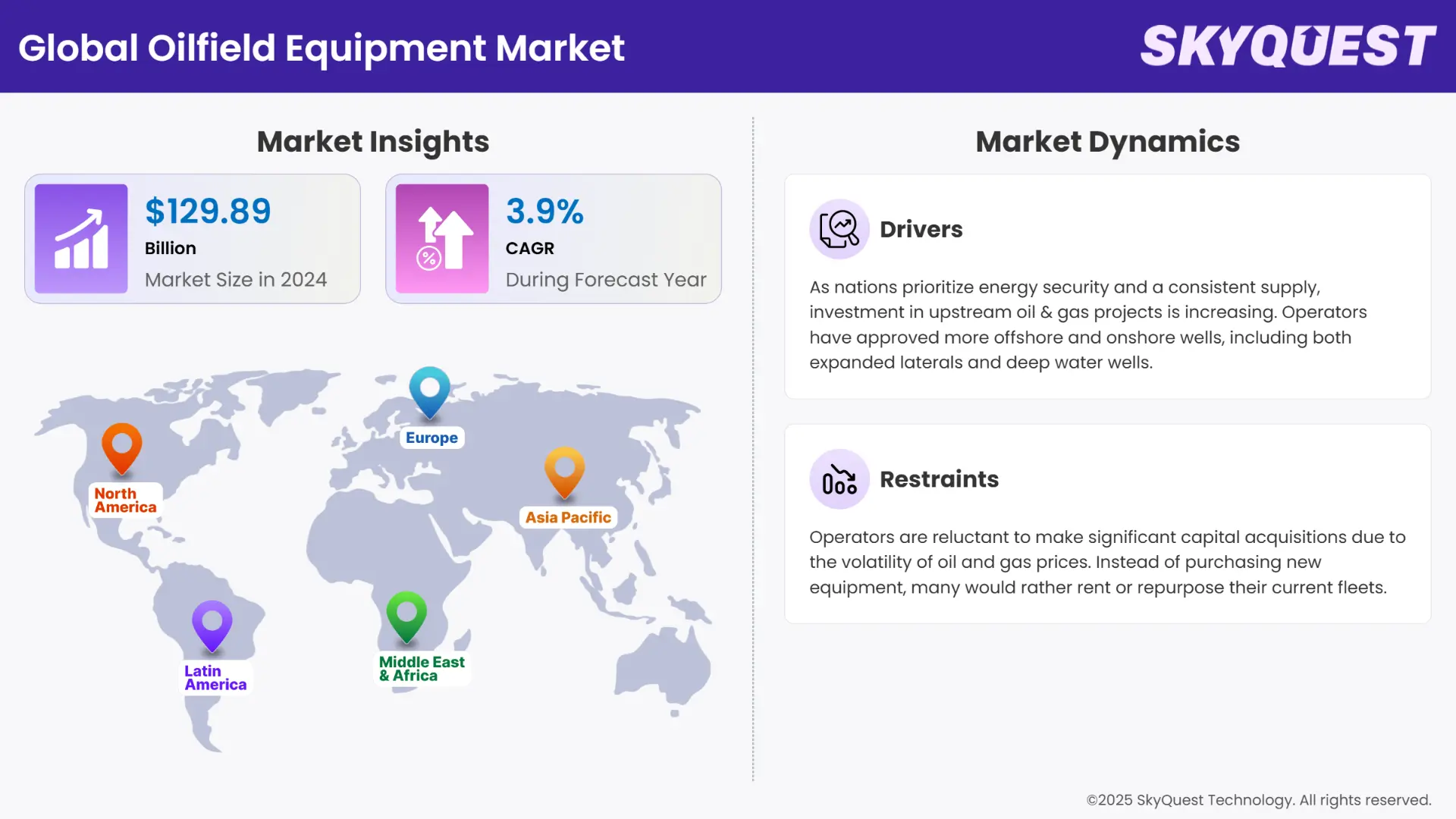
Global Oilfield Equipment Market size was valued at USD 129.89 Billion in 2024 and is poised to grow from USD 134.96 Billion in 2025 to USD 183.28 Billion by 2033, growing at a CAGR of 3.9% in the forecast period (2026–2033).
The global demand for crude oil is driving the global oilfield equipment market growth. Furthermore, developments in the oil and gas industry have increased the demand for oilfield equipment. Additionally, as government efforts to support the petrochemical industry have grown, so has the use of oilfield consumables. Both onshore and offshore projects are growing in number worldwide.
Organizations in the public and private sectors are increasing their financial investments to grow the global oilfield equipment industry. Furthermore, the expanding developments in drilling technologies have been extremely beneficial to the oil & gas industry. Activities related to oil exploration and drilling are increasing in several countries.
The application of AI to oilfield equipment for gas and oil exploration has also attracted a lot of attention lately. The global oilfield equipment market outlook is therefore expected to change over the forecast period as a result of the growing advancement of technologies pertaining to oilfield equipment, including drilling machines, valves, plug sockets, and other machinery.
To get more insights on this market click here to Request a Free Sample Report
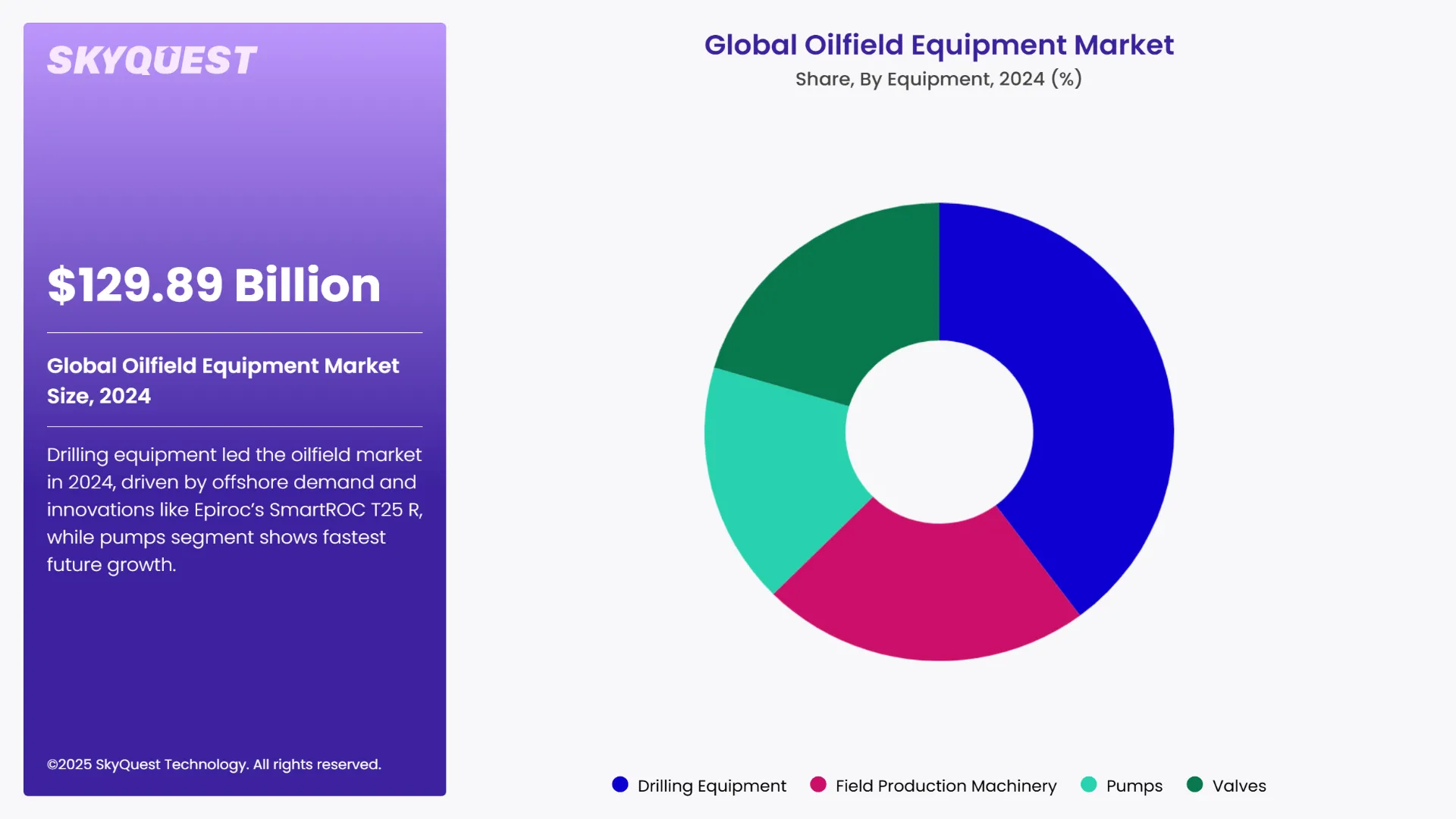
The global oilfield equipment market is segmented into equipment, application, well type, and region. By equipment, the market is divided into drilling equipment, field production machinery, pumps, and valves. Depending on the application, it is bifurcated into onshore and offshore. According to well type, the market is classified into exploration wells, development wells, and production wells. Regionally, it is analyzed across North America, Europe, Asia-Pacific, Latin America, and the Middle East and Africa.
As per the 2024 oilfield equipment market analysis, the drilling segment held the largest market share. The growth of oil & gas companies around the world has increased the demand for drilling equipment, which is driving market expansion. Additionally, the development of drill bits, collars, drill pipes, and other drilling components supports market expansion. Furthermore, as drilling activities become more offshored, there is a greater need for drilling equipment, which is driving growth in the oilfield equipment sector.
The pumps segment is expected to grow at the highest compound annual growth rate during the forecast period. The increasing use of diaphragm pumps, centrifugal pumps, gear pumps, progressive cavity pumps, reciprocating plunger pumps, and metering pumps for fluid transfer in oilfields is helping the market grow.
Why is the Onshore Segment a Key Revenue Driver in the Oilfield Equipment Market?
As per the 2024 oilfield equipment market forecast, the onshore segment held the largest share of the market. An increase in onshore drilling operations in countries such as the United States and the United Arab Emirates has led to a growth in the market. The market is growing because onshore drilling applications are more advantageous than offshore drilling in a number of ways, including increased oil production, cost effectiveness, and lower environmental risks.
The offshore segment is anticipated to have the highest oilfield equipment market share during the forecast period. The market is growing as a result of the increasing demand for submerged hydrocarbons to meet the world's energy needs. Furthermore, advancements in drilling technologies for offshore applications have contributed to the market's expansion. Additionally, it is projected that the advantages of offshore application, such as the ability to access vast subsurface oil & gas reserves and the decrease in conflict with locals, will sustain the growth of the oilfield equipment market over the forecast period.
To get detailed segments analysis, Request a Free Sample Report
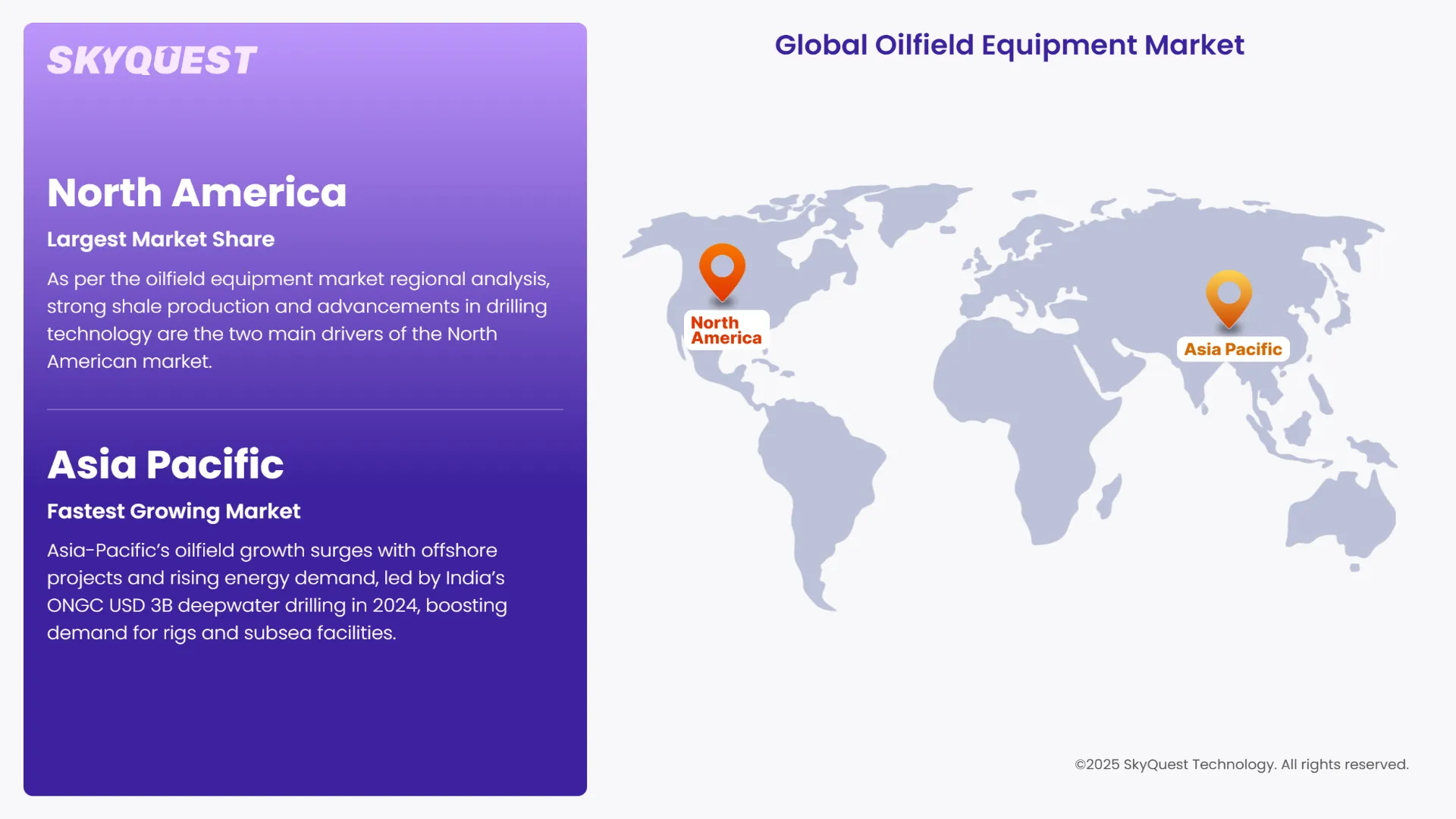
As per the oilfield equipment market regional analysis, strong shale production and advancements in drilling technology are the two main drivers of the North American market. Baker Hughes announced in 2024 that it would increase production of sophisticated rotary steerable systems in Texas by investing USD 600 million. The demand for high-performance drilling and completion equipment is being driven by the United States' increasing crude exports, which average over 4.8 million barrels per day. The region's dominance in the global market is further cemented by supportive energy regulations and ongoing exploration activities in the US and Canada.
U.S. Oilfield Equipment Market
The U.S. dominates the North American oilfield equipment market, due to a solid pace of shale and offshore exploration. In 2024, ExxonMobil's approval of a USD 12.7 billion offshore project in the Gulf of Mexico ramped up demand for blowout preventers and subsea wellheads. One technology that enhances production and safety in new drilling activity is AI-enabled drilling rigs. The increasing pace of domestic production and the development of liquefied natural gas export capacity in several states continue to drive the demand for advanced oilfield equipment.
Canada Oilfield Equipment Market
The expansion of oil sands and offshore exploration are the main drivers of Canada's market growth. Heavy-duty pumps, separators, and drilling equipment expected to see significantly more demand in 2024, will be due to Suncor Energy's USD 1.4 billion dollar project in the Fort Hills oil sands. There are government subsidies for all pipeline and energy infrastructure projects that help for the future purchases of materials. In an added benefit, equipment demand is likewise developing from significantly increased investment in Arctic exploration and upgrading existing older onshore facilities.
Asia-Pacific is growing rapidly due to offshore developments and increased energy consumption. India's ONGC started a USD 3 billion deepwater drilling project in 2024 in the Krishna-Godavari area, and the amount of equipment substantial including high-capacity rigs and subsea production facilities will be in high demand. This is probably due to the LNG projects in Australia and Chinese investments in exploration in the South China Sea. Government programs at the regional level to support domestic energy production means there will be a continued demand for oilfield equipment.
South Korea Oilfield Equipment Market
Offshore engineering and export manufacturing are the main drivers of the South Korean oilfield equipment market. Hyundai Heavy Industries increased its domestic production of high-pressure valves and subsea equipment after securing a USD 1.1 billion contract in 2024 to supply offshore drilling platforms for Middle Eastern operators. Despite producing very little oil of its own, the nation is a major player in the global supply chain due to its robust shipbuilding and exports of oilfield equipment.
Japan Oilfield Equipment Market
The Japan's oilfield equipment sector depends on exporting manufacturing and cutting-edge technologies. In 2024, JGC Corporation and MODEC developed AI-powered floating production storage and offloading (FPSO) equipment for offshore oilfields in Brazil. Despite the low level of domestic oil production, Japanese companies are supplying subsea systems and precision drilling parts around the globe. Japan is positioned as a high-value technology supplier in the oilfield equipment industry due to government support for global energy projects.
Several factors contribute to the ongoing development of the European oilfield equipment industry, including offshore wind-oil hybrid developments, energy security priorities, and exploration activity in the North Sea. For example, Equinor commenced a USD 5.2 billion drilling program in Norway in 2024, which increased demand for blowout preventers, and subsea production systems. The sustainability target fits well with the desire of Government, operators, and regulatory bodies for state-of-the-art low-emission drilling technology. The UK, France, and Germany are important contributors to the manufacturing and engineering know-how needed for international oilfield activity.
UK Oilfield Equipment Market
North Sea investments and advanced construction practices injuries are beneficial to the UK market. Orders for BOPs, wellheads and offshore rigs increased in 2024 when Harbour Energy launched its USD 700 million drilling enhancement program in the UK Continental Shelf. Demand is driven by government support to maximize economic recovery from existing oilfields. Aberdeen continues to be a major center for technical innovation, oilfield engineering, and equipment exporting to foreign markets.
France Oilfield Equipment Market
Engineering firms like TechnipFMC are at the forefront of France's oilfield equipment industry, which is primarily focused on exports. TechnipFMC was awarded a USD 1.6 billion contract to supply subsea production equipment for Brazilian offshore fields in 2024. Despite producing very little oil domestically, France is a global leader in deepwater and subsea technology. French suppliers of oilfield equipment are now more competitive due to R&D efforts in automation and sustainable drilling technologies.
Germany Oilfield Equipment Market
High-precision engineering and component manufacturing are the main drivers of the oilfield equipment market in Germany. To promote limited emission oilfield domineering, Siemens Energy would further promote electric-driven drilling motors in their product offerings by 2024. Despite the small amount of oil extracted domestically, German-made pumps, compressors, and automation systems are highly sought after globally.
To know more about the market opportunities by region and country, click here to
Buy The Complete Report
Increasing Project Approvals and Upstream Investments
Move Toward Safety, Automation, and Emission Reduction
Capital Discipline and Price Volatility as Constraints
Supply Chain Issues and Regulatory Hold-Ups
Request Free Customization of this report to help us to meet your business objectives.
Global leaders compete using full lifecycle solutions, on-the-ground presence, and performance guarantees. Integrated suppliers bundle together hardware, digital platform, and field service solutions together in order to obtain long-term agreements. Several fleets consist of electric frac units, automated rigs, and low-leak surface equipment. Some of the oilfield equipment market strategies include acquisitions in specific segments, producing regionally to meet local content obligations, modular products, and pricing schemes based on performance-based outcomes and fuel efficiency.
Top Player’s Company Profile
Recent Developments in Oilfield Equipment Market
SkyQuest’s ABIRAW (Advanced Business Intelligence, Research & Analysis Wing) is our Business Information Services team that Collects, Collates, Correlates, and Analyses the Data collected by means of Primary Exploratory Research backed by robust Secondary Desk research.
As per SkyQuest analysis, the oilfield equipment industry is spurred on by the depletion of mature fields, new shale and offshore projects and concerns about energy security. Vendors that fuse reliable hardware with digital monitoring and efficient power sources are in the best position because customers are looking for more automation, cleaner operational practices and safer equipment. There will be gains for companies that are able pursue modular equipment designs to reduce supply chain pressures and local support to navigate regulatory challenges and support unpredictable pricing. The opportunity still exists to foster strong integrated offerings in the market, while providing the best aftermarket support and proven emissions reductions in companies that are destined to make the best of this trending and evolving industry in the next years.
| Report Metric | Details |
|---|---|
| Market size value in 2024 | USD 129.89 Billion |
| Market size value in 2033 | USD 183.28 Billion |
| Growth Rate | 3.9% |
| Base year | 2024 |
| Forecast period | 2026–2033 |
| Forecast Unit (Value) | USD Billion |
| Segments covered |
|
| Regions covered | North America (US, Canada), Europe (Germany, France, United Kingdom, Italy, Spain, Rest of Europe), Asia Pacific (China, India, Japan, Rest of Asia-Pacific), Latin America (Brazil, Rest of Latin America), Middle East & Africa (South Africa, GCC Countries, Rest of MEA) |
| Companies covered |
|
| Customization scope | Free report customization with purchase. Customization includes:-
|
To get a free trial access to our platform which is a one stop solution for all your data requirements for quicker decision making. This platform allows you to compare markets, competitors who are prominent in the market, and mega trends that are influencing the dynamics in the market. Also, get access to detailed SkyQuest exclusive matrix.
Table Of Content
Executive Summary
Market overview
Parent Market Analysis
Market overview
Market size
KEY MARKET INSIGHTS
COVID IMPACT
MARKET DYNAMICS & OUTLOOK
Market Size by Region
KEY COMPANY PROFILES
Methodology
For the Oilfield Equipment Market, our research methodology involved a mixture of primary and secondary data sources. Key steps involved in the research process are listed below:
1. Information Procurement: This stage involved the procurement of Market data or related information via primary and secondary sources. The various secondary sources used included various company websites, annual reports, trade databases, and paid databases such as Hoover's, Bloomberg Business, Factiva, and Avention. Our team did 45 primary interactions Globally which included several stakeholders such as manufacturers, customers, key opinion leaders, etc. Overall, information procurement was one of the most extensive stages in our research process.
2. Information Analysis: This step involved triangulation of data through bottom-up and top-down approaches to estimate and validate the total size and future estimate of the Oilfield Equipment Market.
3. Report Formulation: The final step entailed the placement of data points in appropriate Market spaces in an attempt to deduce viable conclusions.
4. Validation & Publishing: Validation is the most important step in the process. Validation & re-validation via an intricately designed process helped us finalize data points to be used for final calculations. The final Market estimates and forecasts were then aligned and sent to our panel of industry experts for validation of data. Once the validation was done the report was sent to our Quality Assurance team to ensure adherence to style guides, consistency & design.
Analyst Support
Customization Options
With the given market data, our dedicated team of analysts can offer you the following customization options are available for the Oilfield Equipment Market:
Product Analysis: Product matrix, which offers a detailed comparison of the product portfolio of companies.
Regional Analysis: Further analysis of the Oilfield Equipment Market for additional countries.
Competitive Analysis: Detailed analysis and profiling of additional Market players & comparative analysis of competitive products.
Go to Market Strategy: Find the high-growth channels to invest your marketing efforts and increase your customer base.
Innovation Mapping: Identify racial solutions and innovation, connected to deep ecosystems of innovators, start-ups, academics, and strategic partners.
Category Intelligence: Customized intelligence that is relevant to their supply Markets will enable them to make smarter sourcing decisions and improve their category management.
Public Company Transcript Analysis: To improve the investment performance by generating new alpha and making better-informed decisions.
Social Media Listening: To analyze the conversations and trends happening not just around your brand, but around your industry as a whole, and use those insights to make better Marketing decisions.
REQUEST FOR SAMPLE
 REQUEST FREE CUSTOMIZATION
Global Oilfield Equipment Market size was valued at USD 129.89 Billion in 2024 and is poised to grow from USD 134.96 Billion in 2025 to USD 183.28 Billion by 2033, growing at a CAGR of 3.9% in the forecast period (2026–2033).
Global leaders compete using full lifecycle solutions, on-the-ground presence, and performance guarantees. Integrated suppliers bundle together hardware, digital platform, and field service solutions together in order to obtain long-term agreements. Several fleets consist of electric frac units, automated rigs, and low-leak surface equipment. Some of the oilfield equipment market strategies include acquisitions in specific segments, producing regionally to meet local content obligations, modular products, and pricing schemes based on performance-based outcomes and fuel efficiency. 'SLB', 'Petrobras', 'Gazprom Neft', 'NOV', 'CNX Resources Corp.', 'Weatherford', 'Tenaris', 'Vallourec', 'ChampionX', 'Weir Group', 'Caterpillar Oil and Gas', 'Helmerich & Payne', 'Nabors Industries'
As nations prioritize energy security and a consistent supply, investment in upstream oil & gas projects is increasing. Operators have approved more offshore and onshore wells, including both expanded laterals and deepwater wells. This continues to fuel the need for drilling rigs, wellheads, tubulars, fleets of pressure pumps, and artificial lift. In addition, aging fields will require repairs and replacement parts, giving the equipment manufacturers and service providers a consistent aftermarket profit opportunity. Thus, enhancing the global oilfield equipment market penetration.
There are a growing number of new developments using lower-emission technologies. Many fleets are deploying electrified frac spreads, natural gas turbine power systems, Tier 4 engines, and methane detection devices. Closed-loop flowback systems, automated valve controls and leak detection can all save fuel consumption and decrease flaring. There will continue to be increasing adoption of modular power-dense technology that integrates performance and emissions reduction.
As per the oilfield equipment market regional analysis, strong shale production and advancements in drilling technology are the two main drivers of the North American market. Baker Hughes announced in 2024 that it would increase production of sophisticated rotary steerable systems in Texas by investing USD 600 million. The demand for high-performance drilling and completion equipment is being driven by the United States' increasing crude exports, which average over 4.8 million barrels per day. The region's dominance in the global market is further cemented by supportive energy regulations and ongoing exploration activities in the US and Canada.


Want to customize this report? This report can be personalized according to your needs. Our analysts and industry experts will work directly with you to understand your requirements and provide you with customized data in a short amount of time. We offer $1000 worth of FREE customization at the time of purchase.
Feedback From Our Clients


 USA (+1) 351-333-4748

