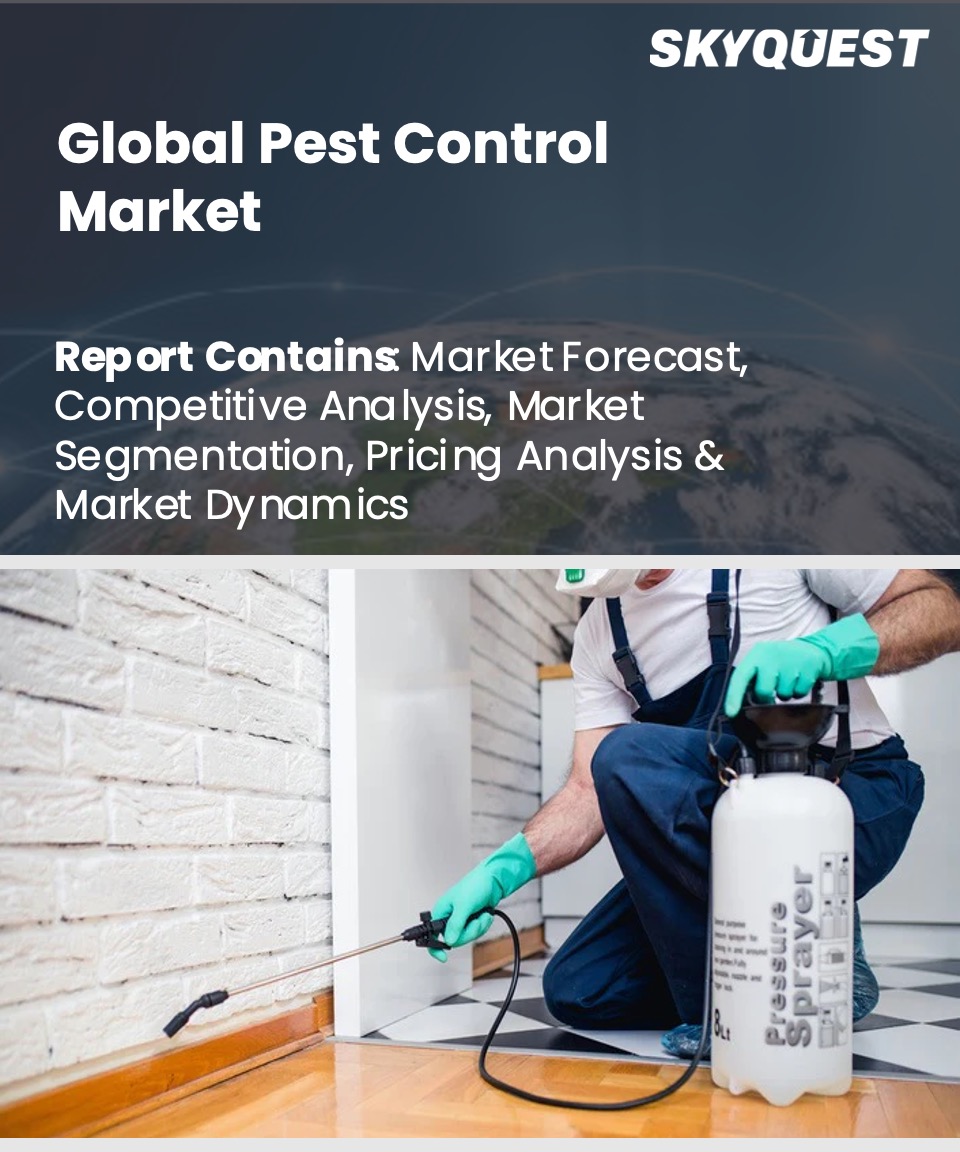
Pest Control Market
Report ID: SQMIG20L2073
Report ID: SQMIG20L2073
[email protected]
USA +1 351-333-4748
Report ID:
SQMIG20L2073 |
Region:
Global |
Published Date: August, 2025
Pages:
196
|Tables:
89
|Figures:
70


Global Pest Control Market size was valued at USD 25.06 Billion in 2024 and is poised to grow from USD 26.61 Billion in 2025 to USD 43.06 Billion by 2033, growing at a CAGR of 6.2% during the forecast period (2026–2033).
The global pest control market growth is driven by government initiatives to promote clean environments, ongoing research and development in pest control systems, growing health consciousness, and technological advancements in pest control.
The increasing focus on the use of biocides is another important factor propelling the growth of the global pest control industry. These are replacing traditional pesticides more frequently because they are more environmentally friendly. The need for pest control services has grown as a result of the ability to prevent the spread of illnesses like dengue, malaria, and bacterial and viral infections contracted through mosquito bites. Additionally, pest control contributes to public safety by preventing property damage and guaranteeing a safe and healthy living environment. The FDA's Food Safety Modernization Act (FSMA) highlights the importance of foodborne illnesses, which result in approximately 48 million illnesses, 128,000 hospitalizations, and 3,000 deaths in the US each year. This highlights the importance of pest control systems in preserving public health.
How is Digital Innovation Reshaping Urban Pest Control Strategies?
The combination of AI-powered smart traps and Internet of Things-based monitoring systems is a significant technological development changing the pest control market outlook. These gadgets identify and report pest activity in real time using cameras and sensors, enabling more rapid, data-driven responses. Rentokil first introduced its "PestConnect+" system in the UK in March 2025. When pests are found, it automatically notifies technicians and offers predictive analytics to stop infestations. As a result, businesses used fewer chemicals, had more accurate targeting, and paid lower operating costs. Particularly in delicate settings like food processing and medical facilities, these developments are propelling a change from reactive to proactive pest control.
Market snapshot - 2026-2033
Global Market Size
USD 23.6 Billion
Largest Segment
Commercial
Fastest Growth
Residential
Growth Rate
6.2% CAGR
To get more insights on this market click here to Request a Free Sample Report
The global pest control market is segmented into application, control method, end use, and region. By application, the market is bifurcated into residential and commercial. Depending on the control method, it is divided into chemical and mechanical. According to end use, the market is classified into insect, rodents, termite, and mosquito. Regionally, it is analyzed across North America, Europe, Asia-Pacific, Latin America, and the Middle East and Africa.
How are Health Risks from Insects Fueling Market Growth?
As per the 2024 pest control market analysis, the insects segment dominated the market with a 42.4% share. Insects like ticks and mosquitoes can transmit diseases that can have a major negative impact on human health. Keeping insect pests under control is essential to preventing diseases like dengue, allergies, and malaria. As more people realize how important it is to maintain clean public spaces, there is a growing demand for pest control services. As the pest control industry adopts new technologies for better monitoring and control methods, the market for pest control services is growing.
The termite segment is expected to grow at a significant compound annual growth rate (CAGR) during the forecast period. The wooden frameworks of both residential and commercial buildings are at risk from termites. This insect can cause significant damage to wooden structures and properties, so early detection and prevention are crucial. Pest control is the most effective method of termite eradication. Additionally, the advanced, more targeted, and environmentally friendly termite control techniques propelling the market expansion have an impact on property owners.
How do Government Standards Influence Commercial Pest Management Needs?
As per the 2024 pest control market forecast, the commercial segment dominated the market. As commercial spaces are subject to stricter health and safety regulations, regular pest control is necessary to maintain a pest-free and healthy environment. The market is expanding because of stringent government regulations pertaining to the upkeep of hygienic conditions in commercial settings, such as food services and hospitals.
Over the course of the forecast period, the residential segment is expected to have a noteworthy pest control market share. People are growing more conscious of the danger pests pose to their health. Numerous diseases are spread by mosquitoes and other insects in and around residential areas. Homeowners are being forced to pay for preventative pest control services because termites and rodents are a threat to their property. Additionally, because of their greater disposable income, residents in various regions can now opt to use pest control services, which is anticipated to support the segment's growth.
To get detailed segments analysis, Request a Free Sample Report
What Role Does Regulation Play in North America's Pest Control Growth?
As per the pest control market regional analysis, North America leads the market because of its strict public health laws and high level of awareness. Nearly 35% of global income was generated in the region in 2024. The adoption rates of digital and environmentally friendly pest control technologies are highest in the United States and Canada. The need for commercial pest control and IPM (Integrated insect management) techniques is fueled by urbanization, disease outbreaks linked to insects, and a flourishing food service sector.
U.S. Pest Control Market
The U.S. has the largest pest control industry due to the strong demand from both the residential and commercial sectors. Insect control alone was worth over USD 4.6 billion in 2023. AI and IoT technologies are being used by businesses like Terminix and Orkin to improve customer service. The U.S. industry has greatly benefited from increased pest activity brought on by climate change and more stringent cleanliness regulations in food and healthcare settings.
Canada Pest Control Market
Canada's pest control sector is continuously growing due to factors like rising urban populations, a greater need for food processing, and an increase in rodent and insect infestations. The Pest Management Regulatory Agency of Health Canada oversees regulations to guarantee safe practices. An increasing focus on sustainable practices and remote monitoring systems has led Canadian businesses and governments to invest more in year-round and preventative pest management programs, particularly for termites, bed bugs, and rats.
What Strategies are European Countries Using to Modernize Pest Control?
Environmentally friendly pest control products based on biopesticides are becoming more necessary in Europe, a developed pest management market. The market is estimated to be worth Euro 8 billion in 2024. Demand in the residential, agricultural, and industrial sectors is being impacted by strict regulations, insect migrations brought on by climate change, and food safety standards. As invasive species like Tapinoma magnum ants and Asian tiger mosquitoes become more prevalent, the public and government are spending more on eco-friendly treatments and pest monitoring.
UK Pest Control Market
Stricter public health regulations and an increase in urban infestations are driving growth in the UK pest control market. A rise in hospital pest incidences led to an increase in NHS spending on pest services between 2021 and 2024. Warm winters and overcrowding are also contributing to an increase in rodent populations. There is a significant demand for lodging, culinary services, and hospitality. Tighter regulations and sustainability goals are driving a rise in the use of non-toxic techniques and digital traps.
France Pest Control Market
Regulations that support telemedicine, public hygiene, and eco-friendly solutions are driving the growth of the French pest control industry. Demand has increased because of urbanization and the spread of exotic species, like bed bugs in Paris. The French government has started initiatives to increase public awareness and provide funding for sustainable pest control in schools and public housing. The alignment of EU green policies has resulted in a shift toward biopesticides, which is driving up demand in the agriculture sector.
Germany Pest Control Market
Numerous factors, such as increased construction activity, adherence to food safety regulations, and public concerns about exotic pests, have an impact on Germany's pest control market. Super-ant infestations caused infrastructure and city disruptions in 2024, necessitating urgent fixes. Digital monitoring systems and integrated pest management are being funded by both the public and private sectors. Germany's focus on sustainability is in line with the growth of green-certified service providers, particularly in the retail, hospitality, and public building industries that need regular pest inspections and treatments.
What Technologies Are Driving the Pest Control Boom in Asia-Pacific?
Through 2032, the pest control market is anticipated to increase at a compound annual growth rate (CAGR) of over 6%, positioning Asia-Pacific as the world's fastest-growing region. The demand for services has increased as a result of urbanization, rising temperatures, and an increase in outbreaks of pest-borne diseases. Funding for pest control and public cleanliness is being provided by the governments of China, India, and Southeast Asia. Digital and chemical-free pest control methods are becoming more popular in the region, particularly in the hospitality, healthcare, and educational sectors.
South Korea Pest Control Market
The South Korean pest control market is expanding quickly due to growing concerns about hygiene and vector-borne illnesses like dengue and Japanese encephalitis. Urbanization and high-density living are driving demand for residential space, while stringent health regulations apply to dining establishments and hospitals. For more intelligent public health management, government health campaigns and smart-city projects are incorporating pest control technologies, like automated traps and AI-powered detection systems, into larger environmental monitoring programs.
Japan Pest Control Market
Japan's aging population, crowded cities, and deteriorating infrastructure all influence the country's pest control business. The need for residential and commercial pest services is rising as a result of increased susceptibility to termite and cockroach infestations. Climate change is also making invasive species a bigger threat to the nation. Robotic and non-chemical pest management technologies are gaining popularity as a means of adhering to safety regulations, and the hospitality and healthcare industries are significant users.
To know more about the market opportunities by region and country, click here to
Buy The Complete Report
Pest Control Market Drivers
Rising Rates of Vector-Born Illness
Expansion of the Hospitality Infrastructure and Urbanization
Pest Control Market Restraints
Impact of Chemical Pesticides on Human Health and the Environment
Expensive, Advanced Pest Management Equipment
Request Free Customization of this report to help us to meet your business objectives.
The highly consolidated pest control market is being driven by leading companies like Rentokil Initial and Rollins through aggressive acquisitions and technological innovation. Players prioritize regional expansion, predictive analytics, and environmentally friendly products. In 2025, Ecolab made an investment in AI-powered pest forecasting tools, and Rentokil purchased a prominent pest-tech company in India. Rapid-response platforms, subscription-based pest services, and green certification are the three areas where competition is growing.
Top Player’s Company Profile
Recent Developments in Pest Control Market
SkyQuest’s ABIRAW (Advanced Business Intelligence, Research & Analysis Wing) is our Business Information Services team that Collects, Collates, Correlates, and Analyses the Data collected by means of Primary Exploratory Research backed by robust Secondary Desk research.
As per SkyQuest analysis, the global pest control market is advancing due to many factors such as urban density, rise in pest-related diseases, and stricter sanitary regulations. Companies are investing in new technologies such as AI, IoT, and organically derived solutions due to consumer demand for safer, greener, and smarter services. Changes in regulations put pressure on players to innovate whilst maintaining compliance, which can be both an impediment and an enabler. In addition, new technologies such as IPM and remote monitoring are reshaping pest management treatments levels, particularly in commercial and high-risk scenarios. Startups are leveraging sustainability and technology to redefine the service delivery model. As people become increasingly aware of health issues, and the industry becomes more heavily compliance-focused and high technology, pest management will become a critical component of public health and corporate continuity.
| Report Metric | Details |
|---|---|
| Market size value in 2024 | USD 25.06 Billion |
| Market size value in 2033 | USD 43.06 Billion |
| Growth Rate | 6.2% |
| Base year | 2024 |
| Forecast period | 2026-2033 |
| Forecast Unit (Value) | USD Billion |
| Segments covered |
|
| Regions covered | North America (US, Canada), Europe (Germany, France, United Kingdom, Italy, Spain, Rest of Europe), Asia Pacific (China, India, Japan, Rest of Asia-Pacific), Latin America (Brazil, Rest of Latin America), Middle East & Africa (South Africa, GCC Countries, Rest of MEA) |
| Companies covered |
Top Player’s Company Profile
|
| Customization scope | Free report customization with purchase. Customization includes:-
|
To get a free trial access to our platform which is a one stop solution for all your data requirements for quicker decision making. This platform allows you to compare markets, competitors who are prominent in the market, and mega trends that are influencing the dynamics in the market. Also, get access to detailed SkyQuest exclusive matrix.
Table Of Content
Executive Summary
Market overview
Parent Market Analysis
Market overview
Market size
KEY MARKET INSIGHTS
COVID IMPACT
MARKET DYNAMICS & OUTLOOK
Market Size by Region
KEY COMPANY PROFILES
Methodology
For the Pest Control Market, our research methodology involved a mixture of primary and secondary data sources. Key steps involved in the research process are listed below:
1. Information Procurement: This stage involved the procurement of Market data or related information via primary and secondary sources. The various secondary sources used included various company websites, annual reports, trade databases, and paid databases such as Hoover's, Bloomberg Business, Factiva, and Avention. Our team did 45 primary interactions Globally which included several stakeholders such as manufacturers, customers, key opinion leaders, etc. Overall, information procurement was one of the most extensive stages in our research process.
2. Information Analysis: This step involved triangulation of data through bottom-up and top-down approaches to estimate and validate the total size and future estimate of the Pest Control Market.
3. Report Formulation: The final step entailed the placement of data points in appropriate Market spaces in an attempt to deduce viable conclusions.
4. Validation & Publishing: Validation is the most important step in the process. Validation & re-validation via an intricately designed process helped us finalize data points to be used for final calculations. The final Market estimates and forecasts were then aligned and sent to our panel of industry experts for validation of data. Once the validation was done the report was sent to our Quality Assurance team to ensure adherence to style guides, consistency & design.
Analyst Support
Customization Options
With the given market data, our dedicated team of analysts can offer you the following customization options are available for the Pest Control Market:
Product Analysis: Product matrix, which offers a detailed comparison of the product portfolio of companies.
Regional Analysis: Further analysis of the Pest Control Market for additional countries.
Competitive Analysis: Detailed analysis and profiling of additional Market players & comparative analysis of competitive products.
Go to Market Strategy: Find the high-growth channels to invest your marketing efforts and increase your customer base.
Innovation Mapping: Identify racial solutions and innovation, connected to deep ecosystems of innovators, start-ups, academics, and strategic partners.
Category Intelligence: Customized intelligence that is relevant to their supply Markets will enable them to make smarter sourcing decisions and improve their category management.
Public Company Transcript Analysis: To improve the investment performance by generating new alpha and making better-informed decisions.
Social Media Listening: To analyze the conversations and trends happening not just around your brand, but around your industry as a whole, and use those insights to make better Marketing decisions.
REQUEST FOR SAMPLE
 REQUEST FREE CUSTOMIZATION


Want to customize this report? This report can be personalized according to your needs. Our analysts and industry experts will work directly with you to understand your requirements and provide you with customized data in a short amount of time. We offer $1000 worth of FREE customization at the time of purchase.
Feedback From Our Clients


 USA (+1) 351-333-4748

