Renewable Energy Market
Report ID: SQMIG55F2089
Report ID: SQMIG55F2089
[email protected]
USA +1 351-333-4748
Report ID:
SQMIG55F2089 |
Region:
Global |
Published Date: August, 2025
Pages:
191
|Tables:
65
|Figures:
69


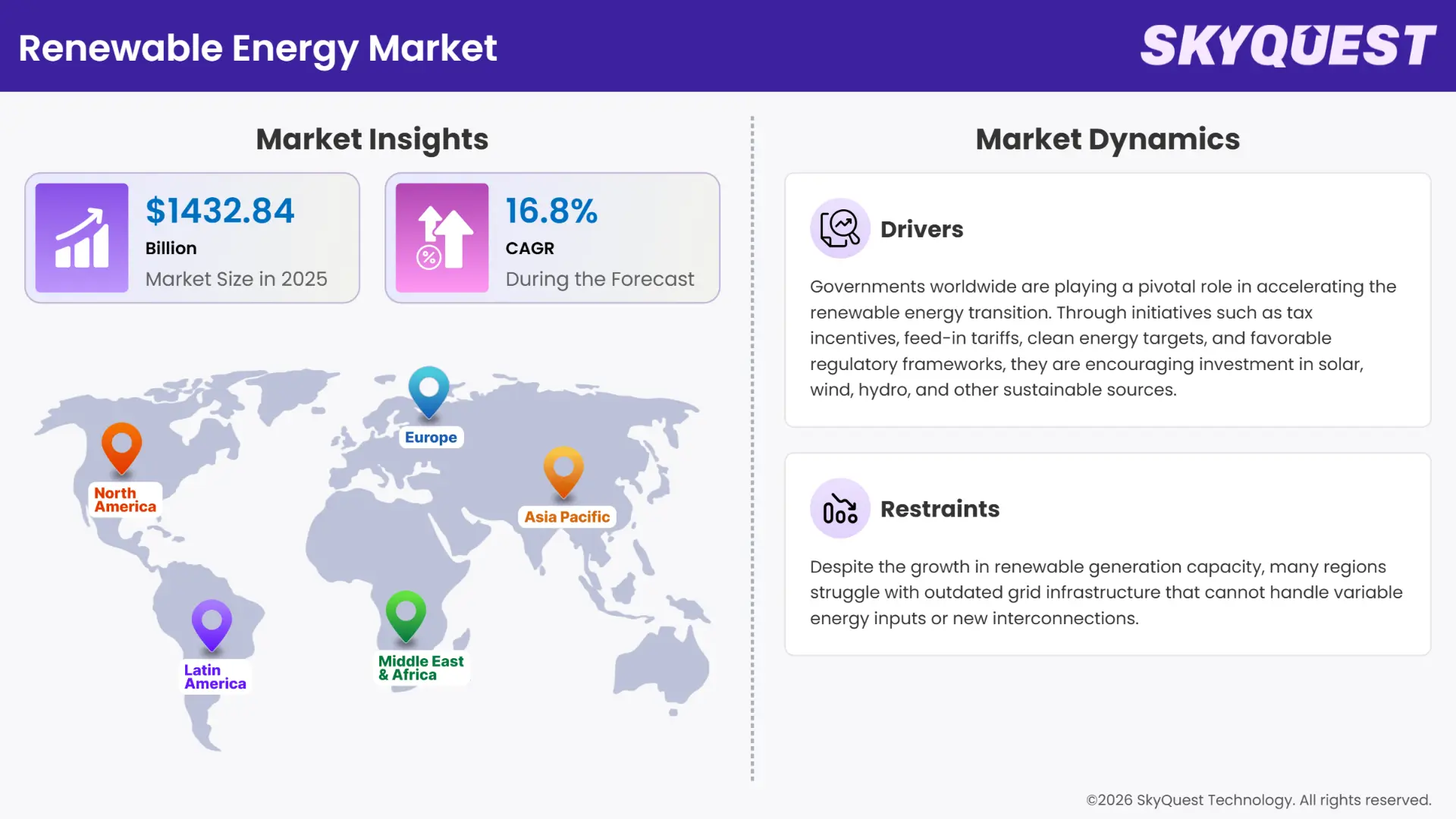
Global Renewable Energy Market size was valued at USD 1226.75 Billion in 2024 and is poised to grow from USD 1432.84 Billion in 2025 to USD 4962.97 Billion by 2033, growing at a CAGR of 16.8% in the forecast period (2026–2033).
Key Takeaways: Market Trends & Insights
The renewable energy market is undergoing significant expansion, driven by global efforts to reduce carbon emissions, enhance energy security, and transition away from fossil fuels.
Governments worldwide are implementing supportive policies, tax incentives, and regulatory frameworks to encourage investment in renewable sources such as solar, wind, hydro, geothermal, and biomass. Technological advancements are improving the efficiency, storage, and integration of renewable energy into existing grids, making it more competitive with traditional energy sources.
Additionally, growing corporate sustainability commitments and rising consumer demand for clean energy are accelerating adoption across residential, commercial, and industrial sectors. The market is also witnessing increased activity in power purchase agreements, green hydrogen projects, and decentralized energy systems, reflecting a broader move toward sustainable, resilient, and diversified energy infrastructures globally.
How is AI Transforming the Renewable Energy Sector?
Artificial Intelligence (AI) is playing a transformative role in the renewable energy market by enhancing operational efficiency, improving forecasting accuracy, and enabling smarter energy management. Utilities and energy companies are increasingly integrating AI-driven platforms to manage complex, distributed energy systems with greater precision. AI algorithms analyze vast amounts of weather, demand, and performance data to predict energy output from variable sources like wind and solar, allowing grid operators to balance supply and demand more effectively. This is especially critical as more renewable energy projects come online and need to be seamlessly integrated into national grids.
To get more insights on this market click here to Request a Free Sample Report
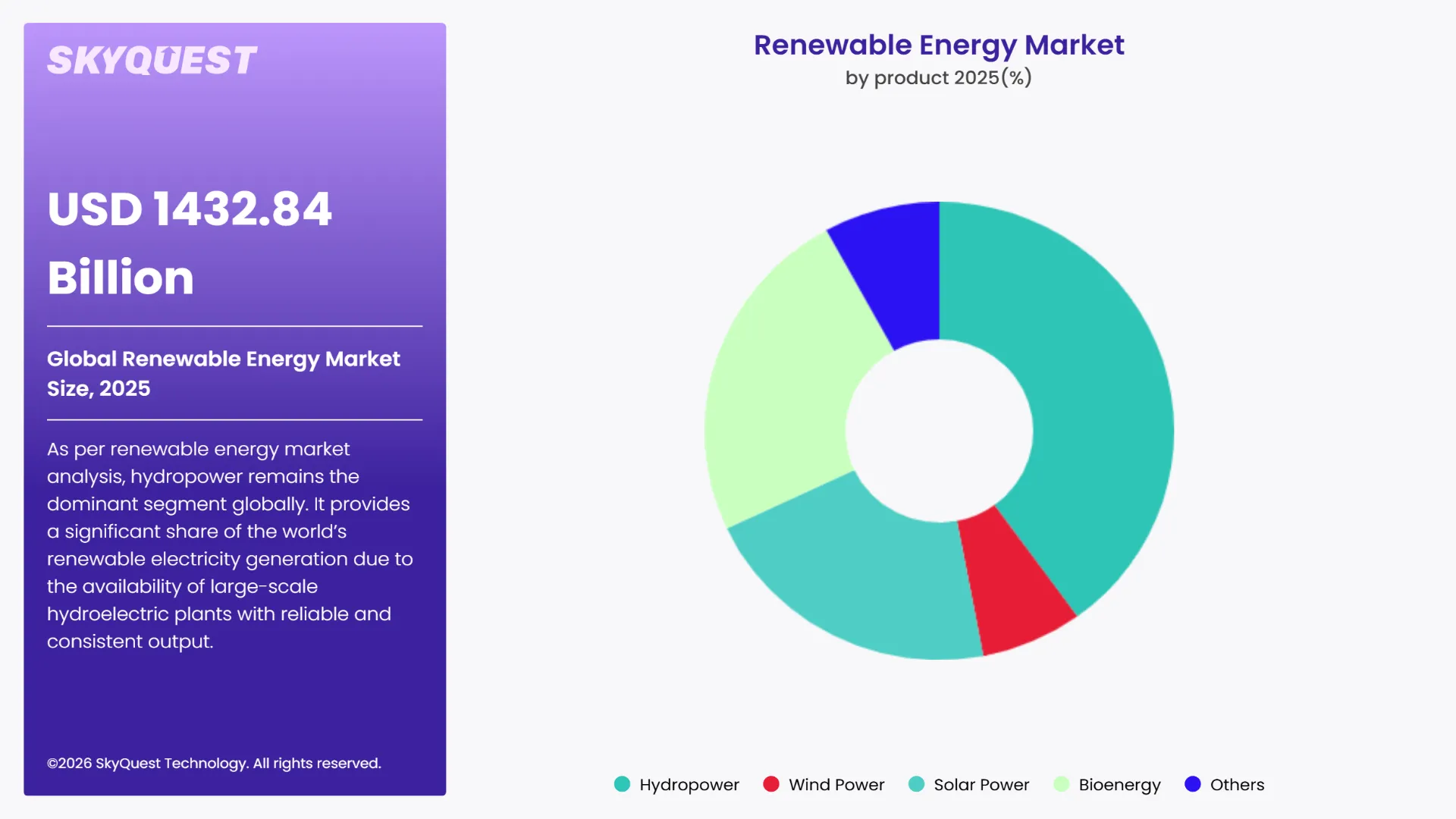
Global renewable energy market is segmented into product, application and region. Based on product, the market is segmented into hydropower, wind power, solar power, bioenergy and others. Based on application, the market is segmented into industrial, residential and commercial. Based on region, the market is segmented into North America, Asia Pacific, Europe, Latin America, Middle East and Africa.
How does Hydropower Contribute to Global Renewable Electricity Generation?
As per renewable energy market analysis, hydropower remains the dominant segment globally. It provides a significant share of the world’s renewable electricity generation due to the availability of large-scale hydroelectric plants with reliable and consistent output. Hydropower’s ability to provide baseload power and grid stability makes it a critical component in many countries’ energy mixes, especially where suitable river systems exist.
As per global renewable energy market outlook, solar power is currently the fastest-growing segment worldwide. Rapid declines in photovoltaic (PV) panel costs, improvements in efficiency, and supportive government policies have fueled massive deployments of solar capacity, both at utility scale and distributed levels (e.g., rooftop solar). The versatility of solar installations from small residential setups to large solar farms combined with accelerating battery storage adoption, drives its swift expansion, especially in emerging markets and regions with high solar irradiance.
Which Industries are Leading Renewable Energy Adoption in the Industrial Sector?
As per global renewable energy market forecast, the industrial segment is dominant in the market. Industries such as manufacturing, mining, chemicals, and heavy machinery rely heavily on energy-intensive processes, making them prime candidates for large-scale renewable energy adoption. Many industrial companies are increasingly integrating renewables like solar farms, wind parks, and bioenergy plants to reduce operational costs and meet stringent environmental regulations. Sustainability commitments, driven by both governmental policies and shareholder expectations, are pushing industries to decarbonize their energy supply. Moreover, renewable energy sources can help industries hedge against volatile fossil fuel prices, ensuring more stable and predictable energy costs.
The residential segment is experiencing the fastest growth in renewable energy adoption, driven largely by technological advancements and increasing consumer awareness. Rooftop solar photovoltaic (PV) systems have become more affordable and accessible due to declining equipment and installation costs, coupled with government incentives such as tax credits and feed-in tariffs. Homeowners are motivated by a desire to reduce electricity bills, increase energy independence, and contribute to climate action. Additionally, the rise of home energy storage systems, such as Tesla’s Powerwall, enables better utilization of solar power by storing excess generation for use during nighttime or outages.
To get detailed segments analysis, Request a Free Sample Report
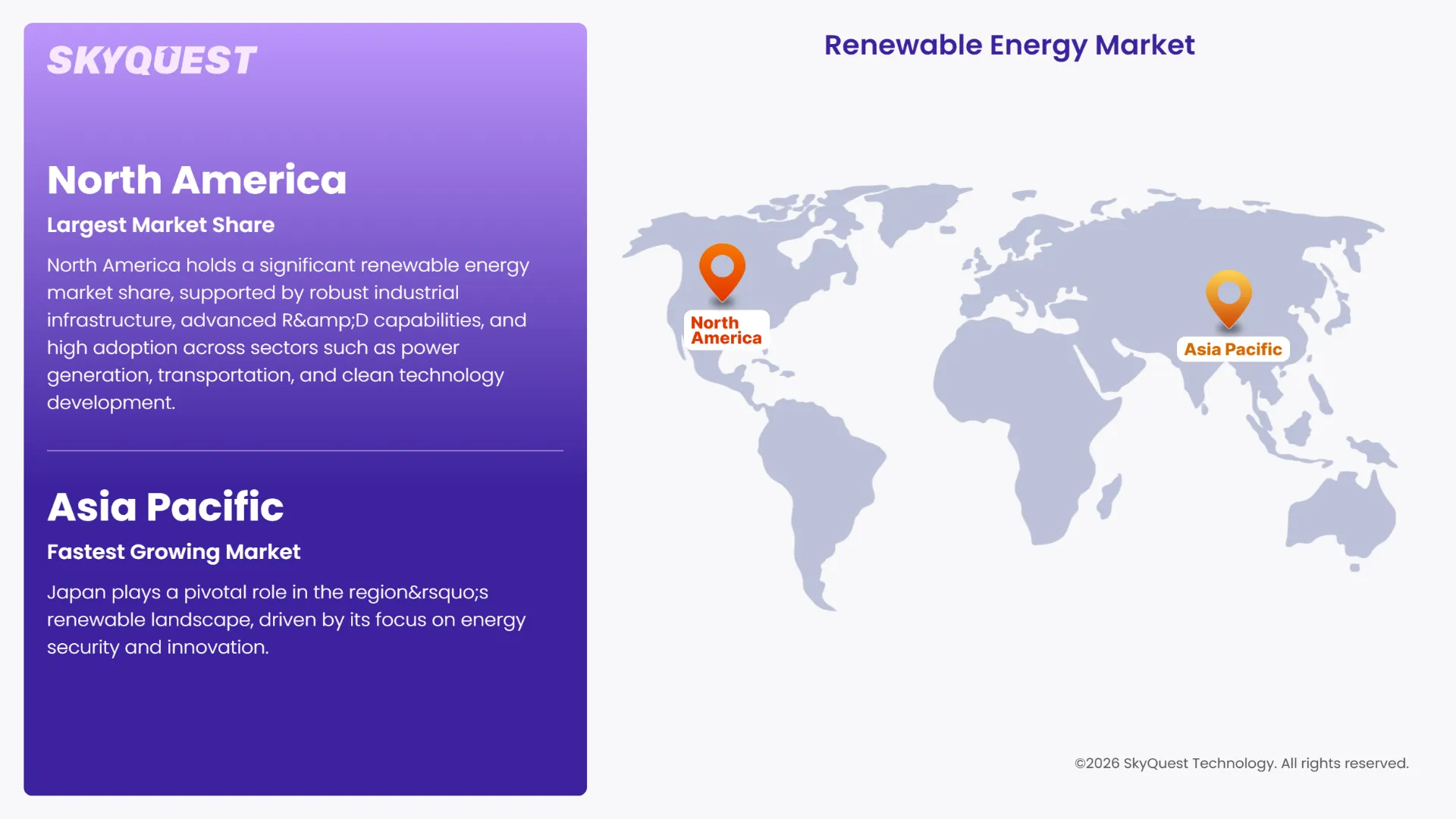
North America holds a significant renewable energy market share, supported by robust industrial infrastructure, advanced R&D capabilities, and high adoption across sectors such as power generation, transportation, and clean technology development. The region benefits from the strong presence of key market players, extensive manufacturing capacity, and regulatory frameworks that encourage investment in sustainable energy solutions.
As per regional forecast, the U.S. is the largest contributor to the North America market, driven by aggressive government policies promoting clean energy adoption and investments in solar, wind, and energy storage projects. Major players like NextEra Energy, Tesla, and GE Renewable Energy lead innovations in utility-scale renewables and smart grid integration. Expanding demand for decarbonization in power generation, transportation electrification, and industrial applications continues to fuel renewable energy market growth.
As per regional outlook, Canada’s market is growing steadily, propelled by abundant natural resources and supportive federal and provincial policies. The country emphasizes renewable sources such as hydropower, wind, and solar to meet energy demand sustainably. Investments in clean technology and grid modernization, especially to serve remote and off-grid communities, are boosting the adoption of renewable energy solutions across various sectors including mining, transportation, and residential use.
As per industry analysis, Asia-Pacific is the fastest-growing region in the renewable energy market due to rapid industrialization, urbanization, and significant investments in solar, wind, and energy storage infrastructure. Rising energy demand, government initiatives focused on carbon reduction, and the emergence of domestic equipment manufacturers are accelerating market growth across countries in this region.
Japan plays a pivotal role in the region’s renewable landscape, driven by its focus on energy security and innovation. The country invests heavily in solar, offshore wind, and hydrogen projects, while emphasizing advanced energy storage and grid technologies to optimize renewable integration and reliability.
South Korea’s renewable energy market is propelled by strong government support for green growth and the electrification of transport. The country is increasing investments in offshore wind, solar energy, and smart grids, aiming to reduce dependence on fossil fuels and meet ambitious emissions targets. The advanced electronics and manufacturing sectors also contribute to technology adoption and innovation.
Europe remains a key renewable energy market, bolstered by stringent environmental regulations, extensive policy support, and leadership in offshore wind and solar PV technologies. The region focuses heavily on innovation, sustainability, and integration of renewables within energy systems to meet the European Green Deal goals.
Germany leads the European renewable sector with a strong emphasis on solar and wind power. The country’s Energiewende (energy transition) strategy drives investments in grid upgrades, energy storage, and decarbonization of industrial processes, making it a global hub for renewable energy innovation.
The U.K. market is growing rapidly, powered by its leadership in offshore wind development and ambitious clean energy targets. The government’s commitment to phase out coal and increase renewable capacity is fostering expansion in solar, wind, and tidal energy projects, supported by strong R&D and private sector collaboration.
Italy’s renewable energy market is supported by growing solar and hydroelectric capacity. The country is focusing on expanding distributed generation and integrating renewables into smart city initiatives. Italy’s commitment to circular economy principles also encourages refurbishment and efficient use of renewable assets.
To know more about the market opportunities by region and country, click here to
Buy The Complete Report
Government Support and Climate Goals
Technological Advancements and Cost Decline
Grid Infrastructure and Transmission Limitations
Intermittency and Storage Challenges
Request Free Customization of this report to help us to meet your business objectives.
The renewable energy industry remains highly competitive, with a mix of global giants and innovative newcomers striving to expand their footprints and technological capabilities. Leading players such as NextEra Energy, Iberdrola, and Enel continue to leverage large-scale project development, diversification across solar, wind, and storage, and strategic acquisitions to solidify their market positions.
As per market strategies, in 2024, Iberdrola pursued an aggressive growth strategy by divesting certain assets to focus more on offshore wind and green hydrogen projects, signalling a shift toward emerging clean technologies.
Startups are playing a crucial role in driving innovation and accelerating growth within the renewable energy market. These agile companies focus on cutting-edge technologies such as advanced energy storage, AI-powered grid management, and novel renewable generation methods like floating solar and offshore wind innovations. Startups often fill gaps left by larger incumbents by rapidly developing scalable solutions that improve efficiency, reduce costs, and enhance sustainability.
Integration of AI and Digital Technologies
Rise of Hybrid Renewable Systems and Microgrids
SkyQuest’s ABIRAW (Advanced Business Intelligence, Research & Analysis Wing) is our Business Information Services team that Collects, Collates, Correlates, and Analyses the Data collected by means of Primary Exploratory Research backed by robust Secondary Desk research.
According to SkyQuest analysis, the market for renewable energy turns into rapid global expansion, reduces carbon emissions, completes clean zero dimensions and is immediately required for transition away from fossil fuels. Government policy, international climate obligations and technological innovations play a key role in accelerating pure energy sources such as sun, wind and hydro. The association of declining costs, better efficiency and digital and AI-based systems make renewable and scalable in different fields. At the same time, challenges such as aging web infrastructure, intermittent and storage limits on full scale affect. The country’s power generation landscape is evolving, with natural gas and renewable energy sources progressively taking the place of coal-fired power generation.
| Report Metric | Details |
|---|---|
| Market size value in 2024 | USD 1226.75 Billion |
| Market size value in 2033 | USD 4962.97 Billion |
| Growth Rate | 16.8% |
| Base year | 2024 |
| Forecast period | 2026–2033 |
| Forecast Unit (Value) | USD Billion |
| Segments covered |
|
| Regions covered | North America (US, Canada), Europe (Germany, France, United Kingdom, Italy, Spain, Rest of Europe), Asia Pacific (China, India, Japan, Rest of Asia-Pacific), Latin America (Brazil, Rest of Latin America), Middle East & Africa (South Africa, GCC Countries, Rest of MEA) |
| Companies covered |
|
| Customization scope | Free report customization with purchase. Customization includes:-
|
To get a free trial access to our platform which is a one stop solution for all your data requirements for quicker decision making. This platform allows you to compare markets, competitors who are prominent in the market, and mega trends that are influencing the dynamics in the market. Also, get access to detailed SkyQuest exclusive matrix.
Table Of Content
Executive Summary
Market overview
Parent Market Analysis
Market overview
Market size
KEY MARKET INSIGHTS
COVID IMPACT
MARKET DYNAMICS & OUTLOOK
Market Size by Region
KEY COMPANY PROFILES
Methodology
For the Renewable Energy Market, our research methodology involved a mixture of primary and secondary data sources. Key steps involved in the research process are listed below:
1. Information Procurement: This stage involved the procurement of Market data or related information via primary and secondary sources. The various secondary sources used included various company websites, annual reports, trade databases, and paid databases such as Hoover's, Bloomberg Business, Factiva, and Avention. Our team did 45 primary interactions Globally which included several stakeholders such as manufacturers, customers, key opinion leaders, etc. Overall, information procurement was one of the most extensive stages in our research process.
2. Information Analysis: This step involved triangulation of data through bottom-up and top-down approaches to estimate and validate the total size and future estimate of the Renewable Energy Market.
3. Report Formulation: The final step entailed the placement of data points in appropriate Market spaces in an attempt to deduce viable conclusions.
4. Validation & Publishing: Validation is the most important step in the process. Validation & re-validation via an intricately designed process helped us finalize data points to be used for final calculations. The final Market estimates and forecasts were then aligned and sent to our panel of industry experts for validation of data. Once the validation was done the report was sent to our Quality Assurance team to ensure adherence to style guides, consistency & design.
Analyst Support
Customization Options
With the given market data, our dedicated team of analysts can offer you the following customization options are available for the Renewable Energy Market:
Product Analysis: Product matrix, which offers a detailed comparison of the product portfolio of companies.
Regional Analysis: Further analysis of the Renewable Energy Market for additional countries.
Competitive Analysis: Detailed analysis and profiling of additional Market players & comparative analysis of competitive products.
Go to Market Strategy: Find the high-growth channels to invest your marketing efforts and increase your customer base.
Innovation Mapping: Identify racial solutions and innovation, connected to deep ecosystems of innovators, start-ups, academics, and strategic partners.
Category Intelligence: Customized intelligence that is relevant to their supply Markets will enable them to make smarter sourcing decisions and improve their category management.
Public Company Transcript Analysis: To improve the investment performance by generating new alpha and making better-informed decisions.
Social Media Listening: To analyze the conversations and trends happening not just around your brand, but around your industry as a whole, and use those insights to make better Marketing decisions.
REQUEST FOR SAMPLE
 REQUEST FREE CUSTOMIZATION
The tipping point will be identified with landing lots of solar and wind projects at a cost-competitive basis with declining battery storage costs, co-creation with government support, and industrial-scale deployment linked to corporate ESG commitments or policy objectives to reduce emissions.
High initial infrastructure costs, site-specific restrictions on the resource, lack of awareness of subsidies or incentive programs, and the inherent complexity of integrating with the grid unnecessarily slow down adoption when technology and cost factors are positive.
The transition to electrification in new smart city environments and increased energy-lifestyle awareness are indicators of increased renewable demand. Trends toward zero-energy buildings and the push toward the adoption of EVs are actively leading the energy demand trend to clean, scalable energy alternatives.
Wind-solar hybrid systems are becoming more attractive, which is reflected in the rural projects that are taking place in India. Small scale hydropower projects also expanding quickly in off-grid markets as countries pursue electrification and government initiated drives.
Investment changes and new collaborations emerging in regions like the Asia-Pacific region will reinforce regional manufacturing capability and competitiveness. The combination of new technologies leading to lower costs and infrastructure deployments leading to regions that are new emerging markets.
The emergence of zero-energy buildings, demand for electrification in smart cities, and use of sustainable materials encompass planning trends that support the integration of renewables in residential, commercial and industrial projects.
Global Renewable Energy Market size was valued at USD 1226.75 Billion in 2024 and is poised to grow from USD 1432.84 Billion in 2025 to USD 4962.97 Billion by 2033, growing at a CAGR of 16.8% in the forecast period (2026–2033).
The renewable energy industry remains highly competitive, with a mix of global giants and innovative newcomers striving to expand their footprints and technological capabilities. Leading players such as NextEra Energy, Iberdrola, and Enel continue to leverage large-scale project development, diversification across solar, wind, and storage, and strategic acquisitions to solidify their market positions. 'BluPine Energy', 'Energy Capital Partners', 'NextEra Energy', 'Iberdrola', 'Enel', 'Orsted', 'Vestas Wind Systems', 'Siemens Gamesa Renewable Energy', 'Tesla (Energy Division)', 'Brookfield Renewable Partners', 'EDF Renewables', 'First Solar', 'Acciona', 'Canadian Solar'
Governments worldwide are playing a pivotal role in accelerating the renewable energy transition. Through initiatives such as tax incentives, feed-in tariffs, clean energy targets, and favorable regulatory frameworks, they are encouraging investment in solar, wind, hydro, and other sustainable sources. These efforts are largely driven by global commitments to reduce greenhouse gas emissions under frameworks like the Paris Agreement. Many countries are also establishing net-zero targets by mid-century, creating a long-term policy environment that favors renewable energy development.
Integration of AI and Digital Technologies: The renewable energy sector is increasingly leveraging artificial intelligence, Internet of Things (IoT), and data analytics for smarter energy management. AI is being used for load forecasting, predictive maintenance, and optimizing the performance of solar and wind farms. This renewable energy market trend is helping utilities manage energy flow more efficiently and reduce operational costs, while also accelerating decision-making in planning and grid balancing.
North America accounted for the largest share in the Renewable Energy Market owing to increasing investments in clean energy technologies, supportive government policies, and growing adoption of wind, solar, and bioenergy projects. The region also benefits from advanced infrastructure, strong research capabilities, and rising demand for sustainable power generation solutions.


Want to customize this report? This report can be personalized according to your needs. Our analysts and industry experts will work directly with you to understand your requirements and provide you with customized data in a short amount of time. We offer $1000 worth of FREE customization at the time of purchase.
Feedback From Our Clients


 USA (+1) 351-333-4748

