
Smart Grid Market
Report ID: SQMIG20E2147
Report ID: SQMIG20E2147
[email protected]
USA +1 351-333-4748
Report ID:
SQMIG20E2147 |
Region:
Global |
Published Date: August, 2025
Pages:
179
|Tables:
89
|Figures:
71


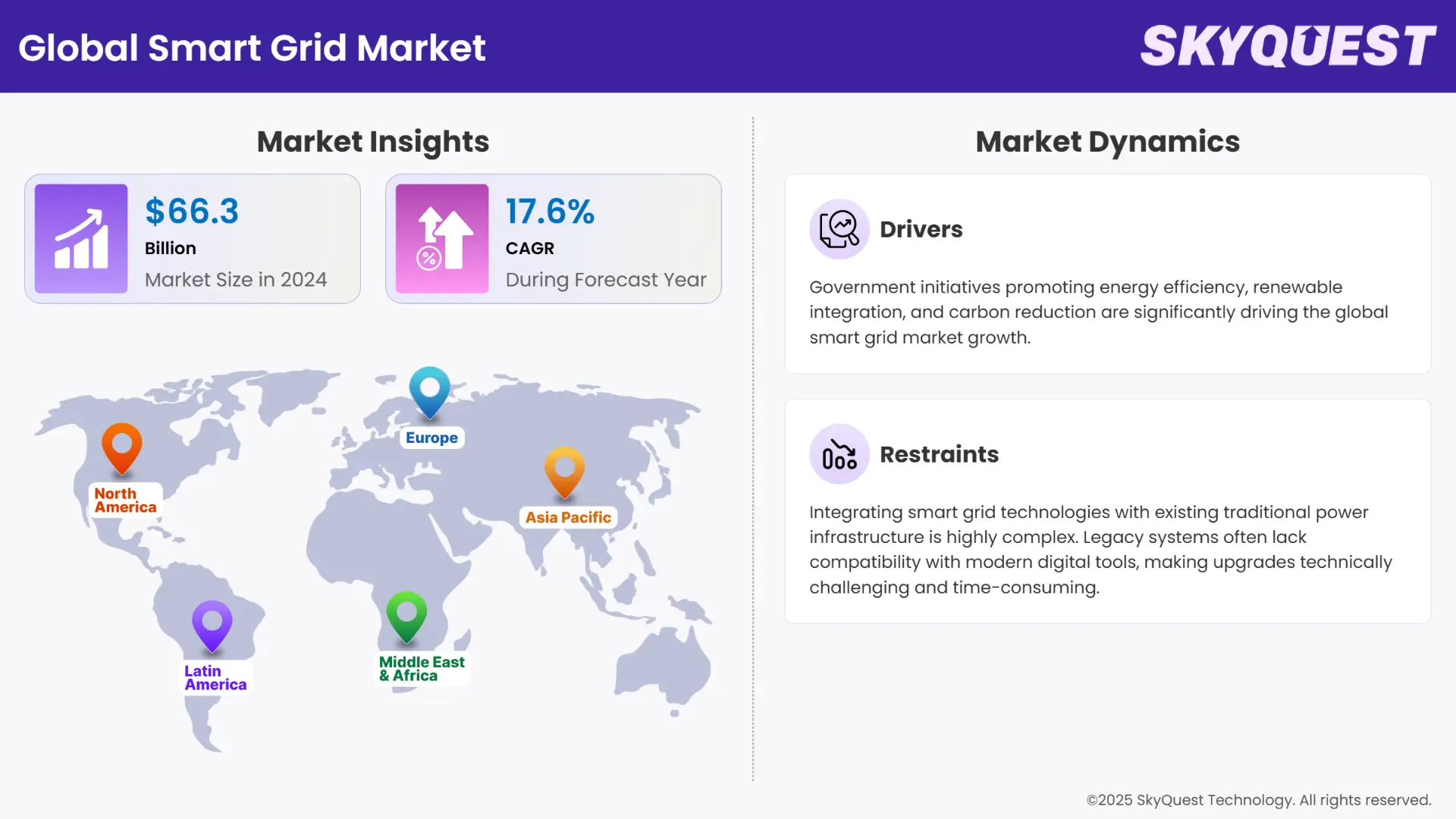
Global Smart Grid Market size was valued at USD 66.3 Billion in 2024 and is poised to grow from USD 77.97 Billion in 2025 to USD 285.22 Billion by 2033, growing at a CAGR of 17.6% in the forecast period (2026–2033).
The global surge in energy demand, driven by urban expansion, industrial growth, and increased electrification of transportation, places immense pressure on existing power grids—many of which were built decades ago. These aging infrastructures are ill-equipped to manage modern energy loads, resulting in frequent outages, voltage fluctuations, and transmission inefficiencies. This mismatch between demand and capacity creates a critical need for transformation. Smart grids address this challenge through advanced sensors, automation, and communication technologies that monitor and control energy flows in real-time. By enhancing reliability, improving operational efficiency, and enabling predictive maintenance, smart grids modernize aging infrastructure to meet growing energy needs.
The global transition toward renewable energy sources like solar, wind, and hydropower introduces new complexities to grid management. Unlike traditional power generation, renewables are intermittent and decentralized, leading to variability in supply and potential grid instability. Smart grids play a crucial role by enabling dynamic two-way communication, real-time data analytics, and automated load balancing to accommodate these fluctuations. They also support distributed energy resources (DERs) like rooftop solar and community wind projects. By intelligently managing supply-demand patterns and storage integration, smart grids ensure seamless, stable, and efficient incorporation of renewables, advancing global sustainability goals and reducing dependence on fossil fuels.
Artificial Intelligence (AI) is transforming the global smart grid market by enabling intelligent, data-driven decision-making across grid operations. As smart grids generate massive amounts of real-time data from sensors, meters, and distributed energy sources, AI algorithms analyze this data to predict demand patterns, detect anomalies, and optimize energy distribution. This results in enhanced grid stability, reduced energy losses, and faster outage recovery. For example, Google’s DeepMind collaborated with the UK’s National Grid to explore AI-based demand forecasting, which could potentially reduce energy waste and carbon emissions. Thus, AI indirectly improves grid efficiency while directly enhancing automation, reliability, and sustainability of energy systems.
In July 2025, GE Vernova announced the acquisition of French AI firm Alteia to enhance its GridOS Visual Intelligence platform. This integration enables AI-powered analysis of visual and operational data, improving smart grid asset monitoring, predictive maintenance, and infrastructure reliability for utility providers globally.
To get more insights on this market click here to Request a Free Sample Report
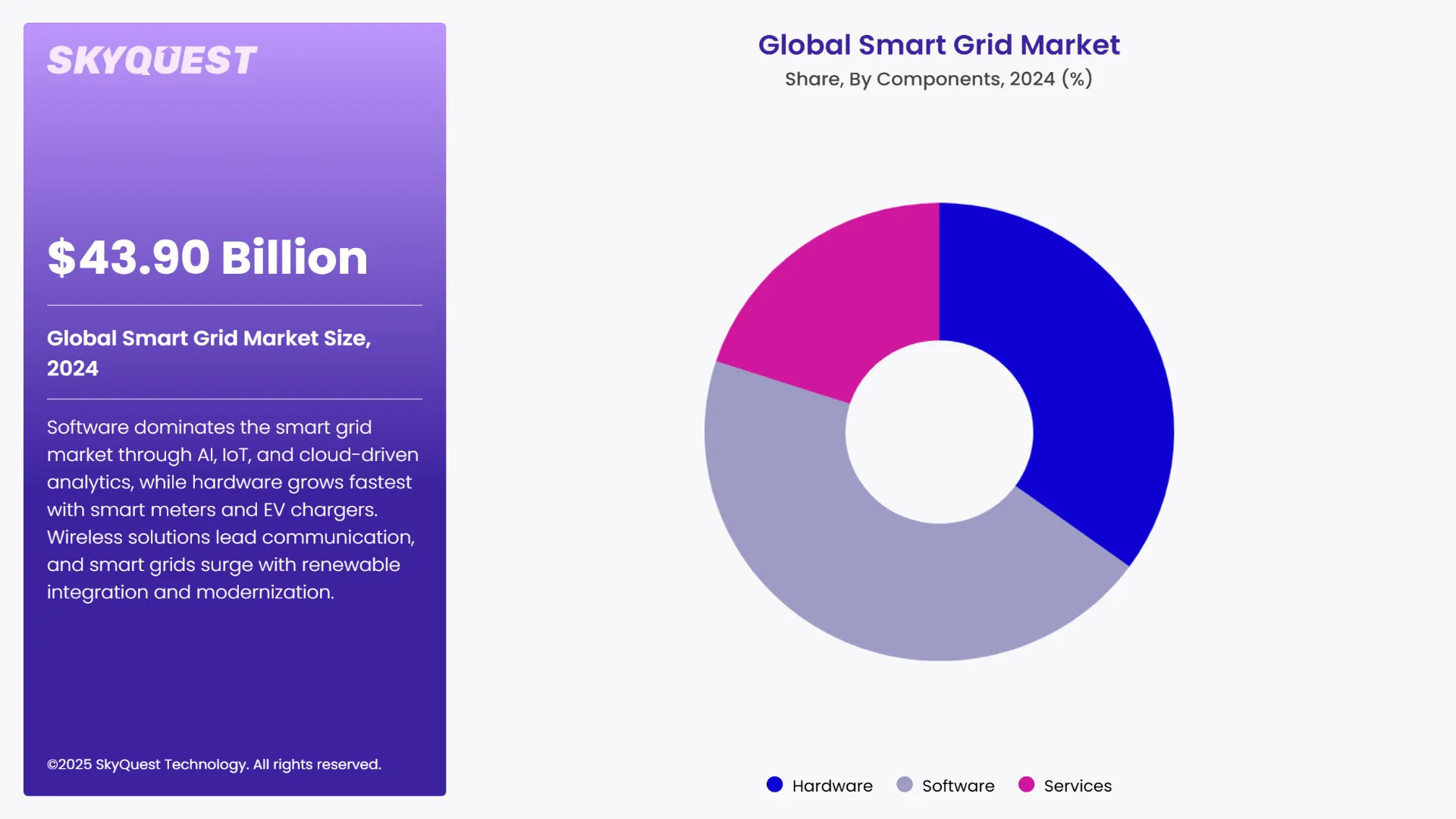
The global smart grid market is segmented based on components, technology, end-user, and region. In terms of components, the market is trifurcated into hardware, software, and services. Based on technology, the market is bifurcated into wired and wireless. Based on end-user, the market is segmented into residential, corporate, and government. Based on region, the market is segmented into North America, Europe, Asia-Pacific, Central & South America and the Middle East & Africa.
The software component is dominating the global smart grid market is experiencing rapid innovation, driven by advancements in AI, IoT, and cloud computing. Utilities are increasingly adopting grid management, analytics, and cyber security software to enable real-time monitoring, predictive maintenance, and efficient energy distribution. Software dominates the market due to its critical role in enabling intelligent decision-making, seamless integration of renewables, and scalability across diverse grid infrastructures, unlike hardware which often requires costly physical upgrades.
The hardware component is expected to be the fastest-growing segment in the global smart grid market due to rising investments in advanced infrastructure, including smart meters, sensors, and EV chargers. As utilities modernize aging systems and expand grid connectivity, demand for reliable, high-performance hardware to support intelligent operations is accelerating significantly.
As per the global smart grid market forecast, wireless technology is dominating in the industry by enabling seamless, real-time communication between grid components, including smart meters, sensors, and control systems. Technologies like ZigBee, Wi-Fi, and cellular IoT are widely used for remote monitoring and fault detection. Wireless solutions dominate the market due to their cost-effectiveness, ease of deployment in remote or dense urban areas, and scalability, making them ideal for rapidly evolving smart grid infrastructures.
Smart grids are the fastest-growing segment in the global smart grid market due to rising energy demand, renewable energy integration, and government initiatives for grid modernization. Their ability to enhance energy efficiency, reduce outages, and enable real-time monitoring is driving rapid adoption across both developed and emerging economies seeking resilient, sustainable energy infrastructure.
To get detailed segments analysis, Request a Free Sample Report
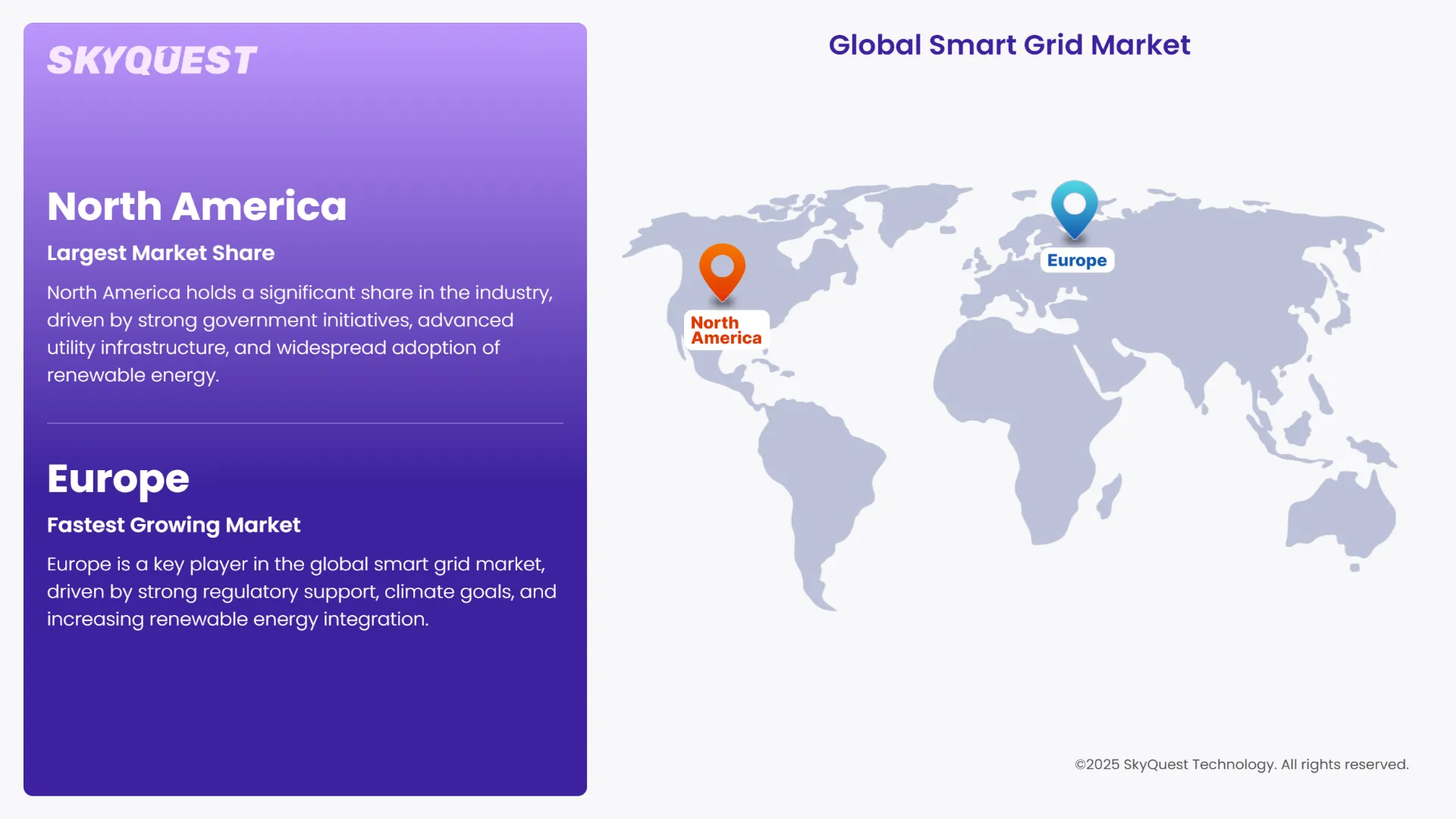
As per the global smart grid market analysis, North America holds a significant share in the industry, driven by strong government initiatives, advanced utility infrastructure, and widespread adoption of renewable energy. The U.S. and Canada are investing heavily in modernizing aging grids with smart meters, grid automation, and AI-driven analytics. Ongoing developments in electric vehicle infrastructure and demand response programs further fuel market growth, making North America a leader in smart grid innovation and deployment.
US Smart Grid Market
The United States plays a leading role in North America’s smart grid market through large-scale investments in grid modernization, federal funding programs, and strong policy support. Initiatives like the Grid Resilience and Innovation Partnership (GRIP) enhance grid reliability and renewable integration. Utilities are actively deploying smart meters, AI-driven energy management systems, and EV infrastructure, positioning the U.S. as a hub for innovation in intelligent and sustainable energy networks.
Canada Smart Grid Market
Canada significantly contributes to North America’s smart grid market by focusing on clean energy integration and modernizing its electricity infrastructure. Government programs such as Smart Grid Program and partnerships with utilities promote the deployment of advanced metering, demand response, and energy storage systems. Canada's commitment to reducing carbon emissions and improving grid resilience in remote and urban areas accelerates its smart grid development, supporting a low-carbon, technology-driven energy future.
Europe is a key player in the global smart grid market, driven by strong regulatory support, climate goals, and increasing renewable energy integration. The European Union’s Green Deal and smart energy initiatives are accelerating investments in grid modernization, digitalization, and cross-border energy exchange. Countries like Germany, France, and the UK are deploying advanced metering infrastructure, automation, and AI-based solutions to enhance grid efficiency, stability, and sustainability across the region.
Germany Smart Grid Market
Germany is a frontrunner in Europe smart grid market, driven by its Energiewende policy, which promotes renewable energy and energy efficiency. The country invests heavily in digital grid infrastructure, smart meters, and decentralized energy systems to manage its growing share of solar and wind energy. Through strong government backing and innovation from companies like Siemens, Germany enhances grid flexibility, reliability, and sustainability, supporting its transition to a low-carbon economy.
France Smart Grid Market
France’s smart grid market is advancing through government-led initiatives like the “Smart Grids Plan” under the energy transition law. The rollout of Linky smart meters by Enedis has enabled improved energy monitoring and demand response. France is focused on integrating renewables, electric mobility, and storage solutions. With strong R&D and regional demonstration projects, France is fostering smart grid innovation to enhance energy efficiency and sustainability across its energy networks.
UK Smart Grid Market
The UK is a key contributor to the Europe smart grid market, emphasizing decarbonization, decentralization, and digitalization of its power systems. The country has widely implemented smart meters and promotes flexible grid operations through demand-side response and energy storage. National Grid ESO uses advanced forecasting tools, AI, and real-time data analytics to enhance grid reliability. Government policies and innovation hubs are driving the UK's transition to a future-ready smart energy ecosystem.
Asia Pacific is witnessing rapid growth in the global smart grid market, fueled by rising energy demand, urbanization, and strong government support for grid modernization. Countries like China, Japan, South Korea, and India are investing heavily in smart meters, grid automation, and renewable energy integration. Technological advancements, coupled with large-scale infrastructure projects and digital transformation initiatives, are positioning Asia Pacific as a dynamic hub for smart grid development and innovation.
Japan Smart Grid Market
Japan is a major contributor to the Asia Pacific smart grid market, driven by its focus on energy security, efficiency, and disaster resilience. Following the Fukushima disaster, Japan accelerated smart grid deployment to integrate renewable energy and ensure grid stability. The country invests in advanced metering, AI-driven energy management systems, and demand response technologies. With strong government support and tech-driven utilities, Japan is advancing toward a decentralized, low-carbon energy future.
South Korea Smart Grid Market
South Korea is actively developing the Asia Pacific smart grid market as part of its “Green New Deal” and carbon neutrality goals. The country emphasizes integrating renewable energy, electric vehicles, and AI-powered grid management. Smart meters, grid automation, and nationwide pilot projects like Jeju Smart Grid Test-bed demonstrate its commitment. With strong collaboration between government, research institutions, and companies like KEPCO, South Korea is shaping an advanced, digital, and efficient energy ecosystem globally.
To know more about the market opportunities by region and country, click here to
Buy The Complete Report
Government Policies and Regulatory Support
Growing Renewable Energy Penetration
Complexity of System Integration
Uncertain Return on Investment
Request Free Customization of this report to help us to meet your business objectives.
The global smart grid market outlook is highly competitive, with key players like Siemens, General Electric, ABB, Schneider Electric, and Hitachi Energy leading innovation. Siemens focuses on digital grid solutions and AI integration, while GE Vernova is expanding through acquisitions like Alteia to enhance visual intelligence. Schneider Electric emphasizes smart energy management systems. These companies compete through strategic partnerships, technological advancements, and regional expansions to strengthen their global smart grid market presence.
As per the global smart grid industry analysis, the startup landscape is rapidly expanding, fuelled by the demand for cleaner, smarter, and more resilient energy systems. Startups are leveraging AI, IoT, and advanced analytics to offer innovative grid solutions such as predictive maintenance, real-time monitoring, and intelligent energy management. These agile players are addressing gaps left by traditional utilities, accelerating smart grid deployment, and enabling better integration of renewables, ultimately transforming how electricity is distributed and consumed globally.
Recent Developments in Smart Grid Market
SkyQuest’s ABIRAW (Advanced Business Intelligence, Research & Analysis Wing) is our Business Information Services team that Collects, Collates, Correlates, and Analyses the Data collected by means of Primary Exploratory Research backed by robust Secondary Desk research.
As per SkyQuest analysis, the global smart grid industry is at the forefront of energy innovation, addressing critical challenges such as aging infrastructure, renewable integration, and rising energy demand. Through AI, IoT, and wireless technologies, smart grids enable real-time monitoring, predictive analytics, and decentralized energy management. Governments, corporations, and startups alike are investing in grid modernization to achieve sustainability goals and energy resilience.
With regional leaders like the U.S., Germany, Japan, and South Korea pushing advancements, and companies such as Siemens, GE Vernova, and Schneider Electric pioneering cutting-edge solutions, the market is set for continued expansion. As trends in cybersecurity, smart metering, and software innovation evolve, the global smart grid market strategies are becoming indispensable in building efficient, flexible, and intelligent power systems for a sustainable energy future.
| Report Metric | Details |
|---|---|
| Market size value in 2024 | USD 66.3 Billion |
| Market size value in 2033 | USD 285.22 Billion |
| Growth Rate | 17.6% |
| Base year | 2024 |
| Forecast period | 2026–2033 |
| Forecast Unit (Value) | USD Billion |
| Segments covered |
|
| Regions covered | North America (US, Canada), Europe (Germany, France, United Kingdom, Italy, Spain, Rest of Europe), Asia Pacific (China, India, Japan, Rest of Asia-Pacific), Latin America (Brazil, Rest of Latin America), Middle East & Africa (South Africa, GCC Countries, Rest of MEA) |
| Companies covered |
|
| Customization scope | Free report customization with purchase. Customization includes:-
|
To get a free trial access to our platform which is a one stop solution for all your data requirements for quicker decision making. This platform allows you to compare markets, competitors who are prominent in the market, and mega trends that are influencing the dynamics in the market. Also, get access to detailed SkyQuest exclusive matrix.
Table Of Content
Executive Summary
Market overview
Parent Market Analysis
Market overview
Market size
KEY MARKET INSIGHTS
COVID IMPACT
MARKET DYNAMICS & OUTLOOK
Market Size by Region
KEY COMPANY PROFILES
Methodology
For the Smart Grid Market, our research methodology involved a mixture of primary and secondary data sources. Key steps involved in the research process are listed below:
1. Information Procurement: This stage involved the procurement of Market data or related information via primary and secondary sources. The various secondary sources used included various company websites, annual reports, trade databases, and paid databases such as Hoover's, Bloomberg Business, Factiva, and Avention. Our team did 45 primary interactions Globally which included several stakeholders such as manufacturers, customers, key opinion leaders, etc. Overall, information procurement was one of the most extensive stages in our research process.
2. Information Analysis: This step involved triangulation of data through bottom-up and top-down approaches to estimate and validate the total size and future estimate of the Smart Grid Market.
3. Report Formulation: The final step entailed the placement of data points in appropriate Market spaces in an attempt to deduce viable conclusions.
4. Validation & Publishing: Validation is the most important step in the process. Validation & re-validation via an intricately designed process helped us finalize data points to be used for final calculations. The final Market estimates and forecasts were then aligned and sent to our panel of industry experts for validation of data. Once the validation was done the report was sent to our Quality Assurance team to ensure adherence to style guides, consistency & design.
Analyst Support
Customization Options
With the given market data, our dedicated team of analysts can offer you the following customization options are available for the Smart Grid Market:
Product Analysis: Product matrix, which offers a detailed comparison of the product portfolio of companies.
Regional Analysis: Further analysis of the Smart Grid Market for additional countries.
Competitive Analysis: Detailed analysis and profiling of additional Market players & comparative analysis of competitive products.
Go to Market Strategy: Find the high-growth channels to invest your marketing efforts and increase your customer base.
Innovation Mapping: Identify racial solutions and innovation, connected to deep ecosystems of innovators, start-ups, academics, and strategic partners.
Category Intelligence: Customized intelligence that is relevant to their supply Markets will enable them to make smarter sourcing decisions and improve their category management.
Public Company Transcript Analysis: To improve the investment performance by generating new alpha and making better-informed decisions.
Social Media Listening: To analyze the conversations and trends happening not just around your brand, but around your industry as a whole, and use those insights to make better Marketing decisions.
REQUEST FOR SAMPLE
 REQUEST FREE CUSTOMIZATION
Global Smart Grid Market size was valued at USD 66.3 Billion in 2024 and is poised to grow from USD 77.97 Billion in 2025 to USD 285.22 Billion by 2033, growing at a CAGR of 17.6% in the forecast period (2026–2033).
The global smart grid market outlook is highly competitive, with key players like Siemens, General Electric, ABB, Schneider Electric, and Hitachi Energy leading innovation. Siemens focuses on digital grid solutions and AI integration, while GE Vernova is expanding through acquisitions like Alteia to enhance visual intelligence. Schneider Electric emphasizes smart energy management systems. These companies compete through strategic partnerships, technological advancements, and regional expansions to strengthen their global smart grid market presence. 'Siemens AG (Germany)', 'General Electric (GE) Vernova (USA)', 'Schneider Electric (France)', 'ABB Ltd (Switzerland)', 'Hitachi Energy (Switzerland)', 'Cisco Systems, Inc. (USA)', 'Oracle Corporation (USA)', 'Honeywell International Inc. (USA)', 'Eaton Corporation (Ireland)', 'Landis+Gyr Group AG (Switzerland)', 'Itron Inc. (USA)', 'Toshiba Corporation (Japan)', 'Mitsubishi Electric Corporation (Japan)', 'Wipro Limited (India)', 'NARI Technology Co., Ltd. (China)'
Government initiatives promoting energy efficiency, renewable integration, and carbon reduction are significantly driving the global smart grid market growth. Supportive regulations, funding programs, and national energy plans incentivize utilities to modernize infrastructure. Policies mandating smart meters, grid automation, and clean energy targets are accelerating global smart grid investments and deployment.
Governments and utilities are accelerating the rollout of smart meters to enable real-time energy consumption tracking and improved billing accuracy. These meters empower consumers with usage insights while helping utilities detect outages and reduce energy losses, making them foundational to demand-side management and efficient grid modernization worldwide.
As per the global smart grid market analysis, North America holds a significant share in the industry, driven by strong government initiatives, advanced utility infrastructure, and widespread adoption of renewable energy. The U.S. and Canada are investing heavily in modernizing aging grids with smart meters, grid automation, and AI-driven analytics. Ongoing developments in electric vehicle infrastructure and demand response programs further fuel market growth, making North America a leader in smart grid innovation and deployment.


Want to customize this report? This report can be personalized according to your needs. Our analysts and industry experts will work directly with you to understand your requirements and provide you with customized data in a short amount of time. We offer $1000 worth of FREE customization at the time of purchase.
Feedback From Our Clients


 USA (+1) 351-333-4748

