Space Tourism Market
Report ID: SQMIG20A2356
Report ID: SQMIG20A2356
[email protected]
USA +1 351-333-4748
Report ID:
SQMIG20A2356 |
Region:
Global |
Published Date: June, 2025
Pages:
198
|Tables:
91
|Figures:
71


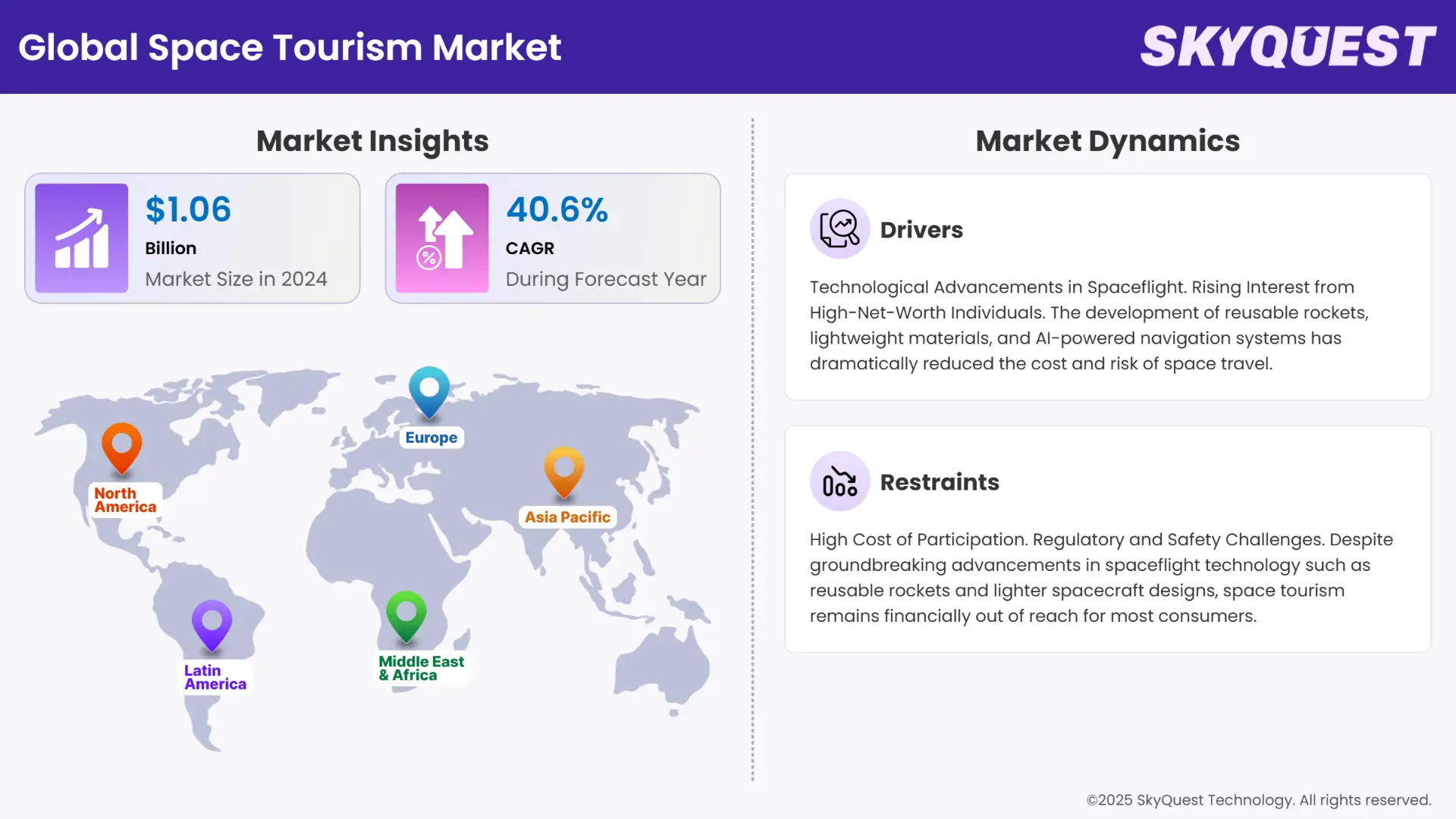
Global Space Tourism Market size was valued at USD 1.21 Billion in 2024 and is poised to grow from USD 1.7 Billion in 2025 to USD 25.96 Billion by 2033, growing at a CAGR of 40.6% in the forecast period (2026–2033).
The space tourism market is experiencing transformative growth, driven by rapid advancements in spaceflight technologies and increasing interest from affluent consumers seeking extraordinary travel experiences. Companies like SpaceX, Blue Origin, and Virgin Galactic are at the forefront of this evolving sector, offering suborbital and orbital flights to non-professional astronauts. The commercialization of space travel is not only unlocking a new luxury segment but also fostering the development of reusable rocket technology and safer spacecraft designs.
This market is further buoyed by growing private and public investments, which are enhancing infrastructure such as launch pads, training facilities, and spaceports. Moreover, partnerships between private space companies and government agencies are paving the way for sustainable and regulated operations. The increasing availability of space-related experiences, including zero-gravity flights, space hotels in conceptual stages, and lunar missions—is also contributing to heightened consumer curiosity and demand.
Despite its promising trajectory, the market faces challenges such as high costs, strict regulatory requirements, safety concerns, and environmental implications of frequent launches. However, continued innovation, economies of scale, and a maturing ecosystem are expected to gradually reduce ticket prices and make space tourism more accessible to a broader demographic in the coming decades.
How is AI Impacting the Space Tourism Market?
Artificial Intelligence (AI) plays a pivotal role in reshaping the space tourism market by enhancing safety, efficiency, and customer experience. From autonomous navigation systems to personalized astronaut training, AI helps streamline operations and reduce human error in spaceflight activities.
One major impact of AI is predictive maintenance of spacecraft. AI algorithms can analyze data from onboard sensors to detect anomalies before they become critical, improving reliability and minimizing costly delays. This is particularly important in space tourism, where mission success and passenger safety are non-negotiable.
To get more insights on this market click here to Request a Free Sample Report
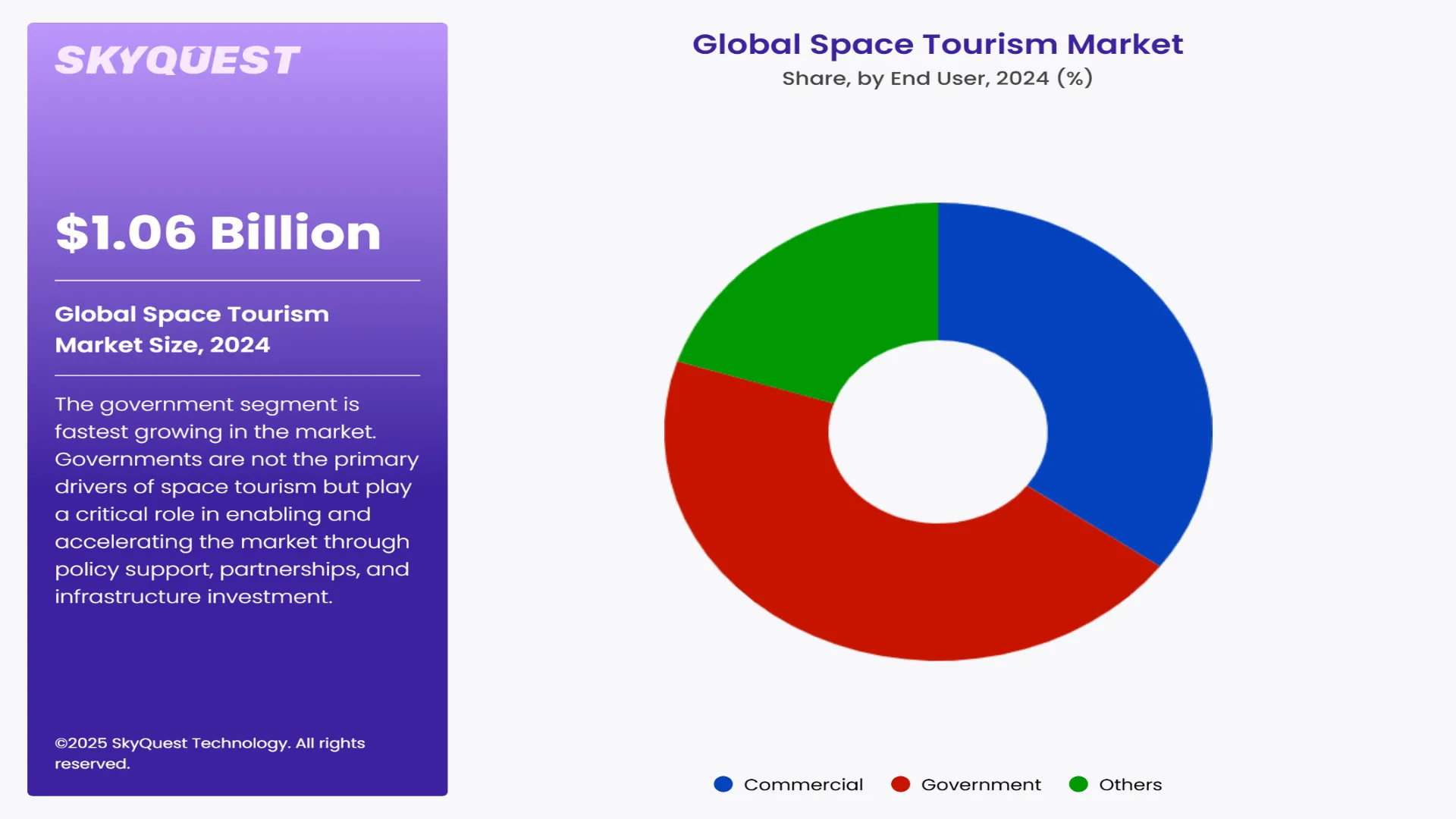
The global space tourism market is segmented by end use, tourism type, tour type, and region. Based on end users, the market is segmented into commercial, government, and others. Based on tourism type, the market is segmented into stratospheric, suborbital, orbital, and others. Based on tour type, the market is segmented into individual travel, professional groups, and group travel. Based on region, the market is segmented into North America, Asia-Pacific, Europe, Latin America, and Middle East & Africa.
As per the global space tourism market outlook, the suborbital segment is currently the dominant segment in the market. Suborbital missions are relatively cost-effective, safer, and quicker to conduct compared to orbital flights, making them the go-to option for most space tourists today. Their short duration, reusable technology, and lower altitude risk have helped suborbital flights capture the largest market share so far.
As per global space tourism market forecast, the stratospheric segment is the fastest growing, driven by innovative approaches to high-altitude space experiences. Companies like Space Perspective and Zero 2 Infinity are offering near-space balloon rides that take passengers up to 30–40 km altitude in a pressurized capsule. These experiences offer extended durations, panoramic Earth views, and eco-friendly alternatives to rocket-based travel.
The commercial segment is currently the dominant segment in the space tourism market. Private companies like SpaceX, Blue Origin, and Virgin Galactic are leading the charge by offering suborbital and orbital spaceflights for civilian passengers. The surge in investments, reusable launch technologies, and a strong push for monetizing space travel has positioned the commercial sector as the primary revenue generator. These companies cater directly to wealthy individuals, researchers, and media ventures, making them the front-runner in terms of operational volume and market influence.
As per global space tourism market analysis, the government segment is fastest growing in the market. Governments are not the primary drivers of space tourism but play a critical role in enabling and accelerating the market through policy support, partnerships, and infrastructure investment. The government segment is evolving into a vital partner that regulates, facilitates, and co-develops the broader space tourism ecosystem. Its growth is tied more to supportive functions and international collaborations than direct passenger operations.
To get detailed segments analysis, Request a Free Sample Report
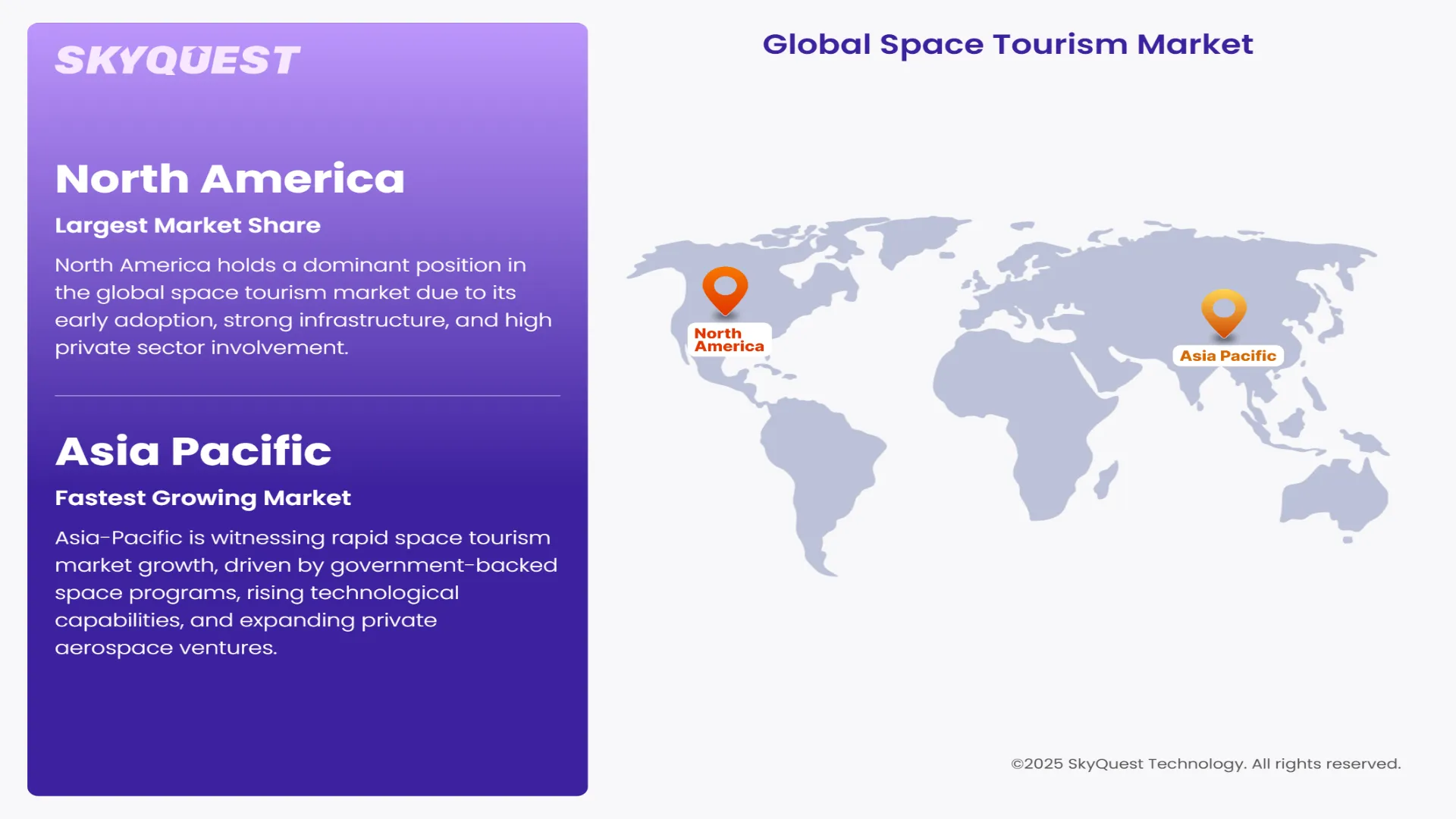
North America holds a dominant position in the global space tourism market due to its early adoption, strong infrastructure, and high private sector involvement. The region is home to several pioneering space tourism companies and benefits from a supportive regulatory environment and well-established aerospace ecosystem.
The United States is the epicenter of space tourism innovation. Companies like SpaceX, Blue Origin, and Virgin Galactic are headquartered here, pushing boundaries in suborbital and orbital tourism. The U.S. government, through agencies like NASA and the FAA, plays a crucial role in facilitating space travel through regulatory approvals and public-private partnerships. High disposable incomes and strong investor interest make the U.S. the largest revenue contributor in the global space tourism market.
As per regional outlook, Canada is emerging as a supportive player in the North American space tourism scene. While it lacks a domestic space tourism operator, Canada's Canadian Space Agency (CSA) collaborates on international missions and supports R&D in aerospace technologies. Canadian companies are also engaging in space-tech supply chains, including space medicine, robotics, and satellite systems, which are vital for enabling future space travel.
Asia-Pacific is witnessing rapid space tourism market growth, driven by government-backed space programs, rising technological capabilities, and expanding private aerospace ventures. The region is investing in both launch capabilities and long-term space tourism infrastructure.
Japan is one of Asia’s most advanced players in space exploration and is gradually expanding into space tourism. Companies like Space One and PD Aerospace are developing suborbital flight capabilities. The Japan Aerospace Exploration Agency (JAXA) is also working with private firms to open its missions to non-astronauts and tourists, signaling Japan’s intention to become a regional space tourism hub.
As per regional outlook, South Korea is accelerating its ambitions in commercial space through increased government funding and tech partnerships. While space tourism is still in its infancy, the country is developing the necessary launch and satellite infrastructure to support future operations. Collaborations with U.S. companies and regional R&D initiatives position South Korea as a rising participant in the market.
Europe is showing steady progress in space tourism, supported by robust government agencies, academic institutions, and emerging private sector initiatives. Regulatory backing from the European Space Agency (ESA) and national governments has been crucial in advancing commercial space activities.
As per regional forecast, Germany is a key innovation hub within Europe’s space ecosystem. Companies like Space Transportation GmbH are developing high-speed transport and suborbital vehicles. The German Aerospace Center (DLR) also supports space tourism research and development, with a focus on safety systems, propulsion, and passenger comfort.
The United Kingdom is becoming a launch site hotspot, with plans to establish multiple spaceports such as those in Cornwall and Sutherland. Firms like Virgin Galactic (with operational links to the UK) and Orbex are positioning the country as a major player in European space tourism. Strong support from the UK Space Agency for accelerating development and regulatory readiness.
As per industry analysis, Italy is emerging as a strategic partner in international space tourism through collaborations with companies like Axiom Space and Virgin Galactic. The Italian Space Agency (ASI) actively engages in research and space station access, and the nation is involved in developing training modules and simulation facilities for space tourists.
To know more about the market opportunities by region and country, click here to
Buy The Complete Report
Technological Advancements in Spaceflight
Rising Interest from High-Net-Worth Individuals
High Cost of Participation
Regulatory and Safety Challenges
Request Free Customization of this report to help us to meet your business objectives.
The global space tourism industry is highly competitive and rapidly evolving, with a mix of established aerospace giants, emerging tech innovators, and visionary startups driving its momentum. Key players like Virgin Galactic, Blue Origin, and SpaceX are leading the charge with distinct strategies. Virgin Galactic focuses on suborbital flights using its spaceplane, targeting high-net-worth individuals for brief experiences beyond the Kármán line. Blue Origin, through its New Shepard rocket, emphasizes vertical take-off and landing technology for short-duration space trips. Meanwhile, SpaceX aims for more ambitious missions, including orbital tourism and planned lunar flybys, leveraging its Falcon 9 and Starship systems.
As per market strategies, collaborations and continuous R&D are defining competition in this space. For example, SpaceX partnered with Axiom Space to send private astronauts to the International Space Station, signaling a shift toward commercializing orbital missions.
SkyQuest’s ABIRAW (Advanced Business Intelligence, Research & Analysis Wing) is our Business Information Services team that Collects, Collates, Correlates, and Analyses the Data collected by means of Primary Exploratory Research backed by robust Secondary Desk research.
As per SkyQuest analysis, key drivers of market growth include the increasing investments from the private sector. The market is experiencing significant growth driven by advancements in technology, a growing interest in adventure travel, and the high net worth of individuals interested in orbiting flights. Space tourism market expansion launches facilities, launch of commercial space, technological developments and access to space tourism, have increased dramatically in the US and Europe. Technological innovation, such as recycling rockets and better spacecraft design, makes astronomical travel more viable and expensive. Technological innovation, such as recycling rockets and better spacecraft design, makes astronomical travel more viable and expensive. This, combined with the increasing demand from affluent individuals seeking unique experiences, is fueling the industry's expansion. Regulations have a significant impact on the space tourism industry, due to strict rules to guarantee passenger safety and the integrity of interplanetary activities.
| Report Metric | Details |
|---|---|
| Market size value in 2024 | USD 1.21 Billion |
| Market size value in 2033 | USD 25.96 Billion |
| Growth Rate | 40.6% |
| Base year | 2024 |
| Forecast period | 2026-2033 |
| Forecast Unit (Value) | USD Billion |
| Segments covered |
|
| Regions covered | North America (US, Canada), Europe (Germany, France, United Kingdom, Italy, Spain, Rest of Europe), Asia Pacific (China, India, Japan, Rest of Asia-Pacific), Latin America (Brazil, Rest of Latin America), Middle East & Africa (South Africa, GCC Countries, Rest of MEA) |
| Companies covered |
|
| Customization scope | Free report customization with purchase. Customization includes:-
|
To get a free trial access to our platform which is a one stop solution for all your data requirements for quicker decision making. This platform allows you to compare markets, competitors who are prominent in the market, and mega trends that are influencing the dynamics in the market. Also, get access to detailed SkyQuest exclusive matrix.
Table Of Content
Executive Summary
Market overview
Parent Market Analysis
Market overview
Market size
KEY MARKET INSIGHTS
COVID IMPACT
MARKET DYNAMICS & OUTLOOK
Market Size by Region
KEY COMPANY PROFILES
Methodology
For the Space Tourism Market, our research methodology involved a mixture of primary and secondary data sources. Key steps involved in the research process are listed below:
1. Information Procurement: This stage involved the procurement of Market data or related information via primary and secondary sources. The various secondary sources used included various company websites, annual reports, trade databases, and paid databases such as Hoover's, Bloomberg Business, Factiva, and Avention. Our team did 45 primary interactions Globally which included several stakeholders such as manufacturers, customers, key opinion leaders, etc. Overall, information procurement was one of the most extensive stages in our research process.
2. Information Analysis: This step involved triangulation of data through bottom-up and top-down approaches to estimate and validate the total size and future estimate of the Space Tourism Market.
3. Report Formulation: The final step entailed the placement of data points in appropriate Market spaces in an attempt to deduce viable conclusions.
4. Validation & Publishing: Validation is the most important step in the process. Validation & re-validation via an intricately designed process helped us finalize data points to be used for final calculations. The final Market estimates and forecasts were then aligned and sent to our panel of industry experts for validation of data. Once the validation was done the report was sent to our Quality Assurance team to ensure adherence to style guides, consistency & design.
Analyst Support
Customization Options
With the given market data, our dedicated team of analysts can offer you the following customization options are available for the Space Tourism Market:
Product Analysis: Product matrix, which offers a detailed comparison of the product portfolio of companies.
Regional Analysis: Further analysis of the Space Tourism Market for additional countries.
Competitive Analysis: Detailed analysis and profiling of additional Market players & comparative analysis of competitive products.
Go to Market Strategy: Find the high-growth channels to invest your marketing efforts and increase your customer base.
Innovation Mapping: Identify racial solutions and innovation, connected to deep ecosystems of innovators, start-ups, academics, and strategic partners.
Category Intelligence: Customized intelligence that is relevant to their supply Markets will enable them to make smarter sourcing decisions and improve their category management.
Public Company Transcript Analysis: To improve the investment performance by generating new alpha and making better-informed decisions.
Social Media Listening: To analyze the conversations and trends happening not just around your brand, but around your industry as a whole, and use those insights to make better Marketing decisions.
REQUEST FOR SAMPLE
 REQUEST FREE CUSTOMIZATION


Want to customize this report? This report can be personalized according to your needs. Our analysts and industry experts will work directly with you to understand your requirements and provide you with customized data in a short amount of time. We offer $1000 worth of FREE customization at the time of purchase.
Feedback From Our Clients


 USA (+1) 351-333-4748

