
Sports Technology Market
Report ID: SQMIG45C2116
Report ID: SQMIG45C2116
[email protected]
USA +1 351-333-4748
Report ID:
SQMIG45C2116 |
Region:
Global |
Published Date: July, 2025
Pages:
192
|Tables:
99
|Figures:
71


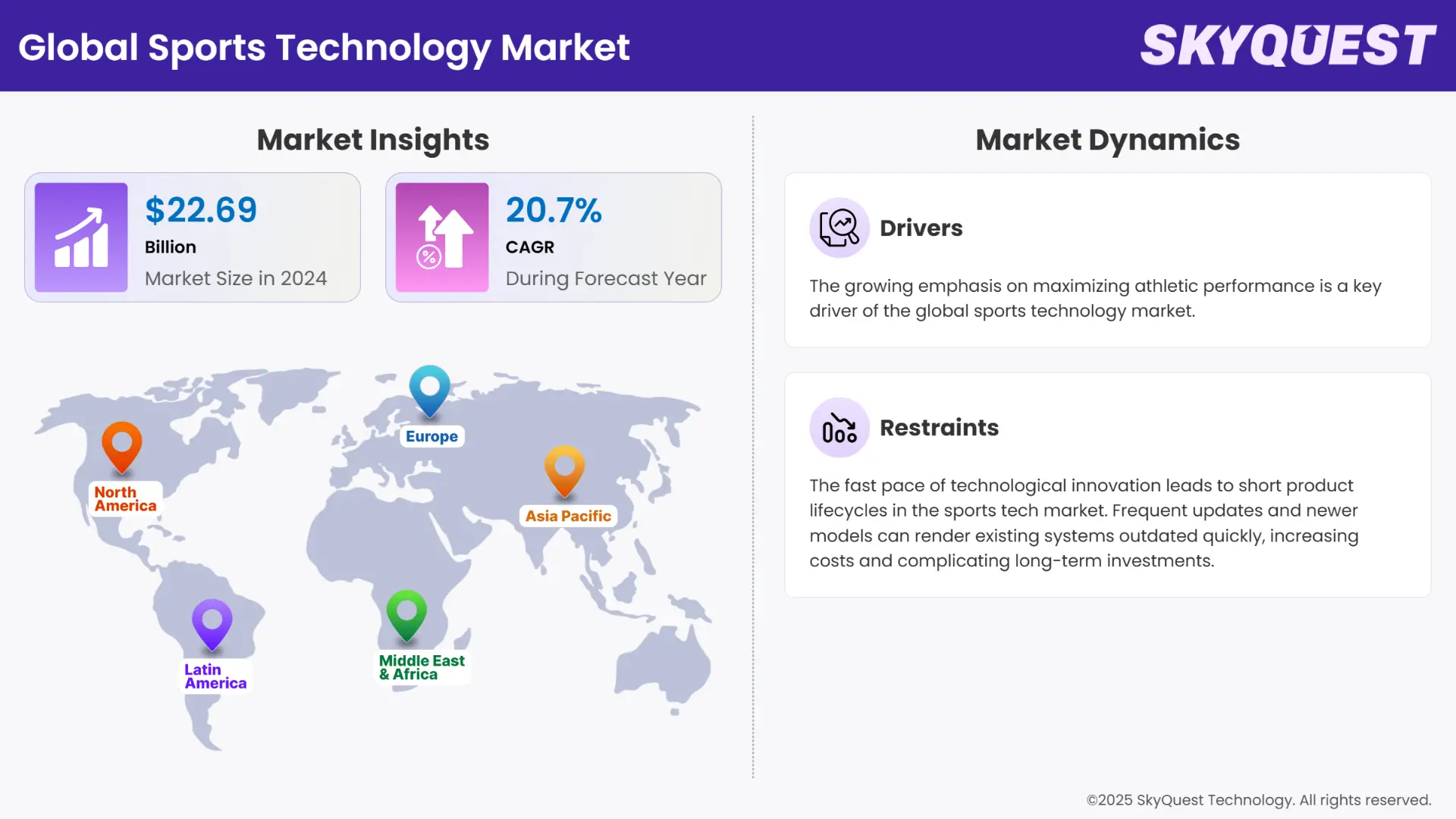
Global Sports Technology Market size was valued at USD 22.69 Billion in 2024 poised to grow between USD 27.39 Billion in 2025 to USD 123.37 Billion by 2033, growing at a CAGR of 20.7% in the forecast period (2026–2033).
The increasing need to enhance athlete performance, prevent injuries, and gain a competitive edge is pushing teams and organizations to adopt data-driven technologies. Wearable sensors, GPS trackers, and biometric devices collect vast amounts of real-time performance and physiological data. This data is analysed using AI and machine learning algorithms to provide actionable insights for coaching, training, and rehabilitation strategies. As a result, sports teams can make more informed decisions regarding player workload, technique adjustments, and tactical planning. This growing reliance on measurable performance metrics is significantly accelerating the adoption and growth of the global sports technology market.
Fan engagement has become a strategic priority for sports organizations aiming to build loyalty and generate revenue beyond live attendance. Augmented reality (AR) and virtual reality (VR) technologies are being integrated to offer immersive fan experiences such as virtual stadium tours, interactive match views, and augmented live broadcasts. These innovations enable fans to feel more connected to the action, regardless of location. The result is increased fan satisfaction, longer viewing times, and higher monetization opportunities through digital merchandise and virtual ticketing. This trend is compelling leagues, broadcasters, and sponsors to invest heavily in AR/VR, strengthening the sports technology market.
How does AI Assist Coaches and Teams in Improving Player Outcomes?
Artificial Intelligence (AI) is transforming the global sports technology market by enabling smarter decision-making, predictive analytics, and enhanced fan experiences. AI algorithms analyze massive datasets from wearables, video footage, and biometric sensors to assess player performance, predict injuries, and optimize strategies. This analytical capability allows coaches and teams to make precise, data-backed decisions, improving outcomes. Indirectly, AI enhances fan engagement through personalized content, chatbots, and recommendation engines. A notable development is IBM’s Watson AI being used at the US Open to generate real-time match insights and highlight reels, demonstrating how AI is revolutionizing both on-field performance and off-field audience interaction.
In April 2025, Warner Bros. Discovery Sports Europe, in partnership with AWS, launched the “Cycling Central Intelligence” (CCI) platform for the UCI Mountain Bike World Series. It uses generative AI (Amazon Bedrock + Claude 3.5) to instantly synthesize rider stats, race histories, and venue data—empowering commentators with richer storytelling and enhancing live broadcast depth.
To get more insights on this market click here to Request a Free Sample Report
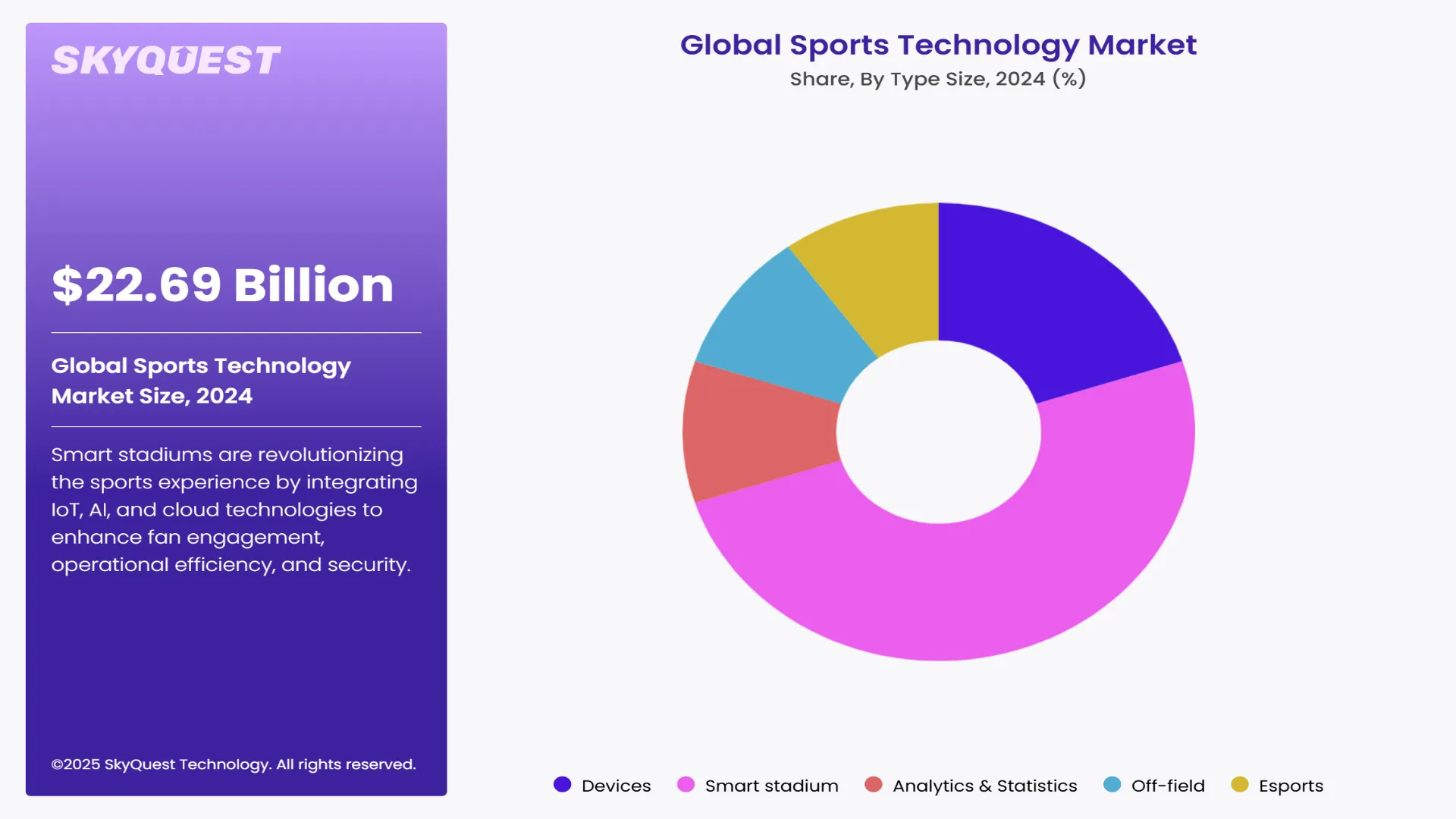
The global sports technology market is segmented based on type, sports, end use, and region. In terms of type, the market is segmented into devices, smart stadium, analytics & statistics, off-field, and esports. Based on sports, the market is grouped into american football/rugby, baseball, basketball, cricket, golf, ice hockey, tennis, soccer, and others. Based on end use, the market is segmented into sports clubs, sports associations, sports leagues, and others. Based on region, the market is segmented into North America, Europe, Asia-Pacific, Central & South America and the Middle East & Africa.
How do Smart Stadiums Contribute to Operational Efficiency?
Smart stadiums are revolutionizing the sports experience by integrating IoT, AI, and cloud technologies to enhance fan engagement, operational efficiency, and security. Innovations like mobile ticketing, contactless payments, real-time crowd analytics, and immersive AR experiences are driving their adoption. Smart stadiums dominate the market due to rising demand for digital connectivity, improved fan services, and data-driven management, making them essential hubs for modern sports entertainment and revenue generation.
Analytics & Statistics is the fastest-growing segment in the global sports technology market due to increasing reliance on data for performance optimization, injury prevention, and strategic planning. As teams seek competitive advantages, AI-driven analytics platforms are becoming essential tools, enabling real-time insights that enhance training efficiency, tactical decisions, and overall athletic outcomes.
How does Soccer’s Global Reach Contribute to its Dominance in the Sports Tech Market?
Soccer is leading the global sports technology market due to its massive international fanbase and early adoption of advanced technologies. Innovations like video assistant referees (VAR), goal-line technology, wearable performance trackers, and AI-driven match analysis tools are transforming gameplay, training, and officiating. Soccer dominates this market because of its commercial scale, global reach, and increasing investments by clubs and leagues to enhance performance, viewer experience, and operational efficiency.
Basketball is expected to be the fastest-growing segment in the global sports technology market due to its increasing global popularity and strong integration of technology. Innovations such as AI-based performance analytics, smart courts, and virtual reality training tools are widely adopted. The NBA’s tech-forward approach and youth-driven fanbase further fuel investment and rapid technological adoption in basketball worldwide.
To get detailed segments analysis, Request a Free Sample Report
Why is North America Considered a Hub for Sports Technology Development?
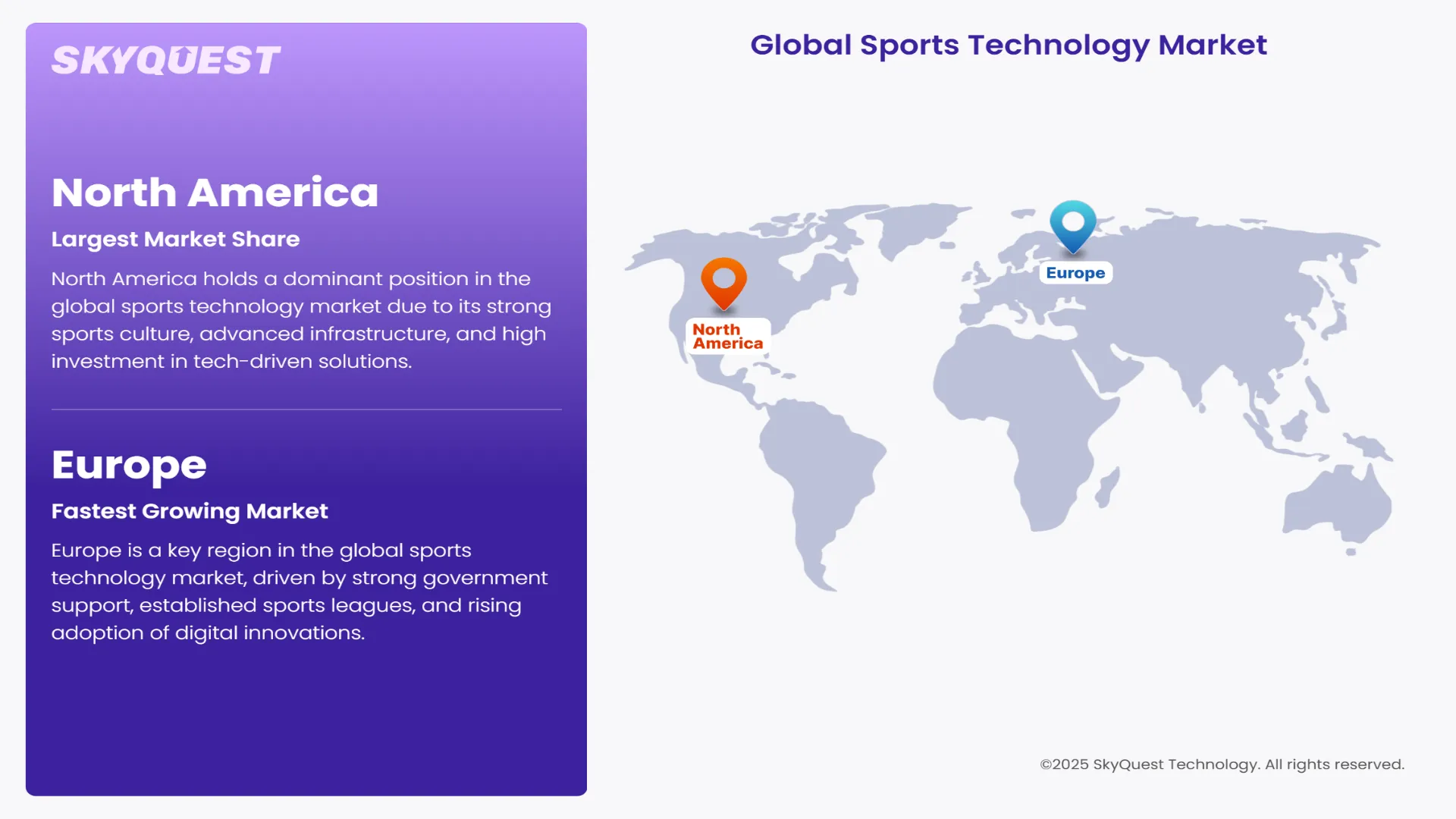
North America holds a dominant position in the global sports technology market due to its strong sports culture, advanced infrastructure, and high investment in tech-driven solutions. Major leagues like the NFL, NBA, and MLB extensively use AI, analytics, and wearables to enhance performance and fan engagement. Additionally, the presence of leading tech companies and startups fosters continuous innovation, making North America a key hub for sports technology development and adoption.
US Sports Technology Market
The United States plays a leading role in North America’s sports technology market, driven by its major leagues like the NFL, NBA, and MLB, which heavily invest in performance analytics, wearable tech, and AI-based systems. The presence of numerous sports tech startups and established tech giants fosters rapid innovation. Additionally, strong fan demand for immersive experiences and data-driven insights continues to push the widespread adoption of advanced sports technologies across the country.
Canada Sports Technology Market
Canada contributes significantly to North America’s sports technology market through growing investments in smart wearables, analytics, and sports performance platforms. Hockey, soccer, and basketball leagues are increasingly adopting data analytics to improve training and injury prevention. The country’s support for tech innovation and collaboration between sports organizations and tech firms is strengthening its position. Canada’s emphasis on grassroots development also encourages the use of technology at amateur and youth levels.
In What Way is Smart Infrastructure Related to Sports Technology Development in Asia Pacific?
Asia Pacific is emerging as a rapidly growing region in the global sports technology market, fueled by increasing investments in smart infrastructure, rising sports participation, and the popularity of major leagues like the IPL and Chinese Super League. Countries such as China, Japan, India, and Australia are adopting AI, wearables, and AR/VR solutions for performance enhancement and fan engagement. Government initiatives and tech-savvy youth populations further accelerate innovation and market expansion across the region.
Japan Sports Technology Market
Japan contributes significantly to the global sports technology market through innovations in smart stadiums, robotics, and advanced analytics. Leagues like the J-League and Nippon Professional Baseball use AI-driven performance tracking, video analytics, and wearable technologies to optimize training and gameplay. Japan's focus on fan engagement is reflected in stadiums equipped with IoT systems, energy-efficient infrastructure, and mobile interactivity. Its strong electronics industry and commitment to technological excellence drive ongoing development in sports tech.
South Korea Sports Technology Market
South Korea plays a pivotal role in advancing sports technology, particularly in virtual experiences, smart infrastructure, and 5G-enabled innovations. The country is known for integrating AR/VR in fan engagement and using AI in performance analysis for sports like baseball and football. Smart stadiums in South Korea feature real-time data feeds, contactless services, and immersive viewing experiences. High digital adoption, government support, and strong tech-sector collaboration fuel South Korea’s rapid sports technology growth.
Why is Athlete Health a Priority in European Sports Technology Investment?
Europe is a key region in the global sports technology market, driven by strong government support, established sports leagues, and rising adoption of digital innovations. Countries like the UK, Germany, and Spain lead in integrating performance analytics, VAR systems, and smart stadium technologies. The region’s emphasis on athlete health, fan engagement, and sustainable operations encourages investment in AI, IoT, and cloud-based platforms, making Europe a dynamic hub for sports tech advancement.
Germany Sports Technology Market
Germany is a key player in the global sports technology market, driven by its strong football culture and advanced infrastructure. Bundesliga clubs are early adopters of performance analytics, VAR, and smart stadium systems. Investments in 5G connectivity, AI-driven fan engagement, and sustainability solutions make German venues some of the most technologically advanced. Additionally, Germany’s focus on athlete health and data science in training programs supports continuous innovation and positions the country as a European leader.
France Sports Technology Market
France is making significant strides in the sports technology market, particularly through its focus on major sporting events and smart stadium upgrades. With international events like the Rugby World Cup and the Paris Olympics, the country is investing in AI-based security, real-time analytics, and immersive fan experiences. France also supports startups and innovation hubs, fueling advancements in wearable tech, video analytics, and fan engagement platforms across football, cycling, and tennis.
UK Sports Technology Market
The United Kingdom plays a central role in advancing sports technology, particularly through the Premier League’s adoption of performance analytics, VAR, and wearable devices. Smart stadium integration is widespread, with Wembley and other venues implementing high-speed networks, real-time data feeds, and mobile engagement tools. The UK also supports a vibrant ecosystem of sports tech startups and research institutions, which drive innovations in injury prevention, fan personalization, and AI-assisted coaching tools.
To know more about the market opportunities by region and country, click here to
Buy The Complete Report
Sports Technology Market Drivers
Rising Demand for Athlete Performance Optimization
Increasing Fan Engagement through Digital Innovation
Sports Technology Market Restraints
Short Product Lifecycles and Rapid Tech Obsolescence
Resistance to Change from Traditional Stakeholders
Request Free Customization of this report to help us to meet your business objectives.
The global sports technology market is highly competitive, with key players like Catapult Sports, Zebra Technologies, IBM, Hudl, and Stats Perform leading innovation. Companies focus on strategies such as AI integration, strategic partnerships, and expanding product portfolios. For example, Catapult invests in wearable tech for athlete monitoring, while IBM uses AI for real-time data insights. Hudl emphasizes video analytics solutions for performance improvement across both professional and amateur sports teams worldwide.
The global sports technology startup landscape is expanding rapidly, driven by rising demand for athlete monitoring, data analytics, and immersive fan experiences. Startups are leveraging AI, IoT, and biosensing technologies to deliver real-time insights, improve performance, and reduce injury risks. With increasing venture capital interest and support from sports leagues, these agile companies are disrupting traditional systems and accelerating innovation across professional, collegiate, and grassroots sports, reshaping the future of athletic training and engagement.
Top Player’s Company Profiles
Recent Developments in Sports Technology Market
SkyQuest’s ABIRAW (Advanced Business Intelligence, Research & Analysis Wing) is our Business Information Services team that Collects, Collates, Correlates, and Analyses the Data collected by means of Primary Exploratory Research backed by robust Secondary Desk research.
As per SkyQuest analysis, the global sports technology market is undergoing rapid transformation, driven by innovations aimed at enhancing athlete performance and fan engagement. Data-driven tools like wearables, AI analytics, and AR/VR experiences are redefining how teams train and how fans interact with sports. Regions such as North America, Asia Pacific, and Europe are fueling growth through strong digital infrastructure, supportive government initiatives, and tech-savvy populations.
Despite challenges like high implementation costs and resistance to change, continuous advancements from both established players and agile startups are driving adoption across professional and grassroots levels. As competitive intensity rises, strategic partnerships, sustainable innovation, and personalized solutions are becoming vital for market leadership. This evolving landscape promises a smarter, more connected, and immersive future for the global sports industry.
| Report Metric | Details |
|---|---|
| Market size value in 2024 | USD 22.69 Billion |
| Market size value in 2033 | USD 123.37 Billion |
| Growth Rate | 20.7% |
| Base year | 2024 |
| Forecast period | 2026-2033 |
| Forecast Unit (Value) | USD Billion |
| Segments covered |
|
| Regions covered | North America (US, Canada), Europe (Germany, France, United Kingdom, Italy, Spain, Rest of Europe), Asia Pacific (China, India, Japan, Rest of Asia-Pacific), Latin America (Brazil, Rest of Latin America), Middle East & Africa (South Africa, GCC Countries, Rest of MEA) |
| Companies covered |
Top Player’s Company Profiles
|
| Customization scope | Free report customization with purchase. Customization includes:-
|
To get a free trial access to our platform which is a one stop solution for all your data requirements for quicker decision making. This platform allows you to compare markets, competitors who are prominent in the market, and mega trends that are influencing the dynamics in the market. Also, get access to detailed SkyQuest exclusive matrix.
Table Of Content
Executive Summary
Market overview
Parent Market Analysis
Market overview
Market size
KEY MARKET INSIGHTS
COVID IMPACT
MARKET DYNAMICS & OUTLOOK
Market Size by Region
KEY COMPANY PROFILES
Methodology
For the Sports Technology Market, our research methodology involved a mixture of primary and secondary data sources. Key steps involved in the research process are listed below:
1. Information Procurement: This stage involved the procurement of Market data or related information via primary and secondary sources. The various secondary sources used included various company websites, annual reports, trade databases, and paid databases such as Hoover's, Bloomberg Business, Factiva, and Avention. Our team did 45 primary interactions Globally which included several stakeholders such as manufacturers, customers, key opinion leaders, etc. Overall, information procurement was one of the most extensive stages in our research process.
2. Information Analysis: This step involved triangulation of data through bottom-up and top-down approaches to estimate and validate the total size and future estimate of the Sports Technology Market.
3. Report Formulation: The final step entailed the placement of data points in appropriate Market spaces in an attempt to deduce viable conclusions.
4. Validation & Publishing: Validation is the most important step in the process. Validation & re-validation via an intricately designed process helped us finalize data points to be used for final calculations. The final Market estimates and forecasts were then aligned and sent to our panel of industry experts for validation of data. Once the validation was done the report was sent to our Quality Assurance team to ensure adherence to style guides, consistency & design.
Analyst Support
Customization Options
With the given market data, our dedicated team of analysts can offer you the following customization options are available for the Sports Technology Market:
Product Analysis: Product matrix, which offers a detailed comparison of the product portfolio of companies.
Regional Analysis: Further analysis of the Sports Technology Market for additional countries.
Competitive Analysis: Detailed analysis and profiling of additional Market players & comparative analysis of competitive products.
Go to Market Strategy: Find the high-growth channels to invest your marketing efforts and increase your customer base.
Innovation Mapping: Identify racial solutions and innovation, connected to deep ecosystems of innovators, start-ups, academics, and strategic partners.
Category Intelligence: Customized intelligence that is relevant to their supply Markets will enable them to make smarter sourcing decisions and improve their category management.
Public Company Transcript Analysis: To improve the investment performance by generating new alpha and making better-informed decisions.
Social Media Listening: To analyze the conversations and trends happening not just around your brand, but around your industry as a whole, and use those insights to make better Marketing decisions.
REQUEST FOR SAMPLE
 REQUEST FREE CUSTOMIZATION


Want to customize this report? This report can be personalized according to your needs. Our analysts and industry experts will work directly with you to understand your requirements and provide you with customized data in a short amount of time. We offer $1000 worth of FREE customization at the time of purchase.
Feedback From Our Clients


 USA (+1) 351-333-4748

