
Synthetic Polymer Waxes Market
Report ID: SQMIG15E2848
Report ID: SQMIG15E2848
[email protected]
USA +1 351-333-4748
Report ID:
SQMIG15E2848 |
Region:
Global |
Published Date: August, 2025
Pages:
191
|Tables:
101
|Figures:
70


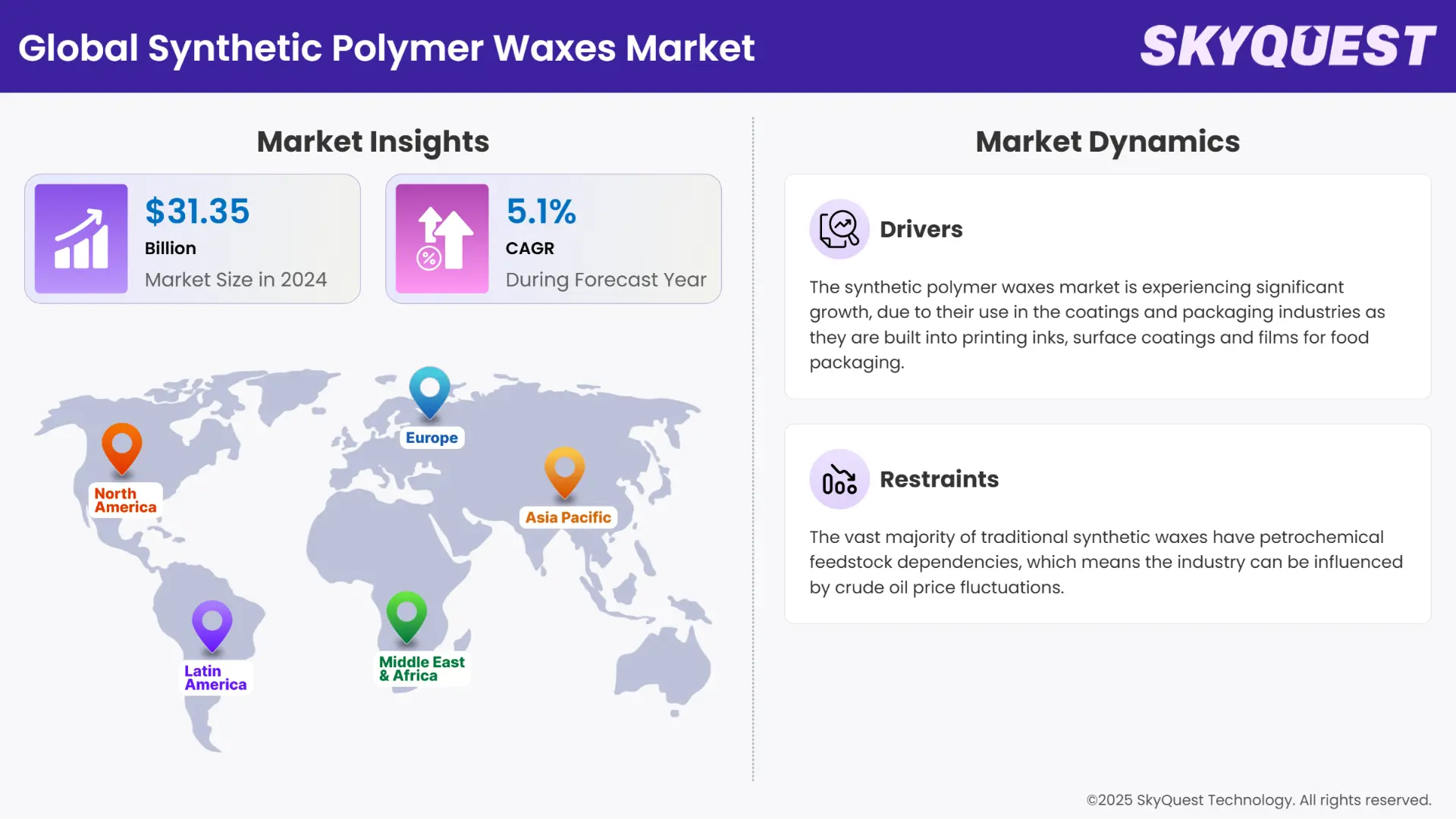
Global Synthetic Polymer Waxes Market size was valued at USD 31.35 Billion in 2024 and is poised to grow from USD 32.95 Billion in 2025 to USD 49.05 Billion by 2033, growing at a CAGR of 5.1% in the forecast period (2026–2033).
The synthetic polymer waxes market has been steadily increasing, mainly due to rising demand from various industries, including packaging, automotive, construction, textiles, and cosmetics. Synthetic polymer waxes are gaining increasing acceptance for their unique properties that often can equal or exceed the properties of natural waxes such as good abrasion resistance, good gloss, smoother lubrication, and better thermal stability. They provide a performance-enhancing additive in industrial applications for use in coatings, adhesives, inks, polishes, and plastic processing with increasing visibility in commercial applications.
With the increased focus on sustainable and eco-friendly materials, many manufacturers are working to continue to create bio-based synthetic polymer waxes and to develop new formulations with a reduced eco-footprint. Emerging economies are quickly industrializing, which creates further opportunities for synthetic polymer wax, especially with growth of the e-commerce packaging industry that will create much more need for synthetic polymer waxes. Challenges for the synthetic polymer waxes market include fluctuating costs for raw materials, and competition from natural wax substitutes. Product development, especially related to continuous innovation, and solid R&D spending will continue to influence the competitive landscape and dynamics in the synthetic polymer waxes market.
The synthetic polymer waxes market is being driven by artificial intelligence which is increasing efficiency and innovation. In 2024, for instance, companies started to use AI-enabled modeling and simulation tools for virtual analysis, to develop and test new wax formulations without costly trial-and-error exploration. As a similar example, data analytics and digitalization will help to improve companies' efficiencies in their production processes, such as providing real-time quality monitoring, predictive maintenance and improving supply chain efficiencies ultimately lowering operational costs, giving faster time-to-market and bringing more consistency to product performance. AI greatly enhances the development of high-performance and sustainable wax solutions while enhancing manufacturers' competitiveness as the global market continues to evolve.
To get more insights on this market click here to Request a Free Sample Report
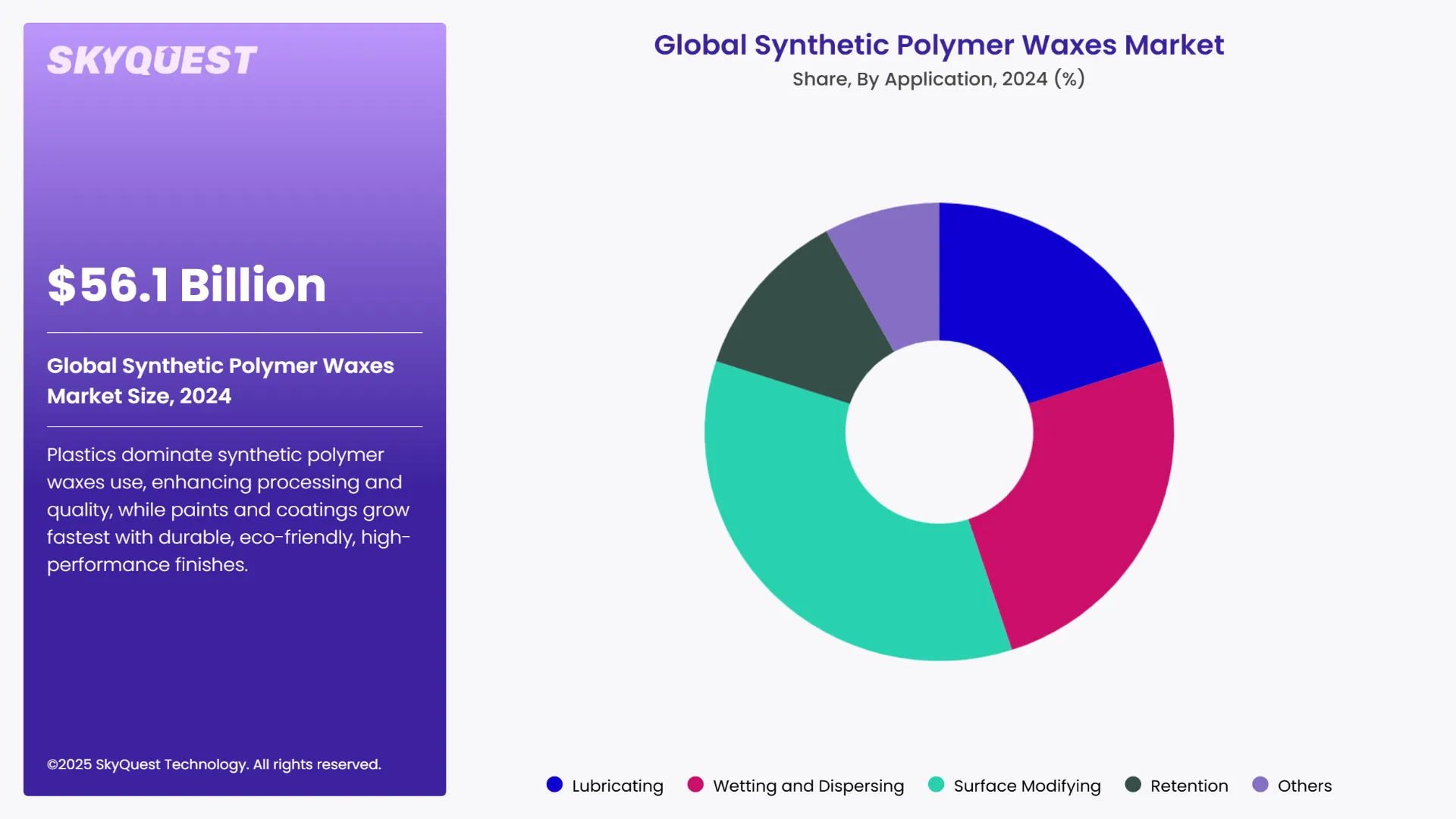
Global synthetic polymer waxes market is segmented into type, application, end-use industry and region. Based on type, the market is segmented into homopolymer wax, polyethylene wax, polypropylene wax, fishcher-trospch wax, co-polymer wax, ethylene vinyl acetate wax, ethylene acrylic acid wax and others. Based on application, the market is segmented into lubricating, wetting and dispersing, surface modifying, retention and others. Based on end-use industry, the market is segmented into automotive, construction, plastic, paint & coating, textile, paper & packaging and others. Region-wise, the market is segmented into North America, Europe, Asia-Pacific, Middle East and Africa, and Latin America.
Polyethylene wax has the highest market share because of its versatility, thermal stability, and cost-effectiveness which is ideal for plastics processing, packaging, adhesives, inks, rubber, and coatings. PE wax is compatible with many polymers which have increased its usage in the industrial market in plastic compounding, masterbatches, hot-melt adhesives, and coatings. The existence of low-density and high-density grades continues to enhance its position in the market.
As per global synthetic polymer waxes market analysis, fischer-tropsch wax is growing rapidly as an eco-friendly and high-performance wax. FT wax comes from a gas-to-liquid process and is cleaner and less-toxic than waxes derived from petroleum. This is an advantage when considering sustainability, which is an increasing trend. Fischer-Tropsch wax is found increasingly in coatings, printing inks, packaging and personal care products where performance and regulatory considerations need to be evaluated with environmental compliance.
According to the global synthetic polymer waxes market forecast, the plastics segment is the most dominant application of synthetic polymer waxes. The growth of this segment can be attributed to the high levels of demand in plastic processing, compounding, and molding. Waxes, including polyethylene and polypropylene are all able to enhance processability, improve surface smoothness of parts, lubricate and enable anti-blocking of films which is instrumental in creating high-quality plastic products. Synthetic polymer waxes are very common in use in masterbatches or general use fillers, they help to enhance the dispersion and performance of the pigments and additives.
As per global synthetic polymer waxes market outlook, the paint and coating industry is the fastest growing market with the increasing look for high-performance finishes that have durability, resistance to scratches and smoothness. The synthetic polymer waxes provide gloss enhancement, slip improvement, chemical resistance, and anti-blocking properties in industrial coatings and automotive paints. As consumers and manufacturers become more eco-conscious, low-VOC (volatile organic compounds) coatings are sought after and wax-enhanced formulations, reducing adverse environmental impact.
To get detailed segments analysis, Request a Free Sample Report
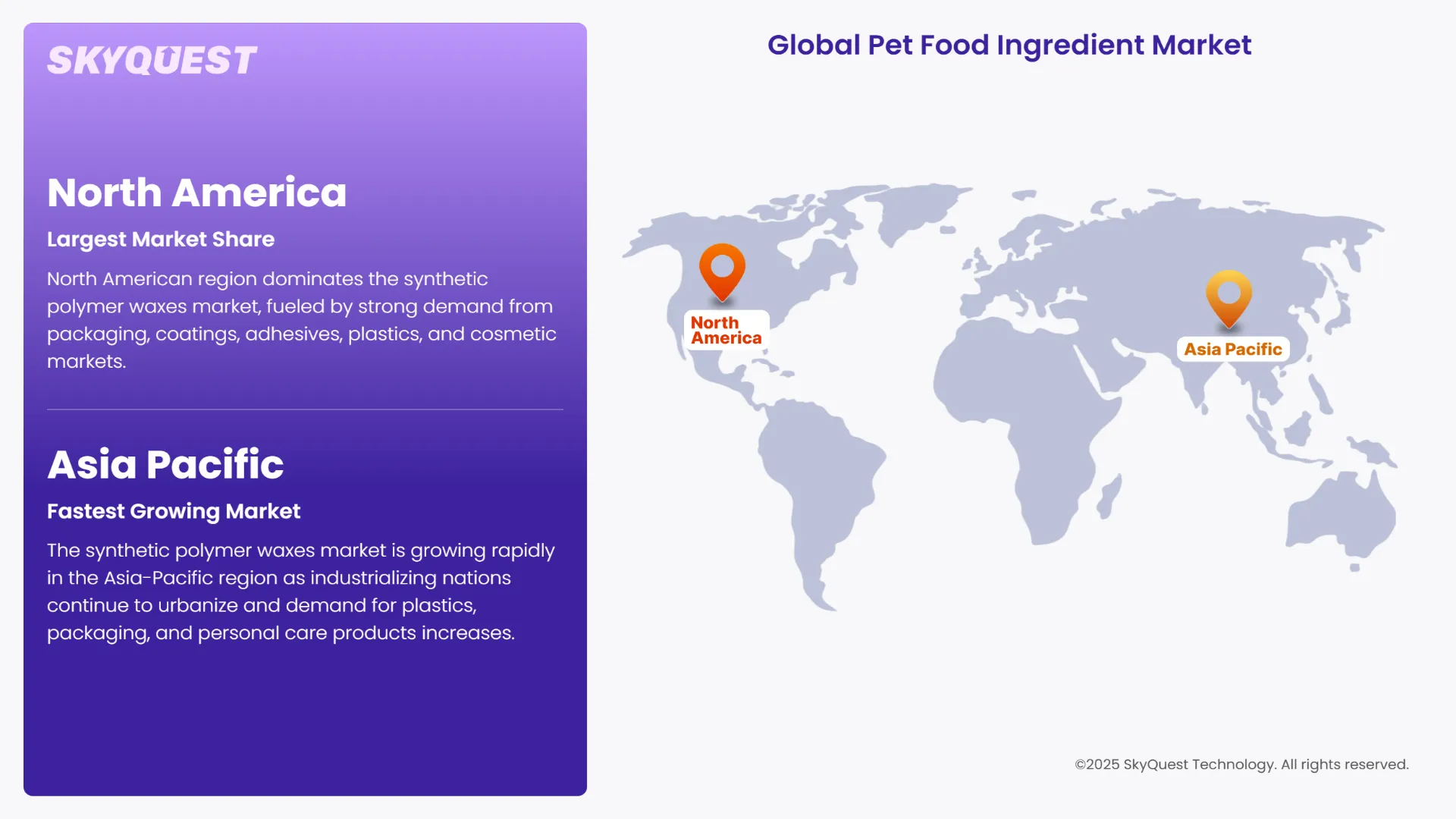
As per regional forecast, North American region dominates the synthetic polymer waxes market, fueled by strong demand from packaging, coatings, adhesives, plastics, and cosmetic markets. North America has established chemical manufacturing systems, innovative and comprehensive R&D systems, an increasing focus on high performance, and sustainable materials. Companies are raising capital to develop new polymer waxes with properties like durability, thermal resistance, and biodegradability.
Synthetic Polymer Waxes Market in U.S.
The U.S. has the highest market share of synthetic polymer waxes in North America, with a large industrial base and high demand in packaging, coatings and automotive applications. Market growth is driven by specialty waxes that enhance product performance, and barrier performance. Many consumers are looking for bio-based and recyclable packaging materials and are innovating feedstocks and technology to reduce petroleum-based waxes.
Synthetic Polymer Waxes Market in Canada
The Canadian market is interested in sustainable and eco-friendly materials, especially in the packaging and cosmetics markets where there are strong environmental demands. Canadian manufacturers are using more bio-based and recycled raw materials in their waxes to meet the sustainability goals of the country. Research institutes and chemical producers are developing processes for industrial, biodegradable, non-toxic, polymer waxes.
The synthetic polymer waxes market is growing rapidly in the Asia-Pacific region as industrializing nations continue to urbanize and demand for plastics, packaging, and personal care products increases. Countries like China, Japan, South Korea, and India are investing in polymer-based products as they prefer cheap and high-quality materials. Local manufacturers are expanding their capacity and governments are implementing stricter environmental laws supporting ecological synthetic waxes.
Synthetic Polymer Waxes Market in Japan
Japan's market expansion is being fostered by innovative firms promoting high-performance materials and the need for polymer waxes in electronics, automotive, and precision coatings. Japanese industry has a strong inclination toward high-quality, high-functionality and development of advanced processing technologies, and is favoring waxes that will offer thermal stability, lubrication, and maximize efficiency during processing.
Synthetic Polymer Waxes Market in South Korea
As per regional outlook, South Korea is pushing to become a regional leader in advanced polymer wax innovation backed by its high-tech manufacturing platform and focus on premium materials performance. The market is seeing strong growth in packaging, automotive, and cosmetics markets, namely from the demand for high-quality, sustainable, and human-grade performance waxes. South Korea is focusing resources on R&D efforts in bio-based feedstocks to decrease dependence on imports and petroleum derivatives.
Europe remains a key synthetic polymer waxes market, due to stringent environmental regulations, an emphasis on sustainability goals, and a strong chemicals industry. The European market continues to favor sustainable, non-toxic and bio-based raw materials which continues to drive new wax formulations. Many companies in Europe are investing in new processing technologies and expanding products to meet demands of the packaging, automotive, construction, and care industries.
Synthetic Polymer Waxes Market in Germany
As per industry analysis, Germany dominates the European market, supported by its advanced chemical industry, strong R&D base, and large-scale manufacturing capacity. The market potential for sustainable and functional waxes is considerable amid rising interest in recycled and biodegradable waxes and high-performance materials.
Synthetic Polymer Waxes Market in the U.K.
The U.K. market fueled by increased usage of renewable content as well as an emphasis on premium and high-performance formulations. Industries such as packaging, personal care and printing are responding to the demand for synthetic polymer waxes that support environmental targets and consumer preference for renewable or "green" materials. The emphasis on local sourcing and the use of plant-based raw materials is gathering momentum in this market.
Synthetic Polymer Waxes Market in Italy
Italy's market is being driven largely by increased adoption in packaging, cosmetics, and coatings, with an emphasis on quality products from consumers and industries alike. Manufacturers are looking to develop natural, recyclable and functional polymer waxes that meet nutritional packaging safety standards as well as sustainability market trends.
To know more about the market opportunities by region and country, click here to
Buy The Complete Report
Increased Demand from Packaging and Coatings Segments
Shift Toward Sustainability and Eco-Friendly Materials
High Costs of Production and Raw Material Dependency
Strict Environmental Regulation
Request Free Customization of this report to help us to meet your business objectives.
The global synthetic polymer waxes industry is sufficiently fragmented and competitive, comprised of many large, multinational chemical companies and product specialty providers.
As per market strategies, for instance, leaders in the market include BASF, Clariant, Honeywell, Evonik, Lubrizol, Dow, DuPont, and Inneospec, all vying for market share and their competitive advantage through innovation, partnerships, and sustainability.
The synthetic polymer waxes industry is seeing the emergence of new and recent startups, founded after 2015, motivated by worldwide shifts toward sustainability and advanced material solutions. Many of these companies are committed to the development of eco-friendly, bio-based and recyclable wax products that address important issues relating to petroleum consumption and environmental impact.
Recent Developments in Synthetic Polymer Waxes Market
SkyQuest’s ABIRAW (Advanced Business Intelligence, Research & Analysis Wing) is our Business Information Services team that Collects, Collates, Correlates, and Analyses the Data collected by means of Primary Exploratory Research backed by robust Secondary Desk research.
According to SkyQuest analysis, the synthetic polymer waxes industry is experiencing consistent expansion, encouraged by robust demand for waxes in packaging, coatings, and automotive applications that enhance product durability, gloss, and surface protection. The increased focus on sustainability is also creating opportunities for eco-friendly waxes and bio-based waxes that support larger global green initiatives. While these trends are positive, there are still concerns regarding operating performance due to heavy production costs, dependency on petrochemical-based feedstocks, and the rapid advancement of environmental regulations and compliance. In addition, the market is undergoing change and development with some industry trends, especially, the use of automated methods and artificial intelligence in production technologies. Waxes will have applications in advanced technologies such as 3D printing and microelectronics, an area of significant growth.
| Report Metric | Details |
|---|---|
| Market size value in 2024 | USD 31.35 Billion |
| Market size value in 2033 | USD 49.05 Billion |
| Growth Rate | 5.1% |
| Base year | 2024 |
| Forecast period | 2026–2033 |
| Forecast Unit (Value) | USD Billion |
| Segments covered |
|
| Regions covered | North America (US, Canada), Europe (Germany, France, United Kingdom, Italy, Spain, Rest of Europe), Asia Pacific (China, India, Japan, Rest of Asia-Pacific), Latin America (Brazil, Rest of Latin America), Middle East & Africa (South Africa, GCC Countries, Rest of MEA) |
| Companies covered |
|
| Customization scope | Free report customization with purchase. Customization includes:-
|
To get a free trial access to our platform which is a one stop solution for all your data requirements for quicker decision making. This platform allows you to compare markets, competitors who are prominent in the market, and mega trends that are influencing the dynamics in the market. Also, get access to detailed SkyQuest exclusive matrix.
Table Of Content
Executive Summary
Market overview
Parent Market Analysis
Market overview
Market size
KEY MARKET INSIGHTS
COVID IMPACT
MARKET DYNAMICS & OUTLOOK
Market Size by Region
KEY COMPANY PROFILES
Methodology
For the Synthetic Polymer Waxes Market, our research methodology involved a mixture of primary and secondary data sources. Key steps involved in the research process are listed below:
1. Information Procurement: This stage involved the procurement of Market data or related information via primary and secondary sources. The various secondary sources used included various company websites, annual reports, trade databases, and paid databases such as Hoover's, Bloomberg Business, Factiva, and Avention. Our team did 45 primary interactions Globally which included several stakeholders such as manufacturers, customers, key opinion leaders, etc. Overall, information procurement was one of the most extensive stages in our research process.
2. Information Analysis: This step involved triangulation of data through bottom-up and top-down approaches to estimate and validate the total size and future estimate of the Synthetic Polymer Waxes Market.
3. Report Formulation: The final step entailed the placement of data points in appropriate Market spaces in an attempt to deduce viable conclusions.
4. Validation & Publishing: Validation is the most important step in the process. Validation & re-validation via an intricately designed process helped us finalize data points to be used for final calculations. The final Market estimates and forecasts were then aligned and sent to our panel of industry experts for validation of data. Once the validation was done the report was sent to our Quality Assurance team to ensure adherence to style guides, consistency & design.
Analyst Support
Customization Options
With the given market data, our dedicated team of analysts can offer you the following customization options are available for the Synthetic Polymer Waxes Market:
Product Analysis: Product matrix, which offers a detailed comparison of the product portfolio of companies.
Regional Analysis: Further analysis of the Synthetic Polymer Waxes Market for additional countries.
Competitive Analysis: Detailed analysis and profiling of additional Market players & comparative analysis of competitive products.
Go to Market Strategy: Find the high-growth channels to invest your marketing efforts and increase your customer base.
Innovation Mapping: Identify racial solutions and innovation, connected to deep ecosystems of innovators, start-ups, academics, and strategic partners.
Category Intelligence: Customized intelligence that is relevant to their supply Markets will enable them to make smarter sourcing decisions and improve their category management.
Public Company Transcript Analysis: To improve the investment performance by generating new alpha and making better-informed decisions.
Social Media Listening: To analyze the conversations and trends happening not just around your brand, but around your industry as a whole, and use those insights to make better Marketing decisions.
REQUEST FOR SAMPLE
 REQUEST FREE CUSTOMIZATION
Global Synthetic Polymer Waxes Market size was valued at USD 31.35 Billion in 2024 and is poised to grow from USD 32.95 Billion in 2025 to USD 49.05 Billion by 2033, growing at a CAGR of 5.1% in the forecast period (2026–2033).
The global synthetic polymer waxes industry is sufficiently fragmented and competitive, comprised of many large, multinational chemical companies and product specialty providers. 'Minerals Technologies Inc.', 'BASF SE', 'Clariant AG (Clariant International Ltd.)', 'Evonik Industries AG', 'Honeywell International Inc.', 'The Lubrizol Corporation', 'Dow Inc.', 'DuPont de Nemours, Inc.', 'Sasol Limited', 'Mitsui Chemicals, Inc.', 'Croda International Plc', 'Paramelt B.V.', 'Micro Powders, Inc.'
The synthetic polymer waxes market is experiencing significant growth, due to their use in the coatings and packaging industries as they are built into printing inks, surface coatings and films for food packaging. Synthetic polymer waxes serve many purposes in these applications such as a protective layer to improve abrasion resistance, surface gloss and sheen and as a protective barrier or defense layer from damage from outside objects.
In today’s market, a transformative shift taking place involves the incorporation of artificial intelligence (AI) and advanced digital tools to design and manufacture synthetic polymer waxes. By utilizing AI-powered simulation models, manufacturers can even test and virtually optimize melting point, viscosity, hardness and thermal stability, thus reducing endless time-consuming physical trials to innovate at speed.
As per regional forecast, North American region dominates the synthetic polymer waxes market, fueled by strong demand from packaging, coatings, adhesives, plastics, and cosmetic markets. North America has established chemical manufacturing systems, innovative and comprehensive R&D systems, an increasing focus on high performance, and sustainable materials. Companies are raising capital to develop new polymer waxes with properties like durability, thermal resistance, and biodegradability.


Want to customize this report? This report can be personalized according to your needs. Our analysts and industry experts will work directly with you to understand your requirements and provide you with customized data in a short amount of time. We offer $1000 worth of FREE customization at the time of purchase.
Feedback From Our Clients


 USA (+1) 351-333-4748

