
Telemedicine Market
Report ID: SQMIG35G2214
Report ID: SQMIG35G2214
[email protected]
USA +1 351-333-4748
Report ID:
SQMIG35G2214 |
Region:
Global |
Published Date: July, 2025
Pages:
182
|Tables:
183
|Figures:
79


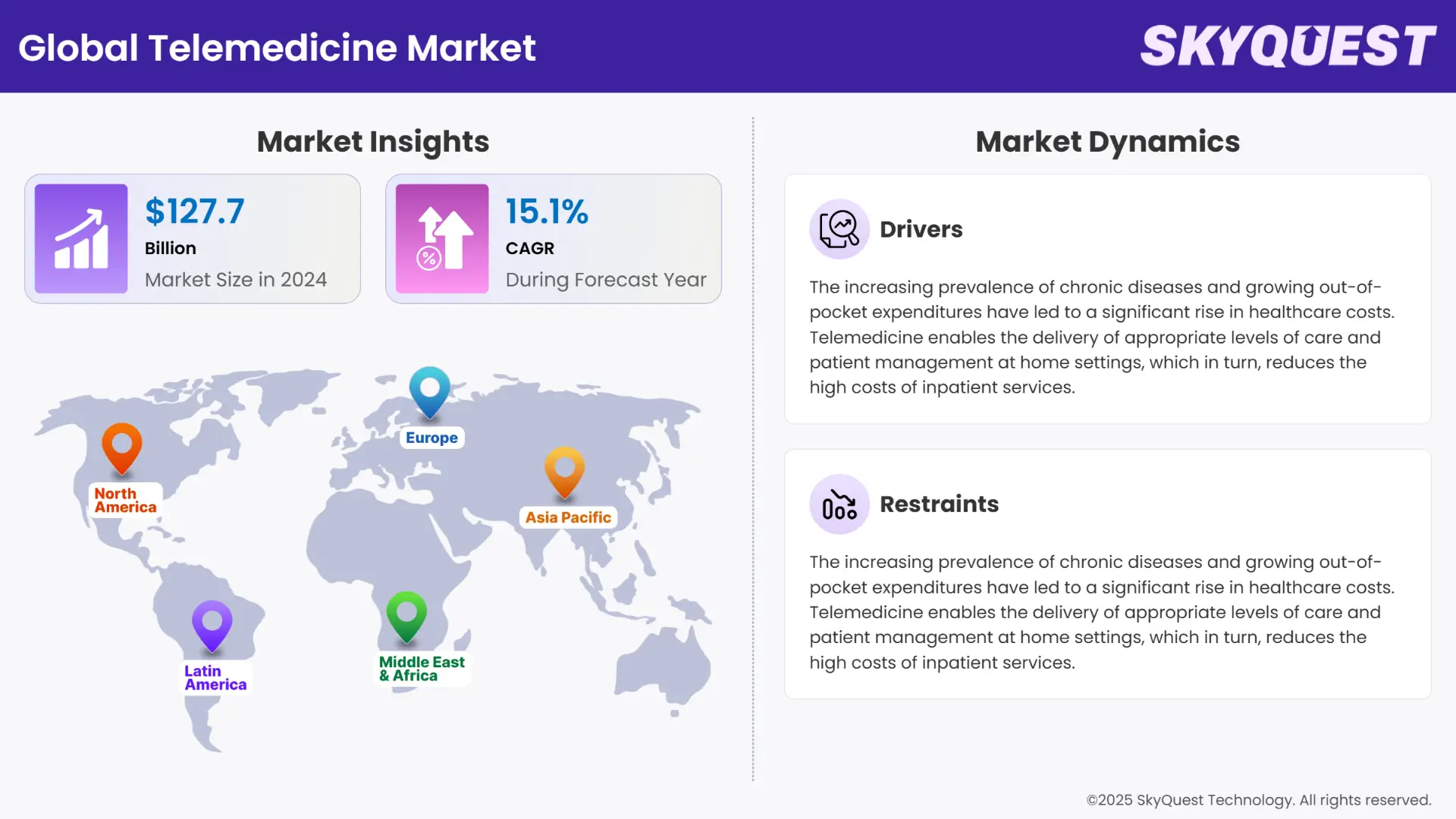
Global Telemedicine Market size was valued at USD 128.11 Billion in 2024 and is poised to grow from USD 147.45 Billion in 2025 to USD 454.2 Billion by 2033, growing at a CAGR of 15.1% during the forecast period (2026–2033).
The telemedicine market is growing substantially. It is being driven by key drivers, such as pressure from chronic disease and an aging population, as well as accessibility challenges for healthcare. Digital health technologies such as artificial intelligence (AI)-based diagnostic applications, health wearables, and 5G internet communications will improve the efficiencies and reliability of virtual consultations. Support for telemedicine will also be enhanced by encouraging government and private sector telemedicine policies and reimbursement models, particularly during and post-COVID-19 pandemic, which has built momentum for telemedicine in developed and developing healthcare systems alike.
On the constraint side, there are several challenges that are preventing telemedicine from scaling entirely. A primary challenge is data privacy and cybersecurity of information. Patients and providers remain concerned about potential abuse or breach of personally identifiable information or sensitive medical information. In addition, the digital divide continues to influence rural and under-developed areas that do not have quality internet, technology access, or technology literacy skills to take advantage of telemedicine. Additionally, many healthcare systems' multifaceted regulatory landscapes have several layers of inconsistency including licensure and cross-border teleconsultation, while reimbursement structures are often unpredictable, creating operational and financial complications for the provider.
Despite these issues, the telemedicine market is expected to remain strongly upwardly mobile. As healthcare systems look to create strong IT infrastructure, raise digital literacy, and unify regulations, telemedicine will be intertwined with popular healthcare delivery. The continued advancement of AI, IoT, and cloud platforms will expand telemedicine already being offered in areas such as remote monitoring, behavioral and mental health support, and chronic disease management. The telemedicine industry will succeed if it balances innovation, equitable access, patient trust, and regulation.
AI is transforming the telemedicine sector as it improves diagnostic accuracy, reduces clinical workflows, and allows real-time remote monitoring. Providers can use AI chatbot and virtual assistant technology to conduct virtual triage, capture appointments, manage chronic conditions, and communicate with patients 24/7. Multimodal AI systems can dynamically process and analyze various inputs (e.g., imaging, voice, biometric) to create individualized and personalized care. Ambient clinical intelligence can streamline documentation and documentation, freeing clinicians to spend time with patients.
A recent example that illustrates this rapidly increasing trend toward personalized telemedicine wellness tools is Movano's EvieAI smart ring that was recently released at CES 2025. EvieAI learns from more than 100,000 peer-reviewed medical journals and then cross-references them with other accredited resources to bring users high-quality wellness recommendations via the Evie Ring app. It achieves 99% accuracy, and with strong privacy protocols, EvieAI provides users with medically validated insights without providing direct diagnoses — this is key to patient trust, while also demonstrating AI's evolution in the space of personalized telemedicine wellness tools.
To get more insights on this market click here to Request a Free Sample Report
Global Telemedicine Market is segmented by Component, Function, Modality, Delivery Mode, Application, End User and region. Based on Component, the market is segmented into Hardware, Software and Services. Based on Function, the market is segmented into Clinical Care Management, Preventive Care Management, Diagnostics & Treatment, Remote Patient Monitoring/Patient Monitoring, Rehabilitation & Recovery, Administrative, Analytics & Reporting, Patient Engagement and Other Functions. Based on Modality, the market is segmented into Store & forward, Real time and Others. Based on Delivery Mode, the market is segmented into Web/Mobile, Audio/Text-based, Visualized and Call Centers. Based on Application, the market is segmented into Primary Care, Specialty Care, Tele ICU, Virtual Sitting & Nursing and Other Applications. Based on End User, the market is segmented into Healthcare Providers, Healthcare Payers, Patients, Pharmaceutical & Biotechnology Companies, Medtech Companies and Other End Users. Based on region, the market is segmented into North America, Europe, Asia Pacific, Latin America and Middle East & Africa.
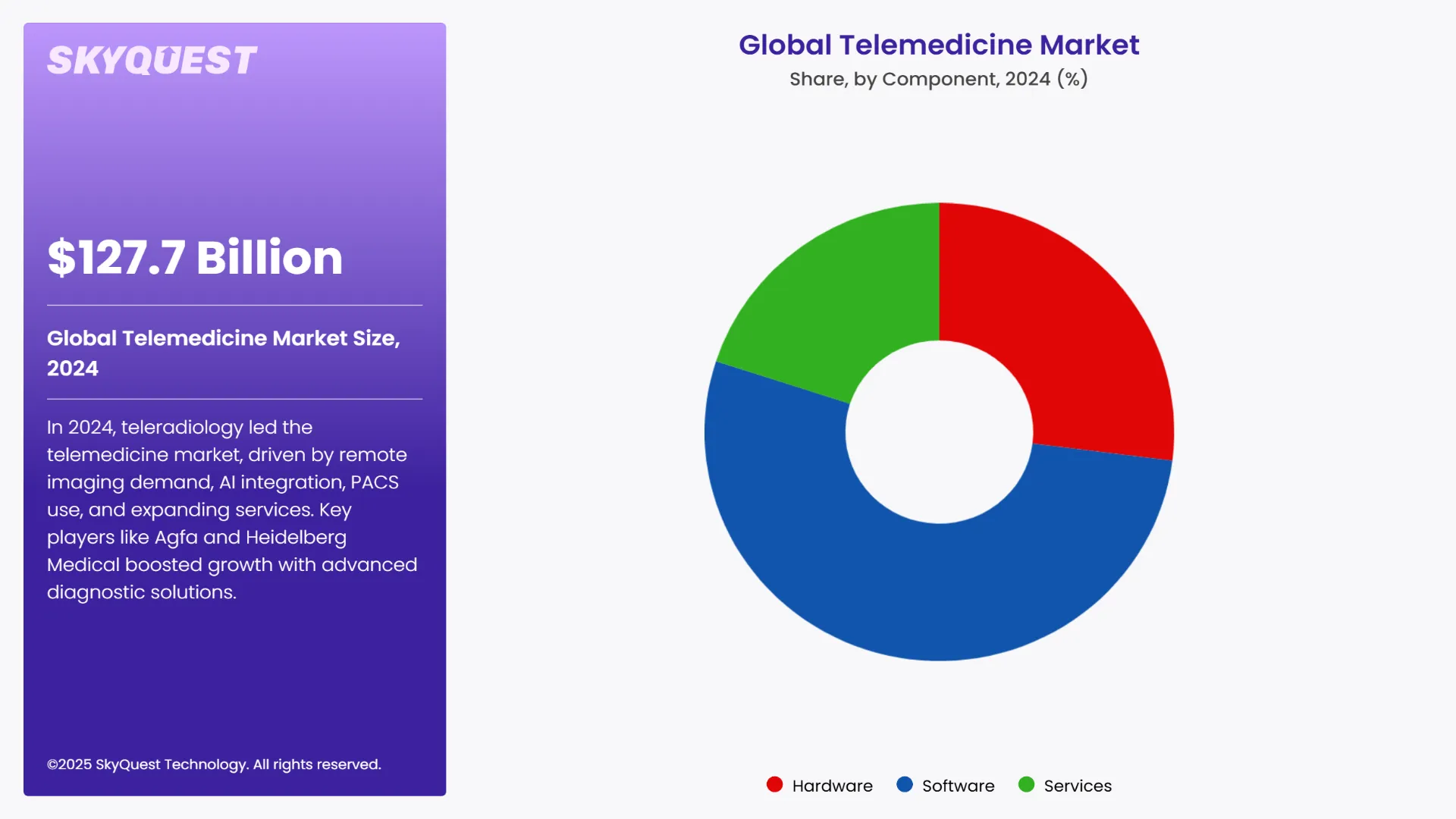
As per global telemedicine market outlook, product segment dominated the market and accounted for the largest market share of 52.97% in 2024. Similarly, NVIDIA CLARA is a powerful combination of software and hardware that brings advanced data analytics to medical imaging systems to advance disease diagnosis, detection, and treatment. For instance, Teladoc Health, Inc. provides several devices, including Xpress & Xpress Cart, TV Pro & TV Pro+, Lite with Boom Camera, and Viewpoint Cart, to facilitate clinical collaboration and point-of-care visits. This can be attributed to the widespread adoption of the various medical peripheral devices, audio equipment, microphones, display screens, and video conferencing devices used to facilitate virtual visits.
As per global telemedicine market analysis, service segment is expected to witness largest CAGR growth during the forecast period, owing to expanding field of remote patient monitoring, widespread use of teleconsulting between patients and clinicians, between physicians is estimated to propel the segment growth. For instance, in December 2021, the Common Services Centre of the Ministry of Electronics and Information Technology in India launched CSC Health Services Helpdesk chatbot-based helpline on WhatsApp. This solution provides teleconsultation services for people living in rural parts of India.
As per telemedicine market forecast, teleradiology segment dominated the market in 2024 due to high demand for remote imaging services. As healthcare providers adopt teleradiology workflows, service offerings within radiology sub-segments expand, introduction of new teleradiology services, and teleradiology practices are regulated, this segment is expected to grow. key growth drivers for this segment include integration of artificial intelligence (AI) into Tailoriaology, use of an image archive and communication system (PAC), and increase R&D activities in E -Helve. In November 2021, for example, Agfa Healthcare launched a real external diagnostic workflow. Telemedicine service provider Heidelberg Medical Consultancy and Health Tourism PVT. Limited specializes in offering customized, high-quality radiology reporting the solutions for dental experts and practice.
Telepsychiatry segment is projected to grow fastest at CAGR due to increasing prevalence of mental and behavioural health disorders, growing awareness, and adoption of telepsychiatry services. In addition, in December 2021, American Well launched Mind Your Mind, a mental health initiative designed to raise awareness about mental health issues. The increasing incidence of anxiety, depression, stress-related disorders, and other behavioural health conditions is driving the demand for accessible mental healthcare solutions.
To get detailed segments analysis, Request a Free Sample Report
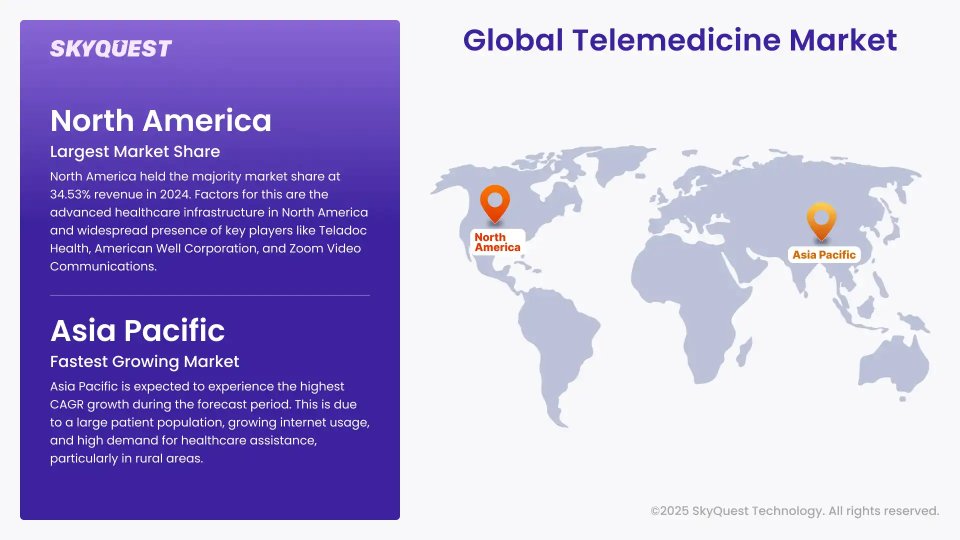
North America held the majority market share at 34.53% revenue in 2024. Factors for this are the advanced healthcare infrastructure in North America and widespread presence of key players like Teladoc Health, American Well Corporation, and Zoom Video Communications, that are based in North America and undertaking strategic initiatives to gain a greater portion of the market.
U.S. Telemedicine Market
The U.S. dominates due to expansive Medicare/Medicaid telehealth policies and robust federal support. Recent government action extended Medicare telehealth flexibilities—allowing care anywhere via audio/video—through September 30, 2025 (H.R. 1968). These measures ensure sustained virtual care access and reinforce the country’s telemedicine leadership.
Canada Telemedicine Market
Canada excels via coordinated federal–provincial virtual care efforts. Health Canada’s 2020 Virtual Care Policy Framework allocated CAD 200 million across provinces for secure video, messaging, RPM, and data systems. This integration supports telehealth in remote and Indigenous communities, driving nationwide growth.
Asia Pacific is expected to experience the highest CAGR growth during the forecast period. This is due to a large patient population, growing internet usage, and high demand for healthcare assistance, particularly in rural areas. The telemedicine market in India, is growing significantly owing to improving internet coverage and increasing health-tech expenditure. India and China are predicted to lead the regional growth, with India's telemedicine service, Sanjeevini, already completing around 3 billion consultations across the country, according to a report from the India Brand Equity Foundation in March 2021.
China Telemedicine Market
China leads with ~25.2% market share, driven by 5G-enabled telemedicine and Healthy China 2030. In May 2024, JD Health launched an AI-powered mental health chatbot “Small Universe,” backed by government digital healthcare funding—reflecting strong public support and infrastructure.
India Telemedicine Market
Accounting for ~20.4% of the regional market, eSanjeevani—India’s government-owned telemedicine platform—hit 80 million consultations by December 2022. The initiative, part of the Ayushman Bharat Digital Mission, is also piloting AI speech translation to overcome language barriers.
South Korea Telemedicine Market
Korea is expanding telemedicine via trial-tolerated models since COVID19. Approximately 15% of its population is over 65, prompting government pilots to bridge rural-urban care gaps. This cautious support fosters steady market growth.
Europe leads the telemedicine market due to strong healthcare infrastructure, widespread digitalization, government support, and high telehealth adoption rates. Germany is at the forefront, driven by progressive digital health laws, telemedicine reimbursements, and increasing AI-driven healthcare solutions.
Germany Telemedicine Market
Germany leads with ~22–26% market share due to its Digital Healthcare Act (DVG) and Hospital Future Act (KHZG) enabling telemedicine & app prescriptions. The Center for Telemedicine (ZTM) received €607,500 in 2024 state funding, supporting its NIDAklinik and AI chatbot projects.
France Telemedicine Market
France benefits from the “My Santé 2022” digital-health initiative and AI diagnostic integration by 60 % of providers. Zava and local startups use government reimbursement to offer teledermatology and telecardiology services, particularly in rural areas.
UK Telemedicine Market
The UK’s dynamic growth (~17 % CAGR) is driven by NHS digital investments and the NHS Long Term Plan. Babylon’s AI-powered triage tools and Doctolib’s eConsult are integrated with NHS systems for virtual GP consultations, enhancing access and reducing NHS waitlists.
To know more about the market opportunities by region and country, click here to
Buy The Complete Report
Significant Reduction in Healthcare Cost Burden to Boost Market Growth:
Adoption of Advanced Technologies to Foster Market Growth:
Poor Infrastructure and Technological Barriers to Hinder Market Expansion:
Obstacles in Law and Regulation:
Request Free Customization of this report to help us to meet your business objectives.
The global telemedicine industry is very competitive, to strengthen the market's appearance to focus on technological progress, strategic partnership and service extension with major players. Mvel (American Well Corporation) offers safe video and telephone medicine solutions, collaborated with health systems, insurance companies and employers to expand access to virtual care. The Taladoc Health is a prominent player that offers a comprehensive virtual health platform that includes telecommunications, mental health services and chronic disease management.
The increasing demand by patients experiencing mental illness for digital health products and services for behavioural health is a key factor in expanding the telepsychiatry segment. As per the Excellus BlueCross BlueShield survey, 22% of the e-visits made by the Excellus BlueCross BlueShield members in 2018 in the U.S. were for behavioural health, which included conditions, such as bipolar disorders, attention disorders, depression, and anxiety. Furthermore, in October 2022, the Union Ministry of Health & Family Welfare of India rolled out tele-mental health services across the nation.
AI-powered booths have been present for the past few years. One component of the system is a smart medicine cabinet that can deliver more than 100 medications. The AI system provides a diagnosis plan after compiling the patient's medical history, which is subsequently sent to a clinical specialist. These tiny clinics are referred to as "One-Minute Clinics". Through these clinics, patients can then be paired with a doctor from Ping a Good Doctor's internal medical staff.
SkyQuest’s ABIRAW (Advanced Business Intelligence, Research & Analysis Wing) is our Business Information Services team that Collects, Collates, Correlates, and Analyses the Data collected using Primary Exploratory Research backed by robust Secondary Desk research.
According to SkyQuest analysis, the increasing prevalence of various chronic and cardiovascular diseases (CVDs), especially amongst the geriatric population has prompted an increase in the need for effective home monitoring systems and smartphone applications for checking various health parameters, including blood pressure sugar and sleeping patterns. This, in turn, is primarily driving the global telemedicine market growth. Additionally, the Government of India (GoI) is undertaking numerous initiatives to strengthen the healthcare information (HCIT) sector, such as the provision of telemedicine services to remotely monitor, diagnose, and provide consultation to patients.
| Report Metric | Details |
|---|---|
| Market size value in 2024 | USD 128.11 Billion |
| Market size value in 2033 | USD 454.2 Billion |
| Growth Rate | 15.1% |
| Base year | 2024 |
| Forecast period | 2026-2033 |
| Forecast Unit (Value) | USD Billion |
| Segments covered |
|
| Regions covered | North America (US, Canada), Europe (Germany, France, United Kingdom, Italy, Spain, Rest of Europe), Asia Pacific (China, India, Japan, Rest of Asia-Pacific), Latin America (Brazil, Rest of Latin America), Middle East & Africa (South Africa, GCC Countries, Rest of MEA) |
| Companies covered |
|
| Customization scope | Free report customization with purchase. Customization includes:-
|
To get a free trial access to our platform which is a one stop solution for all your data requirements for quicker decision making. This platform allows you to compare markets, competitors who are prominent in the market, and mega trends that are influencing the dynamics in the market. Also, get access to detailed SkyQuest exclusive matrix.
Table Of Content
Executive Summary
Market overview
Parent Market Analysis
Market overview
Market size
KEY MARKET INSIGHTS
COVID IMPACT
MARKET DYNAMICS & OUTLOOK
Market Size by Region
KEY COMPANY PROFILES
Methodology
For the Telemedicine Market, our research methodology involved a mixture of primary and secondary data sources. Key steps involved in the research process are listed below:
1. Information Procurement: This stage involved the procurement of Market data or related information via primary and secondary sources. The various secondary sources used included various company websites, annual reports, trade databases, and paid databases such as Hoover's, Bloomberg Business, Factiva, and Avention. Our team did 45 primary interactions Globally which included several stakeholders such as manufacturers, customers, key opinion leaders, etc. Overall, information procurement was one of the most extensive stages in our research process.
2. Information Analysis: This step involved triangulation of data through bottom-up and top-down approaches to estimate and validate the total size and future estimate of the Telemedicine Market.
3. Report Formulation: The final step entailed the placement of data points in appropriate Market spaces in an attempt to deduce viable conclusions.
4. Validation & Publishing: Validation is the most important step in the process. Validation & re-validation via an intricately designed process helped us finalize data points to be used for final calculations. The final Market estimates and forecasts were then aligned and sent to our panel of industry experts for validation of data. Once the validation was done the report was sent to our Quality Assurance team to ensure adherence to style guides, consistency & design.
Analyst Support
Customization Options
With the given market data, our dedicated team of analysts can offer you the following customization options are available for the Telemedicine Market:
Product Analysis: Product matrix, which offers a detailed comparison of the product portfolio of companies.
Regional Analysis: Further analysis of the Telemedicine Market for additional countries.
Competitive Analysis: Detailed analysis and profiling of additional Market players & comparative analysis of competitive products.
Go to Market Strategy: Find the high-growth channels to invest your marketing efforts and increase your customer base.
Innovation Mapping: Identify racial solutions and innovation, connected to deep ecosystems of innovators, start-ups, academics, and strategic partners.
Category Intelligence: Customized intelligence that is relevant to their supply Markets will enable them to make smarter sourcing decisions and improve their category management.
Public Company Transcript Analysis: To improve the investment performance by generating new alpha and making better-informed decisions.
Social Media Listening: To analyze the conversations and trends happening not just around your brand, but around your industry as a whole, and use those insights to make better Marketing decisions.
REQUEST FOR SAMPLE
 REQUEST FREE CUSTOMIZATION
Artificial Intelligence (AI) enhances telemedicine by enabling automated diagnostics, predictive analytics, virtual assistants, and intelligent triage systems, improving decision-making, reducing wait times, and personalizing patient care.
5G technology provides high-speed, low-latency connectivity, essential for real-time video consultations, remote surgery, and continuous patient monitoring, making telemedicine faster and more reliable.
Telemedicine is widely used for primary care consultations, mental health therapy, chronic disease management, post-surgical follow-ups, and remote diagnostics, offering care access across urban and rural settings.
Key technologies in telemedicine include video conferencing platforms, AI-driven diagnostic tools, remote patient monitoring (RPM) devices, mobile health apps, cloud computing, and IoT-based medical devices.
Innovations such as wearable biosensors, AI chatbots, blockchain for data security, remote diagnostic kits, and virtual reality (VR) for mental health are transforming telemedicine delivery and efficiency.
Telemedicine improves care by increasing accessibility, reducing travel time and costs, enabling faster diagnosis, supporting continuous monitoring, and promoting preventive care, especially for remote or underserved populations.
Popular telemedicine services include real-time video consultations, asynchronous store-and-forward communication, remote patient monitoring, mobile health (mHealth) apps, and tele-ICU services.
Key challenges include regulatory barriers, reimbursement issues, data privacy concerns, limited digital literacy, and uneven internet access in remote or low-income areas.
Global Telemedicine Market size was valued at USD 128.11 Billion in 2024 and is poised to grow from USD 147.45 Billion in 2025 to USD 454.2 Billion by 2033, growing at a CAGR of 15.1% during the forecast period (2026–2033).
The global telemedicine industry is very competitive, to strengthen the market's appearance to focus on technological progress, strategic partnership and service extension with major players. Mvel (American Well Corporation) offers safe video and telephone medicine solutions, collaborated with health systems, insurance companies and employers to expand access to virtual care. The Taladoc Health is a prominent player that offers a comprehensive virtual health platform that includes telecommunications, mental health services and chronic disease management. 'AMC Health (USA)', 'Teladoc Health Inc. (USA)', 'The Cigna Group (USA)', 'MDlive, Inc. (USA)', 'Twilio Inc. (USA)', 'SOC Telemed Inc. (USA)', 'Vsee (USA)', 'ACL Digital (USA)', 'ICliniq (India)', 'Oracle Corporation (USA)', 'General Electric Company (USA)', 'American Well Corporation (USA)', 'Doctor on Demand Inc. (USA)', 'Philips Healthcare (Netherlands)', 'Siemens Healthineers (Germany)', 'Medtronic PLC (Ireland)', 'Babylon Health (United Kingdom)', 'Ping An Good Doctor (China)', 'Zoom Video Communications Inc. (USA)', 'Practo (India)'
The increasing prevalence of chronic diseases and growing out-of-pocket expenditures have led to a significant rise in healthcare costs. Telemedicine enables the delivery of appropriate levels of care and patient management at home settings, which in turn, reduces the high costs of inpatient services. The adoption of the digital technologies and teleconsultations can be a useful tool for addressing this issue. Teleconsultations offer cheaper services and also reduce the work burden on healthcare professionals.
North America held the majority market share at 34.53% revenue in 2024. Factors for this are the advanced healthcare infrastructure in North America and widespread presence of key players like Teladoc Health, American Well Corporation, and Zoom Video Communications, that are based in North America and undertaking strategic initiatives to gain a greater portion of the market.


Want to customize this report? This report can be personalized according to your needs. Our analysts and industry experts will work directly with you to understand your requirements and provide you with customized data in a short amount of time. We offer $1000 worth of FREE customization at the time of purchase.
Feedback From Our Clients


 USA (+1) 351-333-4748

