Waste Management Market
Report ID: SQMIG20L2063
Report ID: SQMIG20L2063
[email protected]
USA +1 351-333-4748
Report ID:
SQMIG20L2063 |
Region:
Global |
Published Date: June, 2025
Pages:
199
|Tables:
95
|Figures:
76


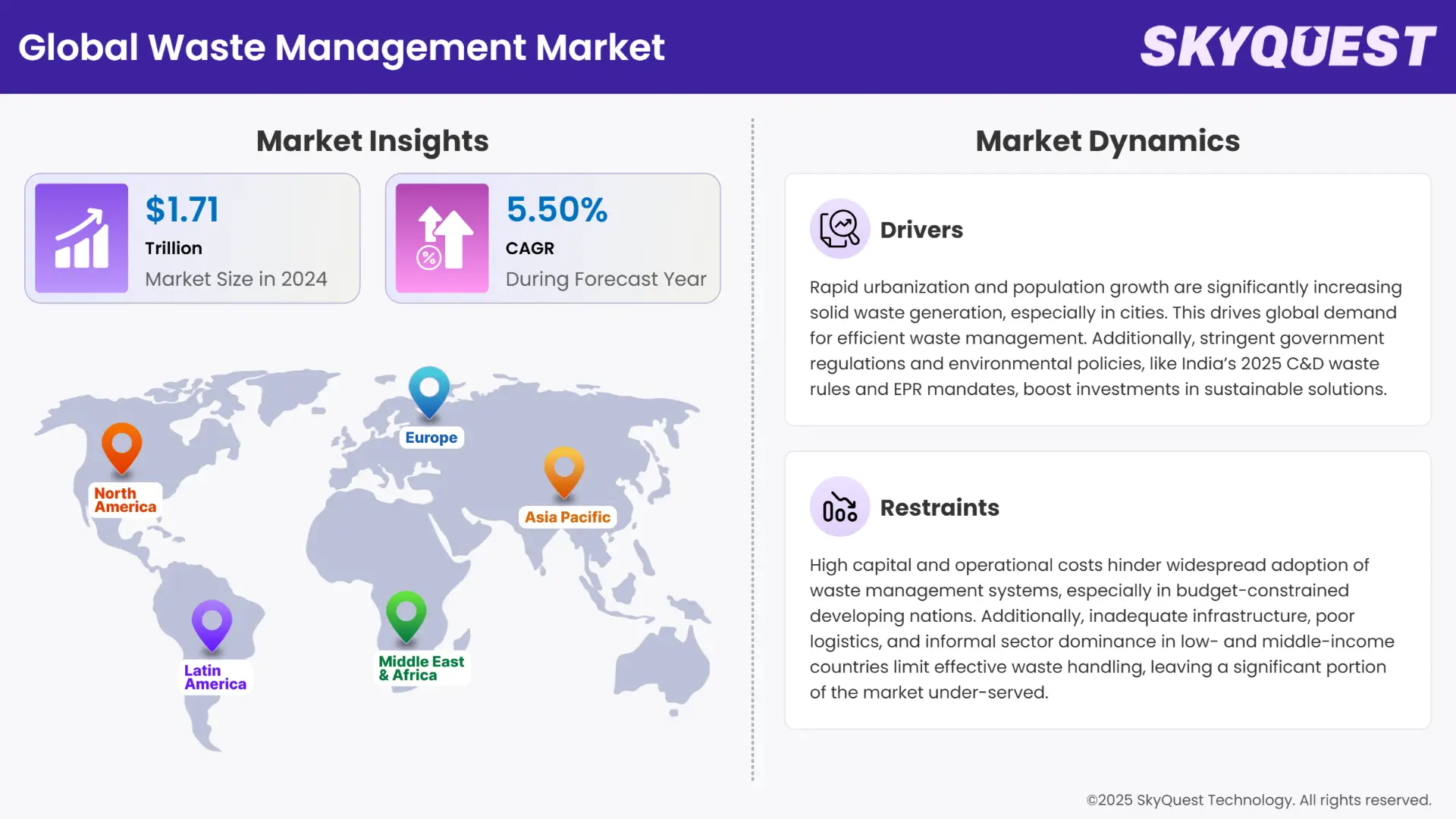
Global Waste Management market size was valued at USD 1.71 Trillion in 2024 and is poised to grow from USD 1.8 Trillion in 2025 to USD 2.77 Trillion by 2033, growing at a CAGR of 5.5% in the forecast period (2026–2033).
Rapidly increasing global population and subsequent urbanization are the primary factors that have resulted in increased volume of waste thereby promoting waste management demand as well. Increasing awareness among consumers, imposition of strict waste management mandates, and emphasis on improving environmental conservation are other factors that could bolster waste management market growth over the coming years. Incentives for recycling and advancements in waste recycling technologies are also expected to alter the global waste management market development trajectory across the study period. Developing countries are lacking in waste management whereas developed countries are leading the adoption of advanced waste management solutions and services.
However, lack of infrastructure in developing regions, high costs of waste management operations, and community opposition are some top restraints that could impede waste management demand in the future.
AI is transforming market dynamics. AI technologies help in real-time waste analytics, automation, and improve resource recovery. Waste management companies which use AI-based predictive maintenance have reported that they have reduced downtime by up to 20%, which has, in turn, ensured smoother operations and lower maintenance costs. AI can also improve the efficiency of sorting, tracks waste composition, and reduce human error in recycling plants. In February 2025, Tadweer Group, in partnership with FAMS Technologies, launched Abu Dhabi’s first AI-integrated waste management platform. This platform helps optimize route planning, reducing carbon emissions, and improving operational transparency throughout the entire waste lifecycle.
To get more insights on this market click here to Request a Free Sample Report
The global waste management market is segmented into service type, waste type, disposal method, source and region. By service type, the market is classified into collection, transportation, sorting & separation, disposal, and others. Depending on waste type, it is divided into non-hazardous industrial waste, construction and demolition waste, municipal solid waste, hazardous waste, medical waste, e-waste, and others. According to disposal method, the market is categorized into open dumping, incineration/combustion, landfills, recycling, composting and anaerobic digestion, and others. Based on source, the market is categorized into residential (urban, rural), commercial (offices and retail stores, hospitals, restaurants, others), and industrial (process industries, construction, renovation, and demolition waste, others). Regionally, the waste management market is analyzed across North America, Europe, Asia-Pacific, Middle East & Africa, and Latin America.
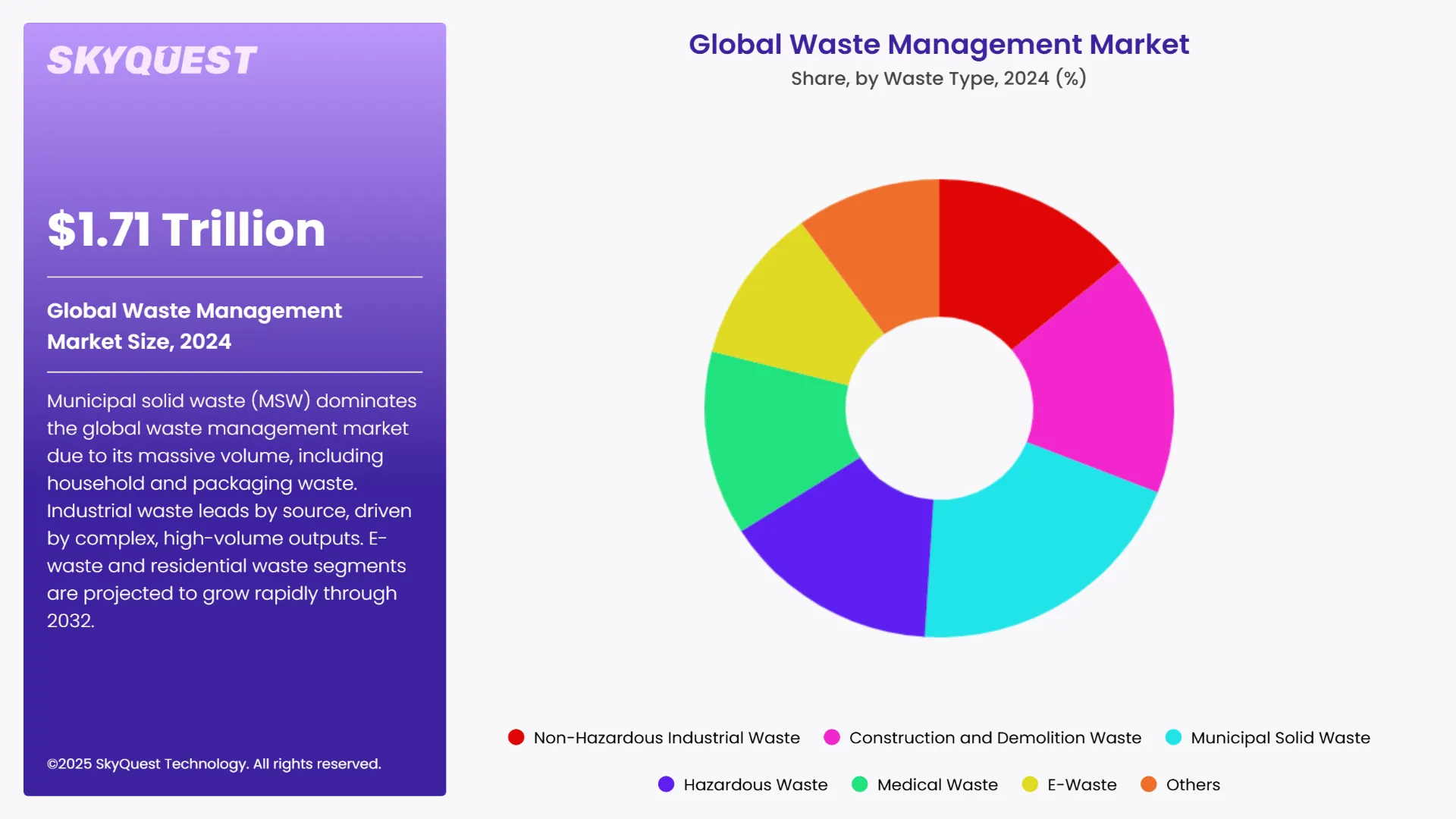
As per the 2024 global waste management market analysis, municipal solid waste sub-segment held the largest share of revenue and controlled the market. MSW includes household waste, packaging, plastics, and organic materials. In the UN’s Global Waste Management Outlook Report of 2024, it was predicted that municipal solid waste generation will grow from 2.1 billion tonnes in 2023 to 3.8 billion tonnes by 2050. The Global Waste Index 2025 by Sensoneo analyzed waste management in 38 countries and revealed that the country with the highest per capita waste generation produced up to 650 kg of municipal waste per person annually. The huge amount of MSW generated annually is a key reason for the sub-segment’s dominance in requiring waste management.
The e-waste segment is expected to experience the highest compound annual growth rate (CAGR) through the forecasted period. This is due to the surge in electronics consumption, shorter device lifecycles, and rising digitalization across the world. The discarded outdated gadgets by consumers and industries require recycling and recovery of rare earth elements. Environmental regulations and producer responsibility laws and are also increasing investments in e-waste management solutions.
Based on the 2024 global waste management market forecast, the industrial in the source segment dominated the market. The waste generated from various industries such as manufacturing, energy, mining, construction, etc. is high in volume and highly complex. It includes hazardous materials, bulk packaging materials, and process residues. Each of these wastes requires specialized handling and disposal. Thus, industries are investing in waste treatment technologies and compliance systems. This makes this segment the largest contributor to the market’s revenue.
The residential category is expected to have the highest growth rate during the forecast period of 2025-2032. With increasing urbanization, growing living standards, and increasing consumption of packaged goods, household waste like plastics, organics, and e-waste have seen a huge rise in quantities. Municipalities are, therefore, upgrading their collection and waste management systems.
To get detailed segments analysis, Request a Free Sample Report
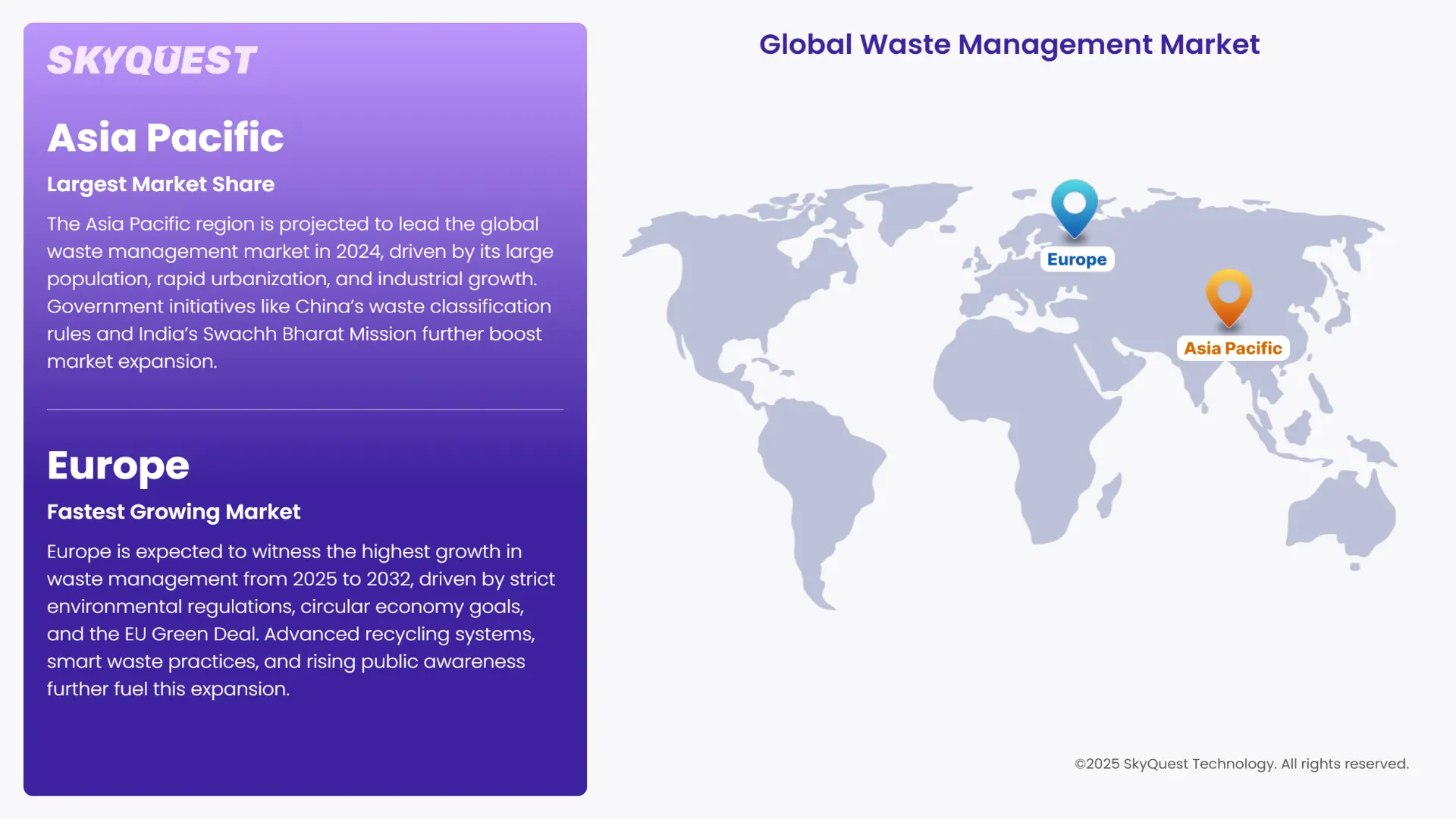
As per the 2024 waste management market regional forecast, the Asia Pacific market is predicted to hold the largest share among all regions in 2024. The huge population in the region along with factors such as rapid urbanization and accelerating industrial activities all contribute to its growth. municipal, industrial, and e-waste. Government initiatives, such as China’s waste classification mandates and India’s Swachh Bharat Mission also continue to spur adoption in the region.
China Waste Management Market
In Asia Pacific, China leads the waste management market share. China’s huge population and industrial output generates high volumes of municipal and industrial waste. Government policies of the Chinese government like the “National Sword” and “Zero Waste Cities” initiative have resulted in improvements in waste segregation and recycling. China’s Shanghai SUS Environment secured a USD 497 million contract for building Iraq’s first waste-to-energy plant in Baghdad. This facility will process 3,000 tonnes of waste daily to generate 100 MW of electricity.
Japan Waste Management Market
Japan in Asia Pacific falls behind China in the waste management market growth. Japan has been setting a global benchmark for efficient management of wastes. The country is known for its high recycling rates, strict regulations, and wide scale participation from citizens in waste segregation. In 2025, Kyushu Electric Power launched a new waste transfer facility at its Sendai Nuclear Power Plant to process and solidify low-level radioactive solid waste on-site. The facility will handle 1,500 drums annually. Waste shipments will begin in FY2027 to the disposal center in Japan Nuclear Fuel Ltd. Even though it has limited landfill space, Japan has built a highly functional infrastructure for waste management, making it a dominant market in the Asia-Pacific waste sector.
Europe is predicted to grow at the highest rate in the waste management market share over the projection period of 2025-2032. The growth in the region is led by regulations related to the environment, circular economy goals, and decarbonization targets. In accordance with the EU’s Green Deal and directives on waste reduction and recycling, countries in the region are adopting modern waste segregation, recycling, and energy recovery systems. Other factors such as rising public awareness and the expansion of smart waste management practices also support greater growth of waste management.
Germany Waste Management Market
The Germany waste management market demand grew at a steady rate during the forecast period. Germany has a well-known recycling infrastructure and strict environmental regulations. The country boasts of one of the highest recycling rates globally, achieving about 90% recycling rate for packaging waste in 2022. Germany focuses heavily on smart technologies for waste management. In 2024, Bigbelly launched its newest international subsidiary, Bigbelly GmbH, in Hamburg, Germany. The company introduced high-capacity, multi-stream, touchless smart bins to reduce waste collections, and improve public sanitation in Germany.
France Waste Management Market
France is among the most dominant countries of Europe’s waste management market growth in 2024. France’s market growth is spurred by presence of major players like Veolia and Suez. The evolving regulatory landscape in France involving policy, innovation, and corporate engagement is also promoting growth. In June 2025, Séché Environnement signed a unilateral purchase offer to acquire Groupe Flamme. Groupe Flamme is a hazardous waste treatment and sanitation services provider in northeastern France. This will make Séché’s position in France and Europe’s market stronger.
North America held a significant waste management market share in 2024 and is likely to continue so during the forecast period of 2025-2032. This is due to the strong environmental regulations, along with already existing consumer awareness, and wide adoption of waste processing technologies. The growing electronic and hazardous waste streams have also necessitated demand for specialized treatment services. Both the public and private sectors are focusing on and investing in digitized waste collection and circular economy models.
U.S. Waste Management Market
U.S. has the largest North American market for waste management industry. Its market is very structured, having well-established systems for collection, recycling, and disposal of waste. Americans dispose of about nearly 5 pounds of trash every day per person. Such high volumes of not only municipal solid waste but also industrial waste, e-waste and medical waste are huge reasons behind the market’s prosperity. State-level policies, such as California’s zero waste initiatives are also key contributors.
Canada Waste Management Market
The Canada waste management market demand is also experiencing steady growth. The advancement of Canada’s waste management can be credited to its strong federal and provincial initiatives. An average Canadian citizen produced about 700 kg of waste in 2022. Municipal partnerships and technically advanced solutions such as smart bins are helping to make collection, sorting, and waste operations easier.
To know more about the market opportunities by region and country, click here to
Buy The Complete Report
Urbanization and Population Growth
Government Regulations and Environmental Policies
High Capital and Operational Costs
Absence of Proper Infrastructure in Developing Regions
Request Free Customization of this report to help us to meet your business objectives.
The global waste management market is a fiercely competitive one. Leading companies, such as Veolia, Suez, and Waste Management Inc., etc. have been adopting strategies centred around integrating technologies and creating strategic partnerships across the value chain. Suez, in 2025, signed a five-year strategic agreement with CNRS to advance research in sustainable water and waste management solutions centred around AI, robotics, and decarbonisation. These types of collaborations show how the industry is slowly shifting towards scientific R&D, circular economy models, and advancing recycling technologies. Other tactics followed by market influencers include scaling digital solutions, investing in green infrastructure and forming joint ventures. Startups are integrating modern AI technologies to standout in the market.
Expansion of Waste-to-Energy Facilities
Rise in Public-Private Partnerships (PPPs)
SkyQuest’s ABIRAW (Advanced Business Intelligence, Research & Analysis Wing) is our Business Information Services team that Collects, Collates, Correlates, and Analyses the Data collected using Primary Exploratory Research backed by robust Secondary Desk research.
As per SkyQuest analysis, rapidly increasing urbanization and rising emphasis on sustainability are projected to be key factors driving up the demand for waste management around the world. However, high operational costs, lack of awareness, and absence of proper infrastructure are some restraints that trouble waste management companies. The presence of a massive population base has allowed the Asia Pacific region to become the leader in the global waste management market. Residential waste management will be the most lucrative segment for market players going forward. Incorporation of circular economy principles in waste management will offer remunerative opportunities for waste management companies in the long run.
| Report Metric | Details |
|---|---|
| Market size value in 2024 | USD 1.71 Trillion |
| Market size value in 2033 | USD 2.77 Trillion |
| Growth Rate | 5.5% |
| Base year | 2024 |
| Forecast period | 2026-2033 |
| Forecast Unit (Value) | USD Trillion |
| Segments covered |
|
| Regions covered | North America (US, Canada), Europe (Germany, France, United Kingdom, Italy, Spain, Rest of Europe), Asia Pacific (China, India, Japan, Rest of Asia-Pacific), Latin America (Brazil, Rest of Latin America), Middle East & Africa (South Africa, GCC Countries, Rest of MEA) |
| Companies covered |
|
| Customization scope | Free report customization with purchase. Customization includes:-
|
To get a free trial access to our platform which is a one stop solution for all your data requirements for quicker decision making. This platform allows you to compare markets, competitors who are prominent in the market, and mega trends that are influencing the dynamics in the market. Also, get access to detailed SkyQuest exclusive matrix.
Table Of Content
Executive Summary
Market overview
Parent Market Analysis
Market overview
Market size
KEY MARKET INSIGHTS
COVID IMPACT
MARKET DYNAMICS & OUTLOOK
Market Size by Region
KEY COMPANY PROFILES
Methodology
For the Waste Management Market, our research methodology involved a mixture of primary and secondary data sources. Key steps involved in the research process are listed below:
1. Information Procurement: This stage involved the procurement of Market data or related information via primary and secondary sources. The various secondary sources used included various company websites, annual reports, trade databases, and paid databases such as Hoover's, Bloomberg Business, Factiva, and Avention. Our team did 45 primary interactions Globally which included several stakeholders such as manufacturers, customers, key opinion leaders, etc. Overall, information procurement was one of the most extensive stages in our research process.
2. Information Analysis: This step involved triangulation of data through bottom-up and top-down approaches to estimate and validate the total size and future estimate of the Waste Management Market.
3. Report Formulation: The final step entailed the placement of data points in appropriate Market spaces in an attempt to deduce viable conclusions.
4. Validation & Publishing: Validation is the most important step in the process. Validation & re-validation via an intricately designed process helped us finalize data points to be used for final calculations. The final Market estimates and forecasts were then aligned and sent to our panel of industry experts for validation of data. Once the validation was done the report was sent to our Quality Assurance team to ensure adherence to style guides, consistency & design.
Analyst Support
Customization Options
With the given market data, our dedicated team of analysts can offer you the following customization options are available for the Waste Management Market:
Product Analysis: Product matrix, which offers a detailed comparison of the product portfolio of companies.
Regional Analysis: Further analysis of the Waste Management Market for additional countries.
Competitive Analysis: Detailed analysis and profiling of additional Market players & comparative analysis of competitive products.
Go to Market Strategy: Find the high-growth channels to invest your marketing efforts and increase your customer base.
Innovation Mapping: Identify racial solutions and innovation, connected to deep ecosystems of innovators, start-ups, academics, and strategic partners.
Category Intelligence: Customized intelligence that is relevant to their supply Markets will enable them to make smarter sourcing decisions and improve their category management.
Public Company Transcript Analysis: To improve the investment performance by generating new alpha and making better-informed decisions.
Social Media Listening: To analyze the conversations and trends happening not just around your brand, but around your industry as a whole, and use those insights to make better Marketing decisions.
REQUEST FOR SAMPLE
 REQUEST FREE CUSTOMIZATION
Innovations in technology have advanced waste processing procedures related to AI-based sorting, predictive maintenance, real-time analytics and other improvements. In turn, established gains in efficiency and reductions in cost have positively impacted the competitive position of the market. An example of AI platforms like Tadweer, is optimizing routes and driving down emissions.
Government regulations such as the introduction of EPR mandates, bans on single-use plastics, and waste segregation have forced industries to employ sustainable waste management practices, thereby generating a demand for professional waste services.
Historically, investments related to ESG objectives, and a focus on sustainability, influence investments in areas such as circular economy models, recycling technologies, and green infrastructure. Companies are striving to stay in compliance with environmental laws and policies to attract customers and stakeholders alike.
E-waste is the fastest-growing sector because of greater use of electronics and shorter periods of time as consumer usage increases. Also, municipal solid waste is the largest sector by volume and growth is being driven by rising urban waste at the household level.
Many strategic M&As such as WM's USD 7.2 billion acquisition of Stericycle are increasing service offerings to bolster competitive advantages especially in more specialized sectors such as healthcare and hazardous waste.
The pressures on companies include high operating costs, lack of proper infrastructure in less developed regions, strong community opposition to implement project scale via the waste management model, and competing regulatory structures that have little carrying capacity for large scale waste management applications and scale up.


Want to customize this report? This report can be personalized according to your needs. Our analysts and industry experts will work directly with you to understand your requirements and provide you with customized data in a short amount of time. We offer $1000 worth of FREE customization at the time of purchase.
Feedback From Our Clients


 USA (+1) 351-333-4748

