
Esports Market
Report ID: SQMIG50I2005
Report ID: SQMIG50I2005
[email protected]
USA +1 351-333-4748
Report ID:
SQMIG50I2005 |
Region:
Global |
Published Date: November, 2025
Pages:
193
|Tables:
95
|Figures:
70


Global Esports Market size was valued at USD 1.75 Billion in 2024 and is poised to grow from USD 2.12 Billion in 2025 to USD 9.85 Billion by 2033, growing at a CAGR of 21.2% in the forecast period (2026–2033).
The growth in competitive gaming has been fueled by a mix of crucial drivers. Increased internet penetration and technological advancements in streaming have made and improved access to live gaming competitions easy for global viewers. Increased popularity of mobile gaming platforms and the dissemination of good gaming hardware have expanded the pool of audiences tremendously. Further, investment from major brands and sponsors, coupled with the establishment of professional teams and leagues, has created a solid foundation upon which the ecosystem has been able to grow. Integration with social media has also accelerated engagement by the community, as fans can interact and follow their favorite players and events in real time.
Challenges do exist, though, that could moderate growth. Regulatory ambiguity over gambling and award money distribution in certain regions inhibits market expansion and introduces uncertainty. The immense cost of hosting grand events and maintaining current broadcasting equipment could also discourage small players from entering the market. Player burnout and mental health concerns are now becoming area points of concentration, as scedules for competitive events become more demanding. Moreover, dependence on constant internet access and tech presence in developing regions limits worldwide accessibility. Cybersecurity complications and cheating controversy also pose reputational risks that need to be treated with sensitivity.
Aside from these drawbacks, the future appears promising and is supported by continuous technological progress and growing mainstream acceptance Development in virtual reality (VR) and augmented reality (AR) technologies will increase viewer experience as well as generate new revenue streams. Expansion into new geographic markets previously untested and genre diversification will add further attractiveness. Strategic partnerships among game developers, broadcasters, and sponsors are also maturing the industry. Cumulative consumer passion along with improving monetization plans bodes well for strong future growth prospects.
How is Artificial Intelligence Transforming the Esports Market Landscape?
Artificial Intelligence (AI) is fundamentally altering the landscape of the esports market by transforming performance analytics, enhancing fan engagement, and optimizing processes. In 2024, the global AI in sports industry was USD 2.61 billion and will increase with a CAGR of 16.7% to hit USD 8.7 billion by 2029. Top esports teams are utilizing AI to filter through vast streams of data, with Team Liquid processing over 550 billion data points to inform strategic decisions. AI technologies are also being used to improve player development, such as with solutions like iTero that review over a billion data points to provide customized coaching, and AI is also being introduced into fan experiences, where AI-chatbots and live analytics are increasing fan engagement. For instance, FlyQuest partnered with Theta Labs to launch an AI-designed esports chatbot, a.PHiD, which provides real-time insights and customized content to fans. In addition, AI is streamlining event logistics, reducing setup time by 30% and improving broadcast translations in 30% of esports events worldwide.
Nevertheless, the global applicability of AI in esports is hindered by costs of implementation and data privacy issues. Small-scale organizations could find it difficult to meet the financial and technical requirements for effective implementation of AI solutions. In addition, the fast pace of advancement in AI requires frequent updates and training to preserve competitive edges, which represents a never-ending challenge to the industry.
Market snapshot - 2026-2033
Global Market Size
USD 1.44 Billion
Largest Segment
Sponsorship
Fastest Growth
Sponsorship
Growth Rate
21.2% CAGR
To get more insights on this market click here to Request a Free Sample Report
Global Esports Market is segmented by Revenue Streaming, Streaming Type, Gaming Genre, and region. Based on Revenue Streaming, the market is segmented into Media Rights, Advertisement, Sponsorship, Ticket & Merchandise, Game Publisher Fees, and Others. Based on Streaming Type, the market is segmented into On demand, and Live Streaming. Based on Gaming Genre, the market is segmented into Real-time Strategy Games, First Person Shooter Games, Fighting Games, Multiplayer Online Battle Arena Games, Mass Multiplayer Online Role-playing Games, Others. Based on region, the market is segmented into North America, Europe, Asia Pacific, Latin America and Middle East & Africa.
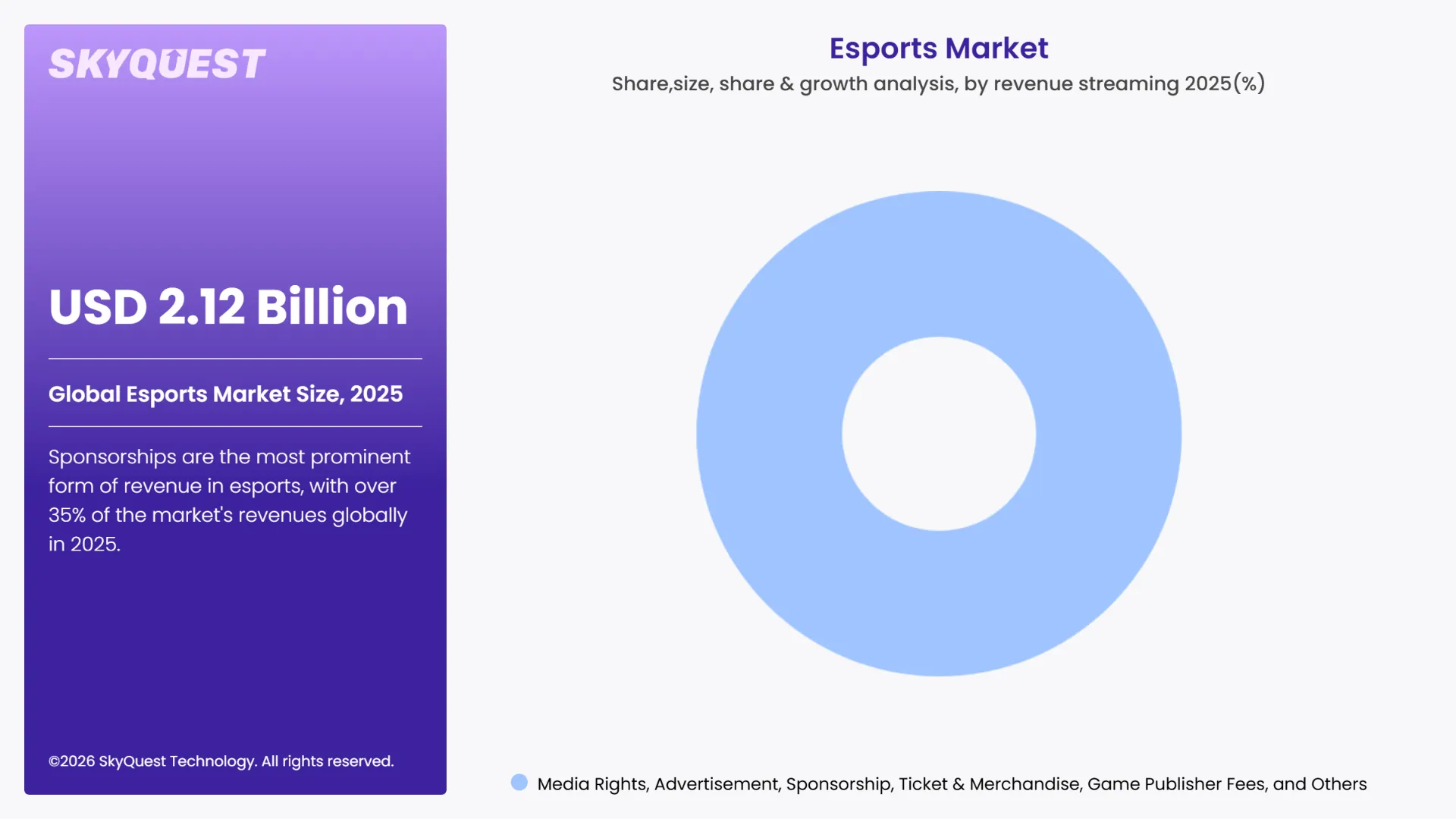
Sponsorships are the most prominent form of revenue in esports, with over 35% of the market's revenues globally in 2025. The industry's ability to hold the attention of a young, technology-savvy demographic is to blame for sponsorship's dominance. 73% of the audience belongs to the 18–34 years demographic, and thus the industry offers a compelling platform for brands to reach out to this age demographic. Red Bull, Mercedes-Benz, and Coca-Cola are just some of the brands that have invested heavily, valuing the value in being associated with the vibrant, rapidly growing ecosystem of esports.
Advertising is the fastest-growing segment of the esports industry, driven by the increasing viewership worldwide in the industry and the increasing effectiveness of digital advertising technology.
The in-game advertisement market was worth USD 8.65 billion in 2024 and is projected to expand to USD 19.64 billion by the year 2033 at a CAGR of 8.78%. Tencent has used AI to improve ad targeting, which resulted in a 26% increase in ad revenue. The integration of esports into mainstream games, such as the Olympic Esports Games, further makes it appealing to advertisers.
Live streaming became the industry practice in esports, spearheaded by its unparalleled ability for direct engagement of a global audience in real-time. In 2024, the number of hours watched for esports live streaming hit 32.5 billion, an increase of 12% over last year and a double from 2019 figures. Twitch and YouTube Gaming have been the leaders in this practice, with Twitch accounting for 61.1% of total watchtime and YouTube Gaming taking 22.9%. Co-streaming has also boosted viewership further, with individual creators responsible for 45% of overall esports viewership in 2024. Peak events such as the League of Legends World Championship 2024 also had a peak viewership of 6.7 million, with evidence pointing towards the rising popularity and convenience of live-streamed esports events.
On-demand streaming is the fastest-growing segment in the esports industry, driven by increased world internet penetration and proliferation of mobile gaming hardware. YouTube Gaming and Kick have expanded audiences with millions of worldwide viewers. Besides that, the rise in co-streaming, where popular influencers stream esports tournaments, has also picked up, with co-streaming accounting for 44% of all esports viewership in 2024.
To get detailed segments analysis, Request a Free Sample Report
North America dominates the world of esports, with strong investments from tech giants like Meta and Microsoft. Advanced digital infrastructure, high consumer penetration, and strong regulatory support enable growth and innovation. The region's established ecosystem enables rapid development of VR, AR, and blockchain technologies and maintains leadership status globally.
United States dominates the esports market due to huge investments by technology giants such as Meta, Microsoft, and NVIDIA. Major developments are Meta's introduction of Horizon Worlds and AI-driven smart glasses, Orion, to help improve immersive experiences.
The most dynamic market is Canada. The esports eCommerce market in Canada will rise from USD 0.5 billion in 2024 to USD 4.2 billion by 2030 at a CAGR of 42.58%. The nation is adopting virtual reality online shopping experience, boosting consumer interaction and increasing online revenues. Additionally, the esports education market in Canada is expected to reach USD 569.2 million by 2030, registering a CAGR of 48.52%.
Asia Pacific leads as the fastest-growing esports market, dominated by China, Japan, and South Korea. Rapid digital adoption, government patronage, and innovation in VR, AR, and blockchain drive growth. Comprehensive mobile penetration and growing esports ecosystems drive demand further, making the region a powerhouse of the esports world.
China's esports market is set to grow to USD 457 billion by 2030 with massive investment from Tencent, Alibaba, and ByteDance. Government assistance with a 10-billion-yuan fund in Shanghai assists with growth. Uses are viewed through e-commerce, fashion, and virtual events, which are being led by immersive shopping by JD.com and Alibaba.
Japan's gaming industry will be USD 56.73 billion by 2030, growing at a CAGR of 48.2%. Government's vision for Society 5.0 promotes digitalization and integration of technologies such as VR, AR, and blockchain. Key players such as Sony, NTT DOCOMO, and Bandai Namco are spending heavily on esports platforms.
South Korea's esports industry is to grow to USD 51.4 billion by 2030 with government support and private sector investment. The Digital New Deal includes a USD 177.1 million investment for the esports industry. Seoul and Changwon are establishing industrial promotion and public service esports platforms.
Europe's esports market is developing more and more, with the UK, Germany, and France at the forefront. The development of AR, VR, and blockchain is spurred by strong government backing, advanced digital networks, and healthy tech systems. Growing startup and established firm investments put Europe on the international esports map.
The UK takes the lead in the European esports market because of significant investments by technology companies and a reliable digital network infrastructure. Support for digital innovation by the government and access to top gaming and virtual reality players maintain the top position.
France's esports sector is growing strongly on the back of a strong gaming sector, official endorsement, and an increasing number of consumers looking to be engaged in immersive experiences.
Italy's esports sector is growing, driven by increased demand for interactive pursuits in entertainment and tourism markets. Its rich cultural heritage and technology innovation are some of the factors driving its growth.
To know more about the market opportunities by region and country, click here to
Buy The Complete Report
Government Support Through Funding and Regulation
Youth Demographic Expansion
Player Health and Well-being Concerns
Cybersecurity Threats and Data Privacy Risks
Request Free Customization of this report to help us to meet your business objectives.
The esports industry is characterised by stiff competition between reigning giants with different strategies to gain control. Governments worldwide encourage this expansion; for example, China's Ministry of Commerce invested USD 1.2 billion in 2023 to drive local gaming companies. Activision Blizzard and Garena use licensing agreements and joint ventures to increase market share. South Korea's Ministry of Culture invested USD 150 million in 2024 in promoting esports league-tech company partnerships. EU grants of USD 250 million through the Horizon Europe program fund diversification initiatives like developing esports platforms with VR. These initiatives aim to reflect a healthy, innovation-led competitive landscape.
SkyQuest’s ABIRAW (Advanced Business Intelligence, Research & Analysis Wing) is our Business Information Services team that Collects, Collates, Correlates, and Analyses the Data collected using Primary Exploratory Research backed by robust Secondary Desk research.
According to analysis by SkyQuest, increasing youth population, government effort in terms of policies and investment, and technology advancements in gaming will push the esports market in 2032. Nevertheless, cybersecurity threats, data privacy issues, and gamers' health issues will continue to be major constraints to market growth in the future. Asia-Pacific is leading due to increased investment in mobile gaming and esports infrastructure, whereas North America is holding firm on the back of its top-notch technological ecosystem and robust regulation setup. AI adoption for anti-cheat solutions and green initiatives in tournament operations is poised to offer profitable opportunities for gamers in the next few years.
| Report Metric | Details |
|---|---|
| Market size value in 2024 | USD 1.75 Billion |
| Market size value in 2033 | USD 9.85 Billion |
| Growth Rate | 21.2% |
| Base year | 2024 |
| Forecast period | 2026-2033 |
| Forecast Unit (Value) | USD Billion |
| Segments covered |
|
| Regions covered | North America (US, Canada), Europe (Germany, France, United Kingdom, Italy, Spain, Rest of Europe), Asia Pacific (China, India, Japan, Rest of Asia-Pacific), Latin America (Brazil, Rest of Latin America), Middle East & Africa (South Africa, GCC Countries, Rest of MEA) |
| Companies covered |
|
| Customization scope | Free report customization with purchase. Customization includes:-
|
To get a free trial access to our platform which is a one stop solution for all your data requirements for quicker decision making. This platform allows you to compare markets, competitors who are prominent in the market, and mega trends that are influencing the dynamics in the market. Also, get access to detailed SkyQuest exclusive matrix.
Table Of Content
Executive Summary
Market overview
Parent Market Analysis
Market overview
Market size
KEY MARKET INSIGHTS
COVID IMPACT
MARKET DYNAMICS & OUTLOOK
Market Size by Region
KEY COMPANY PROFILES
Methodology
For the Esports Market, our research methodology involved a mixture of primary and secondary data sources. Key steps involved in the research process are listed below:
1. Information Procurement: This stage involved the procurement of Market data or related information via primary and secondary sources. The various secondary sources used included various company websites, annual reports, trade databases, and paid databases such as Hoover's, Bloomberg Business, Factiva, and Avention. Our team did 45 primary interactions Globally which included several stakeholders such as manufacturers, customers, key opinion leaders, etc. Overall, information procurement was one of the most extensive stages in our research process.
2. Information Analysis: This step involved triangulation of data through bottom-up and top-down approaches to estimate and validate the total size and future estimate of the Esports Market.
3. Report Formulation: The final step entailed the placement of data points in appropriate Market spaces in an attempt to deduce viable conclusions.
4. Validation & Publishing: Validation is the most important step in the process. Validation & re-validation via an intricately designed process helped us finalize data points to be used for final calculations. The final Market estimates and forecasts were then aligned and sent to our panel of industry experts for validation of data. Once the validation was done the report was sent to our Quality Assurance team to ensure adherence to style guides, consistency & design.
Analyst Support
Customization Options
With the given market data, our dedicated team of analysts can offer you the following customization options are available for the Esports Market:
Product Analysis: Product matrix, which offers a detailed comparison of the product portfolio of companies.
Regional Analysis: Further analysis of the Esports Market for additional countries.
Competitive Analysis: Detailed analysis and profiling of additional Market players & comparative analysis of competitive products.
Go to Market Strategy: Find the high-growth channels to invest your marketing efforts and increase your customer base.
Innovation Mapping: Identify racial solutions and innovation, connected to deep ecosystems of innovators, start-ups, academics, and strategic partners.
Category Intelligence: Customized intelligence that is relevant to their supply Markets will enable them to make smarter sourcing decisions and improve their category management.
Public Company Transcript Analysis: To improve the investment performance by generating new alpha and making better-informed decisions.
Social Media Listening: To analyze the conversations and trends happening not just around your brand, but around your industry as a whole, and use those insights to make better Marketing decisions.
REQUEST FOR SAMPLE
 REQUEST FREE CUSTOMIZATION


Want to customize this report? This report can be personalized according to your needs. Our analysts and industry experts will work directly with you to understand your requirements and provide you with customized data in a short amount of time. We offer $1000 worth of FREE customization at the time of purchase.
Feedback From Our Clients


 USA (+1) 351-333-4748

